
Southwest Airlines
1
Southwest Airlines
INTRODUCTION
This case highlights a pioneering airline company with humble roots, an enduring
culture shaped by a maverick leader, and a record of success in an industry where most
companies have failed to prosper in the decades since deregulation. Southwest Airlines’
history is a case study in itself, but this case analysis focuses on industry and competitive
conditions that face all U.S. airlines. It does provide an opportunity to examine Southwest
Airlines’ distinctive strategic approach and the company’s remarkable performance
record. Furthermore, it allows speculation about whether the firm’s long-term strategic
competitiveness is threatened by inevitable change in the general, industry, and
competitor environments within which Southwest Airlines operates. The foremost matter
for consideration is the company’s 2011 acquisition of AirTran – not only the anticipated
organizational impact that integration will have on the firm’s culture, operations, systems,
and strategy, but the crucial step of entering international markets for the first time.
The case opens with a discussion of the U.S. airline industry, including extensive
industry metrics for major carriers. A detailed explanation of industry economics follows,
along with remarks on recent industry performance. The case then turns its attention to an
in-depth look at the background, operations, and performance of Southwest Airlines. The
leadership of founder Herb Kelleher and the pervasive Southwest spirit are also presented
before delving into firms that have attempted to emulate Southwest Airlines’ successful
strategy – the most noteworthy amongst these being JetBlue Airways. Finally, the case
wraps up by describing the company’s recent expansion initiatives and its acquisition of
AirTran Airways. Fully armed with an understanding of the company and the industry
and competitor environments, an attempt can be made to address the challenges
confronting Southwest Airlines in the immediate and long-term future. A comprehensive
analysis enables a discussion of the opportunities and challenges facing Southwest
Airlines and an assessment of the firm’s readiness for evolving conditions.
• What are the key industry conditions which render profits elusive for airlines?
Using the five forces model of competition, what does the structure of the
industry reveal about competitive rivalry and profit potential?
• Discuss Southwest Airlines’ business-level strategy and its record of success.
How is the company stacking up against other major airlines today? Are there any
strategic shortcomings that need to be addressed?
• Identify and explore the opportunities and challenges presented by Southwest
Airlines’ acquisition of AirTran. What are the merits and concerns of using the
acquisition to launch the company’s expansion into international territories?
• Does Southwest Airlines have a sustainable competitive advantage? What
strategic recommendations can be made to strengthen the durability of the
company’s competitive advantage; or do conditions suggest that it is time for a
shift in Southwest Airlines’ strategic direction to achieve long-term
competitiveness against its rivals?
Southwest Airlines
2
Southwest Airlines
ANALYSIS
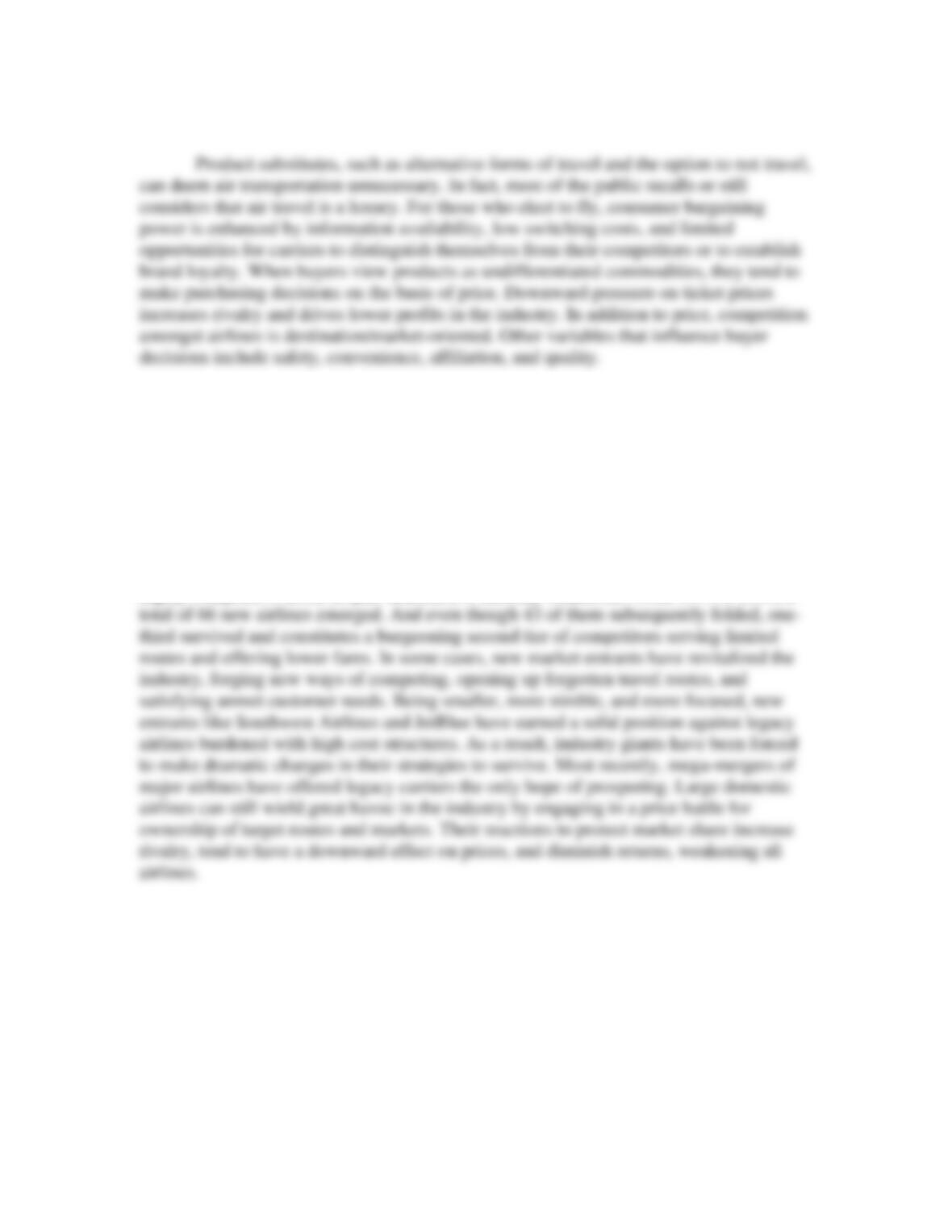
• What are the key industry conditions which render profits elusive for airlines?
Using the five forces model of competition, what does the structure of the industry
reveal about competitive rivalry and profit potential?
approximately 80% of total costs, passenger airlines have perhaps the lowest net
operating margins of any domestic industry. Supplier bargaining power is manifest in the
price and availability of aircraft, fluctuating fuel prices, access to airport terminal
resources, and labor-negotiated salaries.
Intensity of
Rivalry
High
Supplier
Power
Moderate to
High
Threat of
Substitutes
Moderate to
High
Buyer Power
Moderate
Threat of
Potential
Entrants
Moderate
Southwest Airlines
3
Southwest Airlines
Substantial barriers to entry exist in the airline industry, which include: economies
of scale, capital requirements, availability of airport slots and operation certificates,
numerous equally-balanced competitors, high fixed costs, high strategic stakes, and high
exit barriers. Airline ‘fortress hubs’ prevent new carriers from access to what are
considered legacy airline domains, greatly restricting opportunities for route expansion.
One of the more interesting observations that can be made is that, despite significant
entry barriers that should prevent new firms from entering the passenger airline industry,
new companies are continually emerging. Southwest Airlines and JetBlue are prime
examples of newer participants that established successful new business models in the
highly competitive arena despite unattractive industry conditions. From 1994 to 2004, a
In addition to these competitive forces, other industry conditions negatively
influence the level of competitive rivalry amongst airlines. Defense of existing routes and
geographic regions is intense because airlines have a high level of market dependence.
The ability to assertively defend market positions depends on available resources and
capabilities. In the past, poor financial health has limited the ability of major airlines to
strike against infringing competitors. However, operating performance is improving for
legacy carriers, lending to financial stability which will enable them to adopt more
aggressively defensive behavior. There is no question that Southwest Airlines will face
more aggressive competitive behavior as new market conditions emerge. Perhaps the
biggest challenges will come from major U.S. airlines that have emerged from
Southwest Airlines
4
Southwest Airlines
bankruptcy protection and mergers with streamlined operations, lower cost positions, and
a strong desire to protect their share of the post-recession rebound. These large
competitors can leverage their dominant market positions, brand recognition, and access
• Discuss Southwest Airlines’ business-level strategy and its record of success. How
is the company stacking up against other major airlines today? Are there any
strategic shortcomings that need to be addressed?
Southwest Airlines’ cost leadership strategy has led to consistent growth and
performance for over forty years. From a small, short-haul regional upstart in 1971,
Southwest Airlines is now one of the leading airlines in the United States. Focus on
achieving cost advantages and offering low fares in under-served markets has been the
foundation of the company’s success in the volatile airline industry. Perhaps most
importantly, the company has accomplished its strong record by challenging accepted
norms and setting higher competitive thresholds for other airlines to pursue. The
company has established numerous new industry standards by deviating from standard
practices.
Southwest Airlines
5
Southwest Airlines
contributes to its unique position in the industry and ability to provide outstanding
customer service for air travelers. Southwest Airlines’ superior integration of activities
has shaped the company’s competitive advantage and above-average returns, explaining
why imitators are seldom able to duplicate its success.
Operating Data
Southwest
JetBlue
Difference
Operating Cost per ASM (cents)
14.18
11.34
-20.0%
Revenue per ASM (cents)
14.82
12.45
-16.0%
Average flight length (miles)
694
1085
56.3%
Revenue (in billions)
17.1
5.0
-70.8%
Employees (in thousands)
46
15
-67.4%
Destination Cities
97
75
-22.7%
Southwest Airlines
6
Southwest Airlines
In other performance areas, where the company has made a conscious strategic
decision to deviate from industry practices, such as salary levels (see total labor cost per
AMS in Exhibit 8), its relatively higher rates are not necessarily a concern. In fact,
Southwest Airlines’ satisfied and motivated workforce is a distinct advantage. Moreover,
the company is making tremendous gains in some previously disadvantaged performance
areas, such as load factors
1
(see Exhibit 5), where it is narrowing the perceived advantage
of the majors.
• Identify and explore the opportunities and challenges presented by Southwest
Airlines’ acquisition of AirTran. What are the merits and concerns of using the
acquisition to launch the company’s expansion into international territories?
1
The other major airlines once had 5-11% greater load factors, but by 2010, Southwest Airlines’ had
reduced the deficit to 3-5%, growing its own load factor from 66% to 79% between 2002 and 2010 (see
Exhibit 2). Currently, Southwest Airlines’ load factor is up to 80.4%, still within 4-5% of the other major
airlines (see Table 2).
Southwest Airlines
7
Southwest Airlines
Southwest Airlines has limited experience integrating an acquired firm with
ongoing operations, which is essential for achieving acquisition success. Integration
difficulties are the chief impediment to realizing expected synergies. The challenge for
Southwest Airlines will be to integrate the activities, systems, workforces, and cultures of
the two organizations without negatively impacting the company’s inherent effectiveness
and distinct cultural advantages. And during this process, it will be sensible to cultivate
long-term gains, because short-term gains are often elusive.
The domestic airline market is maturing, increasingly competitive, and
characterized by revenue and profit constraints. Southwest Airlines is now thoughtfully
considering growth opportunities outside of the U.S., and the AirTran deal is likely to
play a critical role in this expansion initiative. The acquisition of AirTran’s international
routes is an ideal opportunity to reshape the company’s competitive scope to lessen the
STRATEGY
• Does Southwest Airlines have a sustainable competitive advantage? What strategic
recommendations can be made to strengthen the durability of the company’s
competitive advantage; or do conditions suggest that it is time for a shift in
Southwest Airlines’ strategic direction to achieve long-term competitiveness against
its rivals?
It is essential for the firm to continually evolve, but to do so without damaging the
advantageous qualities of its strategy. To respond to developing industry and competitive
conditions in the short term, Southwest Airlines has recently made some adjustments to
its service features. The company has expanded its simplified fare structure to include
Southwest Airlines
8
Southwest Airlines
For the longer-term, it is difficult to influence the substitutable nature of air travel.
However, the lower the fares and the greater the convenience, air travel can be so
attractive to consumers that the appeal of substitutes is diminished. In addition, the
sustainability of the company’s competitive advantages can persist so long as they
continue to provide value, remain uncommon, and are costly and disruptive to imitate.
Southwest Airlines’ younger, standardized fleet, corporate culture, and high-performing
workforce cannot be emulated (easily or perhaps at all), but other features of its strategy
(such as point-to-point service, the use of secondary airports, a satisfied workforce, and
operational efficiency) are more attainable. And the ability of rivals to enhance customer
conveniences, improve traveler experiences, and make technological advancements to
improve customer processes at lower cost points is a real threat to Southwest’s no-frill,
minimum fare offering.
Based on the analysis in the above sections, there is sufficient evidence to suggest
that Southwest Airlines’ cost leadership business strategy is still a strong fit with existing
industry conditions. It is important, however, that the company identifies and addresses
the operational problems that are negatively impacting its on-time performance and
Southwest Airlines
9
Southwest Airlines
This analysis does not recommend diverging from the cost leadership strategy at
this time, but some analyses may build an argument for it. The loss of strategic focus and
increased costs of incorporating differentiated features would damage Southwest Airlines’
competitive edge. The company’s low cost position and profitability (fueled by its
operating strengths) are still the cornerstones of the company’s competitiveness and
success.
Finally, the keys to strengthening the sustainability of the company’s competitive
advantages are reinforcing the high cost of imitation and fostering internal innovation.
This entails protecting the cultural advantages embedded in Southwest Airlines’
workforce and securing the company’s first mover position in the domestic airline
industry. The keys to continued growth are further penetrating domestic markets or
pursuing expansion opportunities outside of the U.S.
Southwest Airlines
10
Southwest Airlines
Internal Innovation. To combat intense competition and create value in a high-
volume standard-cycle market, internal innovation capabilities are essential. And for
Domestic Growth. The data in the case does not disclose if further regional
market penetration is an option for Southwest Airlines. As new, small carriers continue to
International Expansion. Finally, the analysis above indicates that international
expansion seems to be inevitable for Southwest Airlines, as growth in the domestic
marketplace slows. A strong domestic strategy is an ideal foundation for competitive