
Safaricom: Innovative Telecom Solutions to Empower Kenyans
1
Safaricom
INTRODUCTION
The Safaricom case provides an excellent opportunity to apply strategic
management concepts to a constantly growing and extremely competitive organization.
Safaricom is the largest mobile service provider in Kenya. It offers not only means of
mobile communication, but also is involved within the community. In addition,
Safaricom sponsors athletic events such as Safaricom Sevens and a music festival, Niko
na Safaricom Live.
The purpose of this case study is to examine the factors that are crucial to
Safaricom’s continued success and to propose strategic actions to sustain its competitive
advantage. While Safaricom’s community involvement enhances its brand image, the
mobile service sector of Safaricom is the largest and main focus. Safaricom was formed
in 1997 and has grown to be the largest mobile service provider in Kenya by
implementing different strategies, including acquisitions. The analysis should start with a
scan of the general, industry, and competitive environments. How does the external
environment in Kenya differ from anywhere else? The case also describes Safaricom’s
competitive advantage, and the effectiveness of its strategies against industry rivals
should be examined. Safaricom offers different services such as prepaid mobile, voice
and data services, and its voice packages are bundled with other services such as rewards
programs, music, and games. Finally, the pressing strategic concerns, the effectiveness of
Safaricom’s leadership should also be considered to devise convincing recommendations.
This case is ideal for demonstrating the importance of the external environment,
competitive rivalry, and strategic leadership. The following points are to guide a review
and discussion of these important concepts.
• Describe the general environment that Safaricom faces. What are the segments in
the general environment that relate to Safaricom’s situation? What are the
opportunities and threats derived from the factors from the general environment?
• Describe the competitor environment and identify the competitors. Has Safaricom
done enough to outperform its competitors?
• Evaluate Safaricom’s CEO, Robert Collymore’s strategic leadership. Has he been
able to fulfill his responsibilities and continue to grow Safaricom as a company?
• Describe Safaricom’s next move in terms of growth and expansion. Based on
your analysis, what additional recommendations would you make to help
Safaricom achieve its goals?
Safaricom: Innovative Telecom Solutions to Empower Kenyans
2
Safaricom
ANALYSIS
• Describe the general environment that Safaricom faces. What are the segments
in the general environment that relate to Safaricom’s situation? What are the
opportunities and threats derived from the factors from the general
environment?
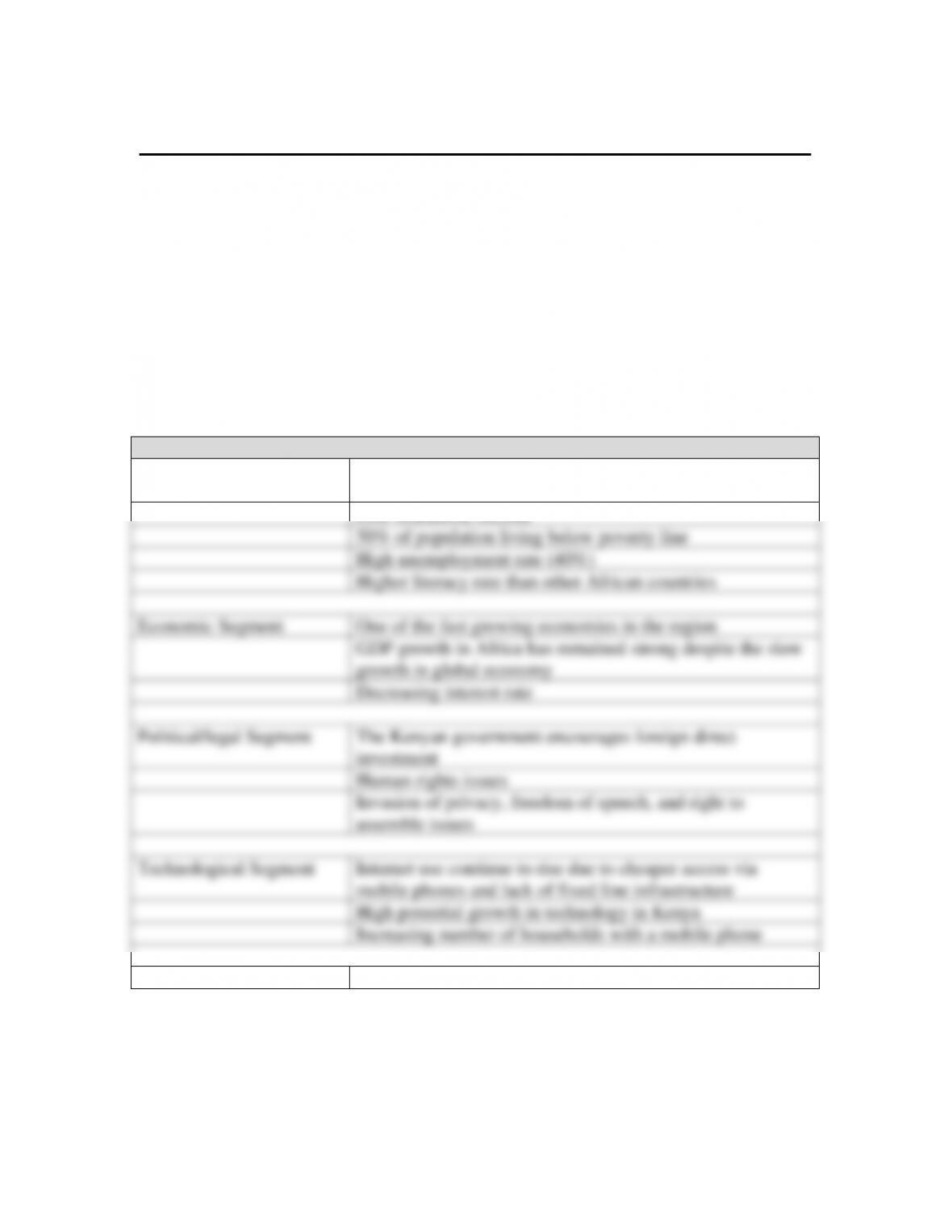
Segments in the general environment that impact Safaricom are primarily
demographic, economic, political/legal, technological, and global segments. Africa is
now the last untapped market in the telecommunication industry. Safaricom is the largest
mobile provider in Kenya, which is also the 3rd largest market in Africa. Kenya has
several important and unique segments in the general environment. The primary
segments in the general environment that Safaricom faces are:
General Environment
Demographic Segment
Different indigenous languages (official languages are
English and Swahili)
Low household income
50% of population living below poverty line
High unemployment rate (40%)
Higher literacy rate than other African countries
Economic Segment
One of the fast growing economies in the region
GDP growth in Africa has remained strong despite the slow
growth in global economy
Decreasing interest rate
Political/legal Segment
The Kenyan government encourages foreign direct
investment
Human rights issues
Invasion of privacy, freedom of speech, and right to
assemble issues
Technological Segment
Internet use continue to rise due to cheaper access via
mobile phones and lack of fixed line infrastructure
High potential growth in technology in Kenya
Increasing number of households with a mobile phone
Global Segment
Global economic crisis starting in 2008
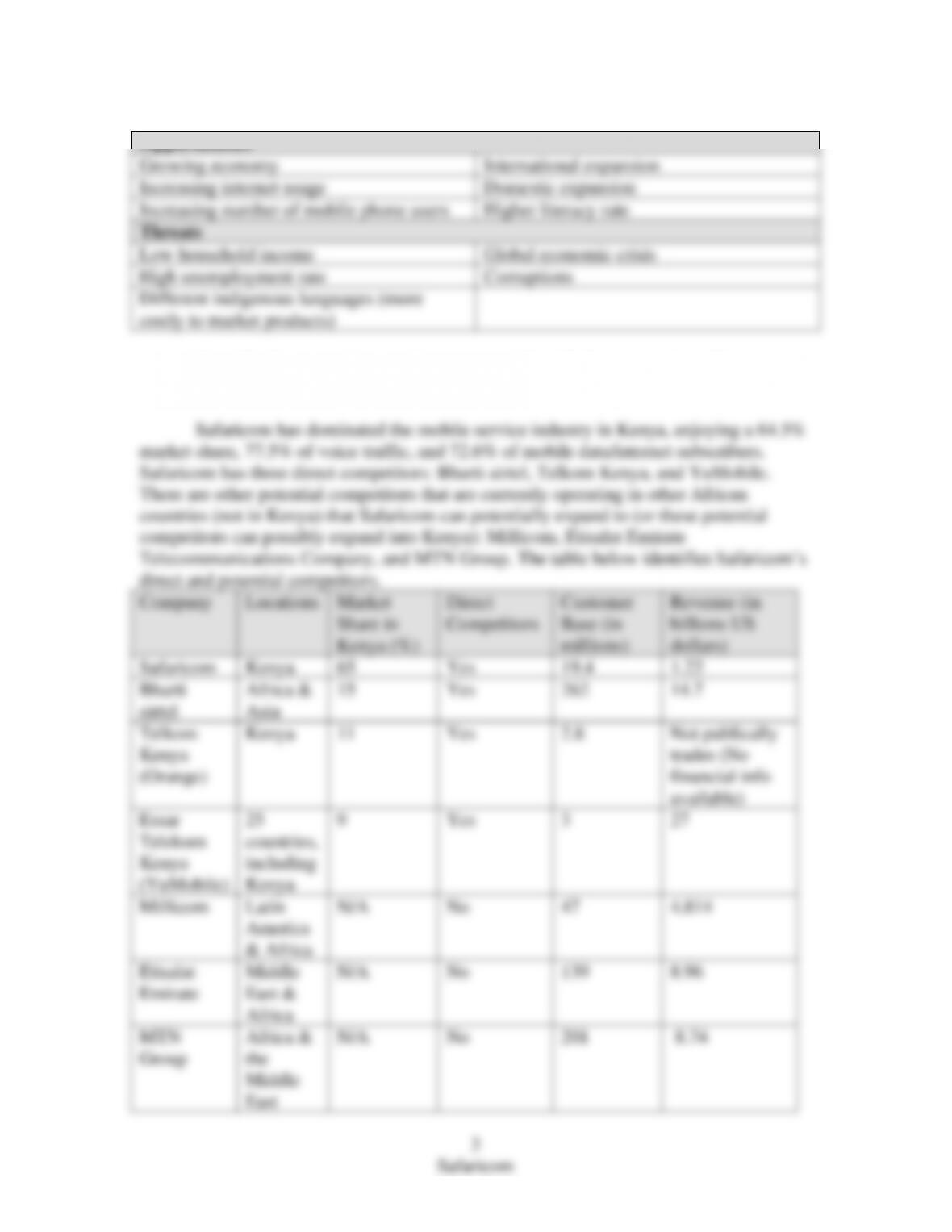
The opportunities and threats derived from the factors in the general environment:
Safaricom: Innovative Telecom Solutions to Empower Kenyans
Opportunities
Growing economy
International expansion
Increasing internet usage
Domestic expansion
Increasing number of mobile phone users
Higher literacy rate
Threats
Low household income
Global economic crisis
High unemployment rate
Corruptions
Different indigenous languages (more
costly to market products)
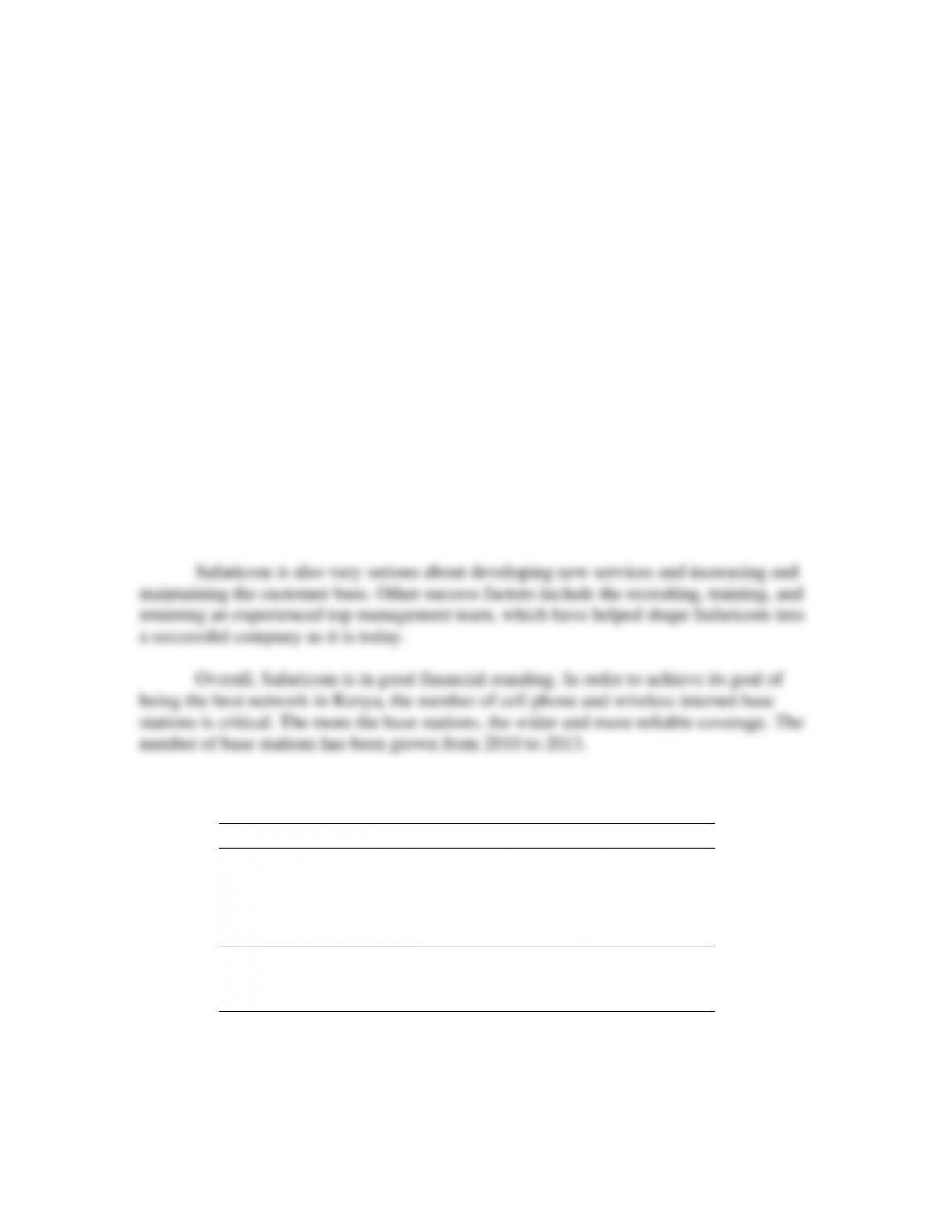
• Describe the competitor environment and identify the competitors. Has
Safaricom done enough to outperform its competitors?
Kenya (%)
millions)
dollars)
Safaricom
Kenya
65
Yes
19.4
1.22
Bharti
airtel
Africa &
Asia
15
Yes
262
14.7
(Orange)
financial info
available)
Kenya
including
Kenya
America
& Africa
Emirate
East &
Africa
Middle
East
Safaricom: Innovative Telecom Solutions to Empower Kenyans
4
Safaricom
Safaricom focuses not only on the company’s growth but also promoting the
growth of Kenya. It is very involved in the community through different initiatives and
events. Safaricom strives to give back to the community, for example, through an
organization called M-PESA Foundation. M-PESA provides programs that help improve
health issues along with environmental and educational problems that Kenyans face.
Safaricom’s goal is to improve the lives of its customers and offers the best service in the
industry. Safaricom’s main strategic priorities are:
1. Deliver the ‘Best Network in Kenya’
2. Grow mobile and fixed data
3. Deepen financial inclusion
4. Retain and reward the loyal customer base
5. Encourage further innovation.
When looking at coverage as a whole in Kenya, Safaricom strives to increase 2G
and 3G coverages along with many other goals such as increase their speeds and deliver a
value-based pricing. Safaricom seeks to provide the best products and services for a price
that Kenyans can afford, given that 23% of the population lives on less than $1 per day,
and 58% of the population lives on less than $2 per day.
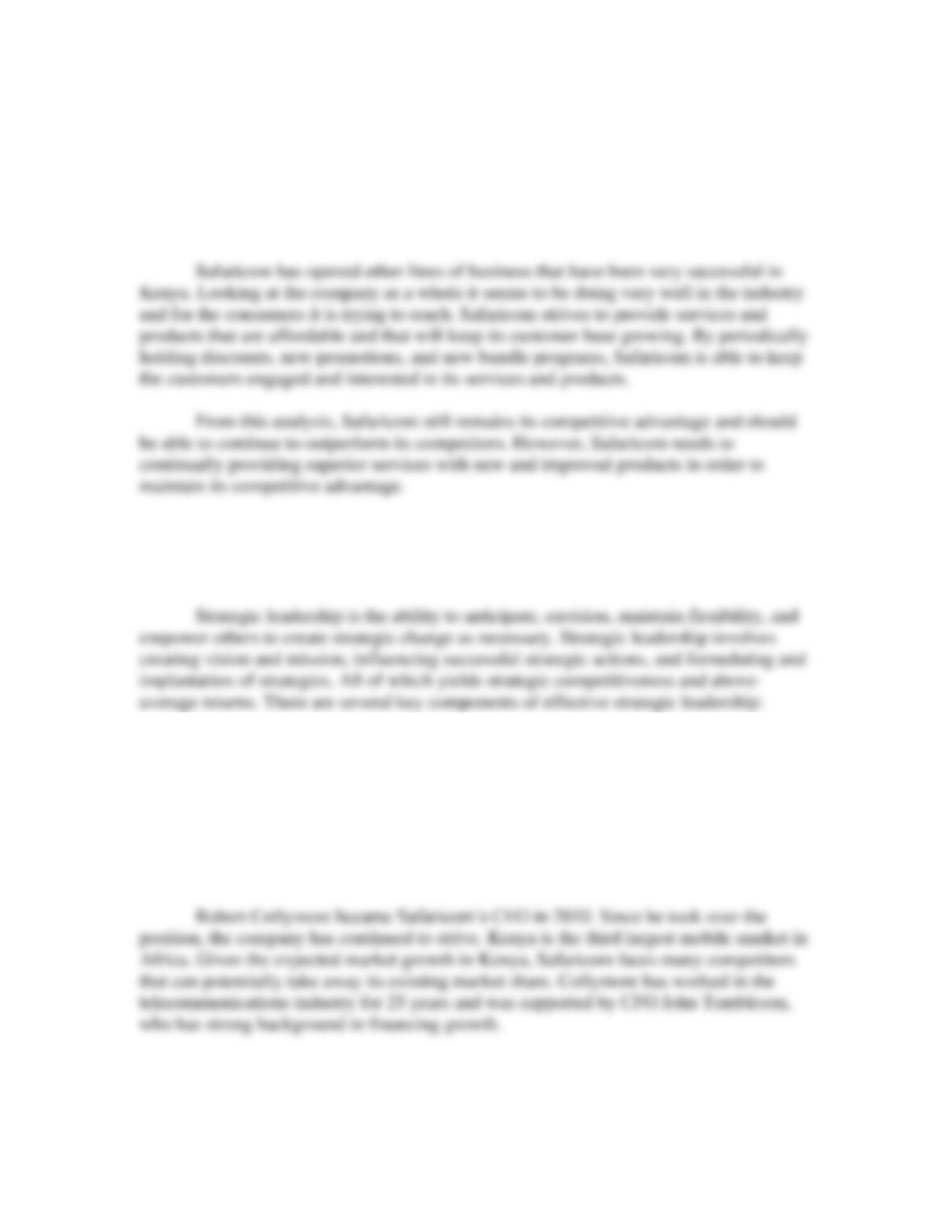
Safaricom Base Stations
Year
2010
2011
2012
2013
Total
2162
2501
2690
2905
3G
607
1140
1439
1604
Wimax
140
193
187
203
Growth
from Last
Year
2010
2011
2012
2013
Total
N/A
15.68%
7.56%
7.99%
3G
N/A
87.81%
26.23%
11.47%
Wimax
N/A
37.86%
-3.11%
8.56%
Safaricom: Innovative Telecom Solutions to Empower Kenyans
5
Safaricom
As shown in the table above, from 2010-2013, the number of Safaricom’s base
stations has grown every year (with the exception of Wimax in 2012). However, the
growth seems to slow down in 2012 and 2013. In order for Safaricom to continue to
expand rapidly, it needs to maintain its growth rate of base stations in order to serve its
customers.
• Evaluate Safaricom’s CEO, Robert Collymore’s strategic leadership. Has he
been able to fulfill his responsibilities and continue to grow Safaricom as a
company?
1. Determining strategic direction
2. Establishing balanced organizational controls
3. Effectively managing the firm’s resource portfolio
4. Sustaining an effective organizational culture
5. Emphasizing ethical practices
Determining strategic direction
Under the leadership of Collymore, Safaricom identified its important strategic
priorities that shape the company’s strategic direction:
Safaricom: Innovative Telecom Solutions to Empower Kenyans
6
Safaricom
1. Deliver the ‘Best Network in Kenya’
2. Grow mobile and fixed data
3. Deepen financial inclusion
4. Retain and reward the loyal customer base
5. Encourage further innovation.
Establishing balanced organizational controls
However, Collymore is also able to balance the strategic controls with financial
controls. Safaricom has performed well financially. Total revenue increased from 107
billion Kshs in 2012 to 124.28 billion Kshs in 2013. There are 7 categories in two major
segments for the revenue stream: service revenue and other revenues. Service revenue
includes Voice, Messaging, Mobile Data, Fixed Service, and M-PESA. Other revenue
includes Handset, Acquisition, and Other Revenue.
Effectively managing the firm’s resource portfolio
Safaricom: Innovative Telecom Solutions to Empower Kenyans
7
Safaricom
John Tombleson – CFO, Board of Director
John Tombleson has a background in financing growth. Tombleson first joined Vodafone
in New Zealand in 2003. After two years of being founded, they captured 48% market
share.
Sylvia Mulinge – General Manager Enterprise Business Unit
With over a decade of marketing experience, half of which was in the
telecommunications industry, Sylvia Mulinge has a high skill in consumer marketing and
brand activation.
Betty Mwangi – General Manager, Financial Services
Betty Mwangi has over 13 years of experience in the telecommunications industry and
manages the business unit that includes M-PESA. Mwangi was recognized by MCI in
June 2010 as one of the top 10 women in mobile globally.
Sustaining an effective organizational culture
Safaricom’s organizational culture is for the experienced management team to
share its expertise with the entire organization. It has a program called Subject Matter
Safaricom: Innovative Telecom Solutions to Empower Kenyans
8
Safaricom
Emphasizing ethical practices
STRATEGY
• Describe Safaricom’s next move in terms of growth and expansion. Based on
your analysis, what additional recommendations would you make to help
Safaricom achieve its goals?
Based on this analysis, recommendations for Safaricom’s next strategic move(s)
should address:
– How should Safaricom maximize growth, increase profitability, and maintain or
expand their market share?
Growth, Profit, and Market Share
Safaricom: Innovative Telecom Solutions to Empower Kenyans
9
Safaricom
Diversification
Differentiation of Banking Services
Differentiation is always a great strategy because if it is done correctly, a
company can enjoy a large market share with higher profit margin. Currently, Safaricom
offers the following banking services:
Competition
Safaricom: Innovative Telecom Solutions to Empower Kenyans
10
Safaricom
Investing in New Technology