
The Movie Exhibition Industry: 2015
Movie Exhibition Industry – 1
INTRODUCTION
This case is an in-depth study of the motion picture exhibition industry which
exposes the tenuous and uncertain outlook for movie theater owners. Changing value
chain dynamics and operating variables that affect the profitability of exhibitors are
discussed, with comparisons provided for the four major exhibitor circuits in the U.S. The
impact of evolving digital technology, trends which influence consumer decisions (most
notably, consumer viewing practices in the age of portable devices), and constraints
within the studio-dominated business model are also reviewed in detail. The case then
closes with a discussion of some of the initiatives taken by exhibitors to confront existing
environmental challenges.
The objective of this case is to thoroughly examine industry conditions and the
performance of key industry participants in order to identify strategic measures which
might improve the viability of major exhibitor operations. By profiling the external
environment, the industry’s competitive forces, competitor circumstances and approaches,
and the standard business revenue/cost structure, meaningful strategic alternatives can be
proposed to aid movie theater owners in their struggle to remain profitable and to
increase their likelihood for success.
• Review trends in the general environment that affect the movie exhibition
business, and establish whether their effects are helpful or harmful to theater
owners.
• Assess the five competitive forces at work in the industry environment. Identify
the forces that threaten the profitability of prevailing movie circuits, and prescribe
the level of competition that can be anticipated amongst industry rivals.
• Perform comparative situation and strategy analyses for the four companies with
dominant market share. What are the advantages and disadvantages for each of
the industry’s top competitors?
• Evaluate the revenue sources and major costs for movie exhibitors. Discuss how
the income structure of their business impacts their financial results.
• Summarize your findings and the current situation for exhibitor circuits. Based on
your analysis, what strategic actions do you propose for theater operators to
increase the appeal of the theater setting to attract the audiences needed for
improved performance under existing industry conditions?
ANALYSIS
• Review trends in the general environment that affect the movie exhibition business,
and establish whether their effects are helpful or harmful to theater owners.
The forces existing in the general environment are beyond the control of
companies competing in the film industry. Nevertheless, these external conditions can
create opportunities and/or threats that will impact the performance and success of movie
The Movie Exhibition Industry: 2015
Movie Exhibition Industry – 2
exhibition firms. Key trends in each of the general environmental segments that have the
greatest potential impact on theater owners are outlined and discussed below.
» Americans spend a very large amount of time on entertainment, and movie viewing is
a prevalent form of entertainment in the U.S. In particular, teens and young adults
frequently seek entertainment options outside of the home for dating purposes. While
these sociocultural conditions should be viewed with optimism, movies are more
widely available to the public than ever. Consequently, with a profusion of substitute
viewing options emerging, the long-term trend in per-capita admissions is negative.
» Studios focus on 12-24 year olds who are consistently the largest demographic group
of movie goers. At just 18% of the U.S. population, this group purchases 30% of all
tickets. (More narrowly, 10% of the population is “frequent” movie goers who attend
more than one movie per month and are responsible for half of all ticket sales.)
The Movie Exhibition Industry: 2015
Movie Exhibition Industry – 3
Demographic
Group
Population
Change
2014-2035
(in millions)
Population
Change
2014-2035
(in percent)
Per Screen
Change
2014-2035
(in millions)
Per Screen
Change 2014-
2035 (in
percent)
2 to 11 yrs
6.8
16%
170
10%
12 to 17 yrs
5.3
21%
132
15%
18 to 24 yrs
4.6
15%
114
13%
25 to 39 yrs
8.9
14%
223
15%
40 to 49 yrs
6.8
16%
170
11%
50 to 59 yrs
-0.1
0%
-2
0%
60 yrs+
33.6
53%
839
36%
Total (mil.)
65.8
19%
1,646
14%
In addition, technological advancements and dramatically reduced prices in retail
electronic equipment have increased the availability, affordability, quality, and
number of “in-home theaters”. Even without home screening rooms, 77% of U.S.
households now have at least one HD television (which deliver very high quality
visual images); and the average TV set in 2014 was 39 inches (up 7 inches in just four
years). Coupled with trends in the use of portable devices and the threat of “Ultra”
HD or 4K televisions hitting the market, these developments are having a
transformational effect on movie (and media) viewing choices and are reducing the
novelty of the exhibition theater setting. These conditions are threats that are likely to
continue to have a significant negative impact on the profit potential of film
exhibitors.
The Movie Exhibition Industry: 2015
Movie Exhibition Industry – 4
• Assess the five competitive forces at work in the industry environment. Identify the
forces that threaten the profitability of prevailing movie circuits, and prescribe the
level of competition that can be anticipated amongst industry rivals.
Threat of New Entrants – Low
Supplier Power – Very High
The strength of studio bargaining power is the leading cause of the industry’s low
profitability. Exhibitors, and their financial well-being, are heavily dependent on studio
policy decisions. Currently, over 81% of box office receipts are generated from the top 6
motion picture studios. These content providers completely control the release channel(s)
The Movie Exhibition Industry: 2015
Movie Exhibition Industry – 5
Buyer Power – Moderate
The industry’s core customer audience is 12- to 24-year-olds, who purchased 30%
of all movie tickets sold in 2014. The preferences and tastes of this age group can be
Product Substitutes – High
The availability of alternatives to movie theaters is another powerful force
working against theater owner profitability. While the industry is seeing the allure of its
value proposition and the theatrical experience diminish, product substitutes are rapidly
Intensity of Rivalry – Moderate
Since the 1980s, declining ticket sales, rising operating costs, and the advent of
The Movie Exhibition Industry: 2015
Now, four major theater companies, with just 24.3% of all cinemas, operate 45.5% of the
industry’s existing screens. The typical exhibitor location has 7-12 screens, which
improves labor and facility efficiencies and increases operator bargaining power.
Excess screen capacity in the U.S. affects the level of industry competition. High
costs associated with the development of megaplexes and with the conversion to digital
home, conveniences (such as parking), and proximity to restaurants (all variables which
cannot be readily changed without large capital allocations).
• Perform comparative situation and strategy analyses for the four companies with
dominant market share. What are the advantages and disadvantages for each of the
industry’s top competitors?
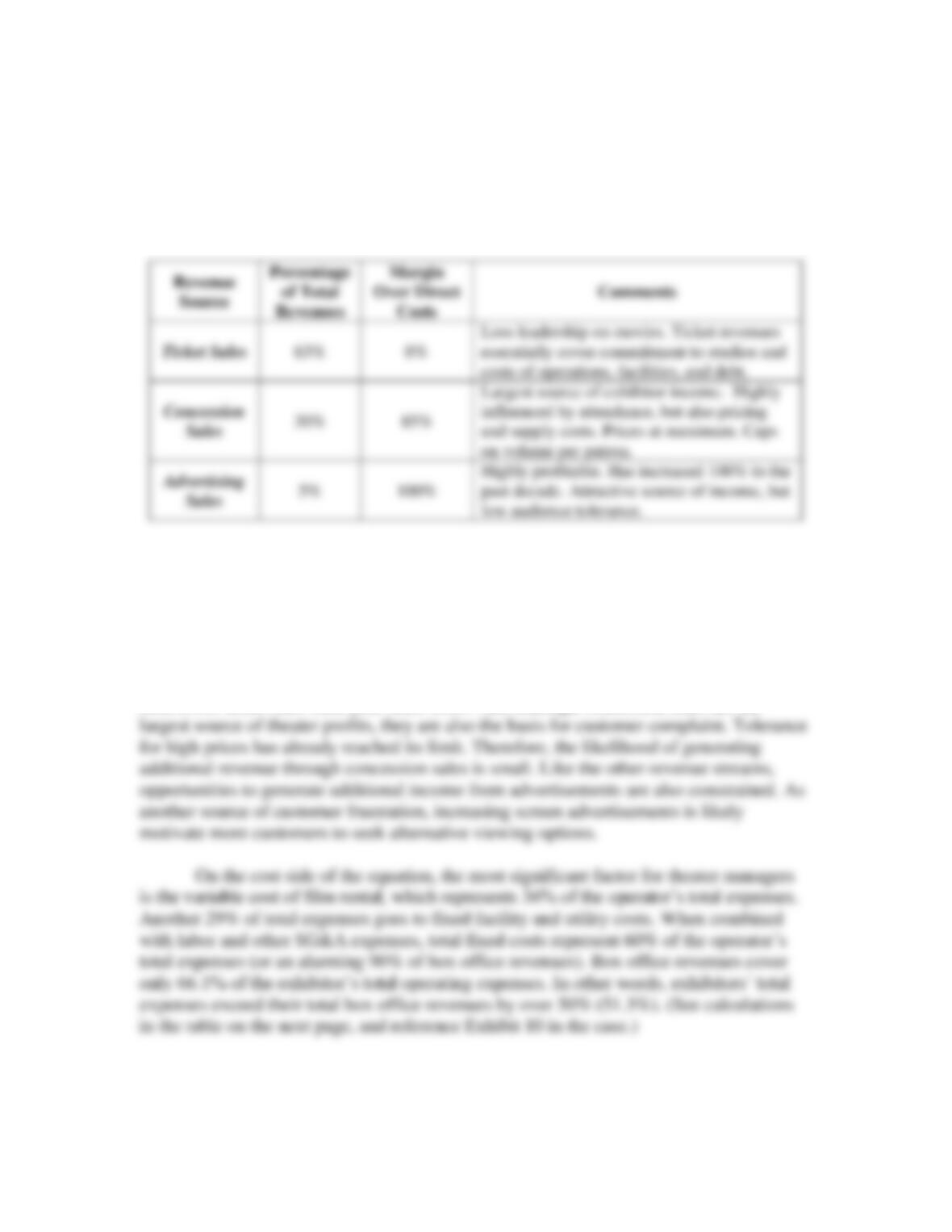
An overview of the top four competitors’ business situations and approaches
provides valuable insight for industry participants seeking to improve performance. The
following table presents a comparison of the market focus, facilities, pricing, costs,
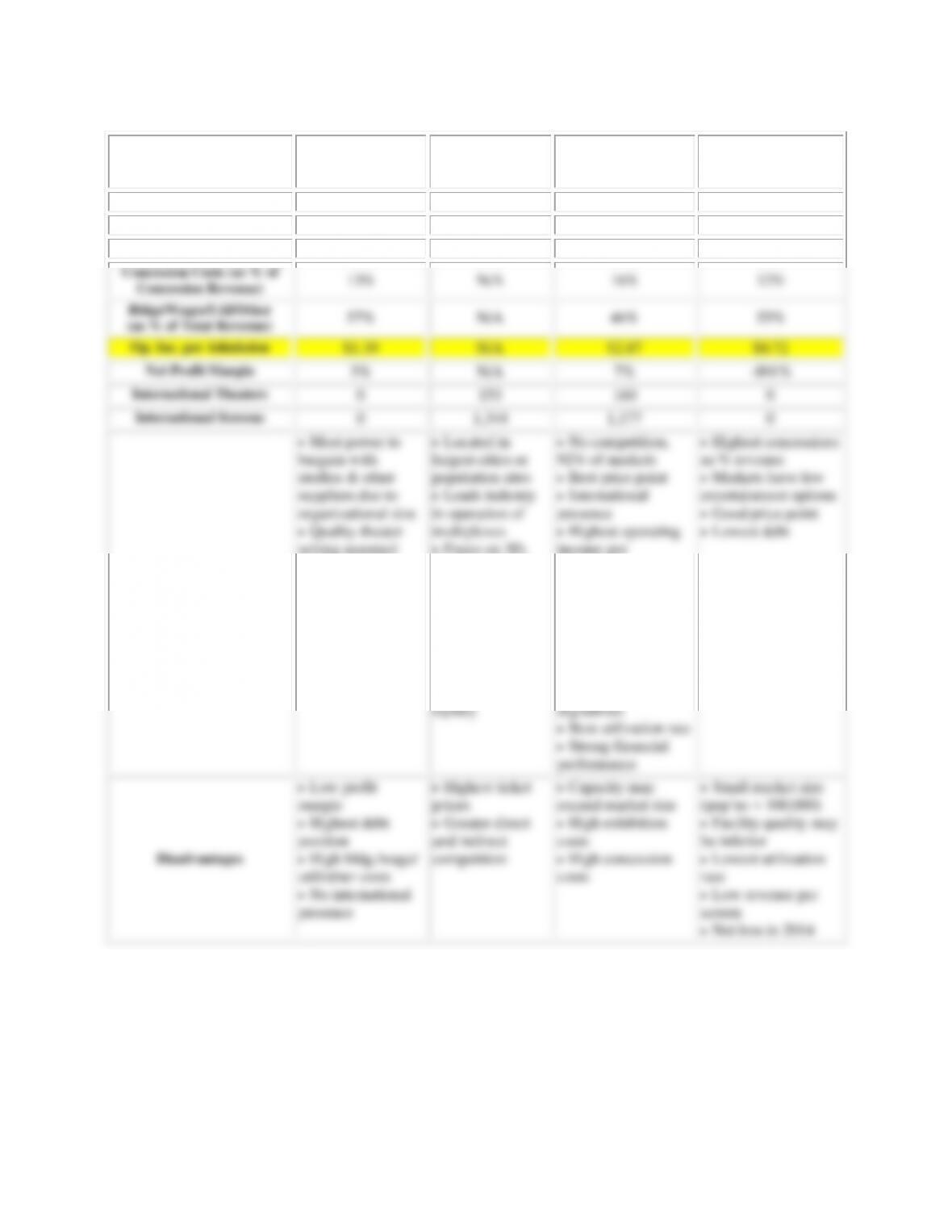
The Movie Exhibition Industry: 2015
continued
Regal
(w/ United Artists
and Edwards)
AMC
(w/ Lowes and
Wanda)
Cinemark
(w/ Century)
Carmike
Admissions (as % of Rev)
67%
N/A
63%
62%
Concessions (as % of Rev)
28%
N/A
32%
33%
Exh Costs (as % Adm Rev)
52%
53%
56%
55%
Concession Costs (as % of
Concession Revenue)
13%
N/A
16%
12%
Bldgs/Wages/Util/Other
(as % of Total Revenue)
57%
N/A
46%
55%
Op. Inc. per Admission
$1.39
N/A
$2.87
$0.72
Net Profit Margin
3%
N/A
7%
–891%
International Theaters
0
153
160
0
International Screens
0
1,344
1,177
0
Advantages
• Most power to
bargain with
studios & other
suppliers due to
organizational size
• Quality theater
setting assumed
• Highest revenue
per screen and
admissions as %
revenue
• Largest domestic
exhibitor
• Lowest exhibition
costs as % revenue
• Located in
largest cities or
population sites
• Leads industry
in operation of
multiplexes
• Focus on 3D,
IMAX, and other
premium viewing
experiences
• International
(Asian) scope
through Wanda
acquisition
• Expanding
rapidly
• No competition,
92% of markets
• Best price point
• International
presence
• Highest operating
income per
admissions
• Greatest total
assets
• Highest NP margin
and operating
income per
admissions
• Completely
digitalized
• Best utilization rate
• Strong financial
performance
• Highest concessions
as % revenue
• Markets have few
entertainment options
• Good price point
• Lowest debt
Disadvantages
• Low profit
margin
• Highest debt
position
• High bldg./wage/
util/other costs
• No international
• Highest ticket
prices
• Greater direct
and indirect
competition
• Capacity may
exceed market size
• High exhibition
costs
• High concession
costs
• Small market size
(pop’ns < 100,000)
• Facility quality may
be inferior
• Lowest utilization
rate
• Low revenue per
A close look at the theater business model reveals that cinema managers have
limited ability to impact revenues with existing tangible and intangible resources. In
addition, restricted power or flexibility to control product, facility, and labor costs leaves
The Movie Exhibition Industry: 2015
Movie Exhibition Industry – 8
operating margins near just 12% across the industry. These constraints severely limit
financial control and profit potential for theater owners.
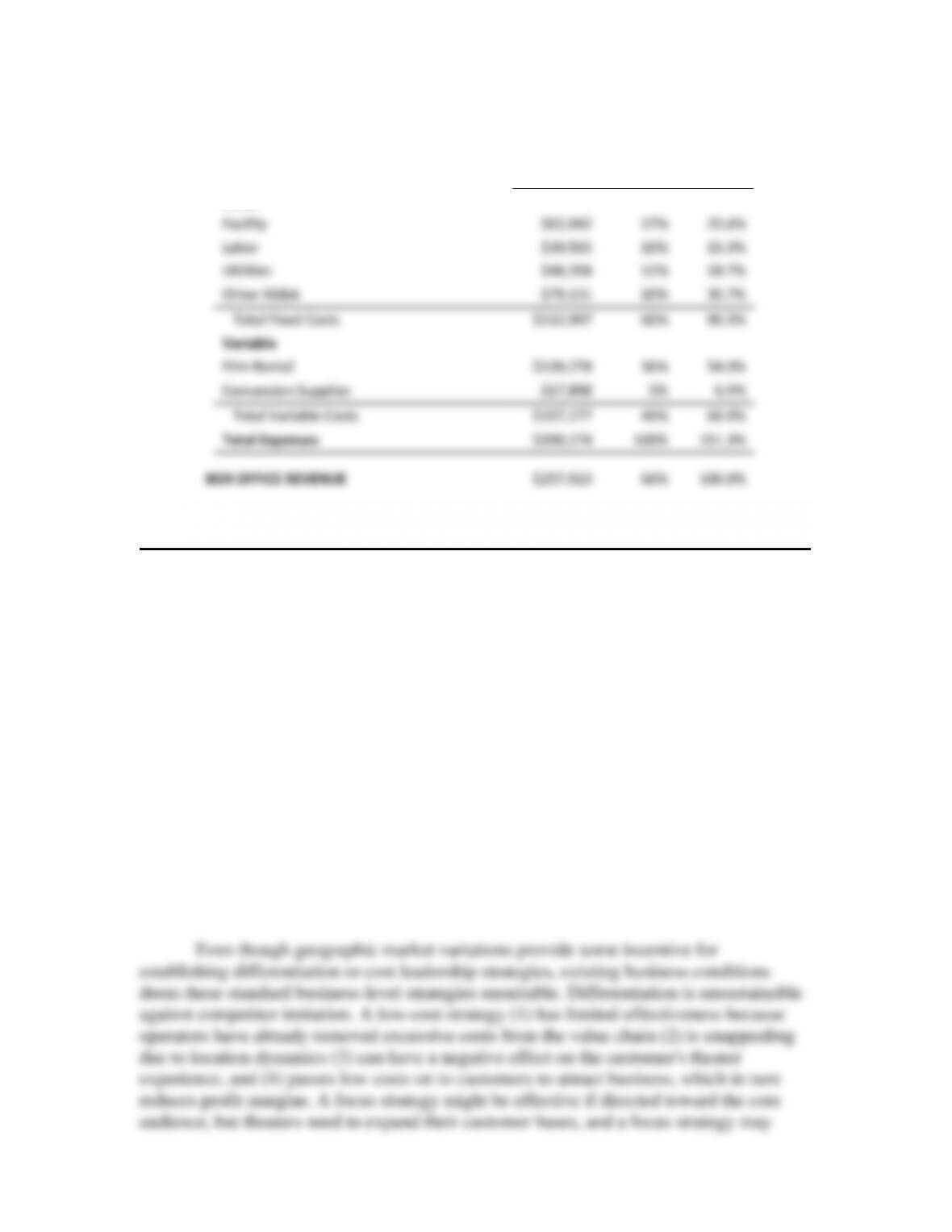
The table below dissects the revenue structure and helps to identify earnings
barriers faced by movie theater managers.
Movie theater profitability is severely hampered by this income structure, and
when trends in both the general and industry environments are also considered, long-term
viability is untenable. Because of the power imbalance with studios, increasing box office
receipts provides virtually no additional income for theater owners, even though they
represent the greatest source of revenue. In addition, consumer tolerance for higher ticket
prices (which have risen 27% since 2005) is low despite that fact that they have risen less
than the inflation rate. Even 3D movies, which temporarily yielded revenue growth, have
seen fewer ticket sales each year since 2010. And although concession sales are the
Revenue
Source
Percentage
of Total
Revenues
Margin
Over Direct
Costs
Comments
Ticket Sales
63%
0%
Loss leadership on movies. Ticket revenues
essentially cover commitment to studios and
costs of operations, facilities, and debt.
Concession
Sales
30%
85%
Largest source of exhibitor income. Highly
influenced by attendance, but also pricing
and supply costs. Prices at maximum. Caps
on volume per patron.
Advertising
Sales
5%
100%
Highly profitable. Has increased 100% in the
past decade. Attractive source of income, but
low audience tolerance.
The Movie Exhibition Industry: 2015
Movie Exhibition Industry – 9
EXHIBITOR EXPENSES
Per Screen
% of
Total
Expenses
% Box
Office
Revenues
Fixed
Facility
$65,942
17%
25.6%
Labor
$39,565
10%
15.3%
Utilities
$48,358
12%
18.7%
Other SG&A
$79,131
20%
30.7%
Total Fixed Costs
$232,997
60%
90.3%
Variable
Film Rental
$139,278
36%
54.0%
Concession Supplies
$17,898
5%
6.9%
Total Variable Costs
$157,177
40%
60.9%
Total Expenses
$390,174
100%
151.3%
BOX OFFICE REVENUE
$257,923
66%
100.0%
STRATEGY
• Summarize your findings and the current situation for exhibitor circuits. Based on
your analysis, what strategic actions do you propose for theater operators to
increase the appeal of the theater setting to attract the audiences needed for
improved performance under existing industry conditions?
The situation overview pinpoints the many factors which are diminishing movie
theater profitability. Today, cinemas are operating from a position of weakness. They are
competing against substitute products, constrained by supplier power, managing an
unprofitable business model, and facing long-term declines in admissions per capita.
Conditions in the general environment are mostly harmful to domestic exhibitors. Global
forces are changing the dynamics of the industry, and technological investment demands
are high with elusive pay-offs. But some bright spots exist – particularly with demand for
quality entertainment, demographic trends if studios look beyond today’s core audience,
and opportunities to grow internationally. To find success, industry leaders must
minimize pressures which are squeezing earnings from all directions and develop
conditions which create superior value for which customers are willing to pay.
The Movie Exhibition Industry: 2015
Movie Exhibition Industry – 10
Because participants in the industry cannot rely on standard business-level
strategies and because of their inability to increase margins by controlling revenue or cost
variables, leaders will find it necessary to discover new and creative strategic measures to
improve or sustain the profitability of ongoing operations.
The completed analysis suggests that to enhance performance and improve the
likelihood of future success, theater operators need to take measures to reduce the
bargaining power of studios and to stimulate demand for established cinema complexes.
It is a question of enhancing profits, increasing venue appeal, and taking steps to reduce
uncertainty. Exhibitors must think in terms of efforts that will offset the high costs of
existing facilities. The following recommendations offer feasible strategies for meeting
these objectives. Suggestions range from smaller scale actions to larger scale cooperative
strategies and facility re-design. Due to the failing business model, retaining patrons and
growing profits may require such dramatic actions by exhibitors.
The Movie Exhibition Industry: 2015
Movie Exhibition Industry – 11
o Engage studios in mutually-beneficial partnership arrangements. While delivery
channels are emerging and evolving, studios are taking steps to recover lost DVD
sales and to react to the success and power of VOD providers. Even though they
o Cater to semi-frequent and frequent movie goers. To deliver the “experience”
being sought by their core audience and to increase attendance of tentative patrons,
theaters need to overcome the declining value proposition and initiate customer
outreach efforts. This involves focusing on quality measures and deepening the
richness and affiliation of customer relationships.
The case material emphasizes that cost, home viewing options, theater
interruptions or distractions, inconvenience, and screen advertising all impact the
quality of the theater experience. Perceived quality can be enhanced through
o Seek alternative facility uses and content. The conversion of most theaters to
digital projection creates great potential to find and offer alternative content.
Alternative content can attract new audiences in novel ways, especially during
off-peak time periods. The greatest advantage of this strategy is that it reduces
theaters’ over-dependence on powerful studios – removing income restraints and
protecting against failure to receive viable hit films. At the time of the case,
exhibitors have begun to collectively seek alternative content through
intermediary distributor services. The benefits of this option are emerging.
The Movie Exhibition Industry: 2015
Movie Exhibition Industry – 12
educational showings, school activities, or other celebratory events (such as
reunions, couples’ wedding showers, or octogenarian guests of honor). With
widespread personal video recording taking place, screening customized content
for such events can be done with very little cost or effort. In fact, the exhibitor
might be able to produce and deliver the content for a surcharge or fee. Theaters
could restage classics or offer series marathons, turning them into social events,
particularly during slow sales periods. Perhaps new forms of health treatment or
therapeutic experiences could be designed with new immersive technologies for
senior or specialty audiences (such as the use of massage seating, sound therapy,
etc.)
o Expand entertainment value of offering. This option involves diversifying into
other forms of entertainment and services or changing the format of the venue
entirely. Partnering with commercial development, restaurant, or other
entertainment groups is a potential way of expanding the service “menu” at
theater facilities. This might involve ideas such as bringing in unique snacking
options (such as ethnic foods or pop-up restaurants/kiosks of the ”mobile food
The Movie Exhibition Industry: 2015
Movie Exhibition Industry – 13
One of the most promising new entertainment offerings is the use of interactive
digital experiences (made possible by new digital technologies, immersive
technologies, and social media capabilities) for purposes other than interactive
advertising. The core theater audience is a media-driven, gaming generation. (In
fact, the original “gamers” are now middle aged men.) Cooperative strategies with
gaming companies could generate especially appealing prospects. Not only could
they offer exciting new experiences for targeted electronic gamers to increase
demand; but if successful, they would create competition for studios to book
theater space (decreasing supplier power). In addition, integrating the social
With this suggestion, viewing selections and flexibility can be increased –
particularly with the growing availability of original digital content. Alliances
with companies like Netflix, Comcast, Hulu, or other major content providers
(even television and cable networks for marathon events of popular series, such as
‘Breaking Bad’ and ‘The Walking Dead’) would secure viewing material and,
again, reduce dependence on studios. Tapping into the recent phenomenon of TV
“binging”, theaters could offer marathon weekends of popular content for
enthusiasts to view full seasons or series with a like-minded crowd.

The Movie Exhibition Industry: 2015
Movie Exhibition Industry – 14