
KIPP Houston Public Schools
1
KIPP Houston
INTRODUCTION
The Knowledge is Power Program (KIPP) Houston Public School case provides
an exciting opportunity to apply strategic management principles to an innovative, non-
profit educational organization. At the time of the case, new regional superintendent
Sehba Ali is seeking solutions to several major challenges. By using a situation analysis
approach to solve these issues, she will be better able to understand and integrate the
factors relevant to making sound strategic decisions.
This case introduces the Houston, Texas charter schools by describing their high
expectations, novel educational techniques, and honorable mission to serve
underprivileged students. From storied beginnings, the successful school system grew
nationally with the help of philanthropic donations before restructuring regionally to
facilitate continued expansion. The case describes general environment segment and
competitive industry conditions, highlighting market needs, regulatory constraints, and
key elements of school funding. Detailed information about the organization’s internal
operations, resources, structure, and strategic concerns are also furnished.
The extensive material provided on KIPP Houston’s external and internal
environments enables a comprehensive examination of the pressures confronting Ali. The
purpose of this case analysis is to develop an integrated and coordinated set of
commitments and actions which will exploit the organization’s core competencies,
strengthen its competitive advantage, address areas of weakness, and enable KIPP
Houston to set and achieve realistic growth objectives. Whether they are caused by
growth, restructuring, or other factors, KIPP Houston schools are experiencing some
problem areas which Ali needs to address if the region is to reach its targeted expansion
levels.
• Summarize the organizational strengths and core competencies which distinguish
KIPP Houston from its competitors. Does the new regional structure advance or
interfere with the goals of the organization?
• What are the weaknesses of KIPP Houston’s internal operations? Compare the
organization’s performance to the achievements of its competitors. What steps
have been taken to manage its problem areas?
• Describe the factors in the external environment which affect the charter
organization’s ability to meet its objectives. Discuss KIPP Houston’s current
expansion goals.
• Describe and consider Ali’s strategic posture on the major issues facing KIPP
Houston. Based on your analysis, do you agree with her judgment? What
additional recommendations can you make to guide the organization’s strategy
and actions?

KIPP Houston Public Schools
2
KIPP Houston
ANALYSIS
• Summarize the organizational strengths and core competencies which distinguish
KIPP Houston from its competitors. Does the new regional structure advance or
interfere with the goals of the organization?
KIPP Houston is a network of branded charter schools in the metro area. With
innovative, energetic, motivational teaching techniques, it is an educational trailblazer in
high-minority, low-income, crime-prone neighborhoods. KIPP’s new model for public
College Rates
Impoverished neighborhoods
18%
Prosperous neighborhoods
77%
KIPP early results
33%
National results
30%

KIPP Houston Public Schools
3
KIPP Houston
Class
# Students
School Total
School Percent
Pre-Kindergarten
1,247
1,247
14.5%
Kindergarten
891
3,261
38.0%
Grade 1
845
Grade 2
696
Grade 3
537
Grade 4
292
Grade 5
719
2,917
34.0%
Grade 6
775
Grade 7
755
Grade 8
668
Grade 9
461
1,159
13.5%
Grade 10
367
Grade 11
206
Grade 12
125
8,584
8,584
100.0%
The freedom to teach as each school sees fit is the cornerstone of the KIPP
educational model. An independent school in the KIPP Houston system has a matrix
organization which looks like the figure below. Approximately 85-100 students take each
subject in each grade level. Subject and grade level chairs all report to a school principal
who has wide discretion over the school’s budget, and staff selection, assignments, and
professional development.
Subject 1
Led by Subject 1
Chair
Grade Level 1
Grade Level 2
Grade Level 3
Grade Level 4
Subject 2
Led by Subject 2
Chair
Grade Level 1
Grade Level 2
Grade Level 3
Grade Level 4
Subject 3
Led by Subject 3
Chair
Grade Level 1
Grade Level 2
Grade Level 3
Grade Level 4
Subject 4
Led by Subject 4
Chair
Grade Level 1
Grade Level 2
Grade Level 3
Grade Level 4
Led by Grade
Level 1 Chair
Led by Grade
Level 2 Chair
Led by Grade
Level 3 Chair
Led by Grade
Level 4 Chair
KIPP Houston Public Schools
Each KIPP school is launched with a principal who has been trained by the KIPP
Foundation. Before the regional organization grouped schools into geographic areas, each
site was autonomously governed by its own Board of Directors. Top-down management
from the Foundation to the school level does not take away from school leader control of
resource allocation (so long as the school is meeting performance expectations). New
linkages of feeder schools to guide students from Kindergarten through Grade 12 should
have a positive effect on achievement results. And resources for college prep (such as
college application counseling) that can be pooled and strengthened should reduce the
total costs of providing these services while furthering KIPP’s goals to increase
educational advancement beyond high school.
• What are the weaknesses of KIPP Houston’s internal operations? Compare the
organization’s performance to the achievements of its competitors. What steps have
been taken to manage its problem areas?
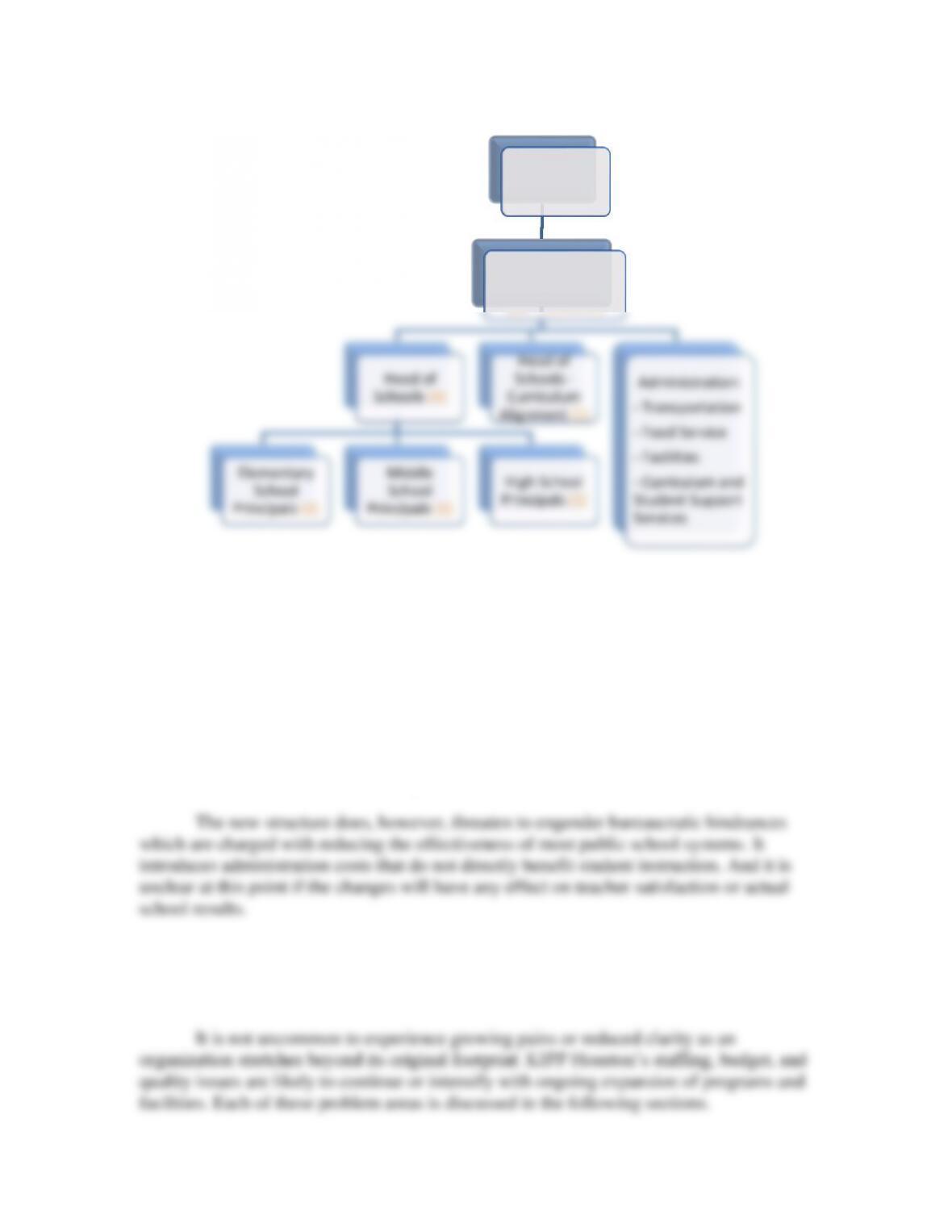
Foundation
CEO
Regional
Superintendents
(Ali – Houston)
Head of
Schools (4)
Elementary
School
Principals (2)
Middle
School
Principals (2)
High School
Principals (1)
Head of
Schools –
Curriculum
Alignment (1)
Administration:
– Transportation
– Food Service
– Facilities
– Curriculum and
Student Support
Services
KIPP Houston Public Schools
Staffing
Pro
Con
The charter school’s high standards and
expectations appeal to optimistic young
teachers who are creative, energized, and
inspired by its social mission.
The intense work load and long
hours take a toll on KIPP teachers
and leaders, leading to early burn-out
and lower job satisfaction.
Extensive and ongoing professional
development is afforded the schools’
teachers and staff; and leadership
opportunities abound.
Resources are considered limited;
and organizational communication is
deemed ineffective by many of the
schools’ staff members.
Most teachers have an enormous degree
of freedom, unmatched in other
educational settings.
Most teachers will not recommend
KIPP as an employer to their friends
and associates.
KIPP staff members enjoy a meaningful
sense of value and have a high level of
commitment to the school’s mission and to
meeting high expectation levels.
The commitment felt by many
KIPP staff members is limited to a
short time frame. Less than half have
plans to stay beyond a 3-year
horizon.
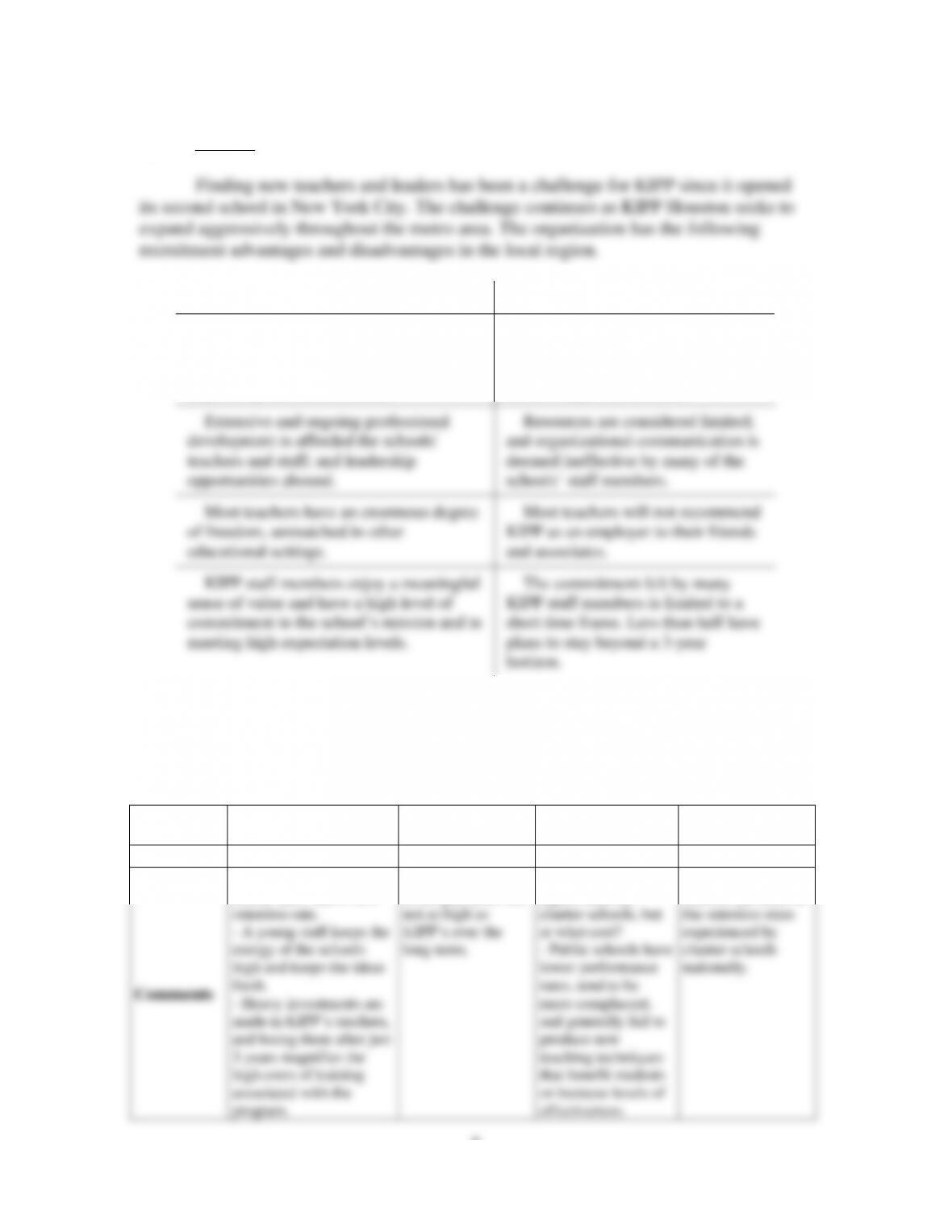
Not only is the talent needed at the charter schools hard to find, it is also hard to
keep. The table below compares KIPP’s retention rates to those seen in competitor school
systems, and comments follow on the next page. KIPP Houston’s teachers have an
average of 3.8 years of experience, compared to an average of 11.6 years statewide.
KIPP
YES
HISD
National
Charters
2011 – 2012
58%
68%
83%
78%
Comments
– Over a longer time
frame, KIPP has a 72%
retention rate.
– A young staff keeps the
energy of the schools
high and keeps the ideas
fresh.
– Heavy investments are
made in KIPP’s teachers,
– Exceeded KIPP’s
in the past year, but
not as high as
KIPP’s over the
long-term.
– Significantly
higher than the
charter schools, but
at what cost?
– Public schools have
lower performance
rates, tend to be
more complacent,
and generally fail to
– Houston’s charter
schools fall short of
the retention rates
experienced by
charter schools
nationally.
KIPP Houston Public Schools
6
KIPP Houston
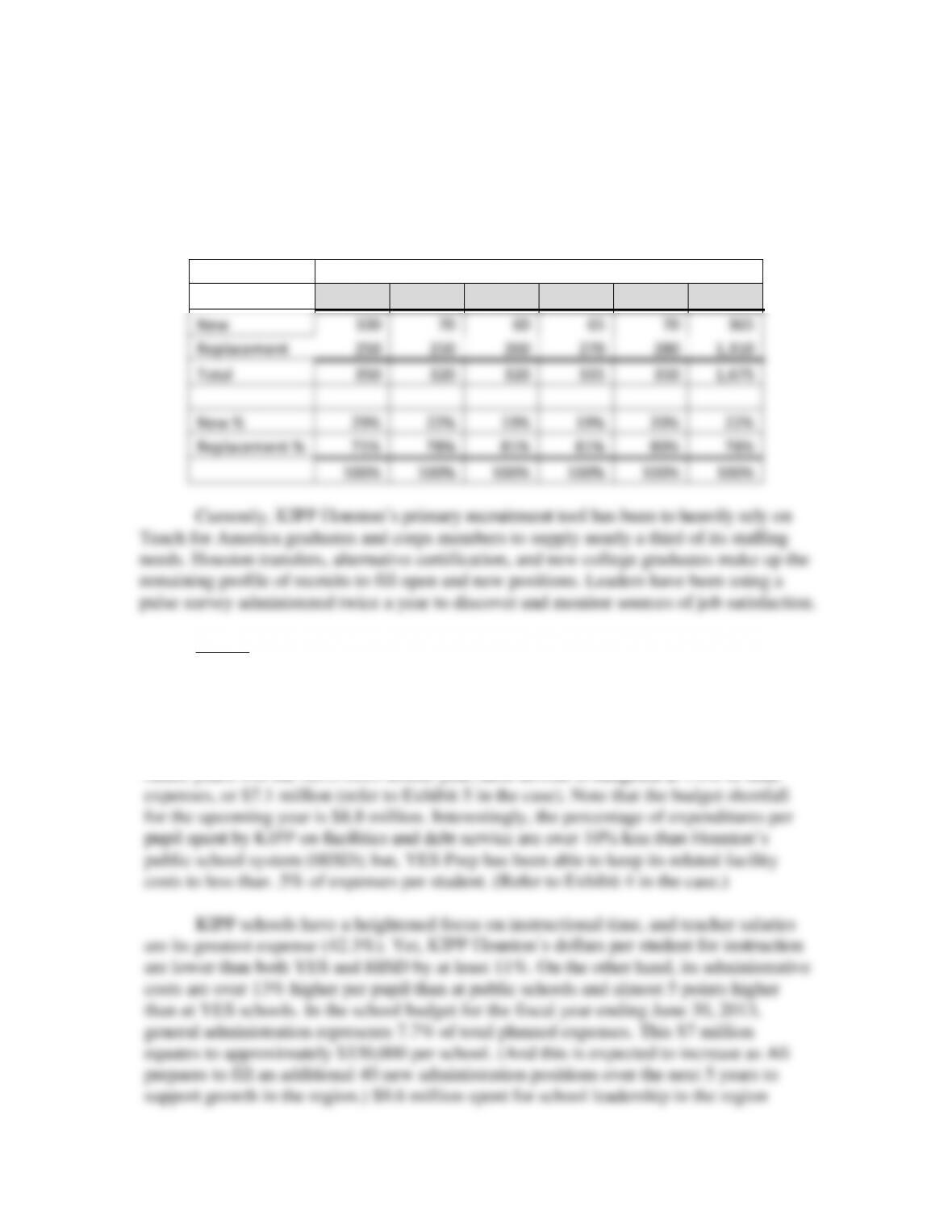
An estimated 1,675 new employees will be required to meet expected staffing
needs for the growing region over the next 5 years. Using Exhibit 6 in the case to
project new and replacement hiring plans, staffing requirements are designated in the
table below. Replacement hiring averages 78% over the entire timeframe, making an
already difficulty task seem unachievable with such a handicap.
Projected Hiring Needs – Next 5 Years
2014
2015
2016
2017
2018
Totals
New
100
70
60
65
70
365
Replacement
250
250
260
270
280
1,310
Total
350
320
320
335
350
1,675
New %
29%
22%
19%
19%
20%
22%
Replacement %
71%
78%
81%
81%
80%
78%
100%
100%
100%
100%
100%
100%
Currently, KIPP Houston’s primary recruitment tool has been to heavily rely on
Teach for America graduates and corps members to supply nearly a third of its staffing
needs. Houston transfers, alternative certification, and new college graduates make up the
remaining profile of recruits to fill open and new positions. Leaders have been using a
pulse survey administered twice a year to discover and monitor sources of job satisfaction.
Budget
Unlike public schools, KIPP Houston receives no state revenue for operational
expenses, which approaches $1,000 for each student in the region. All schools have
budget constraints, but charter schools have to be more creative with their facility
strategy; and bond issues incur interest expenses that drain resources from budgets in
future years. For the 2012-2013 school year, debt service is budgeted at 7.9% of total

KIPP Houston Public Schools
7
KIPP Houston
Quality
Perhaps the most surprising challenge facing KIPP Houston is the organization’s
poor middle and high school accountability ratings when compared to other local charter
schools. See the following figures.
Texas Education
Agency Rating
KIPP
YES
Harmony
Exemplary & Recognized
60%
100%
92%
Acceptable
30%
8%
Unacceptable
10%
• Describe the factors in the external environment which affect the charter
organization’s ability to meet its objectives. Discuss KIPP Houston’s current
expansion goals.
Conditions in the external environment with the potential to impact the growth
and success of KIPP Houston include the following:

KIPP Houston Public Schools
8
KIPP Houston
ways provides the organization with exciting opportunities to provide superior
educational experiences.
Economic – Fiscal pressures at all levels have reduced educational spending,
which increases the challenge of meeting school budgets each year. Philanthropic
sources of income for KIPP are not likely to be replaced as a critical source for
school funding any time in the near term. In fact, they may grow in importance.
Competitive – In response to KIPP’s success, the Houston region has seen new
entrants in the market (such as Harmony) and reactive initiatives from the public
school system to improve performance. In both cases, KIPP’s competitive edge is
threatened. The organization is aware of competitor resources and strategies; but
as an alternative to Houston’s public school district, if KIPP fails to produce
results that exceed performance in neighboring schools, there is no market for the
charter school.

KIPP Houston Public Schools
9
KIPP Houston
STRATEGY
• Describe and consider Ali’s strategic posture on the major issues facing KIPP
Houston. Based on your analysis, do you agree with her judgment? What
additional recommendations can you make to guide the organization’s strategy and
actions?
On strategic issues discussed in the case, Ali’s positions are summarized and
discussed below. Ali’s experience, training, and history of solid results are specific to and
aligned with KIPP philosophies and expectations. Consequently, there should be a strong
inclination to defer to her judgment on strategic issues. With that said, the analysis also
supports her stated positions.
Innovation and Leadership
The Power to Lead Pillar enables an entrepreneurial and creative spirit in
KIPP schools and produces forward-thinking and inventive practices. It
follows that promoting replication is likely to reduce internal innovation.
Ali’s management approach in this situation should focus on removing
organizational constraints, promoting self-directed behavior, supporting new ideas and
experimentation, and striving to continually outperform the market to put KIPP into a
leadership position as new processes are discovered. Capitalizing on KIPP’s core
competencies, it will enable KIPP Houston to be at the forefront of educational
excellence, to attract high caliber talent, and to raise donation funds needed to offset
budget limitations.
KIPP Houston Public Schools
10
KIPP Houston
Curriculum Alignment
Common Core standards are strongly correlated with KIPP objectives to
prepare students to succeed in college. Integration with Texas learning
standards and curriculum alignment should be a priority for the region.
Human Capital
Emphasis on recruitment and development of exceptional teachers is the
key to maintaining KIPP’s high performance levels and establishing the
region as a model of leadership within the national organization.
KIPP Houston Public Schools
11
KIPP Houston
In addition to formalizing or clarifying a cooperative partnership with TFA, KIPP
Houston should deepen its staffing relationships with other regions. Not everyone wants
to lead; but Houston’s pathways to leadership should draw those who do into the region.
To reciprocate, Houston can supply other regions with experienced individuals seeking
teaching opportunities in new environments. Managing career paths throughout KIPP’s
national organization recognizes the sunk training costs and lost knowledge associated
with employees who leave the organization after just a few years.
leadership and school/department communication.
» Pursue curriculum alignment and support from the central office to provide some
relief from heavy workloads.
» Provide as many tools as are available to increase performance results, reduce
pressure, and enhance teacher effectiveness. To promote the use of Better Lesson
and other blended learning tools, find out what teachers and schools need in order
to take advantage of these resources.
» Assess if long hours directly correlate with higher performance achievements. If
not, burnout is for naught. If they are, provide assistance.
KIPP Houston Public Schools
12
KIPP Houston
Market Position
KIPP satisfies a niche in the market which cannot be imitated or
substituted by competitors. When executed properly, its educational
formula delivers uncontested value to the communities it serves.

KIPP Houston Public Schools
13
KIPP Houston
Final Comments