
Keurig: From David to Goliath: The Challenge of Gaining and
Maintaining Marketplace Leadership
1
Keurig
INTRODUCTION
This case describes a new product success story, set in a competitive business
climate. Keurig was one of the companies to commercialize an innovative technology
that allowed people to brew one cup of coffee at a time. Keurig was established in 1992.
The word, “Keurig,” means excellence, and it has been the guiding principle behind its
products and services. Keurig patented its single serve brewing system and first entered
the office coffee service, or Away From Home (AFH), marketplace in 1998. In 2003,
Keurig became one of the first to enter the At Home (AH) marketplace with a single
serve brewing system designed for use in the home.
By 2010, 25 percent of all coffee makers sold in the United States were Keurig
branded machines. Keurig is regarded as a market leader. However, Keurig faces two
major challenges. First, some patents of Keurig’s key technologies are approaching the
expiration date. Without the protection of the patents, Keurig can lose revenue from the
K-Cup portion packs, thus reducing GMCR’s coffee sales. Keurig can also lose royalties
from other roaster coffee sales using Keurig’s technology. The second challenge is the
perceived environmental impact of the K-Cup portion packs. It will need to be addressed
to prevent erosion of Keurig’s position in the marketplace.
A review and evaluation of Keurig’s business-level strategy, competitive rivalry,
and SWOT analysis will aid in the discussion and weighing of strategic options available
to Keurig. The results of the analysis can then be used to establish and support a strong
set of recommendations seeking to ensure a continuation of Keurig’s strong performance
and top market position.
• Identify Keurig’s business–level strategy. Has the company’s business-level
strategy been successful?
• How does Keurig’s strategy stand up against competitive rivalry in the industry?
• Review the important elements of Keurig’s external and internal environments.
Outline key factors in the SWOT analysis.
• Weigh the challenges confronting Keurig. What are the greatest risks for Keurig?
What recommendations can be made to support Keurig’s growth and profitability
objectives?
ANALYSIS
• Identify Keurig’s business–level strategy. Has the company’s business-level
strategy been successful?
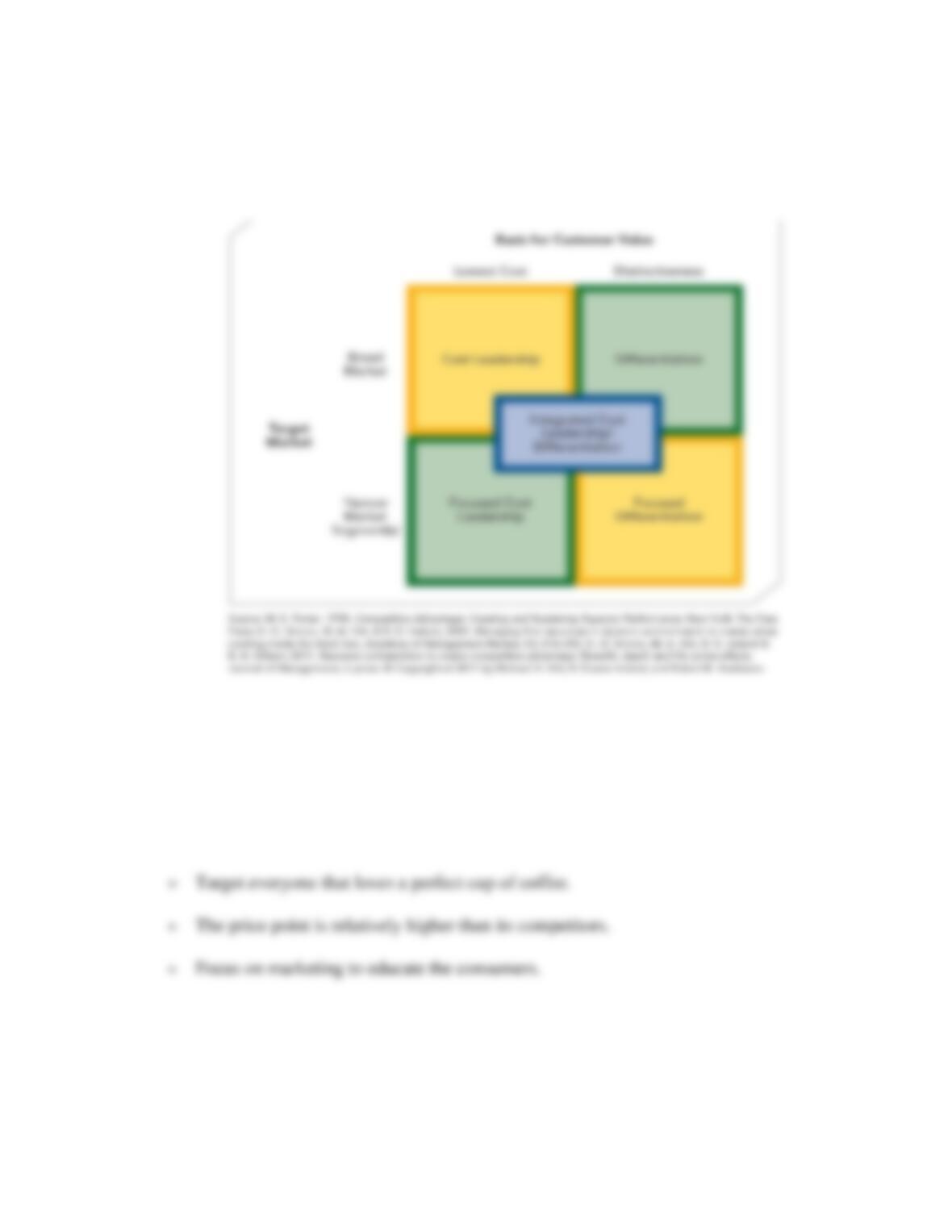
The purpose of a business-level strategy is to create differences between a firm’s
position and those of its competitors. Base on the target market and basis for customer
value, there are five business-level strategies as shown below:
Keurig: From David to Goliath: The Challenge of Gaining and
Maintaining Marketplace Leadership
2
Keurig
Keurig’s overall business-level strategy is differentiation based on the following:
» Its product is unique.
» Focus on patented technology that other competitors cannot imitate.
» Focus on offering more coffee selections.
The key of implementing a differentiation strategy for Keurig is to offer products
that customers perceive as different in ways that are also important to them. The focus is
on non-standardized product that has differentiated features that customers value more
than low cost. For Keurig, its differentiation approaches are:
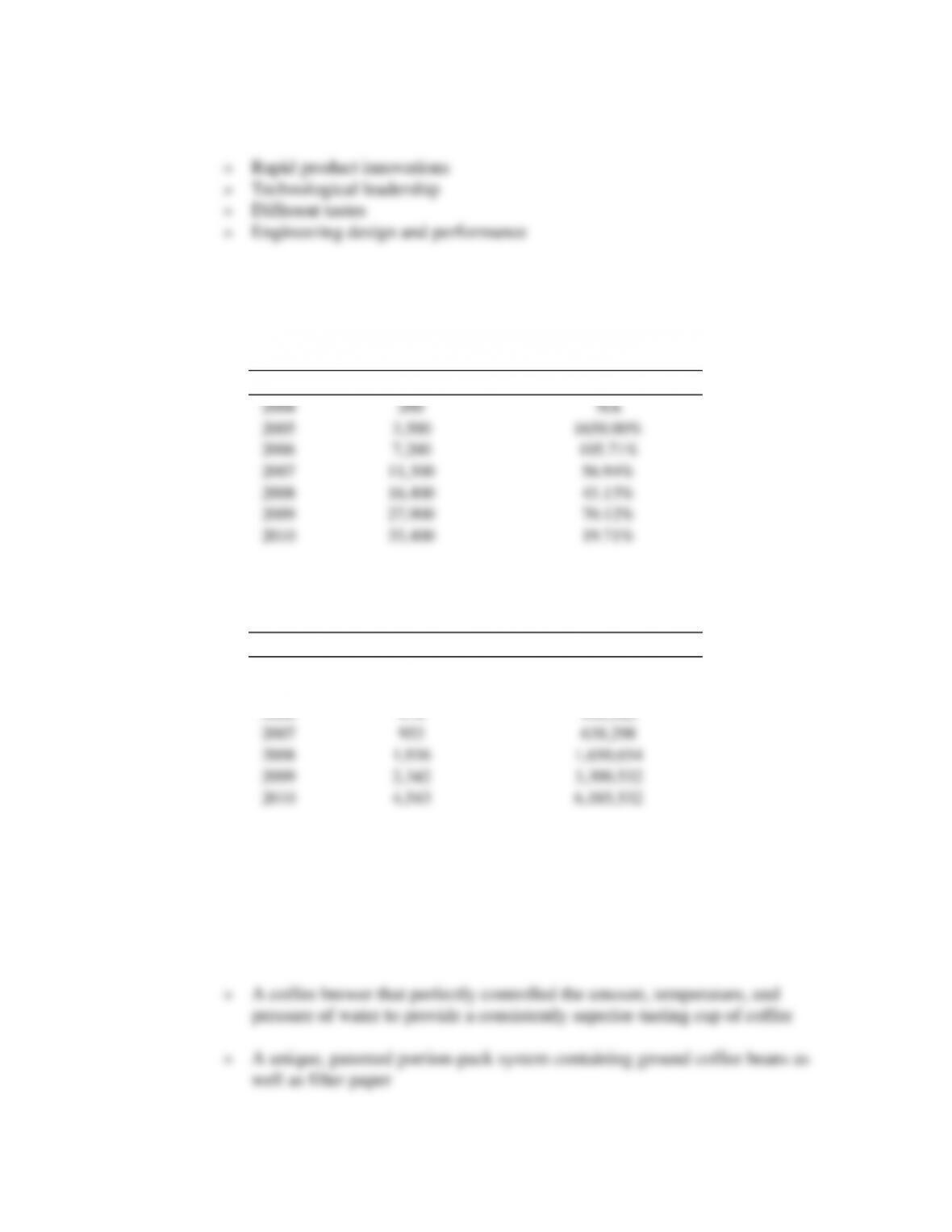
» Unusual features
Keurig: From David to Goliath: The Challenge of Gaining and
Maintaining Marketplace Leadership
3
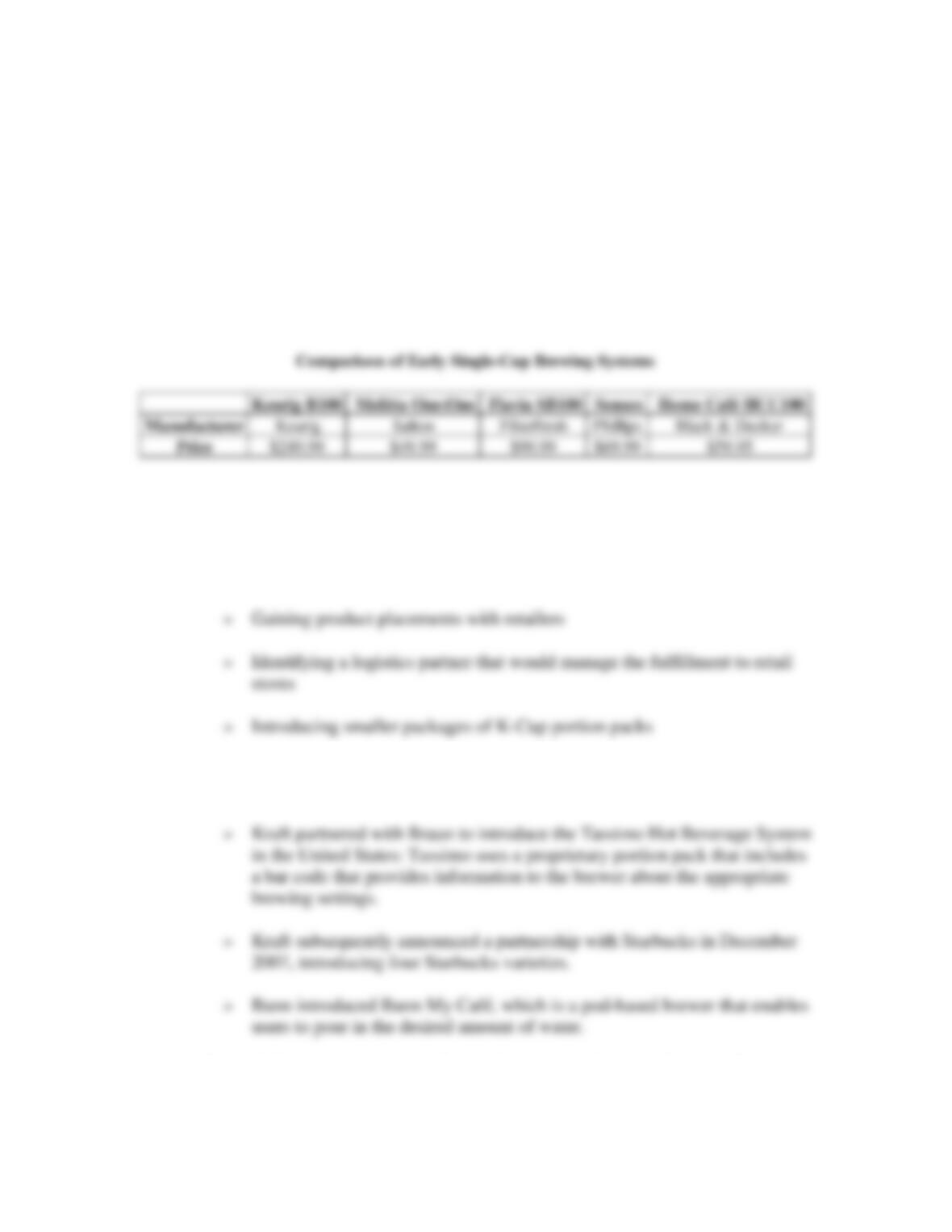
Keurig’s business-level strategy has been very successful. The success can be
shown in the tables below:
• How does Keurig’s strategy stand up against competitive rivalry in the industry?
Keurig’s business strategy leverages the company’s unique ability to internally
design and develop single serve brewing system that are differentiated by three key
product features:
Year
Total Retail Locations Growth from Last Year
2004
200 NA
2005 3,500 1650.00%
2006 7,200 105.71%
2007 11,300 56.94%
2008 16,400 45.13%
2009 27,900 70.12%
2010 33,400 19.71%
Keurig Retail Presence
Year
Keurig-Branded Brewers K-Cup Portion Packs
2004
124
2005 226 312,405
2006 474 448,880
2007 953 638,298
2008 1,936 1,650,654
2009 2,342 3,300,532
2010 4,543 6,185,532
Cumulative Keurig Single-Cup System Sales (in thousands)
Keurig: From David to Goliath: The Challenge of Gaining and
Maintaining Marketplace Leadership
4
Keurig
» A varied coffee selection to replicate the choices available in a gourmet
coffeehouse
While competitors seek to imitate Keurig’s successful products and innovative
technology, Keurig continues to remain as a market leader. In the early years, Keurig
faced competitions from companies such as Salton, Filterfresh, Phillips, and Black &
Decker. Their prices of the single-cup brewing system were relatively cheaper than
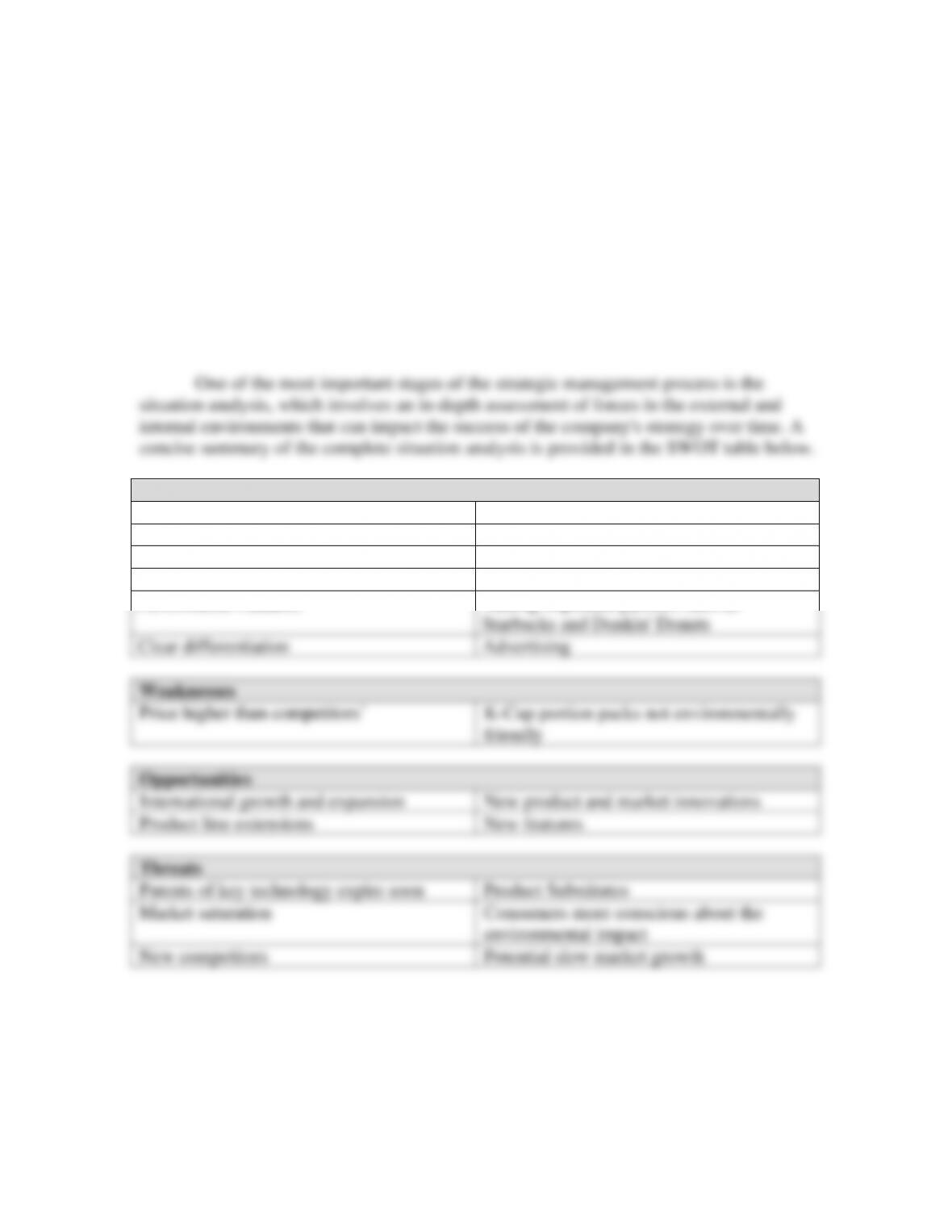
Keurig. The table below shows a comparison of early single-cup brewing systems.
Keurig continually re-invents itself and avoid price competition in product
markets among retailers. It created a minimum advertised price (MAP) program that
minimized price competition by providing incentives to retailers who only advertised
prices at or above the MAP price. Before Keurig launched its B50 machine, the company
focused on the following issues:
» Gaining product placements with retailers
Other competitors were determined to take over the market. Their activities
include:
» Kraft partnered with Braun to introduce the Tassimo Hot Beverage System
Although the competition intensified and the competitors’ product introductions
were not all successful, Keurig introduced the Keurig Elite B40 and the Keurig Special
Keurig: From David to Goliath: The Challenge of Gaining and
Maintaining Marketplace Leadership
5
Keurig
Edition B60. In fall 2006 the Keurig Platinum B70 was introduced. By 2010, Keurig took
approximately 25 percent of the market of coffee makers sold in the United States.
Keurig’s strategy involves the pursuit of opportunities to create demand for its
products in the market. From this analysis, Keurig’s strategy does stand up well against
competitive rivalry in the industry.
• Review the important elements of Keurig’s external and internal environments.
Outline key factors in the SWOT analysis.
One of the most important stages of the strategic management process is the
Strengths
Product innovation
Brand management
New product development
Retail stores availability
Speed to market
Many coffee choices
Market Responsiveness
Great brewing system
Performance Features
Adding important partners such as
Starbucks and Dunkin’ Donuts
Clear differentiation
Advertising
Weaknesses
Price higher than competitors’
K-Cup portion packs not environmentally
friendly
Opportunities
International growth and expansion
New product and market innovations
Product line extensions
New features
Threats
Patents of key technology expire soon
Product Substitutes
Market saturation
Consumers more conscious about the
environmental impact
New competitors
Potential slow market growth
Keurig: From David to Goliath: The Challenge of Gaining and
Maintaining Marketplace Leadership
6
Keurig
STRATEGY
• Weigh the challenges confronting Keurig. What are the greatest risks for
Keurig? What recommendations can be made to support Keurig’s growth and
profitability objectives?
Despite Keurig’s current success, the company faces a variety of troubling issues.
They include:
» Some patents associated with the current generation of K-Cup portion packs
» How to keep its strategy relevant and effective as competitive dynamics
drastically change and how to revamp products to serve customers’ needs.
In other words, how can Keurig keep up as a leader in the market?
Although there are uncertainties and challenges ahead for Keurig, the company
Based on the preceding analysis and discussion, the most promising areas of
consideration are outlined below.
Keurig: From David to Goliath: The Challenge of Gaining and
Maintaining Marketplace Leadership
7
Keurig