
Invitrogen (A)
Invitrogen
INTRODUCTION
This case highlights Invitrogen, one of the largest catalog life science companies
in the industry. In a highly competitive industry, the company has taken some risky steps
in order to continue its growth. Invitrogen built its growth from aggressive acquisitions
combined with merchandising and operational excellence. However, not all acquisitions
were successful, and as a result, the CEO Greg Lucier and the Vice President of
Corporate Strategy Mark Gardner, have some difficult strategic decisions to make as they
direct the future course of the company.
The case opens with a summary of Invitrogen’s history. The life science industry
is discussed, with an emphasis on the future of the industry: next-generation sequencing.
A close look at the path to personalized medicine, along with competitive landscape that
will impact Invitrogen in the years ahead, is discussed. As Lucier Gardner attempts to
manage the quest for growth by acquisition of other companies, they need to be able to
enhance the company’s competitiveness. Suggestions for the company’s acquisition
strategy can be based on an analysis of different situational factors.
This case is ideal for demonstrating the importance of the mergers and
acquisitions (M&As), problems on achieving success after M&As, and strategic
leadership. The following points are to guide a review and discussion of these important
concepts.
• Invitrogen has been very successful in the past. Explain the reasons why
Invitrogen chose acquisitions as its strategy for growth and expansion.
• Are all Invitrogen’s acquisitions successful? What are the problems in achieving
success?
• Evaluate Invitrogen’s CEO, Greg Lucier’s strategic leadership. Has he been able
to expand the company and maintain the growth for the future?
• Evaluate Invitrogen’s next move in terms of acquisitions. Based on your analysis,
what recommendations would you make to help Invitrogen achieve its goals?
ANALYSIS
• Invitrogen has been very successful in the past. Explain the reasons why
Invitrogen chose acquisitions as its strategy for growth and expansion.
Invitrogen (A)
2
Invitrogen
Greg Lucier, recruited from General Electric, Invitrogen acquired 15 companies (2003-
2005). The list below shows a sample of the companies that Invitrogen acquired from
2003 to 2005.
Because of this aggressive acquisition strategy, by 2007, Invitrogen had 4,385
employees and 35,000 products. There are many reasons why Invitrogen chose
acquisitions as a strategy for growth and expansion. The reasons are listed below:
» Increase market power: Invitrogen was founded in 1987 and would soon
become one of the largest life science companies in the industry. When a
company conducts horizontal acquisitions, it can increase its market power.
Because Invitrogen was able to acquire companies in the same industry, its
horizontal acquisition strategy helped the company to increase its company
size and market power.
Invitrogen (A)
3
Invitrogen
» Increased diversification: Invitrogen has been the leader in life science, but
not instrument development, which is where most government funding goes to.
By acquiring a company outside of the current product offerings, Invitrogen
can increase diversification and can have an opportunity to grow even bigger.
• Are all Invitrogen’s acquisitions successful? What are the problems in
achieving success?
Not all Invitrogen’s acquisitions were successful. For example, Invitrogen
acquired Bioreliance, a pharmaceutical services business, for $500 million in 2004. In
2007, Invitrogen sold it for $210 million, due to a refocus on a “platform of technologies,”
instead of services.
There are potentially many problems in achieving success in acquisitions. These
There are also concerns of leadership being overly focused on acquisitions
because Invitrogen had already invested $20 million in its own 3rd generation, next-
generation sequencing program. If it can be developed in-house, why should the company
spend so much money acquiring another company?
Invitrogen (A)
4
Invitrogen
• Evaluate Invitrogen’s CEO, Greg Lucier’s strategic leadership. Has he been
able to expand the company and maintain the growth for the future?
1. Determining strategic direction
2. Establishing balanced organizational controls
3. Effectively managing the firm’s resource portfolio
4. Sustaining an effective organizational culture
5. Emphasizing ethical practices
Determining strategic direction
Greg Lucier became Invitrogen’s CEO in 2003. He was recruited from General
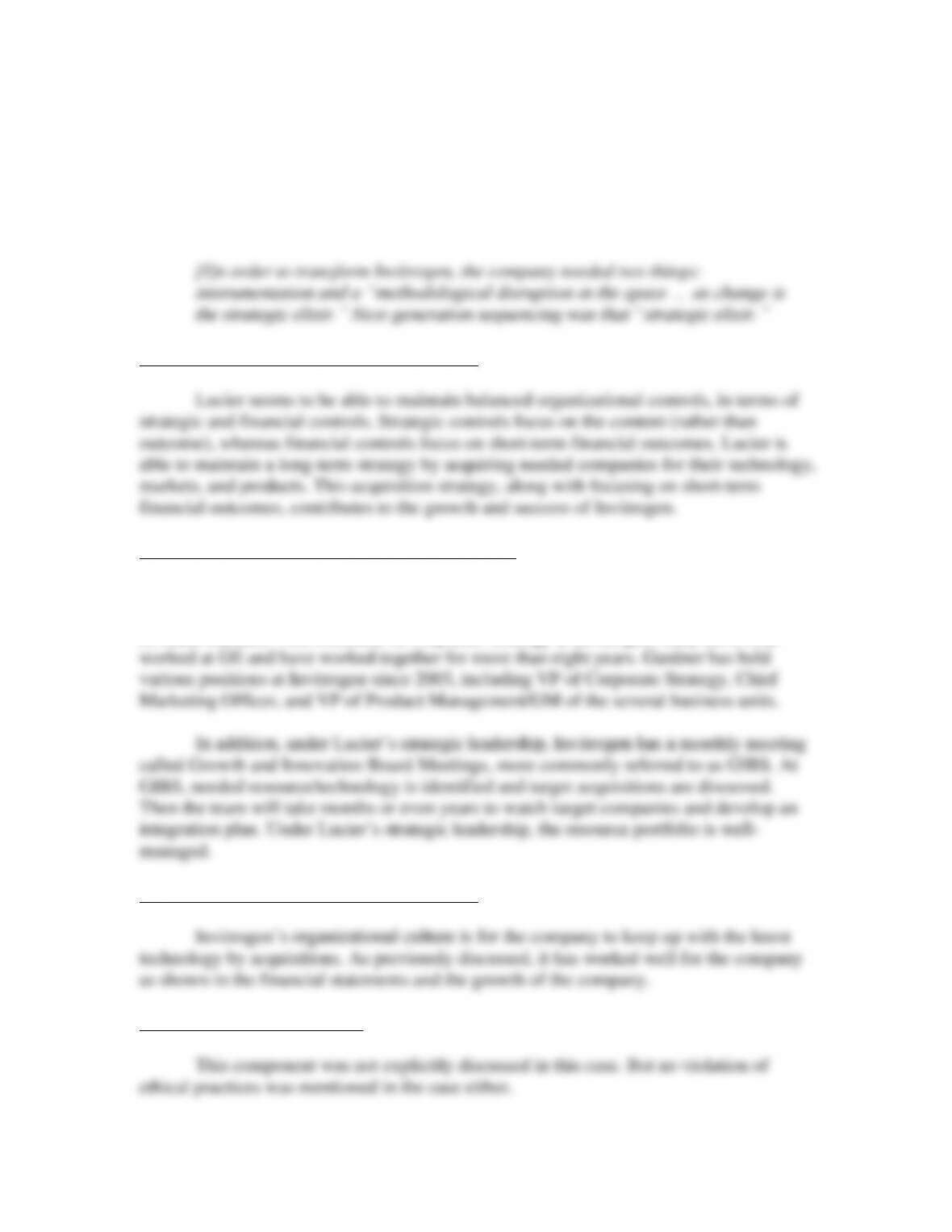
Selected Invitrogen Financials (in US$1000’s)
2007 2006 2005 2004
Change from
2004 to 2007
Net Revenue $1,282.00 $1,151.00 $1,198.00 $1,024.00 25.20%
R&D $112.00 $100.00 $97.00 $73.10 53.21%
Net Income $143.00 -$191.00 $132.00 $88.80 61.04%
Long-Term
Debt
$1,151.00 $1,151.00 $1,152.00 $1,319.00 -12.74%
Invitrogen (A)
5
Invitrogen
However, Lucier also understands that he needs a long-term strategic direction.
Because personalized medicine is the future, he needs to secure the technology of next-
generation sequencing. Therefore, he has to invest in R&D and also examine the
possibility of acquiring another company that specializes in this technology. As the case
describes:
Establishing balanced organizational controls
Effectively managing the firm’s resource portfolio
Managing the firm’s resource portfolio includes exploiting and maintaining core
competencies and developing human and social capital. Lucier is able to utilize the talent
of Mark Gardner, Vice President of Corporate Strategy at Invitrogen. They have both
Sustaining an effective organizational culture
Emphasizing ethical practices
Invitrogen (A)
6
Invitrogen
STRATEGY
• Evaluate Invitrogen’s next move in terms of acquisitions. Based on your
analysis, what recommendations would you make to help Invitrogen achieve its
goals?
About 90% of Invitrogen’s revenue comes from research, which also heavily
depend on the government funding for the National Institutes of Health (NIH) and
National Science Foundation (NSF). The board of directors believes that the future of
Invitrogen’s core competencies should be leveraged to solve the medical problems of the
twenty-first century. In the 2004 Annual Report, Lucier wrote in the CEO letter to the
shareholders:
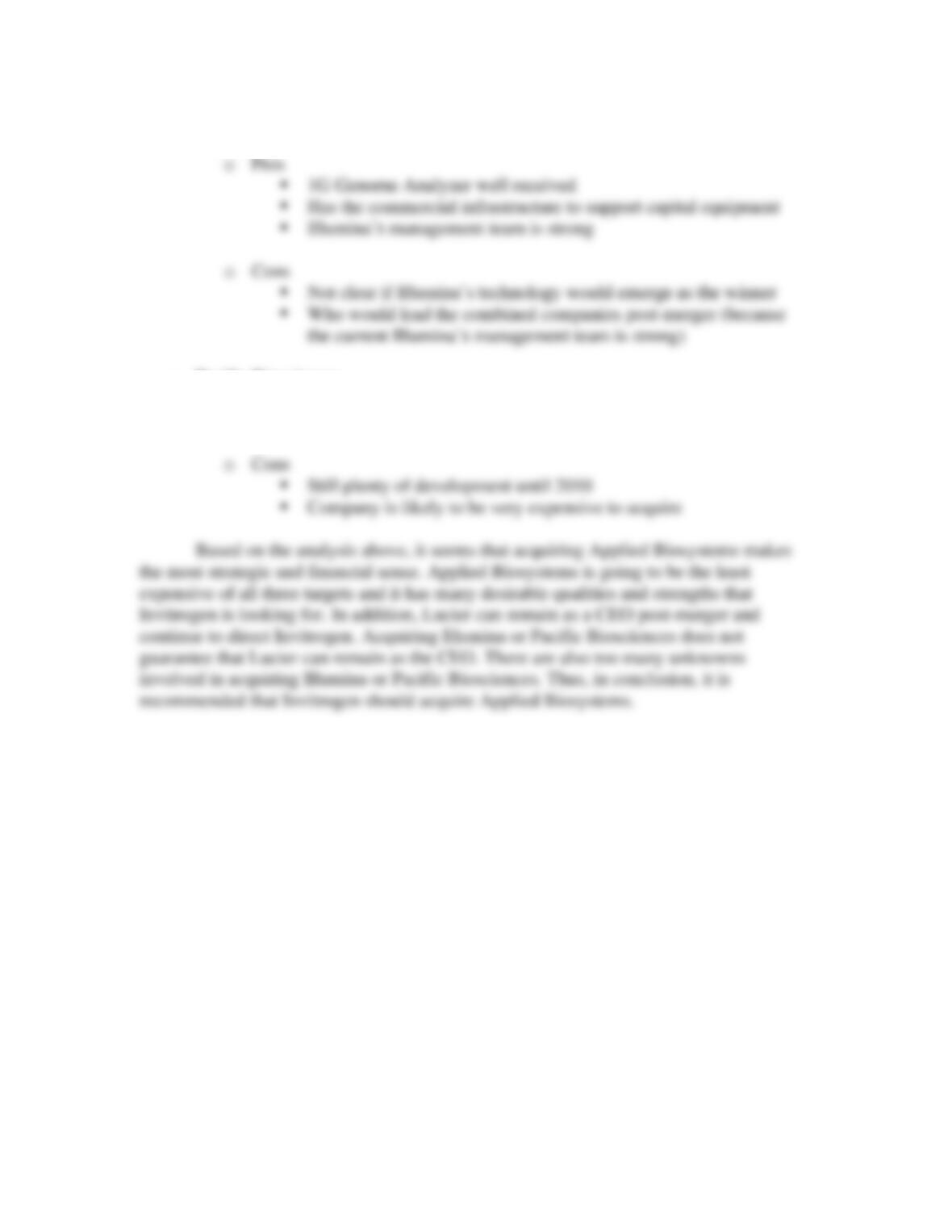
There are a few companies that Invitrogen can acquire. They are listed as below,
along with an analysis of pros and cons:
» Applied Biosystems
o Pros
Invitrogen (A)
7
Invitrogen
» Illumina
» Pacific Biosciences
o Pros
▪ G3 Technology is desirable