
Business Model and Competitive Strategy of IKEA in India
1
IKEA
INTRODUCTION
The IKEA case provides an excellent opportunity to apply strategic management
concepts to a large privately-held company that is expanding into India. IKEA is a
Netherlands-based Swedish company with a presence in 44 countries around the world,
including the US, the UK, Russia, the EU region, Japan, China, and Australia. It is the
largest furniture retailer in the world but did not enter India until 2013, despite the fact
that it has been sourcing from India since the 1980s.
The purpose of this case study is to examine the factors that are crucial to IKEA’s
continued success and to propose strategic actions to sustain its competitive advantage.
The case opens with a review of the company’s humble beginning. IKEA was founded by
17-year-old Ingvar Kamprad (Kamprad) in Sweden in 1943. By the 2000s, IKEA has
become the world’s largest furniture retailer. The corporate structure was constructed to
prevent any takeover and to protect the family from taxes. Thus, the structure is a
complicated arrangement of not-for-profit and for-profit organizations. The IKEA stores
provide customers with a unique shopping experience with low prices, solid quality,
modern designs, and most importantly, the concept of do-it-yourself (DIY) products.
The extensive discussion is followed by a description of the furniture industry in
India and what IKEA had to overcome in order to enter the Indian market. IKEA first met
with regulatory and political roadblocks, and then had to work with suppliers in order to
meet the Indian government’s requirement for sourcing. Finally, there are several
challenges that IKEA faces.
This case is ideal for demonstrating the importance of the general environment,
international corporate-level strategy, and type of entry. The following points are to guide
a review and discussion of these important concepts.
• Review IKEA’s general environment segments and elements in India. What are
the segments in the general environment that relate to IKEA’s situation?
• Describe IKEA’s intended international corporate-level strategy in India. Is it
different from other countries?
• What is IKEA’s choice of international entry mode? What are the advantages and
disadvantages compared to other international entry modes?
• Identify IKEA’s current challenges in India. Based on your analysis, what
additional recommendations would you make to help IKEA achieve its goals?
Business Model and Competitive Strategy of IKEA in India
2
IKEA
ANALYSIS
• Review IKEA’s general environment segments and elements in India. What are
the segments in the general environment that relate to IKEA’s situation?
Factors in the general environment that impact IKEA in India are primarily
demographic, economic, political/legal, sociocultural, and sustainable physical
environment segments. The primary segments and elements in the general environment
that relate to IKEA’s situation are:
General Environment in India
Segments
Elements
Demographic Segment
Lower household income
Large population size
Dense population in the cities
Large income gap
Economic Segment
One of the fast growing economies in the world
Political/legal Segment
Corruption issues
Difficult FDI policies
Some regulatory/political roadblocks
Sociocultural Segment
People prefer readymade furniture
People prefer shop assistants
Cultural difference from other developed countries
Sustainable Physical
Environment Segment
Availability of renewable energy
As the table above shows, the general environment in India is very different from
other countries that IKEA has opened retail stores in. The initial cost of entering the
Indian market will be substantial. For example, the real estate cost in the cities is
extremely expensive. People in India generally have small cars and may not travel a far
distance to a store. Thus, if IKEA opens a store outside of the city, this could impact the
sales negatively. On the other hand, if IKEA opens a store in a city, the real estate price
will be extremely high and it will be very difficult to buy a large land like what IKEA
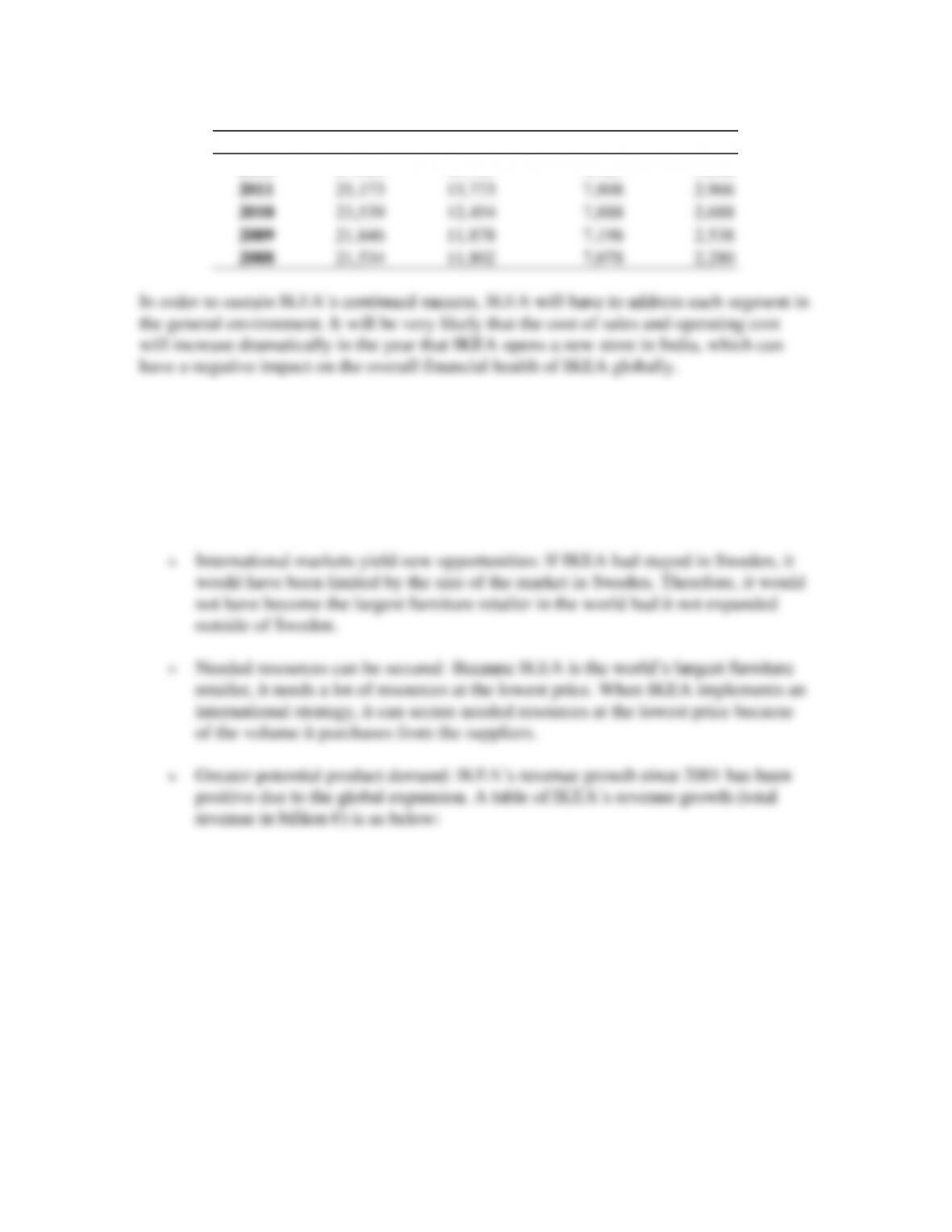
usually does in other countries. The table below shows the financial highlights of IKEA:
Business Model and Competitive Strategy of IKEA in India
3
• Describe IKEA’s intended international corporate-level strategy in India. Is it
different from other countries?
A firm’s international strategy is a strategy through which the firm sells its goods
or services outside its domestic market. There are several reasons for IKEA to pursue an
international strategy:
Revenue Cost of Sales Operating Cost Net Income
2012 27,628 15,723 8,423 3,202
2011 25,173 13,773 7,808 2,966
2010 23,539 12,454 7,888 2,688
2009 21,846 11,878 7,198 2,538
2008 21,534 11,802 7,078 2,280
Business Model and Competitive Strategy of IKEA in India
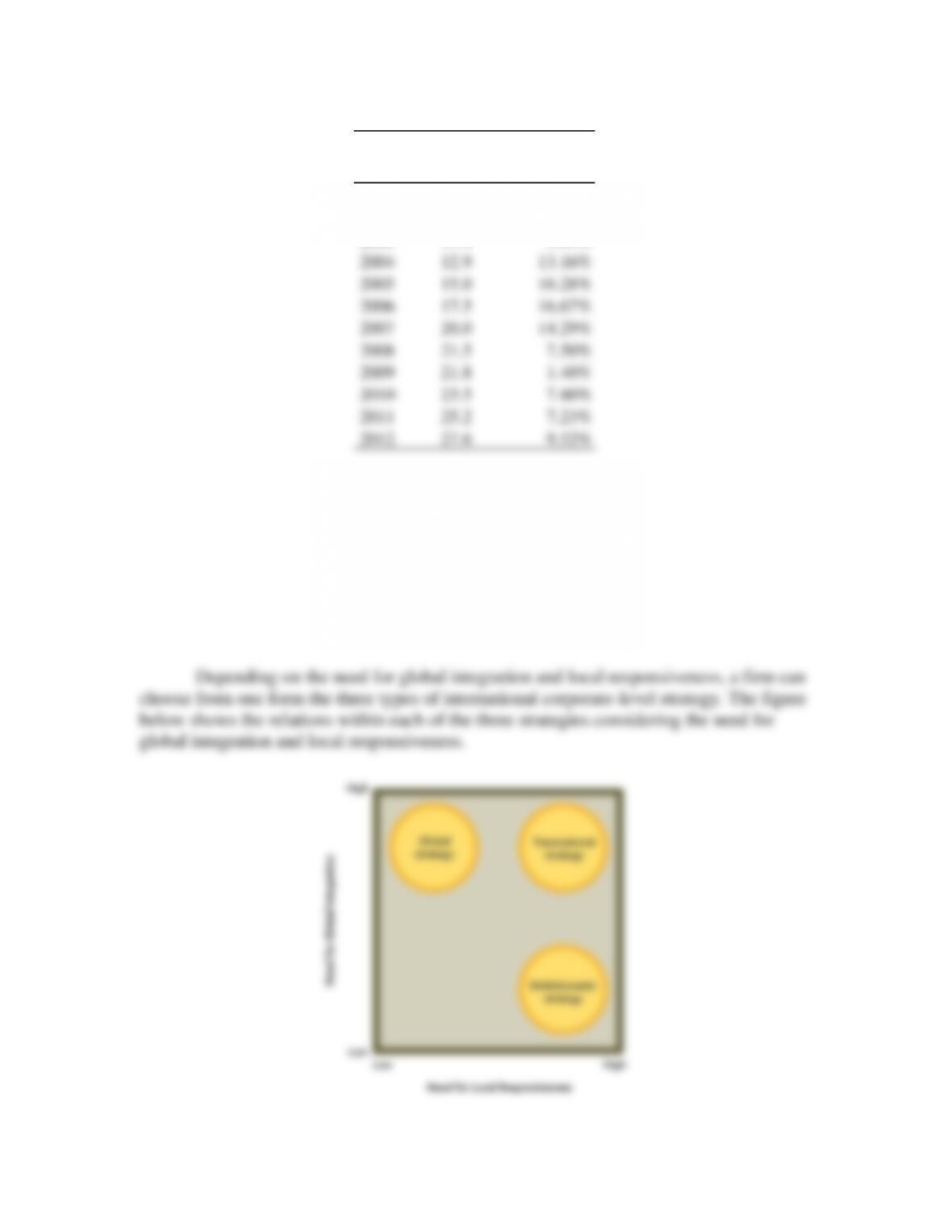
» Borderless demand for globally branded products: IKEA usually have
standardized design with the concepts of DIY and flat packs.
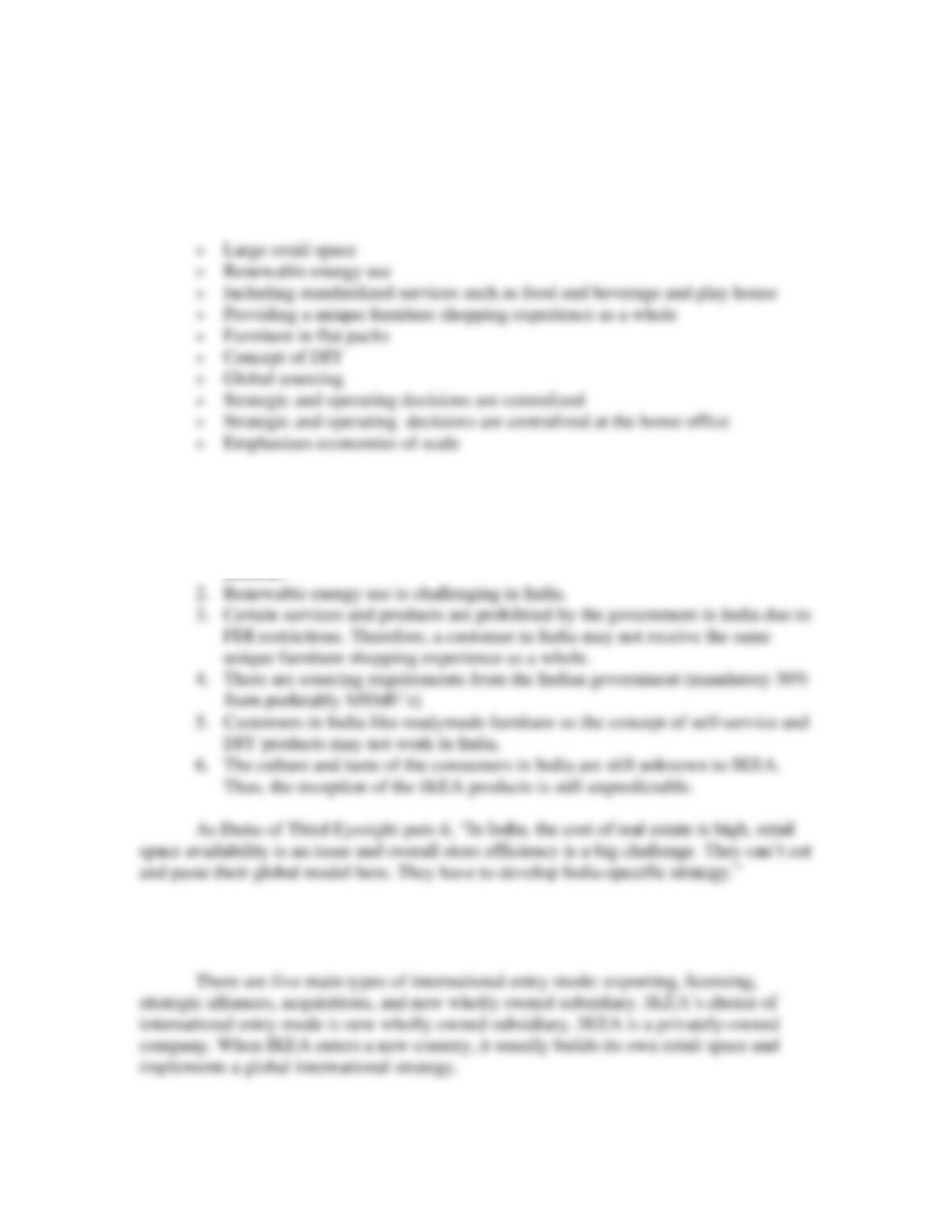
There are three types of international corporate-level strategy:
» Multidomestic
» Global
» Transnational (the combination of the multidomestic and global strategies)
Year Amount
Growth since
last year
2001 10.4 N/A
2002 11.0 5.77%
2003 11.4 3.64%
2004 12.9 13.16%
2005 15.0 16.28%
2006 17.5 16.67%
2007 20.0 14.29%
2008 21.5 7.50%
2009 21.8 1.40%
2010 23.5 7.80%
2011 25.2 7.23%
2012 27.6 9.52%
Business Model and Competitive Strategy of IKEA in India
5
IKEA
From the descriptions of the case, IKEA seems to be able to achieve global
strategy for its stores in most countries. A global strategy is an international strategy in
which a firm’s home office determines the strategies that business units are to use in each
country or region. IKEA’s global strategy includes the following:
» Large retail space
For IKEA’s intended international corporate-level strategy in India, it seems
transnational fits the best. There are several reasons:
1. Retail space in India is extremely expensive, so a large retail space may not be
feasible.
• What is IKEA’s choice of international entry mode? What are the advantages
and disadvantages compared to other international entry modes?
Business Model and Competitive Strategy of IKEA in India
6
IKEA
A new wholly owned subsidiary is also called a Greenfield venture. It is when a
firm invests directly in another country/market by establishing a new wholly owned
subsidiary. There are several advantages and disadvantages. The advantages are:
STRATEGY
• Identify IKEA’s current challenges in India. Based on your analysis, what
additional recommendations would you make to help IKEA achieve its goals?
IKEA’s current challenges in India are:
Based on this analysis, recommendations for IKEA’s next strategic move(s)
should address:
Business Model and Competitive Strategy of IKEA in India
7
IKEA
Hiring activities and vendor negotiations
Last mile supply chain issues
IKEA’s do–it-yourself (DIY) concept may not work in India
IKEA’s anti-corruption policy
Reception of IKEA’s products is unpredictable
It is hard to tell whether consumers in India will like the products that IKEA