
Chapter 8: International Strategy
8-1
Chapter 8
International Strategy
LEARNING OBJECTIVES
1. Explain incentives that can influence firms to use an international strategy.
2. Identify three basic benefits firms achieve by successfully implementing an
international strategy.
3. Explore the determinants of national advantage as the basis for international business-
level strategies.
4. Describe the three international corporate-level strategies.
5. Discuss environmental trends affecting the choice of international strategies,
particularly international corporate-level strategies.
6. Explain the five modes firms use to enter international markets.
7. Discuss the two major risks of using international strategies.
8. Discuss the strategic competitiveness outcomes associated with international
strategies particularly with an international diversification strategy.
9. Explain two important issues firms should have knowledge about when using
international strategies.
CHAPTER OUTLINE
Opening Case: Netflix Ignites Growth through International Expansion, but Such Growth
Also Fires Up the Competition
IDENTIFYING INTERNATIONAL OPPORTUNITIES
Incentives to Use International Strategy
Three Basic Benefits of International Strategy
INTERNATIONAL STRATEGIES
International Business-Level Strategy
International Corporate-Level Strategy
Strategic Focus: Furniture Giant IKEA’s Global Strategy
ENVIRONMENTAL TRENDS
Liability of Foreignness
Regionalization
CHOICE OF INTERNATIONAL ENTRY MODE
Exporting
Licensing
Strategic Alliances
Acquisitions

Chapter 8: International Strategy
8-2
New Wholly Owned Subsidiary
Dynamics of Mode of Entry
RISKS IN AN INTERNATIONAL ENVIRONMENT
Political Risks
Economic Risks
Strategic Focus: The Global Soccer Industry and the Effect of the FIFA Scandal
STRATEGIC COMPETITIVENESS OUTCOMES
International Diversification and Returns
Enhanced Innovation
THE CHALLENGE OF INTERNATIONAL STRATEGIES
Complexity of Managing International Strategies
Limits to International Expansion
SUMMARY
KEY TERMS
REVIEW QUESTIONS
MINI-CASE: An International Strategy Powers ABB’s Future
ADDITIONAL QUESTIONS AND EXERCISES
MINDTAP RESOURCES
LECTURE NOTES
Chapter Introduction: This chapter examines opportunities facing firms as they seek
to develop technological innovation and exploit core competencies by diversifying
into global markets. In addition, it addresses different problems, complexities, and
OPENING CASE
Netflix Ignites Growth through International Expansion, but Such Growth Also Fires Up
the Competition
Chapter 8: International Strategy
8-3
Netflix is a content streaming company that provides a broad selection of on-demand
should be able to identify and discuss some issues encountered by other growing
technological firms with international operations. Ask them to identify instances in
which firms have had to deal with problems/issues arising out of international
operations.
Although national boundaries, cultural differences, and geographical distances all pose
barriers to entry into many markets, significant opportunities draw businesses into the
international arena.
FIGURE 8.1
Opportunities and Outcomes of International Strategy
The following opportunities and outcomes of international strategy are illustrated in Figure
8.1:
Chapter 8: International Strategy
8-4
1
Explain incentives that can influence firms to use an
international strategy.
IDENTIFYING INTERNATIONAL OPPORTUNITIES
Incentives to Use International Strategy
This is explained by Vernon’s adaptation of the product life cycle concept formulated to
explain internationalization.
1. A firm introduces an innovation (new product) in its domestic market.
2. Product demand develops in other countries and exports are provided from domestic
operations.
Traditional motives persist, but other emerging motives also drive international expansion.
• Pressure has increased for global integration of operations, driven mostly by universal
Chapter 8: International Strategy
8-5
Companies seeking to expand operations internationally need to understand the pressure on
them to respond to local, national, or regional customs, especially where goods or services
Opportunities available to firms through an international strategy include:
• Increasing the size of potential markets
Teaching Note: Firms expanding into international markets must recognize that many
countries have characteristics that are unique and may differ significantly from the
traditional European markets into which US firms have expanded. Thus, firms must
recognize this and:
2
Identify three basic benefits firms achieve by successfully
implementing an international strategy.
Three Basic Benefits of International Strategy
Increased Market Size
Chapter 8: International Strategy
8-6
Expanding internationally enables firms to increase greatly the size of the potential market
for their products. This may be of critical importance if the domestic market is too small to
support scale-efficient manufacturing facilities.
Economies of Scale and Learning
By expanding the size and scope of their markets, firms may be able to achieve economies of
scale in manufacturing (and in other operations, such as marketing, research and
development, and distribution) by standardizing products across national borders and
spreading fixed costs over a larger sales base.
Firms may also be able to exploit core competencies in international markets through
resource and knowledge sharing between units across country borders. This sharing generates
synergy, which helps the firm produce higher-quality goods or services at lower cost. In
addition, working across international markets provides the firm with new learning
opportunities.
Location Advantages
Chapter 8: International Strategy
8-7
Other factors that may impact location advantages are as follows:
3
Explore the determinants of national advantage as
the basis for international business-level strategies.
INTERNATIONAL STRATEGIES
International strategies available to firms are business-level and corporate-level (see Chapters
4 and 6).
International Business-Level Strategy
Each business must develop a competitive strategy focused on its own domestic market.
Business-level generic strategies are discussed in Chapter 4, but international business-level
strategies have some unique features.
Figure Note
Porter’s Diamond of Advantage model can be used to introduce the discussion of
Figure 8.3.
FIGURE 8.3
Determinants of National Advantage
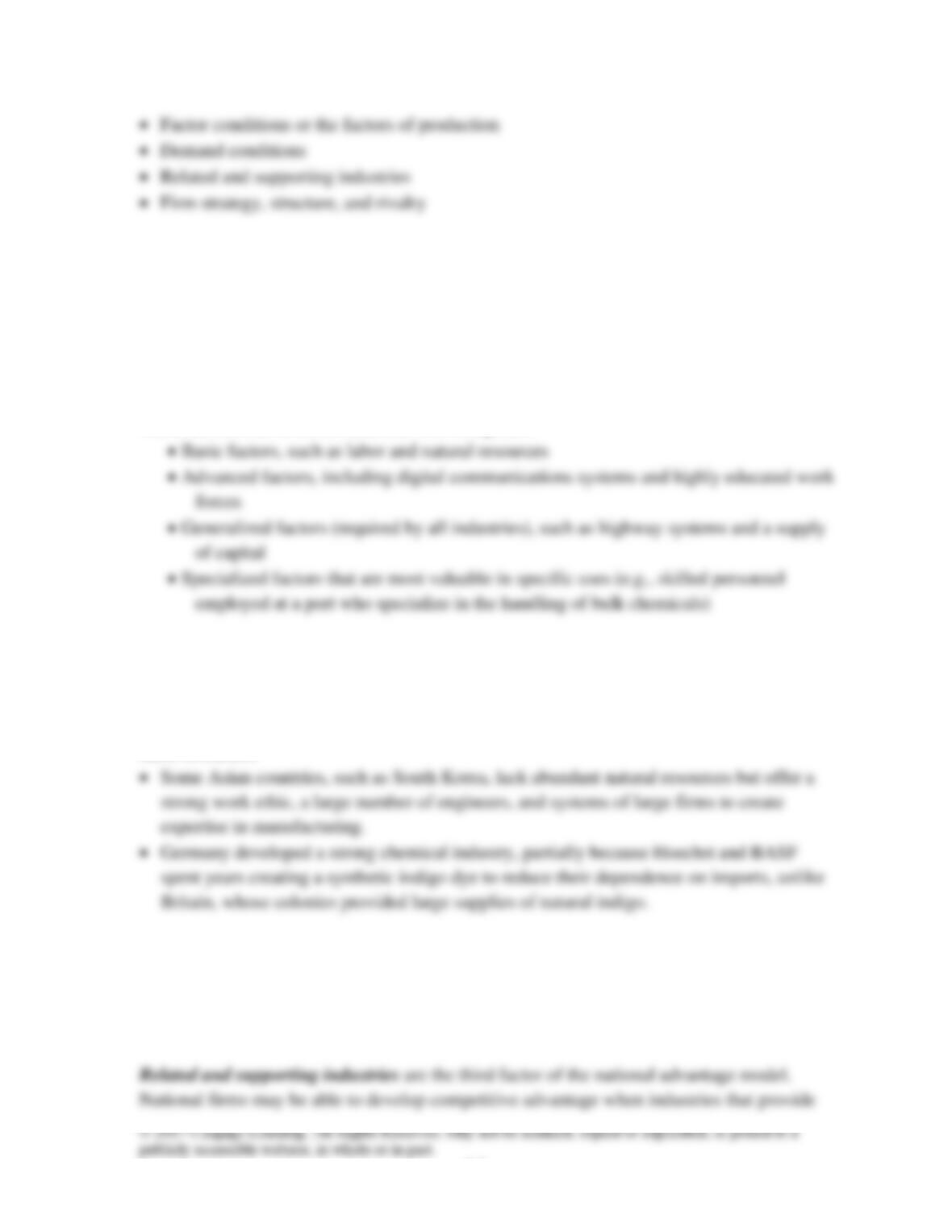
As Figure 8.3 illustrates, four interrelated national or regional factors contribute to the
competitive advantage of firms competing in global industries.
Chapter 8: International Strategy
8-8
Note:
Each of these factors is discussed in the following section.
Perhaps the most basic factor in the model, factor conditions or factors of production, refers
to the inputs necessary to compete in any industry. These include labor, land, natural
resources, capital, and infrastructure (such as highway, postal, and communications systems).
These factors can be subdivided into four categories:
Nations having both advanced and specialized factors are likely to be characterized by
growth in new firms that are strong global competitors.
Ironically, countries often develop advanced and specialized factors because they lack critical
basic resources.
The second factor that determines national advantage is demand conditions, which are
characterized by the nature and size of buyers’ needs in the home market for the industry’s
products or services. The size of the segment can create demand sufficient to justify the
construction of scale-efficient facilities.

Chapter 8: International Strategy
8-9
either materials or components or that support the activities of the primary industry are
present.
Growth in certain industries is fostered by the fourth factor—firm strategy, structure, and
rivalry. As expected, patterns of firm strategy, structure, and competitive rivalry among firms
in an industry vary between nations.
As described, the four basic factors of Porter’s Diamond of Advantage model emphasize the
impact or influence of the environmental or structural attributes of a nation’s economy that
may contribute to a national advantage for its firms in specific industries.
4
Describe the three international corporate-level strategies.
International Corporate-Level Strategy
The type of corporate-level strategy adopted by a firm has an impact on the selection and
implementation of its international business-level strategy.
Chapter 8: International Strategy
8-10
Figure Note: The three types of international corporate-level strategies are illustrated
in Figure 8.4, whereas relationships between structural arrangements and strategy
type are discussed further in Chapter 11.
FIGURE 8.4
International Corporate-Level Strategies
As Figure 8.4 illustrates, a firm should choose its international corporate-level strategy based
on the need for both local responsiveness and for global integration.
Multi-domestic Strategy
Multi-domestic strategy is one where strategic and operating decisions are decentralized to
the strategic business unit in each country in order to tailor products and services to the local
market. The multi-domestic strategy:
Teaching Note
A few years back, Sony’s entertainment business changed its strategy from global to
multi-domestic when it decided to produce films and television programs for local
The use of multi-domestic strategies:
Chapter 8: International Strategy
Global Strategy
A global strategy is one where standardized products are offered across country markets and
competitive strategy is dictated by the home office. The global strategy:
• Assumes strategic business units operating in each country are interdependent
• Attempts to achieve integration across business and national markets, as directed by the
home office
Teaching Note: U.K.-based temporary energy provider, Aggreko, operates in 48
countries and employs a global strategy. The firm’s fleet of equipment is integrated
globally, which allows it to shift equipment to different regions of the world to meet
specific needs. Its global strategy also allows Aggreko to design and assemble its
equipment in-house to meet the needs of its customers.
Strategic Focus: Furniture Giant Ikea’s Global Strategy
Headquartered in Sweden, IKEA has pursued a global strategy in developing its
well-designed, but inexpensive retail furniture strategy. As with most companies
pursuing a global strategy, it emphasizes global efficiencies. A tradeoff that they have
experienced is that packaging can become too efficient at the expense of consumer
frustration at the complexity of assembly once at the home location. So, simple
assemble is also an important criteria.
In 2015, IKEA plans to open 13 new stores, adding to its current total of 315. It is

Chapter 8: International Strategy
8-12
focuses on where a growing middle-class is developing. It has entered China and is
planning on a strong entry into India and is considering Brazil as well. All of these
economies have growing middle-classes. Even in these countries though, it focuses on
“flat packing, transporting, and reassembling its quirky Swedish-styling all across the
planet.”
Transnational Strategy
A transnational strategy is a corporate strategy that seeks to achieve both global efficiency
and local (national market) responsiveness.
Teaching Note: Students sometimes find the transnational strategy difficult to grasp.
This has prompted some to refer to this option as an “idealized form,” suggesting that
Teaching Note: Refer back to Figure 8.4 to summarize relationships between the
need for global integration and local responsiveness and international corporate-level
strategies.
5
Discuss environmental trends affecting the choice of
international strategies, particularly international corporate-
level strategies.
ENVIRONMENTAL TRENDS
Implementing a transnational strategy is difficult; however, firms are challenged to do so
because of these facts:

Chapter 8: International Strategy
8-13
• There is an increased emphasis on local requirements, e.g., customization to meet
government regulations within particular countries or to fit customer tastes and
preferences.
Liability of Foreignness
Regionalization
A firm competing in international markets must decide whether to compete in all (or many)
world markets or to focus its efforts on a specific region or regions.
regarding disadvantages that often accompany over-diversification and the prescribed
downscoping to refocus the firm more on related as opposed to unrelated diversification.
Chapter 8: International Strategy
8-14
Lands’ End Adjusts to the Liability of Foreignness: A Mini-Case
The globalization of businesses with local strategies is demonstrated by the online
operation of Lands’ End, Inc. (now owned by Sears), which uses local Internet portals to
offer its products for sale. Lands’ End, formerly a direct-mail catalog business, launched
its web-based business in 1995. The firm established websites in the U.K. and Germany in
1999, and in France, Italy, and Ireland in 2000—all of this prior to initiating a catalog
business in those countries. Not only are catalogs very expensive to print and mail outside
the United States, but they also must be sent to the right people, and buying mailing lists
is expensive. With limited online advertising and word-of-mouth, a website business can
be built in a foreign country without a lot of initial marketing expenses. Once the online
business is large enough, a catalog business can be launched with mailing targeted to
customers who have used the business online.
Sam Taylor, vice president of international operations for Lands’ End, indicated that the
firm has a centralized Internet team (handling development, design, etc.) at the home
office, but a local presence is also needed. So the firm hired local Internet managers,
designers, marketing support, and so on, to gain insight into the nuances of local markets.
He also explained that each additional website was cheaper to implement. For example, to
set up the Websites for Ireland, France, and Italy, the firm cloned the U.K. site and
partnered with Berlitz for French and Italian translations. This made the process
cheaper—12 times less than the U.K. site for France and 16 times less for Italy. Lands’

Chapter 8: International Strategy
8-15
Teaching Note
The movement of investment funds has not been only from the US to Mexico as
Mexican investors have made significant investments in the US, and some European
firms have invested in Canada to gain access to this unified market.
Most firms enter regional markets sequentially, beginning in markets with which they are
more familiar. And they introduce their largest and strongest lines of business into these
markets first, followed by their other lines of business once the first lines are successful.
They also usually invest in the same area as their original investment location.
6
Explain the five modes firms use to enter international
markets.
CHOICE OF INTERNATIONAL ENTRY MODE
Firms have a variety of alternative means of expanding internationally as indicated in Figure
8.5.
Table Note
Students can refer to Figure 8.5 as you discuss each of the modes of entry into
international markets.
FIGURE 8.5
Modes of Entry and Their Characteristics
Figure 8.5 presents five alternative entry modes available to firms for international
expansion:
Chapter 8: International Strategy
8-16
The next section of this chapter discusses characteristics of each mode, including cost/control
trade-offs.
Exporting
A common—but not necessarily the least costly or most profitable—form of international
expansion is for firms to export products from the home country to other markets.
• Exporters have no need to establish operations in other countries.
Because of the potentially significant transportation costs and the usually greater similarity of
geographic neighbors, firms often export mostly to countries that are closest to its facilities.
Small businesses are the most likely to use exporting. One of the largest problems with
which small businesses must deal is currency exchange rates, a challenge for which only
large businesses are likely to have specialists.
Licensing
Through licensing, a firm authorizes a foreign firm to manufacture and sell its products in a
foreign market.
Teaching Note
Chapter 8: International Strategy
8-17
Counterfeiting is one risk to licensing strategies. Sony and Philips co-designed the
audio CD. In the past, they licensed the rights to companies to make CDs and Sony
and Philips collected 5 cents for every CD sold. However, the returns to Sony and
Philips from CD sales were threatened by cheap counterfeit disks. Sales of counterfeit
disks in China alone are estimated to exceed $1 billion annually.
The costs or potential disadvantages of licensing include the following:
Strategic Alliances
Strategic alliances enable firms to:
Strategic alliances also present potential problems and risks due to (1) selection of
incompatible partners and (2) conflict between partners.
Several factors may cause a relationship to sour. Trust between the partners is critical and is
affected by a number of fundamental issues:
Chapter 8: International Strategy
8-18
Teaching Note
British Telecommunications planned to create a virtual shopping mall in Spain
through its joint venture with Banco Popular, a retail-focused Spanish bank. The two
firms jointly developed a website for business-to-business transactions. They were to
use BT’s portal in Spain to develop a client base of small– and medium-sized
businesses. BT would provide the common portal free of charge for the first year and
Banco Popular would charge only a nominal commission for brokering sales.
Acquisitions
Cross-border acquisitions have also been increasing significantly. In recent years, cross-
border acquisitions have comprised more than 45 percent of all acquisitions completed
worldwide.
As explained in Chapter 7, acquisitions can provide quick access to a new market. In fact,
acquisitions may provide the fastest and often the largest initial international expansion of
any of the alternatives.
Teaching Note
Emphasize that firms often use multiple entry strategies. For example, Walmart has
used multiple entry strategies as it globalizes its operations, ranging from joint