Chapter 6: Corporate-Level Strategy
6-17
open market, either through selloff to another acquirer or through spinoffs where two
stock prices are created, one for the legacy business and one for the spinoff firm
Restructuring of Assets
Tyco International: A Question of Ethics
Under former CEO Dennis L. Kozlowski, Tyco International, Ltd. excelled at
exploiting financial economies through restructuring. Tyco focused on two types of
acquisitions: platform, which represented new bases for future acquisitions, and add-
on, in markets where Tyco currently had a major presence. As with many unrelated
diversified firms, Tyco acquired mature product lines. However, completing large
Success in implementing unrelated diversification strategies usually requires that firms:
Chapter 6: Corporate-Level Strategy
6-18
6
Discuss the incentives and resources that encourage
diversification.
VALUE-NEUTRAL DIVERSIFICATION: INCENTIVES AND RESOURCES
As mentioned earlier, not all firms diversify to increase the value of the overall firm. Some
attempts at diversification are implemented to prevent the value of the firm from decreasing.
Incentives to Diversify
Antitrust Regulation and Tax Laws
In the 1960s and 1970s, government policies – in the form of antitrust enforcement and tax
laws – provided US firms with incentives to diversify the mix of businesses controlled by the
firm. Because of these policies, the vast majority of mergers during the period represented
unrelated diversification. They were classified as conglomerate mergers.
During the 1980s, enforcement of antitrust laws slackened and firms chose to implement
horizontal merger strategies (or mergers with firms in the same [or a related] line of
business).
At the same time, investment bankers aggressively promoted merger and acquisition activity
to the extent that many acquisitions were classified as unfriendly or hostile takeovers.

Chapter 6: Corporate-Level Strategy
6-19
form of dividends. However, during the 1960s and 1970s, dividends were taxed more heavily
than ordinary personal income. (Dividends are taxed twice: once when the firm pays taxes on
its operating income and a second time when net income is paid out to shareholders in the
form of dividends as shareholders pay a tax on dividends received at their personal income
tax rate.)
The recent changes recommended by the Financial Accounting Standards Board (FASB),
regarding the elimination of the “pooling of interests” method for accounting for the acquired
firm’s assets and the elimination of the write-off for research and development in process,
reduce some of the incentives to make acquisitions, especially related acquisitions in high-
technology industries.
Low Performance
When firms are able to earn above-average or superior returns in a single business, they have
little incentive to diversify (as previously discussed in the Wrigley Co. example).
Chapter 6: Corporate-Level Strategy
6-20
Strategic Focus Coca-Cola’s Diversification to Deal with Its Reduced Growth in Soft Drinks
Changing consumer tastes have caused The Coca-Cola Company to diversify its drink
offerings in order to combat falling revenue and profits, which dropped noticeable from 2013
Figure Note
The relationship between level of performance and diversification (for firms that
already have diversified) is illustrated in Figure 6.3.
FIGURE 6.3
The Curvilinear Relationship Between Diversification and Performance
As Figure 6.3 illustrates, firms exhibiting low performance in their dominant businesses
often implement related-constrained diversification strategies that, to a certain point, result in
increased performance.
Teaching Note
DaimlerChrysler had to deal with the challenges that were created partly by its failed
diversification efforts. The firm faced the task of reversing this strategy, which started
Chapter 6: Corporate-Level Strategy
6-21
Uncertain Future Cash Flows
Firms also may implement diversification strategies when their products reach maturity (in
the product life cycle) or are threatened by external factors that the firm cannot overcome.
Thus, firms may view diversification as a survival strategy.
Synergy and Firm Risk Reduction
As you will recall from the discussion earlier in this chapter, firms that diversify in pursuit of
economies of scope take advantage of linkages between primary value-creating activities to
realize synergy from sharing.
To eliminate this risk, firms may do one of two things:
However, these decisions could lead to further diversification
Research suggests that a firm using a related diversification strategy is more careful in
bidding for new businesses, whereas a firm pursuing an unrelated diversification strategy
may be more likely to overprice its bid, because an unrelated bidder may not have full

Chapter 6: Corporate-Level Strategy
© 2017 Cengage Learning. All Rights Reserved. May not be scanned, copied or duplicated, or posted to a
publicly accessible website, in whole or in part.
6-22
information about the acquired firm. However, firms using either a related or an unrelated
diversification strategy must understand the consequences of paying large premiums.
Resources and Diversification
In addition to having incentives to diversify, a firm also must possess the correct mix of
resources – tangible, intangible, or financial – that makes diversification feasible.
Ideally, as discussed earlier, a firm’s intangible resources – because they are less visible and
less understood by competitors – should be used to facilitate and create value from
diversification.
7
Describe motives that can encourage managers to
over diversify a firm.
VALUE-REDUCING DIVERSIFICATION:
MANAGERIAL MOTIVES TO DIVERSIFY
Some managers may be motivated to diversify their firms even if there are no incentives, and
a lack of resources can constrain inclinations toward diversification. Managers’ motives for
diversification include the following:
Chapter 6: Corporate-Level Strategy
6-23
Chapter 6: Corporate-Level Strategy
6-24
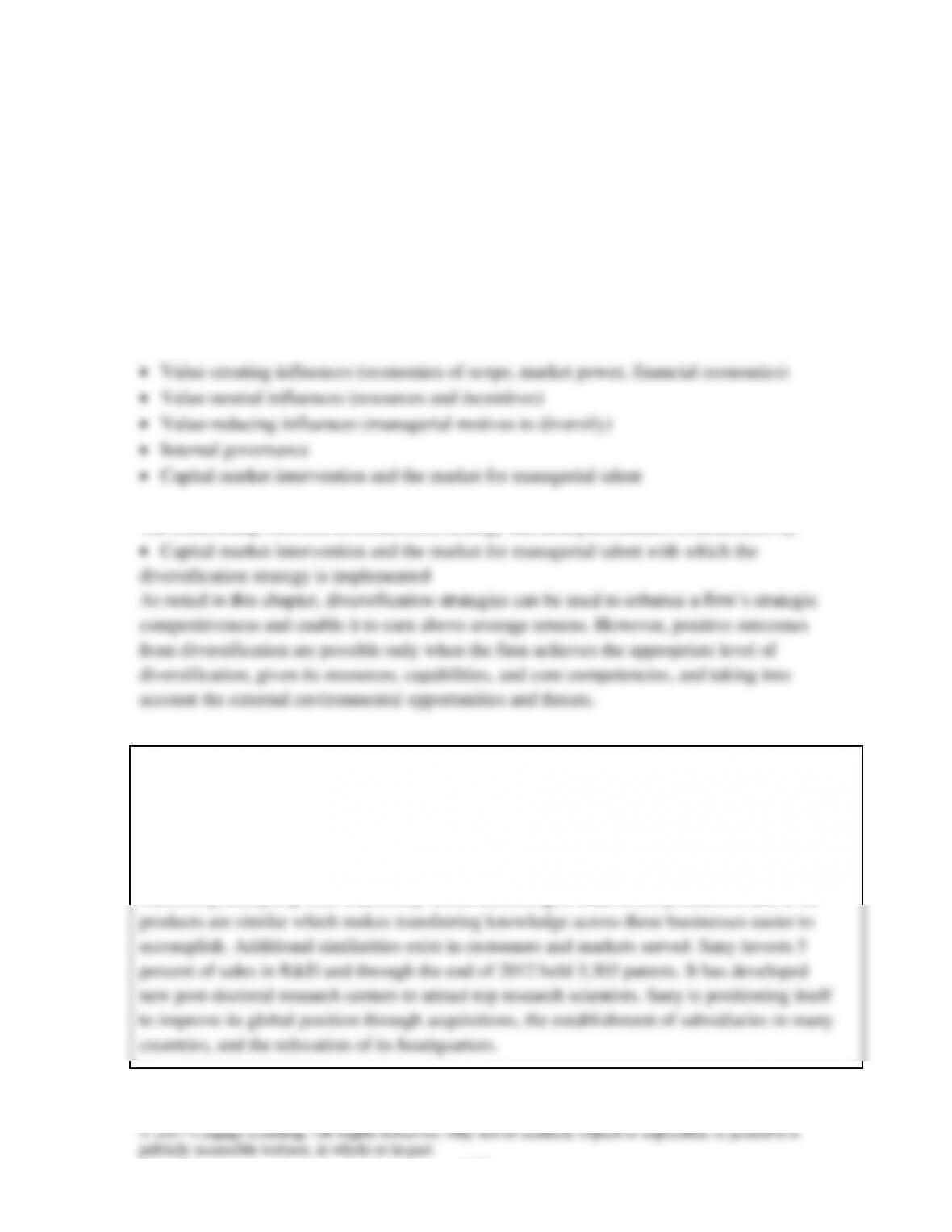
It is useful to note that two factors appearing in Figure 6.4 are discussed in greater
detail in future chapters. Governance structures in Chapter 10 and strategy
implementation is covered in Chapter 11. The overall relationship between reasons
for diversification, governance, and firm performance is provided in Figure 6.4.
FIGURE 6.4
Summary Model of the Relationship Between Diversification and Firm Performance
As shown in Figure 6.4, a firm’s diversification strategy is determined by several inter–
related factors,
The relationship between diversification strategy and firm performance is moderated by:
Mini-Case
Sany’s Highly Related Core Businesses
Sany Heavy Industry Company, Ltd. Is China’s largest producer of heavy equipment (and 5th
largest globally). Sany’s businesses consist of cranes, road construction machinery, port
machinery, and pump over machinery. Some technologies used in the production and in its
Chapter 6: Corporate-Level Strategy
6-25
ANSWERS TO MINI CASE DISSCUSSION QUESTIONS
1. What is corporate-level strategy and why is it important?
2. What are the different levels of diversification firms can pursue by using different
corporate-level strategies?
Chapter 6: Corporate-Level Strategy
6-26
Chapter 6: Corporate-Level Strategy
6-27
Chapter 6: Corporate-Level Strategy
6-28

Chapter 6: Corporate-Level Strategy
6-29
Ethics Questions
1. Propose the following statement: “Those managing an unrelated diversified firm face far
more difficult ethical challenges than do those managing a dominant-business firm.”
Based on their reading of this chapter, do the students this statement true or false? Why?
2. Is it ethical for managers to diversify a firm rather than return excess earnings to
shareholders? Have students provide their reasoning in support of their answers.
3. What unethical practices might occur when a firm restructures? Ask students if they
believe that ethical managers are unaffected by the managerial motives to diversify
discussed in this chapter. If so, why? In addition, do they believe that ethical managers
should help their peers learn how to avoid making diversification decisions on the basis
of the managerial motives to diversify? Why or why not?
INSTRUCTOR’S NOTES FOR MINDTAP
Cengage offers additional online activities, assessments and resources inside MindTap,
our online learning platform. The following activities can be assigned within MindTap
for students to complete.
INSTRUCTOR’S NOTES FOR EXPERIENTIAL EXERCISES
Revolution or Evolution: Strategizing To Gain Competitive Advantage
The introduction to this chapter defines corporate-level strategy as “actions a firm takes
to gain a competitive advantage by selecting and managing a group of different
businesses competing in different product markets.” In this group exercise, students will
analyze the corporate-level strategy for a publically traded firm and how those strategies
increase the company’s value.
Chapter 6: Corporate-Level Strategy
6-30
Students will form a research consultancy, providing large firms with background on
corporate-level strategies and your recommendations for strategy for their firms. In this
group project, you will have the opportunity to practice valuable strategic management
skills, including research management, strategic thinking and teambuilding.
INSTRUCTOR’S NOTES FOR BRANCHING EXERCISE
Branching Exercises are real-world activities that allow each student to work through
challenges by choosing from different decision-making options. These exercises provide
students with the opportunity to practice strategic management in a business scenario
utilizing company case studies. Students are placed in the role of a decision maker and
asked to consider the needs and priorities of stakeholders as they determine strategy
recommendations for a company.
Lockheed Martin
Lockheed Martin is a global aerospace, defense, security and advanced
technologies company. The U.S.-based company is a top U.S. government contractor and
employees 16,000 people across the globe.
Students will review these concepts:
• Related and Unrelated Diversification in value creation
• Different levels of Innovation
Chapter 6: Corporate-Level Strategy
6-31

Chapter 6: Corporate-Level Strategy
6-32
2. How does Starbucks’ current market power increase its chances for success in
expanding its product offerings to include bakery items?
3. Starbucks’ previous attempts to include food in its product offerings have met
with mediocre results. Currently, only one-third of customers buy food products
at Starbucks. How does using vertical integration increase Starbucks’ financial
risk by buying and operating its own bakery supplier?