
Chapter 6: Corporate-Level Strategy
6-1
Chapter 6
Corporate-Level Strategy
LEARNING OBJECTIVES
1. Define corporate-level strategy and discuss its purpose.
2. Describe different levels of diversification achieved using different corporate-level
strategies.
3. Explain three primary reasons firms diversify.
4. Describe how firms can create value by using a related diversification strategy.
5. Explain the two ways value can be created with an unrelated diversification strategy.
6. Discuss the incentives and resources that encourage diversification.
7. Describe motives that can encourage managers to over diversify a firm.
CHAPTER OUTLINE
Opening Case: Disney Adds Value Using a Related Diversification Strategy LEVELS
OF DIVERSIFICATION
Low Levels of Diversification
Moderate and High Levels of Diversification
Reasons for Diversification
VALUE-CREATING DIVERSIFICATION: RELATED CONSTRAINED AND
RELATED LINKED DIVERSIFICATION
Operational Relatedness: Sharing Activities
Corporate Relatedness: Transferring of Core Competencies
Market Power
UNRELATED DIVERSIFICATION
Efficient Internal Capital Market Allocation
Restructuring of Assets
Strategic Focus: GE and United Technology are Firms that Have Pursued Internal
Capital Allocation and Restructuring Strategies
Strategic Focus: Ericsson’s Substantial Market Power
VALUE-NEUTRAL DIVERSIFICATION: INCENTIVES AND RESOURCES
Incentives to Diversify
Resources and Diversification
Strategic Focus: Coca Cola’s Diversification to Deal with Its Reduced Growth in Soft
Drinks

Chapter 6: Corporate-Level Strategy
6-2

Chapter 6: Corporate-Level Strategy
6-3
LECTURE NOTES
Chapter Introduction: Chapters 4 and 5 looked at strategy at the level of the business
and focused on the factors and approaches that can lead to competitive advantage and
superior performance. Chapter 6 takes this a step further by standing back to consider
material of the chapter.
OPENING CASE
Disney Adds Value Using a Related Diversification Strategy
The Walt Disney Company has pursued a related diversification strategy by using its
movies to create franchises and platforms around its popular cartoon and action movie
figures. While competitive content providers have weakened to lower TV ratings, Disney
was strengthened through its other businesses including consumer products, interactive
product businesses.
Teaching Note
While many content creating competitors are facing revenue losses due to lower
TV ratings, The Walt Disney Company is growing through a related
diversification strategy by using its movies to create franchises and platforms
around its popular cartoon and action movie figures. Ask students to evaluate
these related franchises and platforms to support its movie content. Why is this
strategy successful in creating value?
1
Define corporate-level strategy and discuss its purpose.
Chapter 6: Corporate-Level Strategy
6-4
industry or product market – and the actions and responses that affect the competitive
dynamics of a single industry or product market.
In contrast, when a firm diversifies its operations by operating business in several industries,
corporate-level strategy becomes a primary focus. This means that a diversified firm has two
The ultimate measure of the value of a firm’s corporate-level strategy is that the businesses in
the firm’s portfolio are worth more under current management (and by following the firm’s
corporate-level strategy) than they would be under different ownership or management.
Teaching Note
Indicate to students that the unique organizational structure that is required by this
strategy is discussed in Chapter 11.
LEVELS OF DIVERSIFICATION
Diversified firms vary according to two factors:
• The level of diversification
• Connection or linkages between and among business units
FIGURE 6.1
Levels and Types of Diversification
Chapter 6: Corporate-Level Strategy
6-5
Figure 6.1 should be used as a reference point during your discussion of diversification
types. Students’ attention should be directed to inter-unit linkages depicted on the right side
of Figure 6.1.
Levels and types of diversification defined in Figure 6.1 and discussed in more detail in the
next sections of this chapter are:
2
Describe different levels of diversification achieved using
different corporate-level strategies.
LOW LEVELS OF DIVERSIFICATION
Firms that follow single- or dominant-business strategies have low levels of diversification.
A single business is a firm where more than 95 percent of its revenues are generated by the
dominant business. Firms such as the Wrigley Co. are examples of single-business firms.
Wrigley Co. has dominated the global gum-related industry as the largest manufacturer of
chewing gum, specialty gums, and gum bases. Its brands, Doublemint, Spearmint, and Juicy
Fruit, led the market.
Chapter 6: Corporate-Level Strategy
6-6
A dominant business is a firm that generates between 70 and 95 percent of its sales within a
single business area.
Teaching Note
Moderate and High Levels of Diversification
A related-diversified firm is one that earns at least 30 percent of its revenues from sources
outside the dominant business and whose units are related to each other – e.g., by the sharing
of resources and by product, technological, and distribution linkages.
Unrelated-diversified (or highly diversified) firms do not share resources or linkages, as
illustrated in Figure 6.1. Firms that pursue unrelated diversification strategies – often known
as conglomerates – include United Technologies, Samsung, and Textron.
Though there are more unrelated diversified firms in the US than in most other countries,
conglomerates (firms following unrelated diversification strategies) dominate the private

Chapter 6: Corporate-Level Strategy
6-7
3
Explain three primary reasons firms diversify.
REASONS FOR DIVERSIFICATION
Teaching Note
Firms may implement diversification strategies to enhance or increase the strategic
competitiveness of the overall organization, and thus the value of the firm increases.
Value can be created through either related or unrelated diversification if the strategies
enable the firm’s mix of businesses to increase revenues and/or decrease costs when
implementing business-level strategies.
Table Note
Reasons or motives for implementing diversification strategies are presented in Table
6.1. They are discussed in the following chapter sections.
TABLE 6.1
Reasons for Diversification
Firms follow diversification strategies for many reasons. These can be grouped into three
broad sets of motives:
Chapter 6: Corporate-Level Strategy
6-8
Motives to create value:
Motives that are value-neutral with respect to strategic competitiveness are used to:
• avoid violations of antitrust regulations
• take advantage of tax incentives
Figure Note
As illustrated in Figure 6.2, firms seek to create value by sharing activities and
transferring skills or corporate core competencies. This figure can help students
organize their thoughts about the options firms have to exploit various forms of
relatedness.
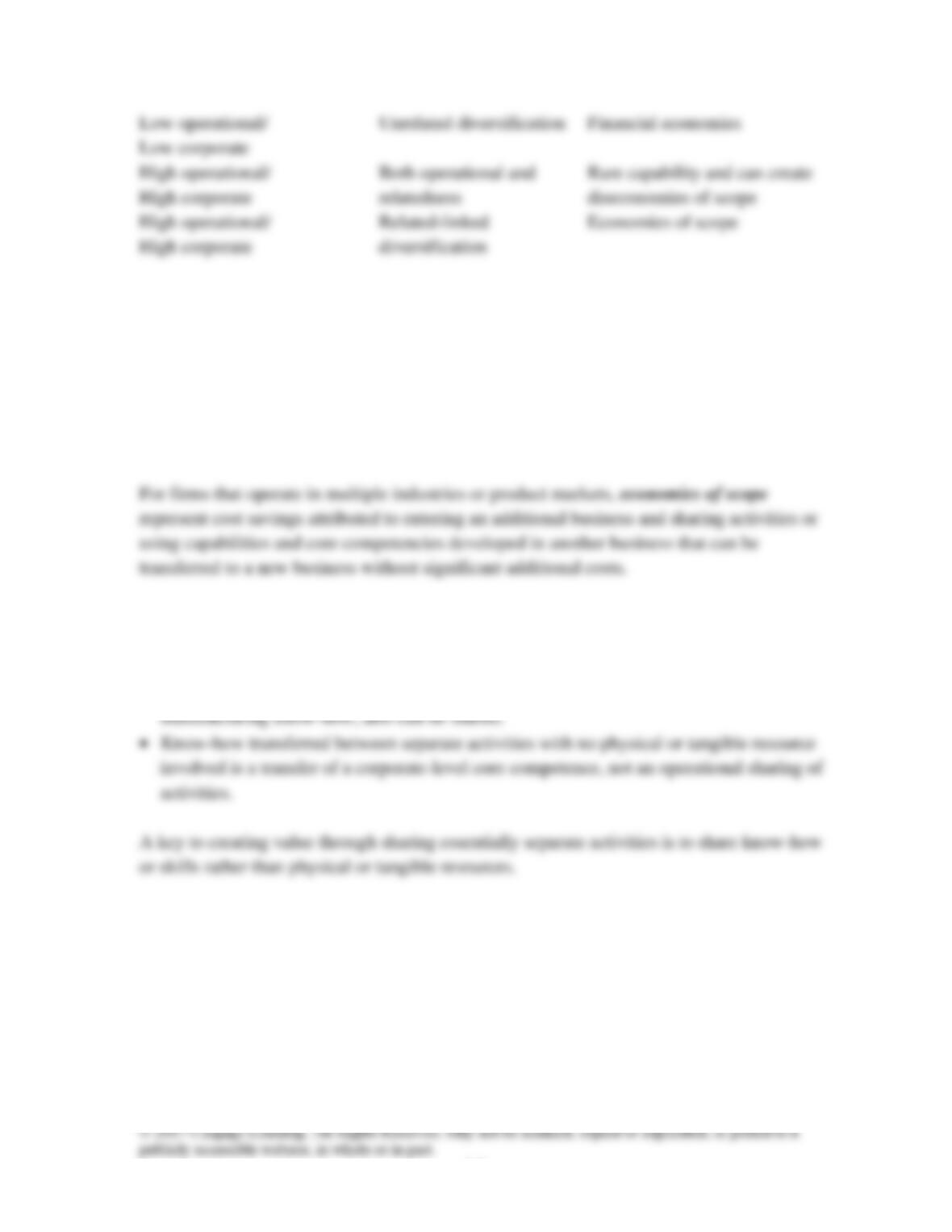
FIGURE 6.2
Value-Creating Strategies of Diversification: Operational and Corporate Relatedness
Combinations of Economies
Resulting Strategy
Economies for Advantage
High operational/
Low corporate
Vertical integration
Market power
Chapter 6: Corporate-Level Strategy
6-9
Chapter 6: Corporate-Level Strategy
6-10
Chapter 6: Corporate-Level Strategy
6-11
There are at least two ways the related linked diversification strategy helps firms create
value:
Teaching Note
As an example, Philip Morris acquired Miller Brewing at a time when competition in
the brewing industry was focused on establishing efficient operations.
• Philip Morris used marketing competencies coming from the competitive cigarette
Other firms have focused on transferring a variety or resources/capabilities across businesses
in their control.
• Virgin has transferred its marketing skills across travel, cosmetics, music, drinks, and
other retail businesses.
One way that firms can facilitate the transfer of competencies between or among business
units is to move key personnel into new management positions in the receiving unit.
However, research suggests that transferring expertise often does not lead to performance
improvement.
Teaching Note
It is good to help students understand the human dimensions of strategic decisions –
Chapter 6: Corporate-Level Strategy
6-12
Market Power
Firms also may implement related diversification strategies in an attempt to gain market
power.
Firms also might gain market power by following a vertical integration strategy, which exists
when a company produces its own inputs (backward integration) or owns its own distribution
system (forward integration). A vertical integration strategy may be motivated by a firm’s
desire to strengthen its position in its core business relative to competitors by increasing its
market power.
Note
Establishing a market price would result in high search and transaction costs, so firms seek
to vertically integrate rather than remain separate businesses.
Teaching Note
As an example of vertical integration, CVS, a Walgreen’s competitor, recently
merged with Caremark, a pharmaceutical benefits manager. This represents a vertical
move for CVS from a retail-only firm to broader-based health care. However, CVS
Chapter 6: Corporate-Level Strategy
6-13
risks alienating Walgreen’s, which may then choose to align with another benefits
manager.
However, like other strategies that create value and aid the firm in achieving strategic
order to achieve scale economies.
Many manufacturing firms no longer pursue vertical integration. In fact, deintegration is the
focus of most manufacturing firms, such as Intel and Dell, and even among large automobile
companies, such as Ford and General Motors, as they develop independent supplier
networks. Solectron Corp., a contract manufacturer, represents a new breed of large contract
Ericsson’s Substantial Market Power
Ericsson is the largest global manufacturer of mobile telecommunications networks
equipment (with 38 percent global market share in 2012). It has a presence in 108 countries
and their business unit support system provides charging and billing service for 1.6 billion

Chapter 6: Corporate-Level Strategy
6-14
communications will be needed in the near future and it is positioning itself to be a leader in
all of these areas.
Simultaneous Operational and Corporate Relatedness
As Figure 6.2 suggests, some firms simultaneously seek operational and corporate
relatedness to create economies of scope. Because simultaneously managing two sources of
knowledge is very difficult, such efforts often fail, creating diseconomies of scope.
A Bit of Disney History: A Mini-Case
By using operational relatedness and corporate relatedness, Disney made $3 billion
on the 150 products that were marketed with its movie, The Lion King. Sony’s Men in
Disney’s assets as well as other media firms such as AOL Time Warner have been
discounted somewhat because “the biggest lingering questions is whether multiple
revenue streams will outpace multiple-platform overhead.”
5
Explain the two ways value can be created with an unrelated
diversification strategy.
UNRELATED DIVERSIFICATION
Firms implementing unrelated diversification strategies hope to create value by realizing
financial economies, which are cost savings realized through improved allocations of
financial resources based on investments inside or outside the firm.
Chapter 6: Corporate-Level Strategy
6-15
Financial economies are realized through internal capital allocations (that are more efficient
than market-based allocations) and by purchasing other companies and then restructuring
their assets.
Efficient Internal Capital Market Allocation
Although capital generally is efficiently distributed in a market economy through the capital
markets, large diversified firms may be able to distribute capital more efficiently to divisions
and thus create value for the overall organization. This generally is possible because:
One implication of increased access to information is that the internal capital market may be
able to allocate resources between investment opportunities more accurately (and at more
adequate levels) than the external capital market. There are several reasons for this:
• Information disclosed to capital markets through annual reports may not fully disclose
negative information, reporting only positive prospects while meeting all regulatory
disclosure requirements.
Other advantages of internal capital markets:
Research suggests that in efficient capital markets, the unrelated diversification strategy may
be discounted. Stock markets have applied what some have called a “conglomerate discount”

Chapter 6: Corporate-Level Strategy
6-16
reflected in the valuation of diversified manufacturing conglomerates at 20 percent less, on
average, than the value of the sum of their parts.
STRATEGIC FOCUS
GE and United Technology are Firms that Have Pursued Internal Capital Allocation
and Restructuring Strategies
General Electric is a diversified company with a storied past. While GE’s businesses
compete in a number of different industries, because of similarities among some of them,
they are currently grouped into four divisions: GE Capital, GE Energy, GE Technology
Infrastructure, and GE Home and Business Solutions. In recent years, however, more
than 50 percent of GE’s annual revenue came from the GE Capital division. Though it
has enjoyed success throughout its history, recent performance has been unimpressive.
Both GE and United Technology has used internal capital allocate resources among its
diversified business units efficiently. Also, both business have used the restructuring
strategy to make their business more efficient and when appropriate sold them on the