
Chapter 5: Competitive Rivalry and Competitive Dynamics
5-1
Chapter 5
Competitive Rivalry and Competitive Dynamics
LEARNING OBJECTIVES
1. Define competitors, competitive rivalry, competitive behavior, and competitive
dynamics.
2. Describe market commonality and resource similarity as the building blocks of a
competitor analysis.
3. Explain awareness, motivation, and ability as drivers of competitive behaviors.
4. Discuss factors affecting the likelihood a competitor will take competitive actions.
5. Describe factors affecting the likelihood a competitor will respond to actions
taken by its competitors.
6. Explain competitive dynamics in slow-cycle, in fast-cycle, and in standard-cycle
markets.
CHAPTER OUTLINE
Opening Case: Does Google have competition? Dynamics of the High Technology
Markets
A MODEL OF COMPETITIVE RIVALRY
COMPETITOR ANALYSIS
Market Commonality
Resource Similarity
Strategic Focus: Does Kellogg have the Tiger by the Tail or is it the reverse?
DRIVERS OF COMPETITIVE BEHAVIOR
COMPETITIVE RIVALRY
Strategic and Tactical Actions
LIKELIHOOD OF ATTACK
First-Mover Benefits
Organizational Size
Quality
LIKELIHOOD OF RESPONSE
Type of Competitive Action
Actor’s Reputation
Market Dependence
COMPETITIVE DYNAMICS
Slow-Cycle Markets
Fast-Cycle Markets

Chapter 5: Competitive Rivalry and Competitive Dynamics
5-2
Strategic Focus: The Ripple Effect of Supermarket Wars: Aldi is Changing the Markets
in Many Countries
Standard-Cycle Markets
SUMMARY
REVIEW QUESTIONS
MINI-CASE
ADDITIONAL QUESTIONS AND EXERCISES
MINDTAP RESOURCES
LECTURE NOTES
Chapter Introduction: The competitive landscape is characterized by increasing
globalization, advanced technological development, and other factors that will lead to an
environment that is more dynamic and charged with rivalry. Firms will act and react in a
dance of sorts, but one involving very high stakes—even survival. This chapter
introduces terms and concepts relevant to the conversation about competitive behavior in
a variety of markets. Figure 5.2 is central to the discussion of most of the chapter.
OPENING CASE
Does Google have competition? Dynamics of the High Technology markets
Chapter 5: Competitive Rivalry and Competitive Dynamics
5-3
Teaching Note
1
Define competitors, competitive rivalry, competitive
behavior, and competitive dynamics.
DEFINING COMPETITION
A strategy’s success is determined not only by the firm’s initial competitive actions, but also
by how well it anticipates competitors’ responses to them and by how well the firm responds
to its competitor’s initial actions (also called attacks).
Some important definitions:
Teaching Note
Firms must learn to compete differently if they are to achieve strategic
competitiveness. To provide an idea of what this means, new ways of competing may
include the following:
Chapter 5: Competitive Rivalry and Competitive Dynamics
5-4
Chapter 5: Competitive Rivalry and Competitive Dynamics
5-5
Expanding geographic scope contributes to the increasing intensity in competitive rivalry
among firms. That is, firms trying to predict competitive rivalry should anticipate that they
will meet a larger number of increasingly diverse competitors in the future; thus, competitive
rivalry will affect their strategies more than in the past.
A MODEL OF COMPETITIVE RIVALRY
Competitive rivalry exists when firms jockey with one another to pursue an advantageous
market position. When one or more firms competing in an industry feels pressure to act or
FIGURE 5.2
A Model of Competitive Rivalry
Viewing the model leads to a number of observations:
• Interfirm rivalry or competitive dynamics begins with competitive analysis in terms of
Teaching Note
Competitive rivalry exists because of competitive asymmetry, which describes the fact
Chapter 5: Competitive Rivalry and Competitive Dynamics
5-6
interdependence among firms in the industry as each firm tries to establish a
2
Describe market commonality and resource similarity as
the building blocks of a competitor analysis.
COMPETITOR ANALYSIS
Market Commonality
Market commonality is the extent to which firms compete in the same markets. And market
commonality is increasing as more and more firms compete internationally.
Teaching Note
If firms overlap in a number of markets—sometimes referred to as multipoint
Chapter 5: Competitive Rivalry and Competitive Dynamics
5-7
Resource Similarity
Resource similarity is the extent to which a firm’s tangible and intangible resources are
comparable to a competitor’s in terms of both type and amount. Firms with similar types and
amounts of resources are likely to have similar strengths and weaknesses and to use similar
strategies.
Teaching Note
In contrast to market commonality, assessing resource similarity can be difficult,
particularly when critical resources are intangible (e.g., brand name, knowledge, trust,
capacity to innovate) rather than tangible (e.g., access to raw materials, ability to
borrow capital).
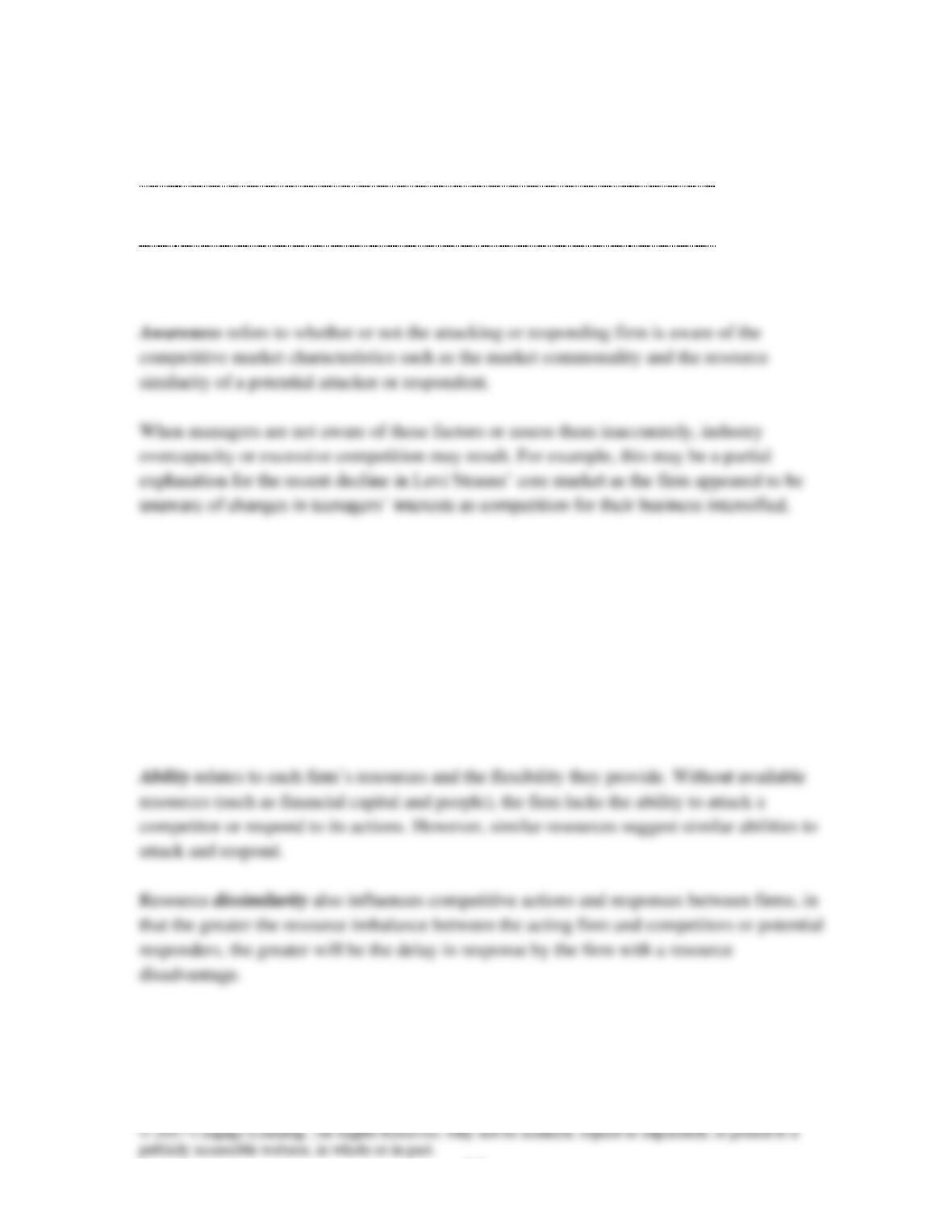
FIGURE 5.3
A Framework of Competitor Analysis
Chapter 5: Competitive Rivalry and Competitive Dynamics
5-8
and as companies’ resources change in type and amount. Thus, those with whom the firm is a
direct competitor change across time.
3
Explain awareness, motivation, and ability as drivers of
competitive behavior.
DRIVERS OF COMPETITIVE ACTIONS AND RESPONSES
Market commonality affects the firm’s perceptions and resulting motivation. For example, all
else being equal, the firm is more likely to attack the rival with whom it has low market
commonality than the one with whom it competes in multiple markets. The primary reason is
that there are high stakes involved in trying to gain a more advantageous position over a rival
with whom the firm shares many markets.
Motivation is represented by the incentives that a firm has to either initiate an attack or to
respond when attacked.
COMPETITIVE RIVALRY
Competitive rivalry is the ongoing set of competitive actions and responses occurring
between competing firms for an advantageous market position. Because the ongoing
Chapter 5: Competitive Rivalry and Competitive Dynamics
5-9
competitive action/response sequence between a firm and a competitor affects the
performance of both firms, it is important for companies to carefully study competitive
rivalry to successfully use their strategies.
Strategic and Tactical Actions
Firms use both strategic and tactical actions when forming their competitive actions and
competitive responses in the course of engaging in competitive rivalry.
• A competitive action is a strategic or tactical action the firm takes to build or defend its
competitive advantages or improve its market position.
4
Discuss factors affecting the likelihood a competitor
will take competitive actions.
LIKELIHOOD OF ATTACK
First-Mover Benefits
Chapter 5: Competitive Rivalry and Competitive Dynamics
5-10
By being early, the first mover hopes to:
Teaching Note
Consider the success of Harley-Davidson in large motorcycles (cruisers). In the
1980s, Harley-Davidson set the standard for low, heavyweight motorcycles and has
successfully defended its position by emphasizing its reputation and brand name.
Organizational slack is what makes it possible for firms to have the ability (as measured by
available resources) to be first movers. Slack is the buffer or cushion provided by actual or
obtainable resources that aren’t currently in use? Thus, slack is a liquid resource that the firm
can quickly allocate to support the actions (e.g., R&D investments and aggressive marketing
campaigns) that lead to first mover benefits.
There also are dangers or disadvantages to being a first mover.
• It is difficult to accurately estimate the returns that will be earned from introducing
product innovations.
Chapter 5: Competitive Rivalry and Competitive Dynamics
5-11
• Rapidly and meaningfully interpret market feedback to respond quickly yet
successfully to the first mover’s successful innovations
Teaching Note
An example of industry dynamics—and how a second mover can succeed—is
provided by looking at the competitive dynamics of the athletic shoe industry.
• New Balance is a second mover in the athletic shoe industry.
• It effectively competes against industry leaders Nike and Reebok by focusing on
Late movers are firms that respond to competitive actions, but only after considerable time
has elapsed after the first mover’s action, and the second mover’s response.
Typically, a late response is better than no response at all, although any success achieved
from the late competitive response tends to be slow in coming and considerably less than that
achieved by first and second movers.
Organizational Size
Chapter 5: Competitive Rivalry and Competitive Dynamics
5-12
Large firms are likely to initiate more competitive actions as well as strategic actions during
a given time period. Thus, the competitive actions a firm will likely encounter from larger
competitors will be different than the competitive actions it will encounter from smaller
competitors.
Quality
Product quality shapes the competitive dynamics in many industries. In fact, product quality
is no longer a competitive issue but a necessary or mandatory product attribute if firms
expect to successfully implement any of the generic business strategies discussed in Chapter
3—low cost, differentiation, focus, or integrated cost leadership/differentiation. Quality
involves meeting or exceeding customer expectations in the products and/or services offered.
• The firm can predict that the competitor is unlikely to be aggressive in terms of taking
competitive actions, given that its quality problems must be corrected in order to gain
credibility with customers.
Chapter 5: Competitive Rivalry and Competitive Dynamics
5-13
TABLE 5.1
Quality Dimensions of Goods and Services
5
Describe factors affecting the likelihood a competitor
will respond to actions taken by its competitors.
LIKELIHOOD OF RESPONSE
Once a competitive action has been taken, its success generally is determined by the
likelihood and nature of the competitive response.
In general, a firm is likely to respond to a competitor’s action when:
1. The action leads to better use of the competitor’s capabilities to gain or produce stronger
competitive advantages or an improvement in its market position,
2. The action damages the firm’s ability to use its capabilities to create or maintain an
advantage, or
3. The firm’s market position becomes less defensible.
To predict how a competitor is likely to respond to competitive actions, firms should
consider (see Figure 5.2):
Chapter 5: Competitive Rivalry and Competitive Dynamics
5-14
Type of Competitive Action
Teaching Note
Remember, competitive actions are significant competitive moves taken by a firm
Because tactical actions require fewer organizational resources and are relatively easy to
implement and reverse, their effects on the competitive situation are more immediately felt.
Some examples of strategic actions include:
• Walmart’s entry into the European market
• Continental’s decision to initiate flights into Lima, Peru
• Bank One’s implementation of an Internet banking company
Teaching Note