Chapter 2: The External Environment
2-1
Chapter 2
1. Explain the importance of analyzing and understanding the firm’s external environment.
2. Define and describe the general environment and the industry environment.
3. Discuss the four parts of the external environmental analysis process.
4. Name and describe the general environment’s seven segments.
5. Identify the five competitive forces and explain how they determine an industry’s profit
potential.
6. Define strategic groups and describe their influence on firms.
7. Describe what firms need to know about their competitors and different methods (including
ethical standards) used to collect intelligence about them.
CHAPTER OUTLINE
Opening Case: Are There Cracks in the Golden Arches?

Chapter 2: The External Environment
2-2
Threat of Substitute Products
Intensity of Rivalry among Competitors
Chapter 2: The External Environment
2-3
LECTURE NOTES
Chapter Introduction: This chapter can be introduced with a general statement regarding
the importance of understanding what is happening outside of the firm itself and how
what is happening can affect the firm’s ability to achieve strategic competitiveness and
earn above-average returns. This importance is illustrated by the Opening Case, which
discusses the impact events in the external environment can have on a firm’s
performance.
OPENING CASE
Are There Cracks in the Golden Arches?
The opening case illustrates how McDonald’s can use information from the general
environment to develop plans for the future and how sociocultural factors affect their
decision making. Over the years, McDonald’s was a leader not only in market share but also
with the introduction of new menu items to the fast food market. Recently, McDonald’s
problems have revolved around increased competition and changing consumer tastes.
1
Explain the importance of analyzing and understanding the
firm’s external environment.
Teaching Note
Given that the external environment will continue to change – and that change may be
unpredictable in terms of timing and strength – a firm’s management is challenged to
be aware of, understand the implications of, and identify patterns represented in these
changes by taking actions to improve the firm’s competitive position, to improve
operational efficiency, and to be effective global competitors.
Chapter 2: The External Environment
2-4
External environmental factors – like war and political unrest, variations in the strength of
national economies, and new technologies – affect firm growth and profitability in the US
and beyond.
buffer the firm from negative environmental impacts, and (3) pursue opportunities to better
serve stakeholders’ needs.
2
Define and describe the general environment and
the industry environment.
Teaching Note
The firm’s understanding of the external environment is matched with knowledge
about its internal environment (discussed in Chapter 3) to form its vision, to develop
its mission, and to take strategic actions that result in strategic competitiveness and
above-average returns. This is an important point to make.
Chapter 2: The External Environment
2-5
1. The general environment
• Demographic
• Political/Legal
• Sociocultural
• Economic
• Technological
• Global
• Physical
2. The industry environment
• Threat of New Entrants
• Power of Buyers
• Power of Suppliers
• Intensity of Rivalry
• Product Substitutes
3. The competitor environment
(Note: These components of the external environment and their elements or factors and how
TABLE 2.1
The General Environment: Segments and Elements
Table 2.1 lists elements that characterize each of the seven segments of the general
Chapter 2: The External Environment
The industry environment is the set of factors – threat of new entrants, suppliers, buyers,
product substitutes, and the intensity of rivalry among competitors – that directly influence a
firm and its competitive decisions and responses.
general environment, the industry environment, and the competitor environment.
Teaching Note
It should be noted that, although firms cannot directly control the elements of the
external environment, they may be able to influence, and will be influenced by, these
factors.
Chapter 2: The External Environment
2-7
EXTERNAL ENVIRONMENTAL ANALYSIS
In addition to increasing a firm’s awareness and understanding of an increasingly turbulent,
complex, and global general environment, external environmental analysis also is necessary
to enable the firm’s managers to interpret information to identify opportunities and threats.
Teaching Note
According to a recent comment by an industry analyst from a national firm, the
Internet is becoming an increasingly valuable source of data and information for
analyzing the general environment. Showing students how to do this in class or via an
assignment can be a very helpful exercise.
Table 2.2 identifies the four parts of the external environmental analysis: scanning,
monitoring, forecasting, and assessing.
Chapter 2: The External Environment
2-8
most important in highly volatile environments, and the scanning system should fit the
organizational context (e.g., scanning systems designed for volatile environments are not
suitable for firms competing in a stable environment).
Teaching Note
Scanning may signal a future change in the needs and lifestyles of baby boomers as
they approach retirement age. This may not only provide opportunities for financial
Monitoring
Monitoring represents a process whereby analysts observe environmental changes over time
Chapter 2: The External Environment
2-9
Assessing
Assessing represents the step in the external analysis process where all of the other steps
come together. The objective of assessing is to determine the timing and significance of the
inputs so a single source is not able to manipulate the information and to seek
frequent feedback regarding the accuracy or usefulness of forecasts and assessments.
4
Name and describe the general environment’s seven segments.
SEGMENTS OF THE GENERAL ENVIRONMENT
As outlined in Table 2.1, the general environment consists of seven segments: demographic,
economic, political/legal, sociocultural, global, technological, and the physical environment.
The Demographic Segment
The demographic segment is concerned with a population’s size, age structure, geographic
distribution, ethnic mix, and distribution of income.
Chapter 2: The External Environment
2-10
Teaching Note
Though each of the elements of this segment are discussed below, you might note that
the challenge for analysts (and managers) is to determine what the changes that have
been identified in the demographic characteristics or elements of a population imply
for the future strategic competitiveness of the firm.
Population Size
Age Structure
Changes in a nation’s birth rate or life expectancy can have important implications for firms.
Are people living longer? What is the life expectancy of infants? These will impact the health
care system (and firms serving that segment) and the development of products and services
targeted to an older (or younger) population.
Geographic Distribution
Ethnic Mix
This reflects the changes in the ethnic make-up of a population and has implications both for
a firm’s potential customers and for the workforce. Issues that should be addressed include:
• Will new products and services be demanded or can existing ones be modified?
• How will changes in the ethnicity of a population affect the composition of the workforce?
• Are managers prepared to manage a more culturally diverse workforce?
Chapter 2: The External Environment
2-11
• How can the firm position itself to take advantage of increased workforce heterogeneity?
Income Distribution
Changes in income distribution are important because changes in the levels of individual and
group purchasing power and discretionary income often result in changes in spending
(consumption) and savings patterns. Tracking, forecasting, and assessing changes in income
patterns may identify new opportunities for firms.
The Economic Segment
In addition, the implications of changes and trends in the economic segment may affect the
political/legal segment both domestically and in other global markets. This may be of critical
importance as nations eliminate or reduce trade barriers and integrate their economies.
The Political/Legal Segment
Chapter 2: The External Environment
2-12
Because of the influence that this segment can have on the nature of competition as well as
on the overall profitability of industries and individual firms, analysts must assess changes
and trends in administration philosophies regarding:
• Anti-trust regulations and enforcement
• Tax laws
• Industry deregulation
• Labor training laws
• Commitments to education
• Free trade versus protectionism
Teaching Note
The Sociocultural Segment
The sociocultural segment is concerned with different societies’ social attitudes and cultural
values. This segment is important because the attitudes and values of society influence and
thus are reflected in changes in a society’s economic, demographic, political/legal, and
technological segments.
Chapter 2: The External Environment
2-13
The Technological Segment
As noted in many of the other segments of the general environment, and as discussed in
Chapter 1 as a key driver of the new competitive landscape, technological changes can have
The Global Segment
Among the global factors that should be assessed are:
• The potential impact of significant international events such as peace in the Middle East or
the recent entry of China into the WTO
• The identification of both important emerging global markets and global markets that are
changing
Teaching Note
Globalfocusing is a cautious approach to globalization in which firms with a moderate
level of international operations increase their internationalization by focusing on global
niche markets (and/or limiting operations/sales to one geographical region of the world).
This approach allows firms to build on and use their core competencies while limiting
their risks within the niche market.
Chapter 2: The External Environment
2-14
STRATEGIC FOCUS
Target has lost Its Sway Because Tar-zhey No Longer Drew the Customers
Target became known by consumers as Tar-zhey, the retailer of cheaper but ‘chic’ products. The firm
environment and business practices that are intended to positively respond to and deal with
those changes. Ecological, social, and economic systems interact to influence what happens
in this segment. Global warming, energy consumption, and sustainability are all examples of
issues related to the physical environment.
5
Identify the five competitive forces and explain how they
determine an industry’s profit potential.
Chapter 2: The External Environment
2-15
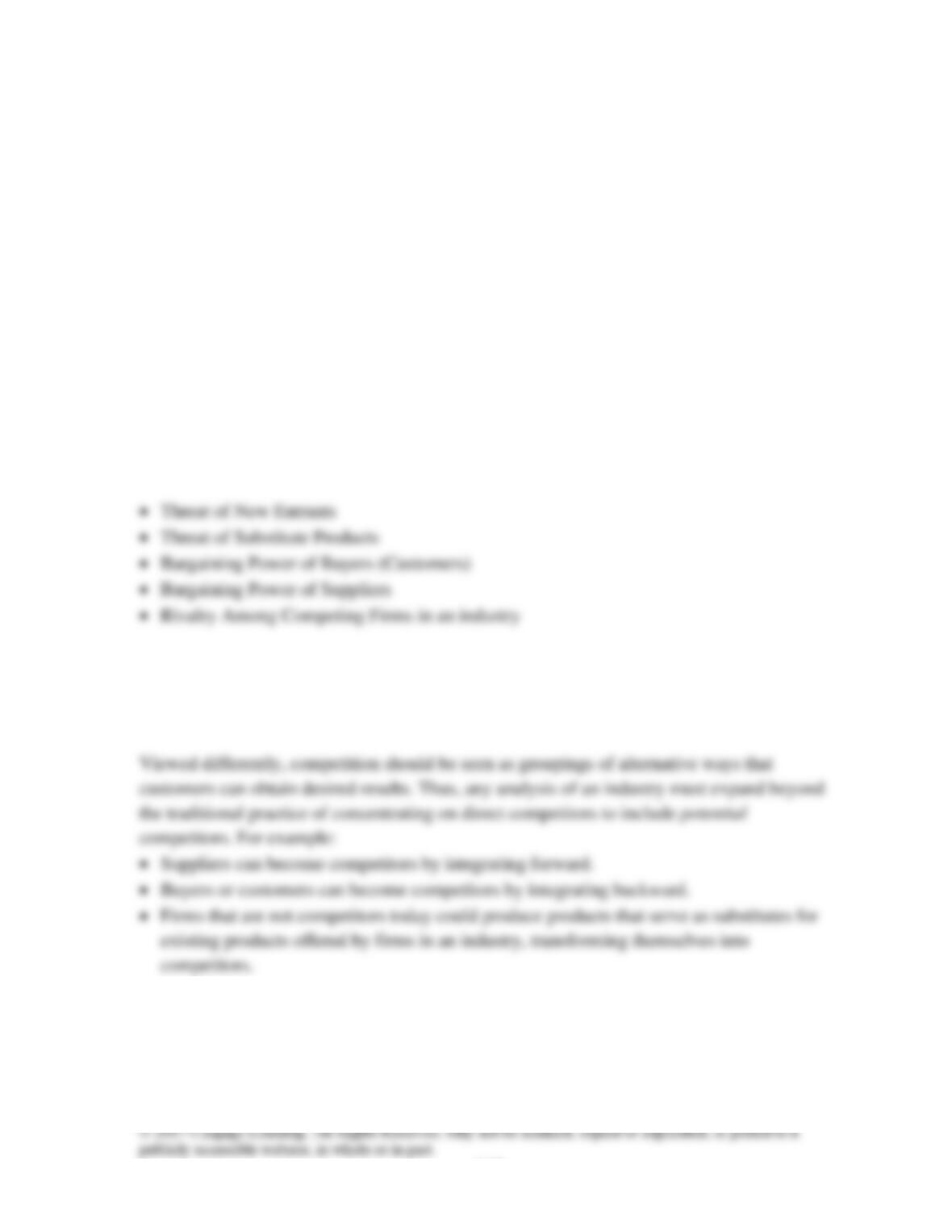
Figure Note: Students should refer to Figure 2.2 as it provides a framework that can be
used to analyze competition in an industry. A broader discussion of the five competitive
forces and other factors follows Figure 2.2.
FIGURE 2.2
The Five Forces Model of Competition
The Five Forces Model of Competition indicates that these forces interact to determine the
intensity or strength of competition, which ultimately determines the profitability of the
industry.
Assessing the relative strength of the five competitive forces is important to a firm’s ability
to achieve strategic competitiveness and earn above-average returns.
Threat of New Entrants
New entrants to an industry are important because with new competitors, the intensity of
competitive rivalry in an industry generally increases. This is because new competitors may
Chapter 2: The External Environment
2-16
bring substantial resources into the industry and may be interested in capturing a significant
market share. If a new competitor brings additional capacity to the industry when product
demand is not increasing, prices that can be charged to consumers generally will fall. One
result may be a decline in sales and lower returns for many firms in the industry.
The seriousness or extent of the threat of new entrants is affected by two factors: barriers to
entry and expected reactions from – or the potential for retaliation by – incumbent firms in the
industry.
Barriers to Entry
Economies of Scale refers to the relationship between quantity produced and unit cost. As
the quantity of a product produced during a given time period increases, the cost of
manufacturing each unit declines.
Chapter 2: The External Environment
2-17
manufacturing technology facilitated by advanced information systems has allowed the
development of “mass customization” in an increasing number of industries, and online
ordering has enhanced the ability of customers to obtain customized products (often referred
to as “markets of one”).
Capital Requirements: Firms choosing to enter any industry must commit resources for
facilities – to purchase inventory, to pay salaries and benefits, etc. Though entry may seem
attractive (because there are no apparent barriers to entry) a potential new entrant may not
have sufficient capital to enter the industry.
This may be particularly true for consumer nondurable goods (because of the limited amount
of shelf space available in retail stores) and in international markets. In the case of some
durable goods or industrial products, to overcome the barrier, new entrants must again incur
costs in excess of those paid by existing firms, either through lower prices or price breaks,
costly promotion campaigns, or advertising allowances. New entrants may have to incur
Chapter 2: The External Environment
2-18
Potential entrants must find ways to overcome these disadvantages to be able to effectively
compete in the industry. This may mean successfully adapting technologies from other
industries and/or non-competing products for use in the target industry, developing new
sources of raw materials, making product (or service) enhancements to overcome location-
related disadvantages, or selling at a lower price to attract customers.
Expected Retaliation
Even if a firm concludes that it can successfully overcome all of the entry barriers, it still
must take into account or anticipate reactions that might be expected from existing firms.
Strong retaliation is likely when existing firms have a heavy investment in fixed assets
(especially when there are few alternative uses for those assets) or when industry growth is
slow or declining. Retaliation could take the form of announcements of anticipated future
investments to increase capacity, new product plans, price-cutting or a study to assess the
impact of lower prices (this might imply price-cutting as a “promised” entry barrier-creation
strategy by existing firms).