Chapter 1: Strategic Management and Strategic Competitiveness
• Tend to be relatively short and concise, easily remembered
• Rely on input from multiple key stakeholders
Examples of vision statements:
• Our vision is to be the world’s best quick service restaurant. (McDonald’s)
purpose and the scope of its operations in product and market terms.
As with the vision, the final responsibility for forming the firm’s mission rests with the CEO,
though the CEO and other top-level managers tend to involve a larger number of people in
forming the mission. This is because middle- and first-level managers and other employees
have more direct contact with customers and their markets.
Chapter 1: Strategic Management and Strategic Competitiveness
STAKEHOLDERS
Stakeholders are the individuals and groups who can affect and are affected by the strategic
outcomes achieved and who have enforceable claims on a firm’s performance.
• Capital market stakeholders
• Product market stakeholders
• Organizational stakeholders
Note: Students can use Figure 1.4 while you discuss the challenges of meeting conflicting
stakeholder expectations.
Chapter 1: Strategic Management and Strategic Competitiveness
1-18
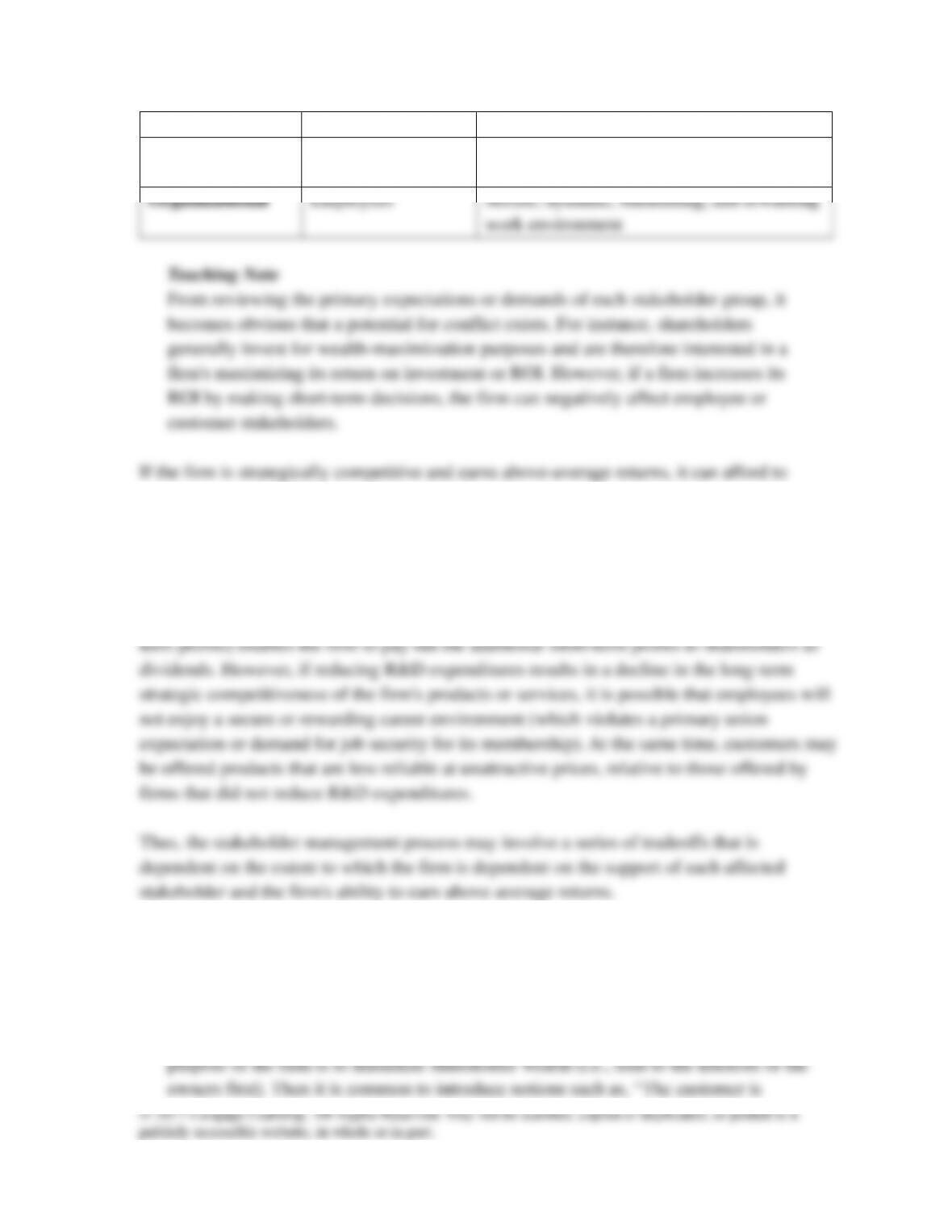
minimum use of public support services
Unions
Ideal working conditions and job security for
membership
Organizational
Employees
Secure, dynamic, stimulating, and rewarding
work environment
simultaneously satisfy all stakeholders. When earning average or below-average returns,
tradeoffs must be made. At the level of average returns, firms must at least minimally satisfy
all stakeholders. When returns are below average, some stakeholders can be minimally
satisfied, while others may be dissatisfied.
For example, reducing the level of research and development expenditures (to increase short-
Teaching Note
Stakeholder management has introduced some interesting notions into business
practice. For example, business schools typically teach that there are three main
stakeholder groups (owners, customers, and employees) and that they should be
tended to in that order. That is, it is important to begin with the idea that the primary

Chapter 1: Strategic Management and Strategic Competitiveness
1-19
always right.” This suggests that customer interests are to be tended to next. Finally,
we get around to looking to the needs of employees, if resources make that possible.
This is the standard approach, but some firms have turned this idea on its head. For
example, Southwest Airlines has been extremely successful by taking great efforts to
select the right employees and treat them well, which then spills over into appropriate
treatment of the customer. As you might guess, the company assumes that these
emphases will naturally lead to positive outcomes for stockholders as well (as has
been the case). This issue can lead to interesting discussions with students about their
thoughts on the topic.
STRATEGIC FOCUS
The Failure of BlackBerry to develop an Ecosystem of Stakeholders
In 2007 the Apple iPhone was introduced as a consumer product which became known as the
smartphone. At the time, the dominant player in this category was Research in Motion (RIM)
and later known as BlackBerry. As late as 2010, BlackBerry held 43 percent of the
commercial and government communications sectors. Consumers soon realized the
smartphone was a superior as far as utility. BlackBerry’s market share began to decrease
precipitously. Because BlackBerry had remarkably loyal customers and a strong product,
it failed to recognize the importance of Apple’s ecosystem innovation which allowed it to
expand and diversify its range of applications for its handheld computers.
7
Describe the work of strategic leaders.
STRATEGIC LEADERS
Teaching Note
One way of covering this section is through a series of questions and answers as
presented in the following format.
Who are strategic leaders?
Chapter 1: Strategic Management and Strategic Competitiveness
1-20
Although it depends on the size of the organization, all organizations have a CEO or top
manager and this individual is the primary organizational strategist in every organization.
`Small organizations may have a single strategist: the CEO or owner. Large organizations
may have few or several top-level managers, executives, or a top management team. All of
these individuals are organizational strategists.
What are the responsibilities of strategic leaders?
Top managers play decisive roles in firms’ efforts to achieve their desired strategic outcomes.
As organizational strategists, top managers are responsible for deciding how resources will
The Work of Effective Strategic Leaders
Though it seems simplistic, performing their role effectively requires strategists to work hard,
perform thorough analyses of available information, be brutally honest, desire high
performance, exercise common sense, think clearly, ask questions, and listen. In addition,
Predicting Outcomes of Strategic Decisions: Profit Pools
Top-level managers try to predict the outcomes of their strategic decisions before they are
implemented, but this is sometimes very difficult to do. Those firms that do a better job of
Chapter 1: Strategic Management and Strategic Competitiveness
1-21
anticipating the outcomes of strategic moves will obviously be in a better position to succeed.
One way to do this is by mapping out the profit pools of an industry. Profit pools are the total
profits earned in an industry at all points along the value chain. Four steps are involved:
1. Define the pool’s boundaries
2. Estimate the pool’s overall size
3. Estimate the size of the value-chain activity in the pool
4. Reconcile the calculations
8
Explain the strategic management process.
THE STRATEGIC MANAGEMENT PROCESS
Teaching Note
The final section of this chapter reviews Figure 1.1 (The Strategic Management
9)
Chapter 1: Strategic Management and Strategic Competitiveness
The final sections of the text, Chapters 10–13, examine actions necessary to effectively
implement strategies. Effective implementation has a significant impact on firm
Chapter 1: Strategic Management and Strategic Competitiveness
1-23
2. What are the characteristics of the current competitive landscape? What two
factors are the primary drivers of this landscape?
3. According to the I/O model, what should a firm do to earn above-average returns?
The I/O model suggests that conditions and characteristics of the external environment
(the general, industry, and competitive environments) are the primary inputs to and
determinants of strategies that firms should formulate and implement to earn above-
4. What does the resource-based model suggest a firm should do to earn above-
average returns?
Chapter 1: Strategic Management and Strategic Competitiveness
1-24
unique capabilities. Thus, all firms competing within an industry (or industry segment)
5. What are vision and mission? What is their value for the strategic management
process?
6. What are stakeholders? How do the three primary stakeholder groups influence
organizations?
Chapter 1: Strategic Management and Strategic Competitiveness
1-25
7. How would you describe the work of strategic leaders?
8. What are the elements of the strategic management process? How are they
interrelated?
Chapter 1: Strategic Management and Strategic Competitiveness
1-26
returns. A feedback loop links strategic outcomes with strategic inputs.
ADDITIONAL QUESTIONS AND EXERCISES
The following questions and exercises can be presented for in-class discussion or assigned as
homework.
Application Discussion Questions
1. Business success is often tied to effectively managed strategies. Using the Internet, study
Starbuck’s current performance. Based on analysis, do you judge Starbucks to be a
success? Why or why not?
2. Choose several firms in your local community with which you are familiar. Describe the
twenty-first century competitive landscape to them, and ask for their feedback about how
they anticipate that the landscape will affect their operations during the next five years.
Ethics Questions
1. Can a firm achieve a competitive advantage and, thereby, strategic competitiveness
without acting ethically? Explain.
2. What are a firm’s ethical responsibilities if it earns above-average returns?
3. What are some of the critical ethical challenges to firms competing in the global
economy?
4. How should ethical considerations be included in analyses of a firm’s internal and
external environments?
5. Can ethical issues be integrated into a firm’s vision and mission? Explain.
6. What is the relationship between ethics and stakeholders?
© 2017 Cengage Learning. All Rights Reserved. May not be scanned, copied or duplicated, or posted to a
publicly accessible website, in whole or in part.
1-27
7. What is the importance of ethics for organizational strategists?
INSTRUCTOR’S NOTES FOR MINDTAP
Cengage offers additional online activities, assessments and resources inside MindTap,
our online learning platform. The following activities can be assigned within MindTap for
students to complete.
INSTRUCTOR’S NOTES FOR DIRECTED CASE
Directed Case exercises are a series of multiple choice questions designed to focus on the
concepts from the chapter utilizing the case study analysis steps, such as gaining
familiarity, recognizing symptoms, identifying goals, conducting the analysis, making the
diagnosis and doing the action planning.
Equal Exchange
Equal Exchange is the largest company in the United States selling fair trade products exclusively.
Equal Exchange is unique in its mission which is to pay its producers an above market price for
their products out of a desire to provide stable income and to more equitably distribute the
proceeds of the final sales.
Students will review these concepts:
Chapter 1: Strategic Management and Strategic Competitiveness
1-28
INSTRUCTOR’S NOTES FOR EXPERIENTIAL EXERCISES
The Heart of Planning: A Non-profit Organization
In this student team exercise, students will practice analysis and strategy formulation
sources to support growth. The founder realizes that it is time to reexamine the
organization’s vision, mission and strategic initiatives. The founder and Board of
Directors want to be sure they’ve identified all of their stakeholders and developed plans
to satisfy their needs and create value for them.
INSTRUCTOR’S NOTES FOR VIDEO EXERCISES
The media quiz offers additional opportunities for students to apply the concepts in the
chapter to a real-world scenario as it is described in news reports.
Recently there was a takeover attempt of Lululemon Athletica, Inc. by its founder and previous
Chapter 1: Strategic Management and Strategic Competitiveness
1-29
Suggested Discussion Questions and Answers
• Which stakeholder group did the company fail to satisfy?
o Primary customers were the least satisfied with this defective product and
represent an important constituency among product market stakeholders.
• The competitive landscape of the women’s athletic apparel market is widening
with Lululemon at the forefront. A hyper-competition is rising in this industry. The
current influx could be due to what?
o Globalization refers to a product of a large number of firms competing
• The strategic management process at Lululemon has been severely compromised
with drops in stocks, negative media stories, and changes in leadership. Which part
of the A-S-P process should Lululemon reconsider if it wants to truly understand
the root of its challenges and determine the best path to stay ahead of emerging
competitors?

Chapter 1: Strategic Management and Strategic Competitiveness
1-30