
Carlsberg in Emerging Markets
1
Carlsberg
INTRODUCTION
This case identifies a unique strategy for the 5th largest breweries in the world,
Carlsberg A/S, whose leaders have recognized that in order to survive in the business, it
has to be either the first or second leader in any market it is operating in. The CEO of
Carlsberg A/S, Jørgen Buhl Rasmussen, decided that the emerging markets determine the
future success of the company and thus his vision shaped the long-term strategy of
Carlsberg A/S.
This case begins with the history of Carlsberg A/S, in which the core businesses
were brewing, marketing and selling beer. In 1847, Carlsberg A/S’s first brewery was
opened in Copenhagen, Denmark, and then the first foreign brewery was established in
Malawi in 1968. Although by 2008, Carlsberg A/S became the 5th largest breweries in the
world, it was losing its market position as one of the strongest brands in the world. One
of the difficulties Carlsberg A/S faced was the ownership structure. The Carlsberg
Foundation was obligated to own at least 51% of the Carlsberg A/S shares, and this
created a disadvantage for Carlsberg A/S to release capital quickly for acquisitions.
However, the situation was improved after it bought Orkla’s shares, making the
Foundation obligated to own only 25% of the shares. Carlsberg A/S then continued to
grow through expansions in Russia and China, making Eastern Europe and Asia its future
primary markets.
This case is ideal for demonstrating the importance of the industry environment
analysis, reasons for acquisitions, and the international corporate-level strategy. The
following points are to guide a review and discussion of these important concepts.
• Conduct an industry environment analysis. Is Carlsberg A/S in an attractive
industry?
• Identify the reasons for Carlsberg A/S’ mergers and acquisitions (M&As)? What
type of the M&A strategy does Carlsberg A/S use?
• Describe Carlsberg A/S’ international corporate-level strategy.
• Integrating the results of the analysis, do you think Carlsberg A/S’ decision to go
into the emerging markets is a good decision? Summarize your findings and
propose recommendations that could improve Carlsberg A/S’ market performance
in the industry.
ANALYSIS
• Conduct an industry environment analysis. Is Carlsberg A/S in an attractive
industry?
Carlsberg in Emerging Markets
2
Carlsberg
» The threats posed by new entrants: According to the case, the global
brewing industry of the mid-2000s was characterized by a process of
intense consolidation. Because of this reason, the number of breweries
» The power of buyers: The power of buyers is high in the brewery industry.
There are many substitutes, for example, wine and spirits, and there are
many different brands of beer in the industry that the buyer can easily
switch to.
» Threats of substitute products: There are many substitute products in the
market, and they all have an effect in the profitability of the brewery
industry. For example, a consumer can choose wine over beer. This is what
suppliers and buyers, the treats of substitute products, and the intensity of the rivalry are
high. However, this does not mean that Carlsberg A/S should exit the industry. It is
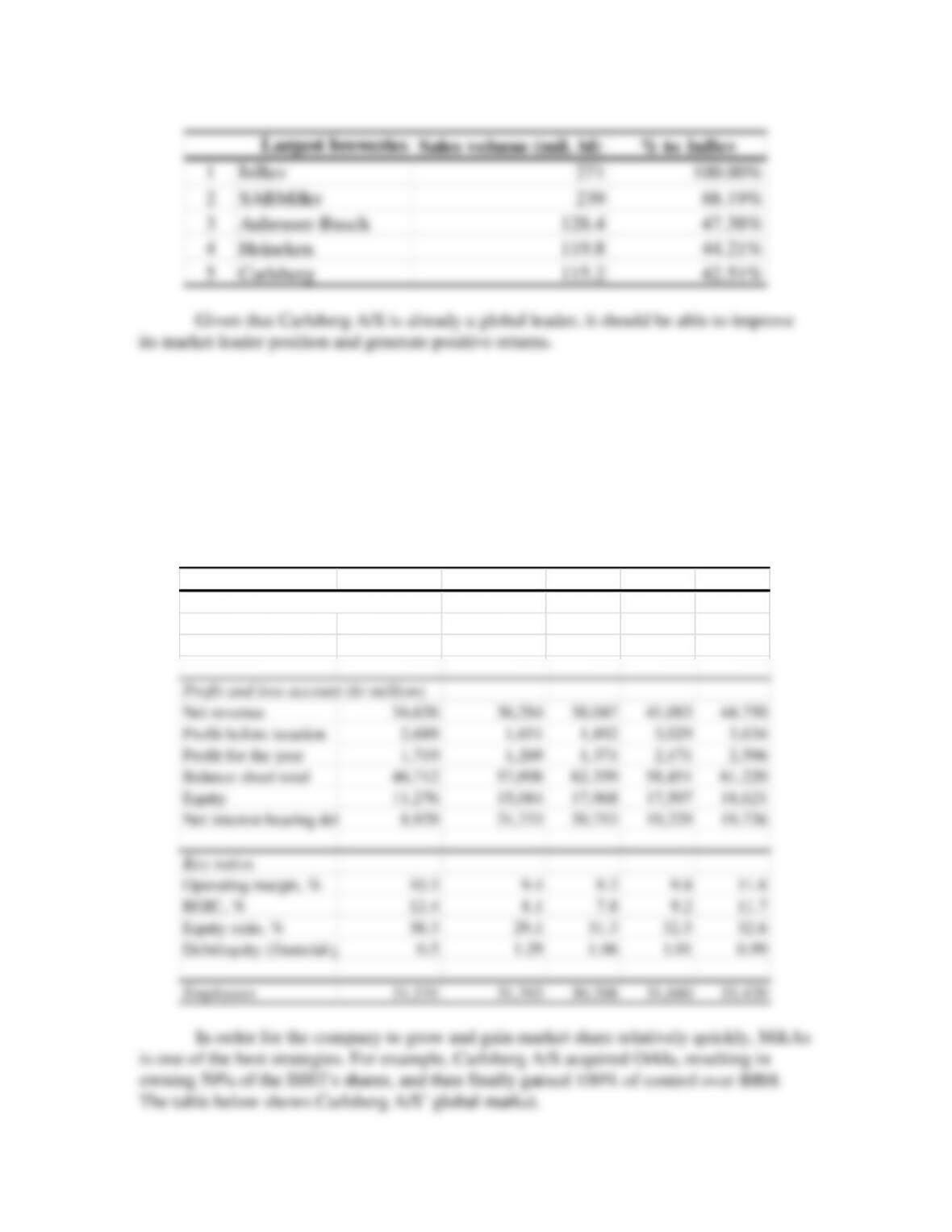
already in the industry and is the 5th largest breweries in the world. The table below
shows the top global breweries:
Carlsberg in Emerging Markets
• Identify the reasons for Carlsberg A/S’ mergers and acquisitions (M&As)?
What type of the M&A strategy does Carlsberg A/S use?
There are many reasons for Carlsberg A/S’ M&As, and they are:
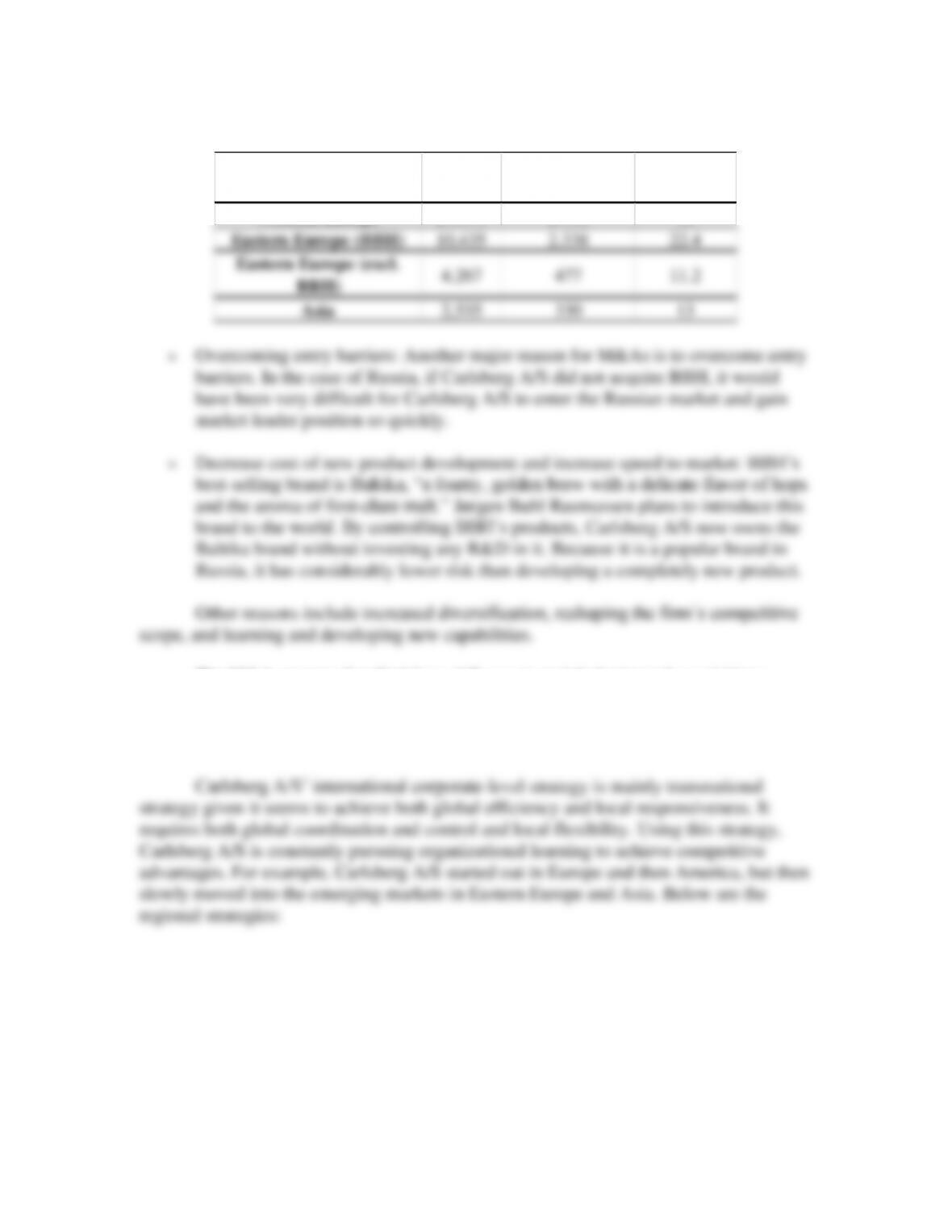
» Increase market power: Although Carlsberg A/S is the 5th largest breweries in the
world, it was losing ground. The key financial numbers below show that it has not
grown very much since 2003:
Sales volume (mil. hl) % to InBev
1 InBev 271 100.00%
2 SABMiller 239 88.19%
3 Anheuser-Busch 128.4 47.38%
4 Heineken 119.8 44.21%
5 Carlsberg 115.2 42.51%
Largest breweries
2003 2004 2005 2006 2007
Sales volume (million hl)
Beer 81.4 92 101.6 100.7 115.2
Soft drinks 21.2 19.4 19.1 20.2 20.8
Profit and loss account (kr million)
Net revenue 34,626 36,284 38,047 41,083 44,750
Profit before taxation 2,688 1,651 1,892 3,029 3,634
Profit for the year 1,719 1,269 1,371 2,171 2,596
Balance sheet total 46,712 57,698 62,359 58,451 61,220
Equity 11,276 15,084 17,968 17,597 18,621
Net interest-bearing debt
8,929 21,733 20,753 19,229 19,726
Key ratios
Operating margin, % 10.3 9.4 9.2 9.8 11.8
ROIC, % 12.4 8.1 7.8 9.2 11.7
Carlsberg in Emerging Markets
4
Carlsberg
The M&A strategy that Carlsberg A/S uses is mainly horizontal acquisitions
because it is buying other firms in the same industry.
• Describe Carlsberg A/S’ international corporate-level strategy.
Revenue
(kr mil.)
Operating
Profit (kr mil.)
Operating
Margin (%)
Western Europe 27,944 2.738 10
Eastern Europe (BBH) 10,435 2.338 22.4
Eastern Europe (excl.
BBH)
4,267 477 11.2
Asia 2,535 330 13
Carlsberg in Emerging Markets
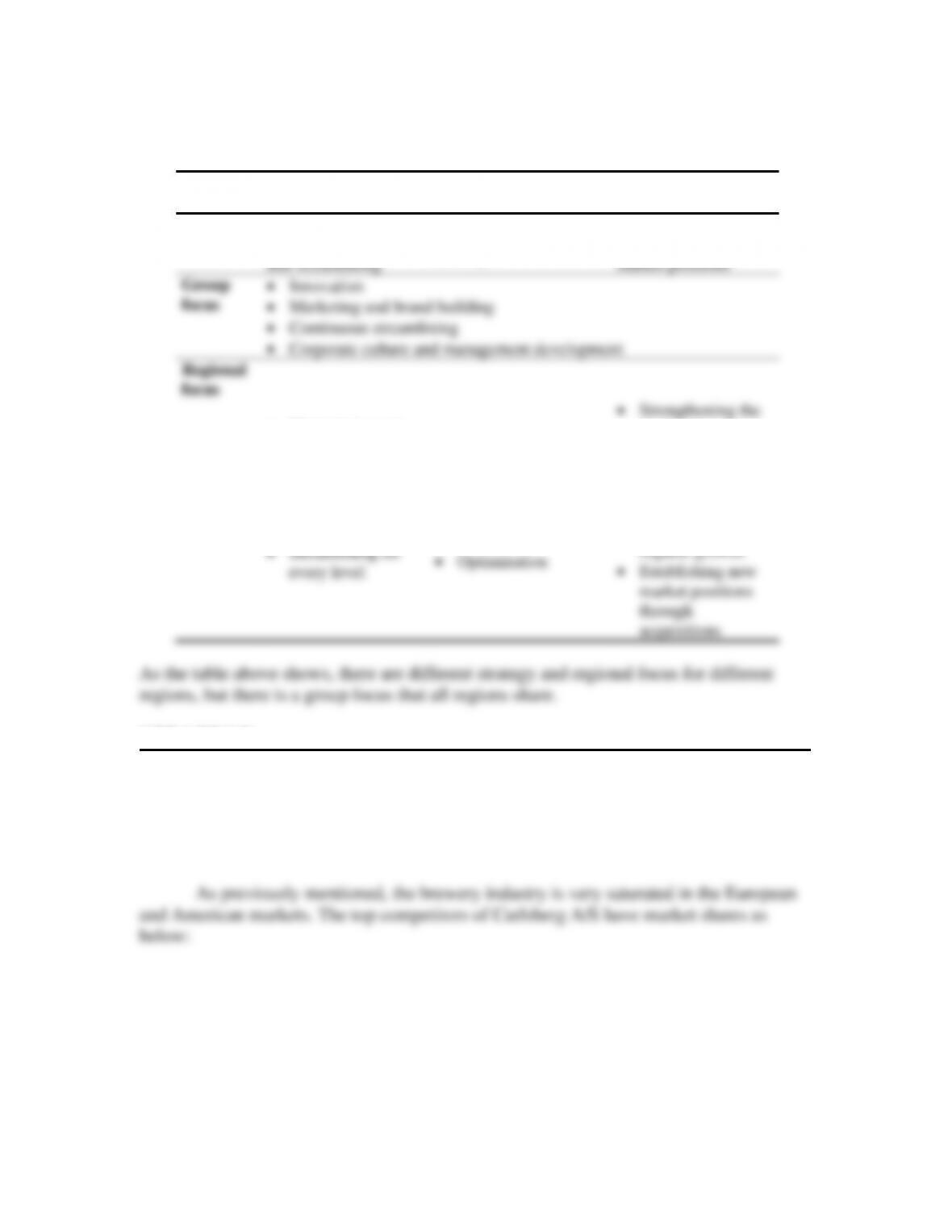
Carlsberg A/S Regional Strategies
STRATEGY
• Integrating the results of the analysis, do you think Carlsberg A/S’ decision to
go into the emerging markets is a good decision? Summarize your findings and
propose recommendations that could improve Carlsberg A/S’ market
performance in the industry.
Western Europe
BBH and the rest of
Eastern Europe
Asia
Strategy
Improved profitability
through innovation
and streamlining
Rapid growth and higher
earnings
Long-term growth
through build-up of
market positions
Group
focus
• Innovation
• Marketing and brand building
• Continuous streamlining
• Corporate culture and management development
Regional
focus
• Maintaining and
developing market
positions
• Marketing
• Innovation
• Focus on value
• Streamlining on
every level
• Strengthening and
developing market
positions
• Increased focus on
premium segments
• Investments
• Optimization
• Strengthening the
product range
• Improving sales
work
• Strengthening
existing market
positions through
organic growth
• Establishing new
market positions
through
acquisitions
Carlsberg in Emerging Markets
6
Carlsberg
As the tables above shown, there are still not a lot of competitions in Asia and
Eastern Europe. Carlsberg A/S’ strategy is to become a market leader in Russia and
China before other competitors. The strategies are:
InBev
North America 4.6
Latin America North 37.3
Latin America South 11.3
Western Europe 13.3
Central and Eastern Europe 18.2
Asia Pacific 13.4
Global Export and Holding Companies 1.9
Anheuser-Busch
United States 81.3
International 18.7
Heineken
Western Europe 30.4
Central and Eastern Europe 10.5
Americas 36.8
Africa and the Middle East 6.5
Asia Pacific 15.8
SABMiller
Latin America 25
Europe 20
North America 10
Africa and Asia 12
South Africa 33
Worldwide beer volume 2007, %
Worldwide beer volume 2007, %
Worldwide beer volume 2007, %
Worldwide beer volume 2007, %
Carlsberg in Emerging Markets
7
Carlsberg
» Carlsberg in China: Carlsberg A/S’ strategy in China is through a focus on
achieving leadership and the first-mover advantage in Western China, while
avoiding the fierce competition in the southeast. Carlsberg A/S tried the strategy