BP in Russia: Bad Partners or Bad Partnerships?
1
BP
INTRODUCTION
This case portrays the challenging events and circumstances confronting BP in
Russia during 2011. It illustrates the difficulties of managing issues associated with
cooperative strategies, especially complex cross-border alliances. The case opens with
background on the oil industry in Russia and provides a timeline of the investments and
strategic alliances made by BP to access the market. The company’s recent attempt to
form a partnership with Rosneft is then described, followed by an explanation of the five
basic alliances that are common in the oil industry.
In the wake of unraveling relations with cooperative partner, AAR, and the failed
alliance attempt with Rosneft, ideal strategic conditions in Russia seem implausible for
the global oil company. In order to maximize outcomes in such an imperfect business
climate, BP needs to fully measure situational opportunities against environmental risks,
understand the dynamics and motivations driving stakeholder behavior, and establish a
plan which can satisfy the interests of all parties. The following analysis is designed to
shape an informed decision about how to proceed and manage the company’s Russian
business holdings in this uncertain environment.
• Outline the challenges of conducting business in Russia’s oil industry. Why is it
strategically important for BP to secure a position in this market?
• Who are the prominent stakeholders in this situation, and what important
motivational factors underlie their behavior?
• Review the terms, nature, and timing of BP’s strategic alliances in Russia. What
are the benefits and costs of the arrangement for each party?
• Assess BP’s management of its investments and strategic alliances in Russia.
Why is the TNK-BP partnership experiencing so much internal conflict? What
can BP do to salvage the situation in Russia? Do you agree with BP’s decision to
block a TNK-BP cooperative arrangement with Rosneft?
ANALYSIS
• Outline the challenges of conducting business in Russia’s oil industry. Why is it
strategically important for BP to secure a position in this market?
BP in Russia: Bad Partners or Bad Partnerships?
2
BP
– Regulatory and licensing uncertainty
– Recent political actions to regain central control
The oversight of a nation’s vital natural resources is often intense, especially in
the energy sector. The importance of crucial oil and gas supplies to local and global
economies makes this industry highly vulnerable to major shifts in government policy.
Furthermore, the interplay between powerful nations influences decisions made regarding
friendly nations as well as countries with poor relations. National leaders use petroleum
production and gas exports as a means of achieving foreign policy objectives and
manipulating international political events. Thus, it is not surprising that the government
would want to retain heavy influence or control over oil and gas companies in Russia.
against state-sanctioned corporate raiding practices. The ability to manage operations and
safeguard investments is continuously at risk in this environment.
Narrowing the focus to the specific challenges of working with its partner, AAR,
BP is operating from a weakening position. The relationship between BP and AAR has
been contentious since its inception
1
. As a result of ongoing power plays between the two
firms since that time, their working relationship has severely deteriorated and is plagued
with mistrust.
BP in Russia: Bad Partners or Bad Partnerships?
3
BP
Despite these unfavorable conditions, success in Russia is critical to the
achievement of BP’s strategic objectives. Two major factors underscore the company’s
need to secure a strong position in the Russian oil market. First, competitiveness in the oil
and gas industry depends upon continually increasing oil and gas production and
replacing reserves. The industry is capital-intensive, and BP faces intense rivalry amongst
several international oil giants. Therefore, the company’s ability to expand its global
portfolio of oil assets and to grow revenues (especially after the company’s extraordinary
losses in the Gulf) is crucial. Second, since opening its markets to private investment,
Russia has grown to become the second largest oil producing nation in the world.
Reserves are limited globally, which restricts new exploration and development options
• Who are the prominent stakeholders in this situation, and what important
motivational factors underlie their behavior?
BP in Russia: Bad Partners or Bad Partnerships?
4
BP
Product Market Stakeholders – State of Russia. In this case, another powerful
stakeholder is the state of Russia. Like other host governments in oil-producing nations,
Russia seeks the best contractual terms to maximize the financial benefits earned from its
natural reserves. The nation’s oil and gas revenues provide Russia with stability and clout
in the eyes of the world. International recognition of rising political stability and progress
in economic development helps the country attract and support foreign investment and
integrate with the world economy (assuming these are, in some form, objectives of the
Russian government). Even though Western nations and BP leaders believe that it is in
Russia’s best interest to attract professionally-run, modernized companies capable of
competing in the world marketplace, the country’s legal measures and political actions
show that the country is equally motivated by generating revenues and protecting
strategic natural resources which can be used for international posturing on issues of
national importance.
BP in Russia: Bad Partners or Bad Partnerships?
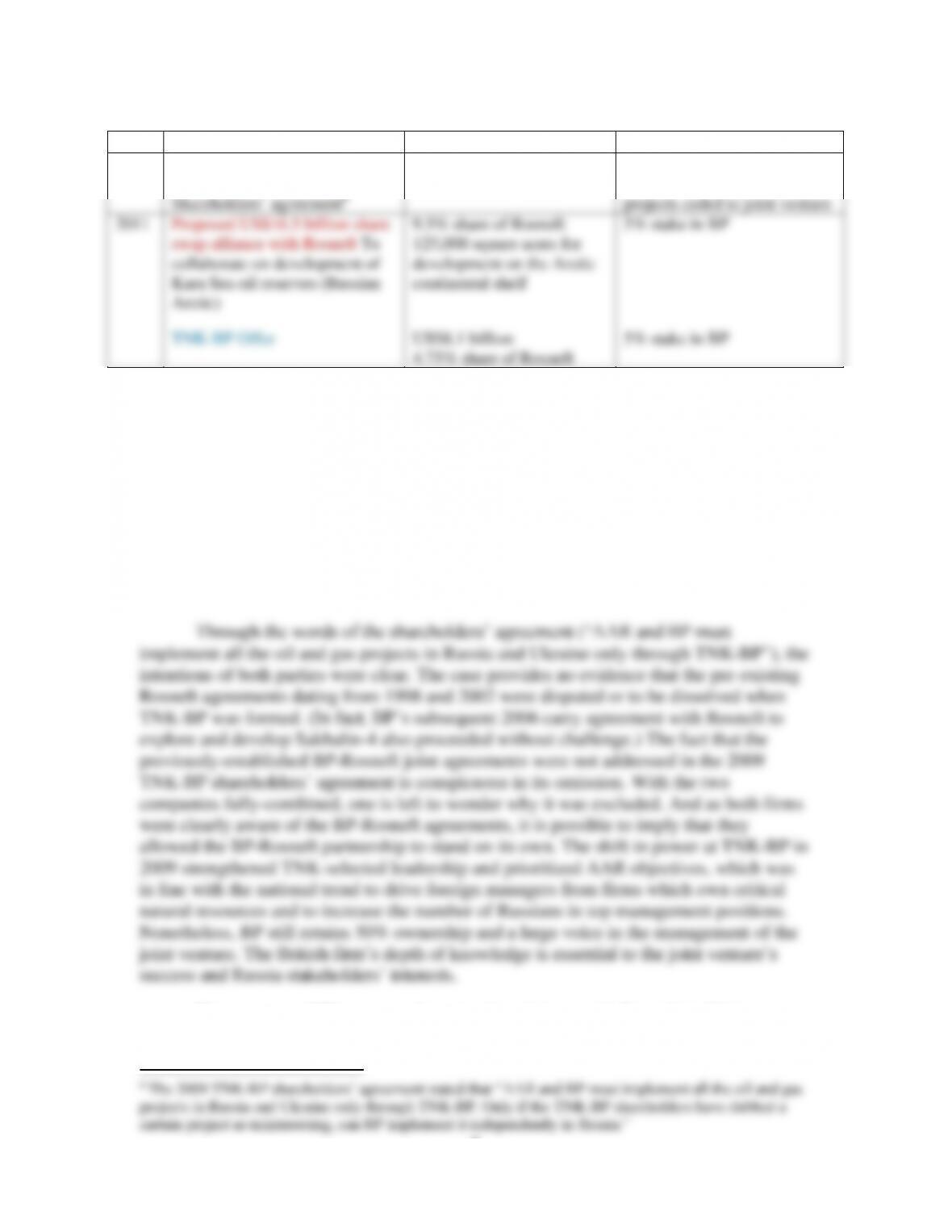
• Review the terms, nature, and timing of BP’s strategic alliances in Russia. What
are the benefits and costs of the arrangement for each party?
Exploration and development are cost prohibitive in the oil industry unless
collaborative relationships are formed to obtain required capital. And due to the strategic
importance of energy to national interests, many countries do not allow foreign majority
Year
Agreements/Terms
Benefits
Costs
1997
Purchased 10% stake in
Sidanko (Private)
Entry into privatized Russian
oil market
US$571 million
1998
Joint venture with Rosneft
(State) To explore and mine
licensed areas of Sakhalin
Island (East Coast)
Over 10 billion tons of oil and
natural gas reserves
Exploration funding
$40 million
1999
Equitable share in Sidanko
with TNK (Private) and
managerial authority
Control over highly prized
Chernogorneft oil field
(Western Siberia)
25% equity stake in
Sidanko to TNK – and
one veto share
2002
Purchased additional 15% stake
in Sidanko
Carry agreement with Rosneft
(51%) To explore and develop
Sakhalin-5
Expanded ownership share in
Sidanko
Rosneft liable for costs if
project successful
US$375 million
Exploration funding
$40 million
2003
2005
50/50 Consolidated joint
venture with AAR (Private)
Created separate entity TNK-
BP and greatly increased BP’s
scope in Russian oil market
Voluntary share exchange
program to consolidate minor
TNK subsidiaries into TNK-BP
holding company3
51% share in TNK
56% share in Sidanko
50% share in Slavneft
29% share in Russia Petroleum
85% share in OAO Onako
Combined majority ownership
in RP’s Kovyotka gas field
license to explore opportunities
offshore Sakhalin Island,
refineries, and extensive retail
network (Russia and Ukraine)
US$6.75 billion
25% share in Sidanko
33% share in Russia
Petroleum
Capital, experience,
expertise, introduce AAR
to world oil market
2006
Carry agreement with Rosneft
(51%) To explore and develop
Sakhalin-4
Rosneft liable for costs if
project successful
Exploration funding
$700 million
2007
TNK-BP takeover attempt by
license violations
Takeover thwarted
Forced to sell Kovyotka
BP in Russia: Bad Partners or Bad Partnerships?
6
BP
Year
Agreements/Terms
Benefits
Costs
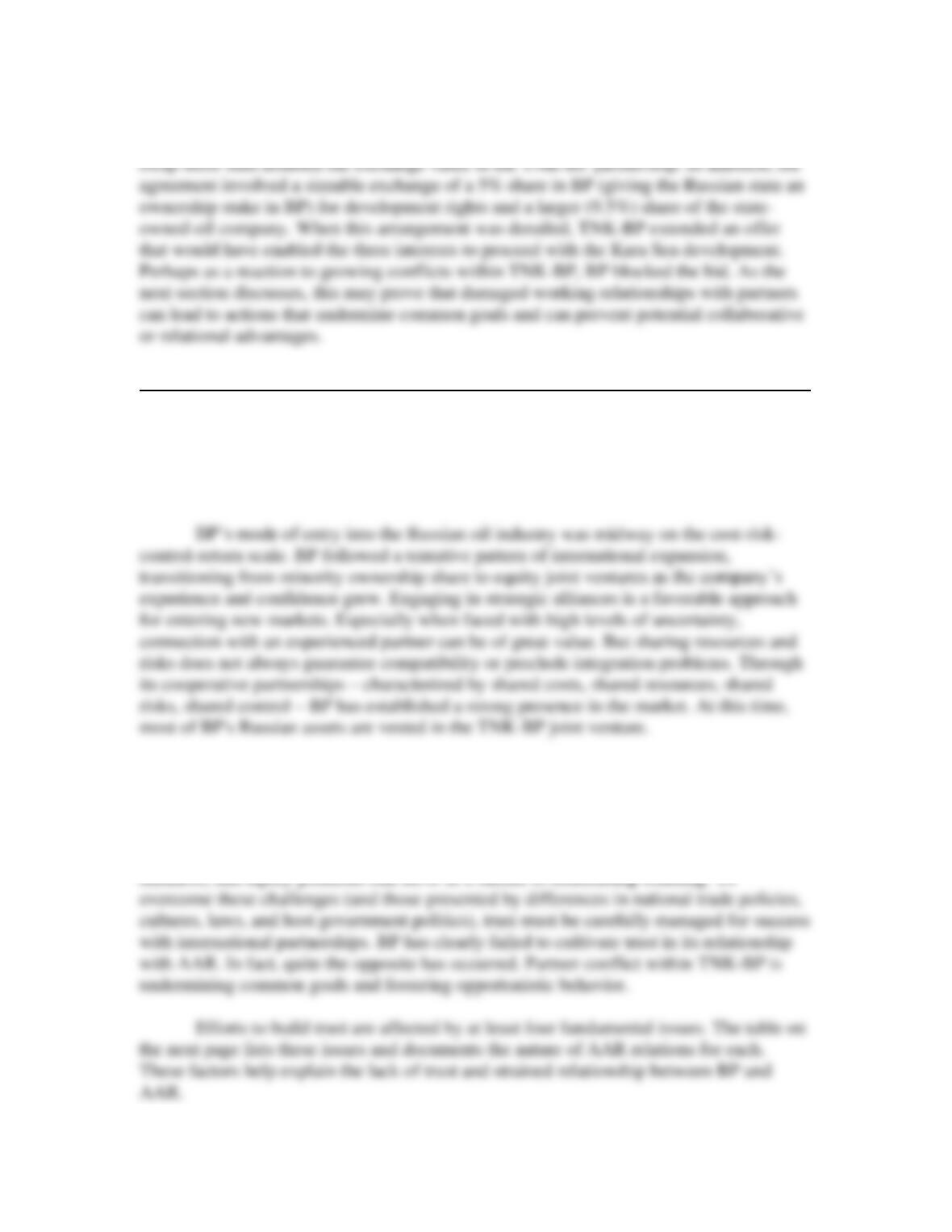
2009
TNK-BP board restructuring
and change in leadership
Shareholders’ agreement4
Retain 50% ownership in
TNK-BP joint venture
Operating control lost to AAR
Control of independent
projects ceded to joint venture
2011
Proposed US$16.5 billion share
swap alliance with Rosneft To
collaborate on development of
Kara Sea oil reserves (Russian
Arctic)
TNK-BP Offer
9.5% share of Rosneft
125,000 square acres for
development on the Arctic
continental shelf
US$8.1 billion
4.75% share of Rosneft
5% stake in BP
5% stake in BP
A strategic alliance is a cooperative strategy that combines firms’ resources and
capabilities in order to create a competitive advantage. The TNK-BP partnership
agreement between BP and AAR in 2003 was a cross-border alliance that expanded BP’s
scope in the Russian oil market and offered AAR access beyond Russia into global oil
markets. AAR contributed massive domestic resources; and BP infused US$6.75 billion
and a wealth of experience into the consolidated joint venture. By 2005, the Russian
assets and interests of the two firms were fully integrated into one legally independent
entity. The joint venture is a 50-50 partnership which combines AAR’s human resources,
political connections, and cultural knowledge of the country with BP’s Russian assets,
retail network, equity investments, and expansive management expertise.
The purpose of BP’s proposed cooperative strategy with Rosneft in 2011 was to
develop Russian Arctic oil and gas reserves on 125,000 square acres of the continental
BP in Russia: Bad Partners or Bad Partnerships?
7
BP
shelf in the Kara Sea. This was no small proposal. The US$16.5 billion value of the share
STRATEGY
• Assess BP’s management of its investments and strategic alliances in Russia. Why
is the TNK-BP partnership experiencing so much internal conflict? What can BP
do to salvage the situation in Russia? Do you agree with BP’s decision to block a
TNK-BP cooperative arrangement with Rosneft?
The analysis above describes the resource constraints and development demands
in the industry that support the company’s use of cooperative alliances to enter the
foreign market. Despite the advantages of this entry mode, cross-border alliances like
TNK-BP can be complex and difficult to manage. 50% of all strategic alliances end in
failure. Incompatibility and conflict are the primary reasons for the failure of strategic
alliances; and equity positions can serve as a barrier to relationship building. To
BP in Russia: Bad Partners or Bad Partnerships?
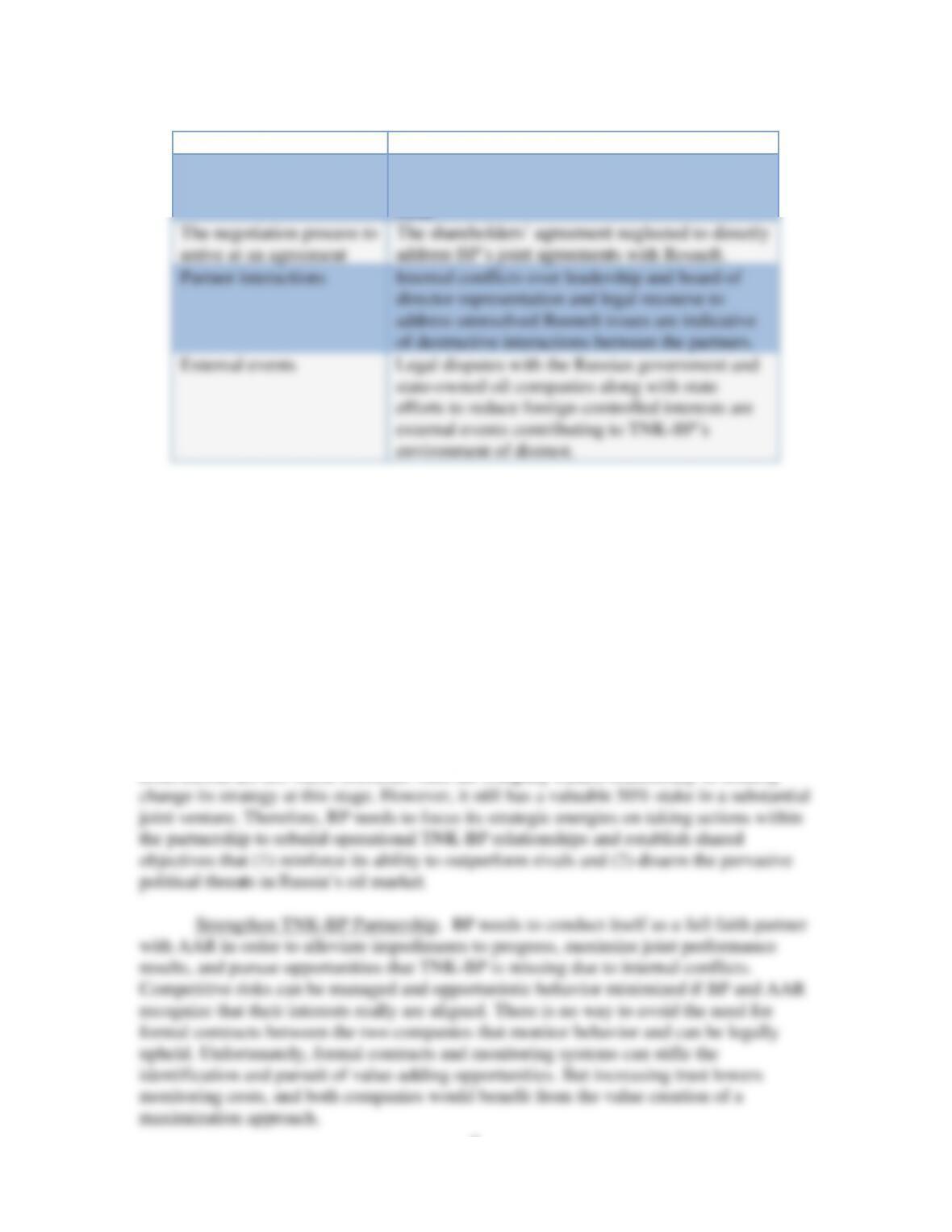
Trust-Related Issues
BP-AAR Relationship
The initial condition of
the relationship
The relationship was initially established in the
battle and settlement for the Chernogorneft oil
field.
The negotiation process to
arrive at an agreement
The shareholders’ agreement neglected to directly
address BP’s joint agreements with Rosneft.
Partner interactions
Internal conflicts over leadership and board of
director representation and legal recourse to
address unresolved Rosneft issues are indicative
of destructive interactions between the partners.
External events
Legal disputes with the Russian government and
state-owned oil companies along with state
efforts to reduce foreign-controlled interests are
external events contributing to TNK-BP’s
environment of distrust.
Despite their fractious beginnings, by 2005, BP’s and AAR’s Russian assets were
fully consolidated (with the exception of the extant Rosneft exploration agreements.)
From that point, the relationship between BP and AAR deteriorated to such an extent that
internal issues had to be resolved through legal disputes. Unfortunately, BP did not
structure an exit plan in the event that the partnership went sour or inadequate returns
resulted. Now, the complexity of TNK-BP’s organizational units is such that the likely
losses from dissolution would be enormous. The question is: have the interests of the two
parties diverged so far that resolution is no longer possible?
BP requires an integrated strategic plan that ensures the company’s lasting
presence, protects its assets, and maximizes the performance of ongoing operations in
Russia. The situation seems dire, but BP is not entirely out of options. Direct investment
acquisitions, disengagement from TNK-BP, new cooperative alliances, and withdrawal
from Russia are not viable solutions. And the company cannot realistically or feasibly
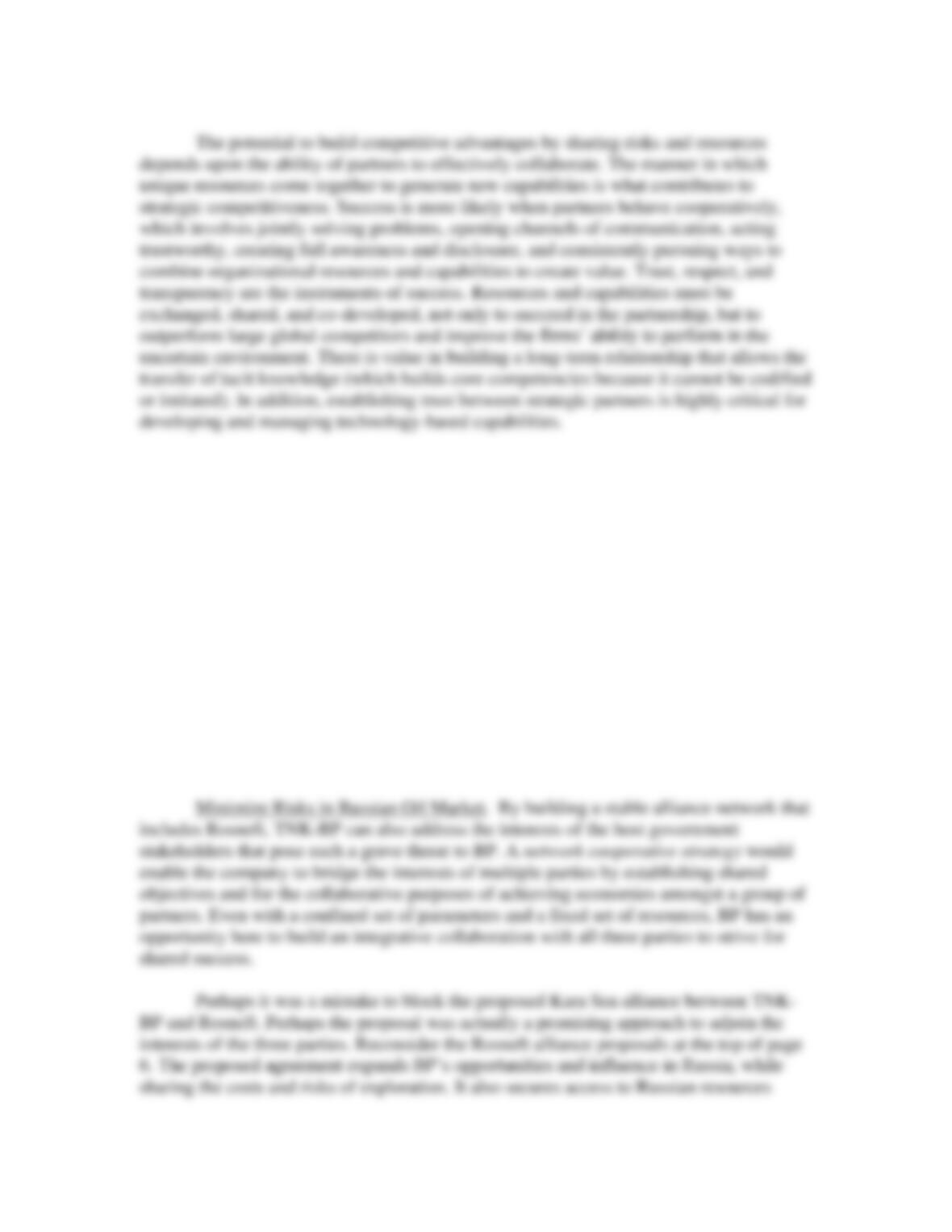
BP in Russia: Bad Partners or Bad Partnerships?
9
BP
BP also needs to encourage the exercise of proper corporate governance and the
concepts of transparency, safety, and ethics. Governance mechanisms are meant to align
owner interests with manager interests and to improve relationships among stakeholders.
By establishing Board oversight of strategic planning and financial projections, fairness
and a voice for all shareholders can be assured. Even though all terms may not be
enforceable through legal authorities in Russia, values consistent with international trade
standards will be instilled, and their importance will be emphasized at TNK-BP.
Trust is one of the most efficient way to influence and control alliance partner
behavior. Building trust and social capital will prevent AAR from acting only in its own
best interests, enable TNK-BP to prioritize collaborative advantages, and exploit the
partnership’s potential by positioning it to take advantage of unexpected opportunities in
the marketplace. By working collaboratively with AAR to achieve aligned objectives, BP
can maximize TNK-BP performance to satisfy the interests of all capital market
stakeholders.
BP in Russia: Bad Partners or Bad Partnerships?
while protecting the company from lost ownership rights or assets to the state. It satisfies
the following decision criteria:
– Does it help to achieve performance objectives?
– Does it reduce threats?
– Does it increase future opportunities?
– Is it manageable?
Based on this assessment, it is advisable for BP to reconsider its objections to a
Rosneft-TNK-BP agreement. While it increases management and relationship
complexities, it reduces tensions and threats of predatory behavior by other state-owned
institutions or the Russian government. However, to protect BP’s independent interests,
the following suggestions are also recommended.
BP in Russia: Bad Partners or Bad Partnerships?
11
BP
The company should be very cautious about allowing the state of Russia to attain
an ownership stake in the BP parent company.
Conclusion. Given the current landscape, there are troubling risks associated with
doing business in Russia. The success of BP is linked to the success of the joint venture.
And the threats of operating in Russia’s volatile oil industry would be reduced by
securing an ongoing and mutually-beneficial relationship with the state. Because this may
not be possible independent of its AAR partners, this relationship should be established
through the TNK-BP organization.