
American Express: Bank 2.0
1
American Express
INTRODUCTION
This case describes a unique opportunity for one of the largest financial brand
names in the world, American Express, whose leaders have demonstrated a knack for
identifying obscure market niches. The rapid success of Green Dot has drawn attention to
American Express and creates an interesting opportunity to explore the dynamics within a
company attempting to diversify its revenue stream and to discover a long-term strategy.
This case begins with the birth of Enterprise Growth. The CEO of American
Express, Kenneth Chenault, named Dan Schulman to lead the group, and stated, “[t]he
Enterprise Growth group is designed to extend our leadership into the world of
alternative payments and to create new fee-based revenue streams for the post-recession
environment.” Other leaders include Chokshi as the president and Wright as the head of
the product development. The case then delves into the American Express’s primary and
traditional business model, the model of exclusion for the affluent consumers. The
leadership team, competitive landscape, history of prepaid products, the target customer
segments, and marketing efforts are presented to justify why American Express wants to
serve the unbanked and the underbanked. Financial records are also included, so that an
assessment of the company’s performance and capital structure can be conducted.
This case is ideal for demonstrating the importance of the business-level strategy,
competitive rivalry, and the SWOT analysis. The following points are to guide a review
and discussion of these important concepts.
• Define American Express’s overall business-level strategy. Does Bank 2.0 fit into
American Express’s overall business-level strategy?
• How does Bank 2.0 stand up against the competitors in the industry?
• What insights does a SWOT analysis reveal about how Bank 2.0 should be
positioned in the future?
• Integrate the results of the analysis into recommendations for growing the
business and combatting competitive pressures to maximize performance.
ANALYSIS
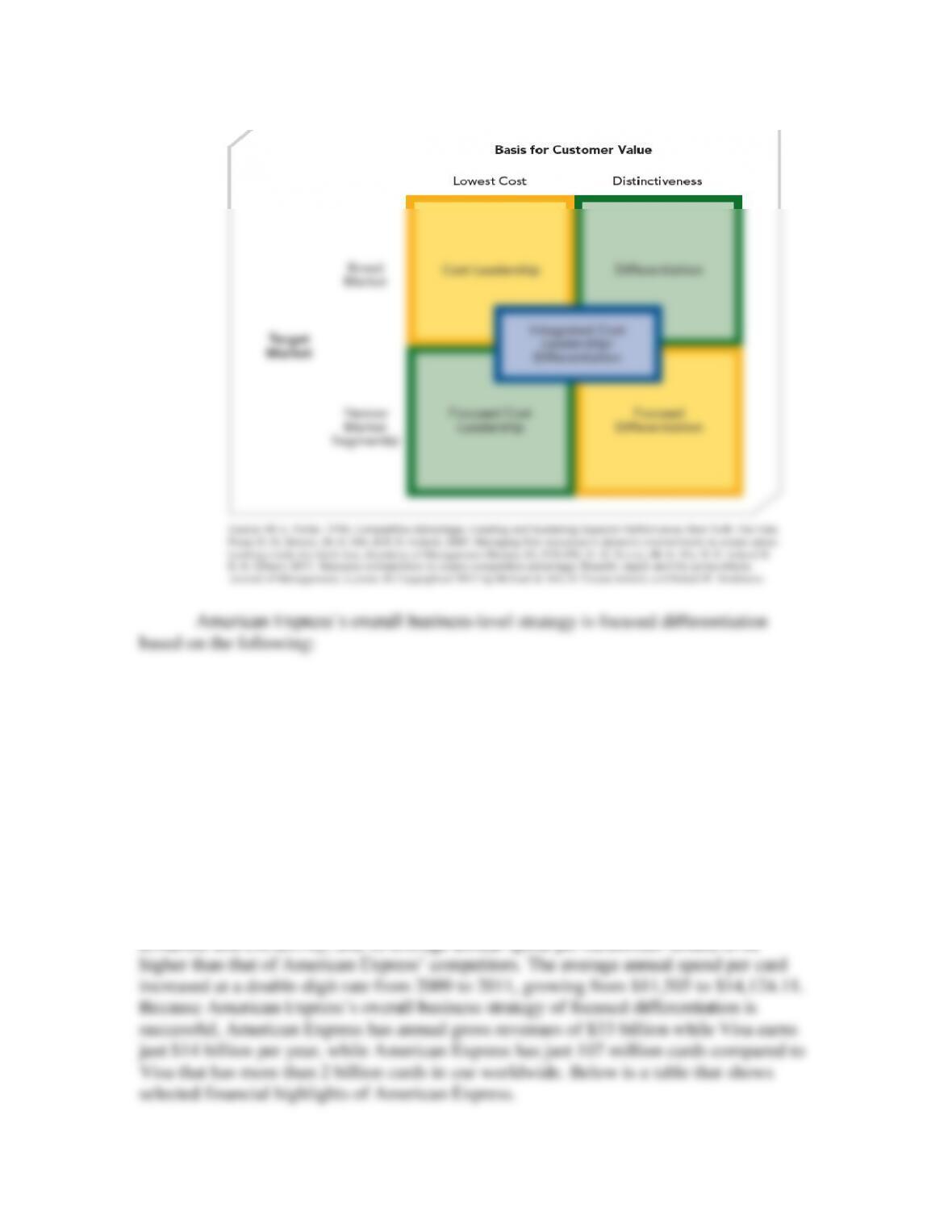
• Define American Express’s overall business-level strategy. Does Bank 2.0 fit
into American Express’s overall business-level strategy?
American Express: Bank 2.0
2
American Express
» Appropriate when customers value differentiated features more than they value
low cost
» Focus on a particular buyer group
The key of implementing a focused differentiation strategy for American Express
is to offer products and services that customers perceive as different in ways that are also
important to them. In order to remain a leader in focused differentiation strategy,
American Express needs to continue to offer its card members exceptional customer
service and the perceived prestige and status. American express is often associated with
affluence and exclusivity, and its average annual spend per cardholder tended to be
Bank 2.0 does not seem to fit in the overall business-level strategy of American Express.
However, as a business grows, American Express needs to attract more customers.
As Chokshi puts it, “why wouldn’t you want to serve more people?” For Bank 2.0,
volume is the key and it will be able to bring American Express more customers and raise
its brand awareness.
• How does Bank 2.0 stand up against the competitors in the industry?
Bank 2.0’s target customers are mainly the underbanked. They are:
» Constantly engaged in financial transactions outside of the traditional banking
system
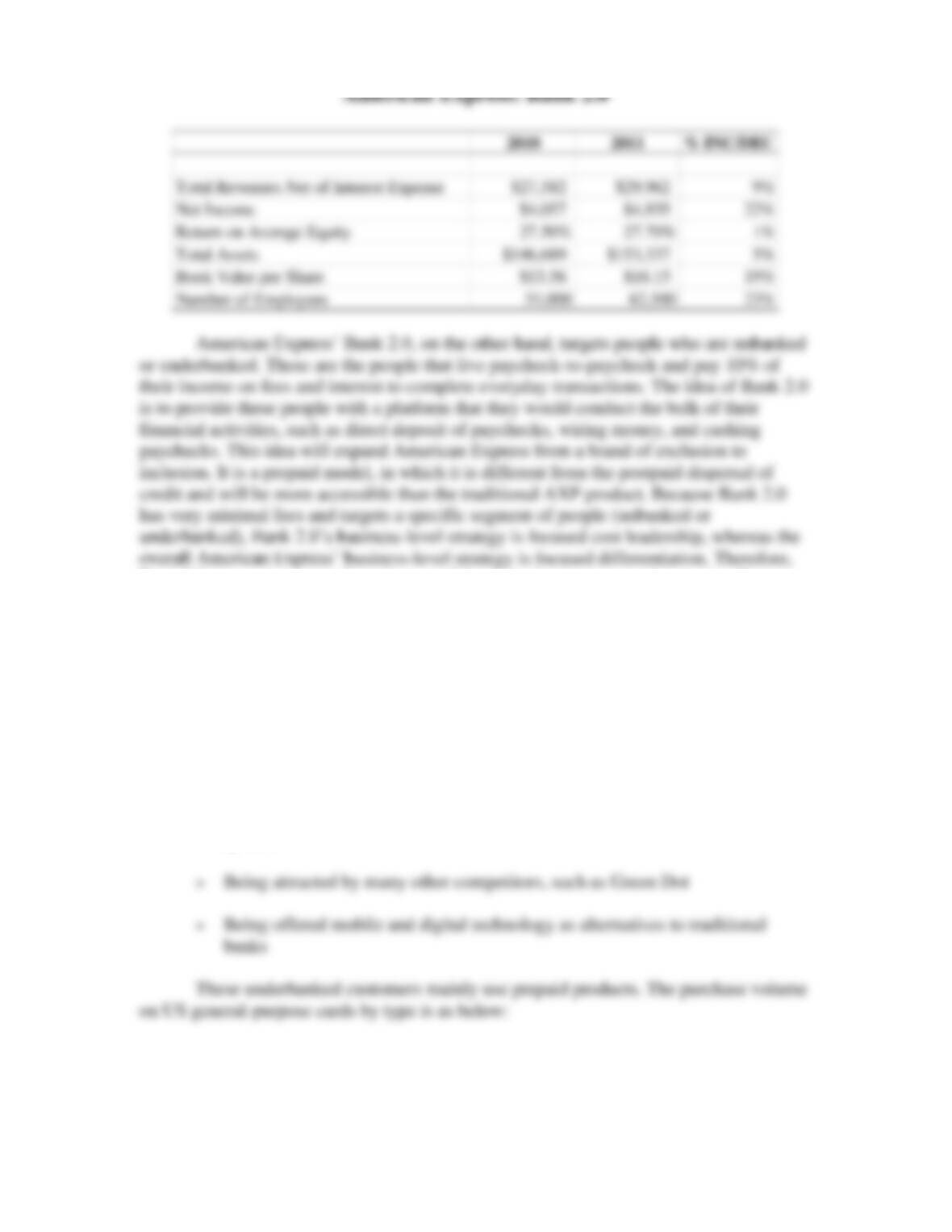
2010 2011 % INC/DEC
Total Revenues Net of Interest Expense $27,582 $29,962 9%
Net Income $4,057 $4,935 22%
Return on Average Equity 27.50% 27.70% 1%
Total Assets $146,689 $153,337 5%
Book Value per Share $13.56 $16.15 19%
Number of Employees 51,000 62,500 23%
American Express: Bank 2.0
There are several competitors:
Competitors
Their Strengths
Current Market
Green Dot
Partnership with Wal-Mart
Already in the
market and known
Square Cash
Provide an opportunity for consumers to
send and receive money to and from
one another
Just launched
Traditional financial
institutions
Have physical branches to serve people
Already in the
market and known
Retailers
One-stop shop for customers
Already in the
market and known
Other potential competitors are the credit card companies. The tables below show
a companion of prepaid versus credit cards:
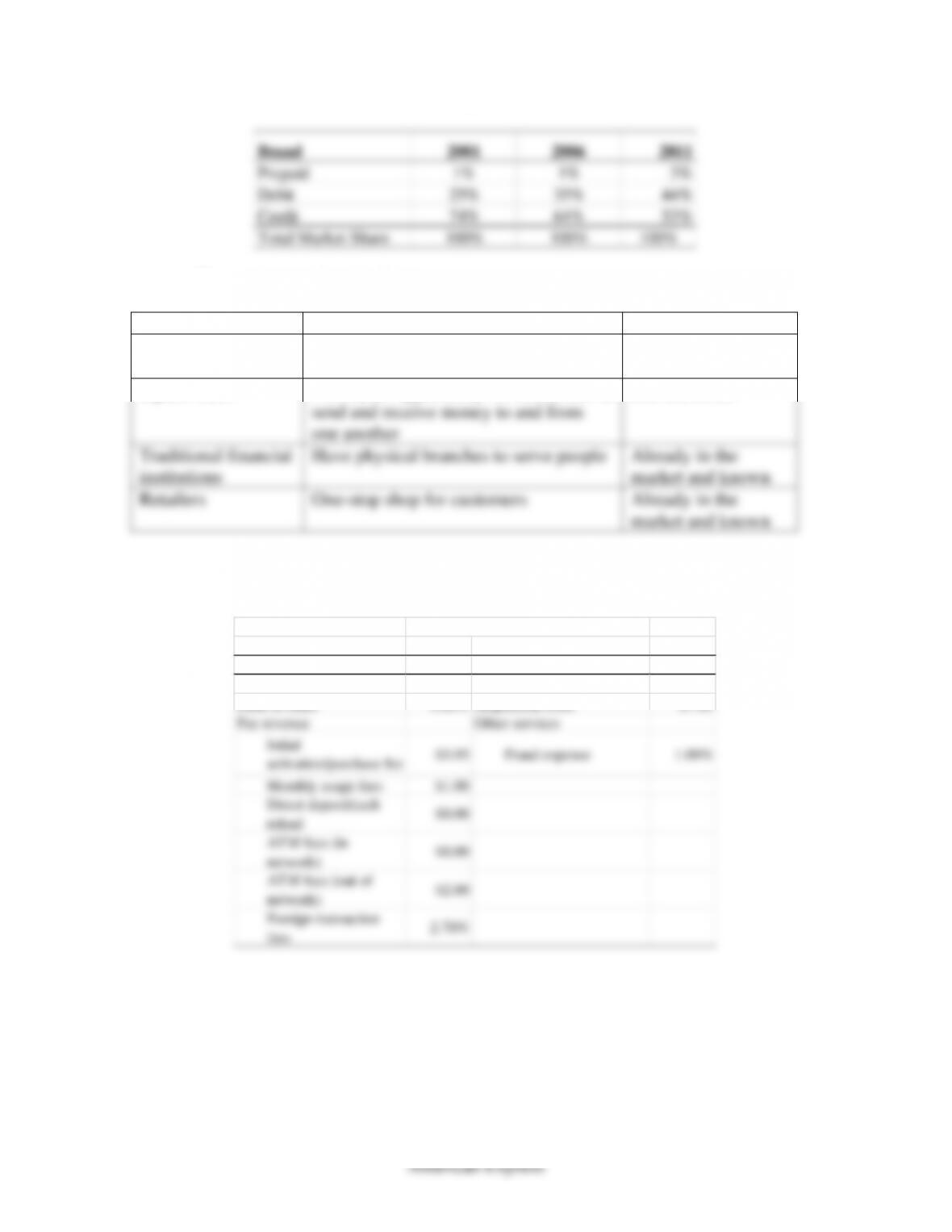
Brand 2001 2006 2011
Prepaid
1% 1% 3%
Debit 25% 35% 44%
Credit 74% 64% 53%
Total Market Share 100% 100% 100%
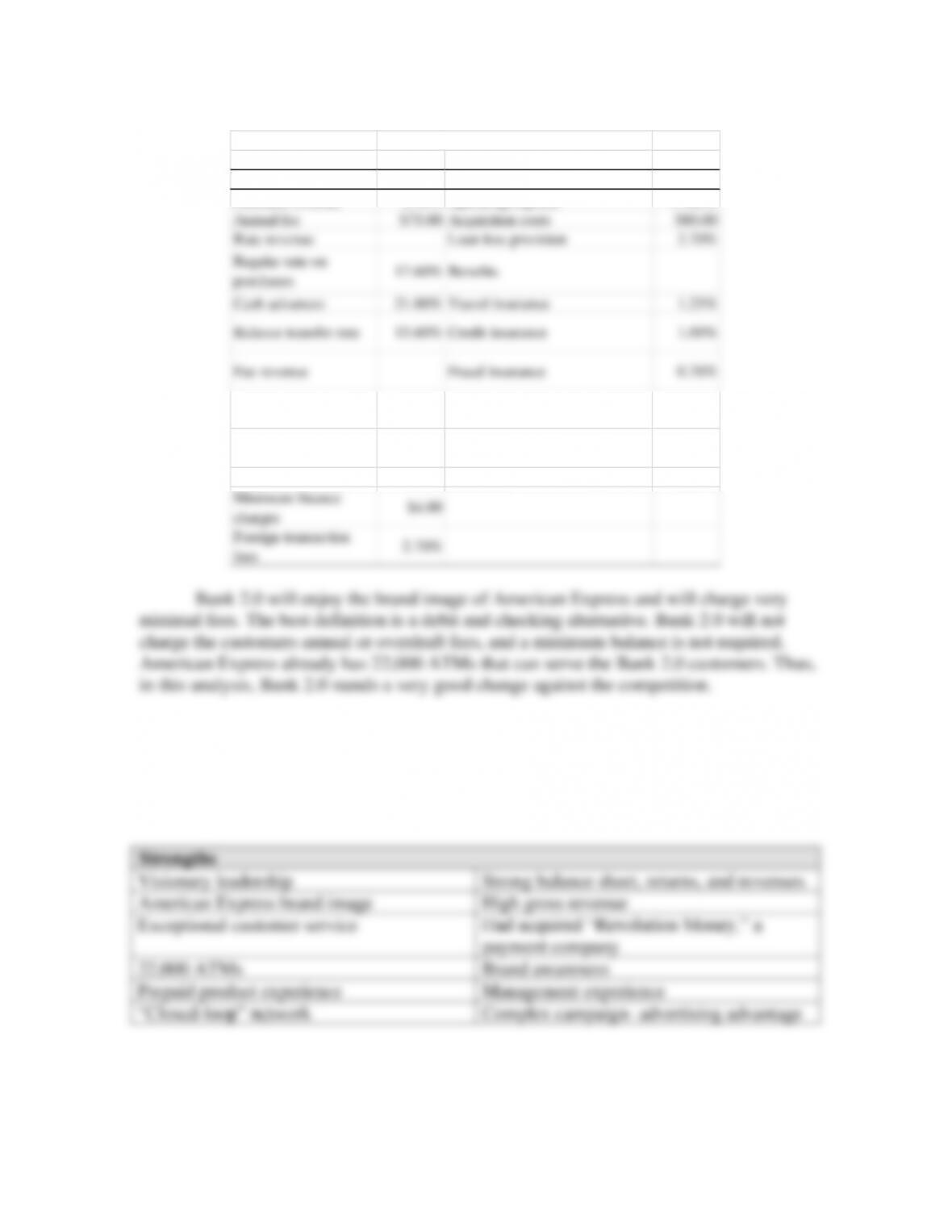
Prepaid Customers
Sources of Revenue Sources of Costs
Discount revenue 2.40% Operating expense 6.00%
Float revenue 4.80% Acquisition costs $7.00
Fee revenue Other services
Initial
activation/purchase fee
$3.95 Fraud expense 1.00%
Monthly usage fees $1.00
Direct deposit/cash
reload
$0.00
ATM fees (in
network) $0.00
ATM fees (out of
network)
$2.00
Foreign transaction
fees
2.70%
American Express: Bank 2.0
• What insights does a SWOT analysis reveal about how Bank 2.0 should be
positioned in the future?
Delving into the American Express’ internal and external environments reveals
the strengths, weaknesses, opportunities, and threats prevailing in the current situation.
Credit Card Customers
Sources of Revenue Sources of Costs
Discount revenue 2.40% Operating expense 11.00%
Annual fee $75.00 Acquisition costs $80.00
Rate revenue Loan loss provision 2.70%
Regular rate on
purchases
17.60% Benefits
Cash advances 21.00% Travel insurance 1.25%
Balance transfer rate 15.60% Credit insurance 1.00%
Fee revenue Fraud insurance 0.76%
Late payment fees $35 Rebates 1.00%
Overlimit fees $25 Miles 1.00%
Cash advance fees $5.00 Cash back 1.00%
Minimum finance
charges
$4.00
Foreign transaction
fees
2.70%
American Express: Bank 2.0
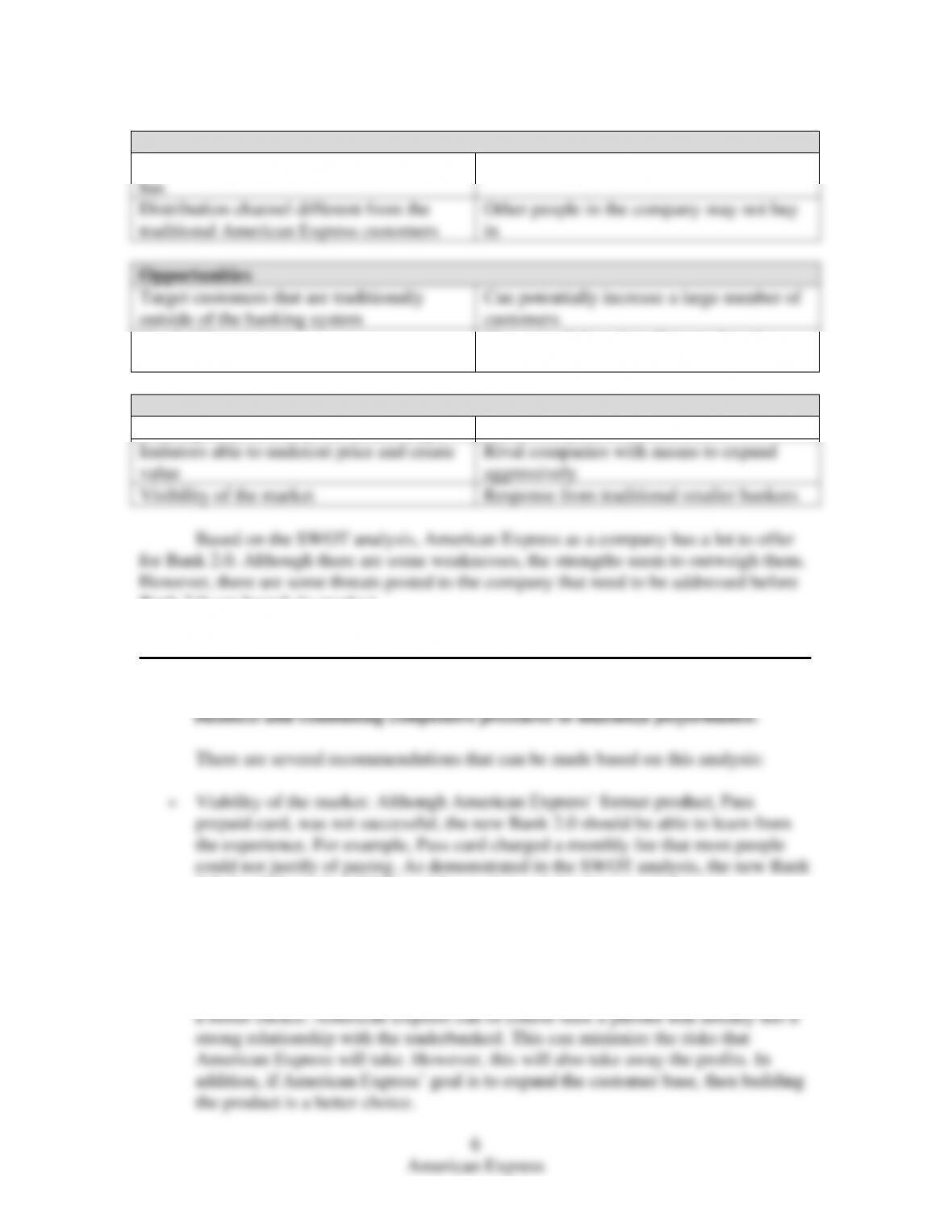
Weaknesses
Not as many users as Visa or MasterCard
has
Traditionally been a brand of exclusion
Distribution channel different from the
traditional American Express customers
Other people in the company may not buy
in
Opportunities
Target customers that are traditionally
outside of the banking system
Can potentially increase a large number of
customers
Can build or partner
Can expand American Express brand
image into a new segment of customers
Threats
Diluting American Express brand image
Fierce competition on the rise
Imitators able to undercut price and create
value
Rival companies with means to expand
aggressively
Visibility of the market
Response from traditional retailer bankers
Bank 2.0 can launch its product.
STRATEGY
• Integrate the results of the analysis into recommendations for growing the
2.0 should have the visibility of the market and should prove to be more
successful than its predecessor.
» Build or partner choice: American Express has been a leader in credit card
logistics and pioneered the “closed–look” networks; it can utilize the existing
management and marketing talents for Bank 2.0. Thus, building Bank 2.0 will be
American Express: Bank 2.0
7
American Express
» Acquiring: Alternatively, American Express can acquire its competitors such as
Green Dot. This way, it will gain access to Green Dot’s existing technology,
logistics, and distribution channels.
» Distribution channels: American Express can use its existing distribution channel
(it has 22,000 ATMs) and can partner with established retailer bankers to offer
even more ATMs for customers to use. The key is that there need to be as many
ATMs as possible so customers can conveniently use Bank 2.0 anywhere. If a
customer cannot find an ATM to use the product, he/she will have very little
motivation to sign up for Bank 2.0.
» American Express Brand: Many critics are skeptical about American Express’
pursuit on the underbanked. Given that American Express has been a brand of