
Kindle Fire: Amazon’s Heated Battle for the Tablet Market
1
Amazon
INTRODUCTION
This case is about how Amazon started to compete in the tablet market from the
perspective of its founder Jeff Bezos. It provides an overview of the strategic
entrepreneurship process under his vision, emphasizing the entrepreneur mind-set and
innovation. Bezos was able to formulate and utilize the entrepreneurial opportunities
presented to him.
The case opens with a history of Amazon, describing how Bezos started out his
company in a 400-square foot garage. By 1999, Amazon became the largest online
bookstore, and by 2001, it turned its first profit. While other brick-and-mortar-based
competitors struggled to transit to e-commerce, Amazon was able to succeed by many
innovative strategic moves, such as user-based reviews of products and 1-click ordering
on the website. All the while, Bezos tried to be innovative and be the first mover. As he
stated in his 2010 annual letter to shareholders, “invention is in [Amazon’s] DNA.”
Amazon continues to offer more innovative products such as cloud-based services. This
case focuses on one particular product from Amazon, the Kindle Fire. The Amazon
Kindle was launched in 2007 and went through many product development phases. Bezos
believed that the e-book ecosystems can bring Amazon many potential revenue streams,
and thus Amazon Kindle was selling at cost (or below cost as some analysts believed).
Kindle Fire was previewed in 2011 and referred as “the culmination of the many things
we’ve [Amazon has] been doing for 15 years.” The strategies of Kindle Fire are
examined and the competitors (mainly Apple and Barnes & Noble) are analyzed.
This case is ideal for demonstrating the importance of the business-level strategy,
competitive rivalry, and strategic entrepreneurship. The following points are to guide a
review and discussion of these important concepts.
• Define Amazon’s business-level strategy. Based on the analysis, what changes
should Bezos make in his efforts to significantly differentiate the company?
• How does Amazon’s Kindle Fire strategy stand up against competitive rivalry in
the industry?
• Describe the entrepreneurial characteristics of Amazon. How has Bezos promoted
innovation within the organization?
• Is the current strategy for Amazon’s Kindle Fire suitable for the existing market?
What recommendations can be made to address strategic concerns and safeguard
Amazon’s growth and market share?
Kindle Fire: Amazon’s Heated Battle for the Tablet Market
ANALYSIS
• Define Amazon’s business-level strategy. Based on the analysis, what changes
should Bezos make in his efforts to significantly differentiate the company?

Kindle Fire: Amazon’s Heated Battle for the Tablet Market
3
Amazon
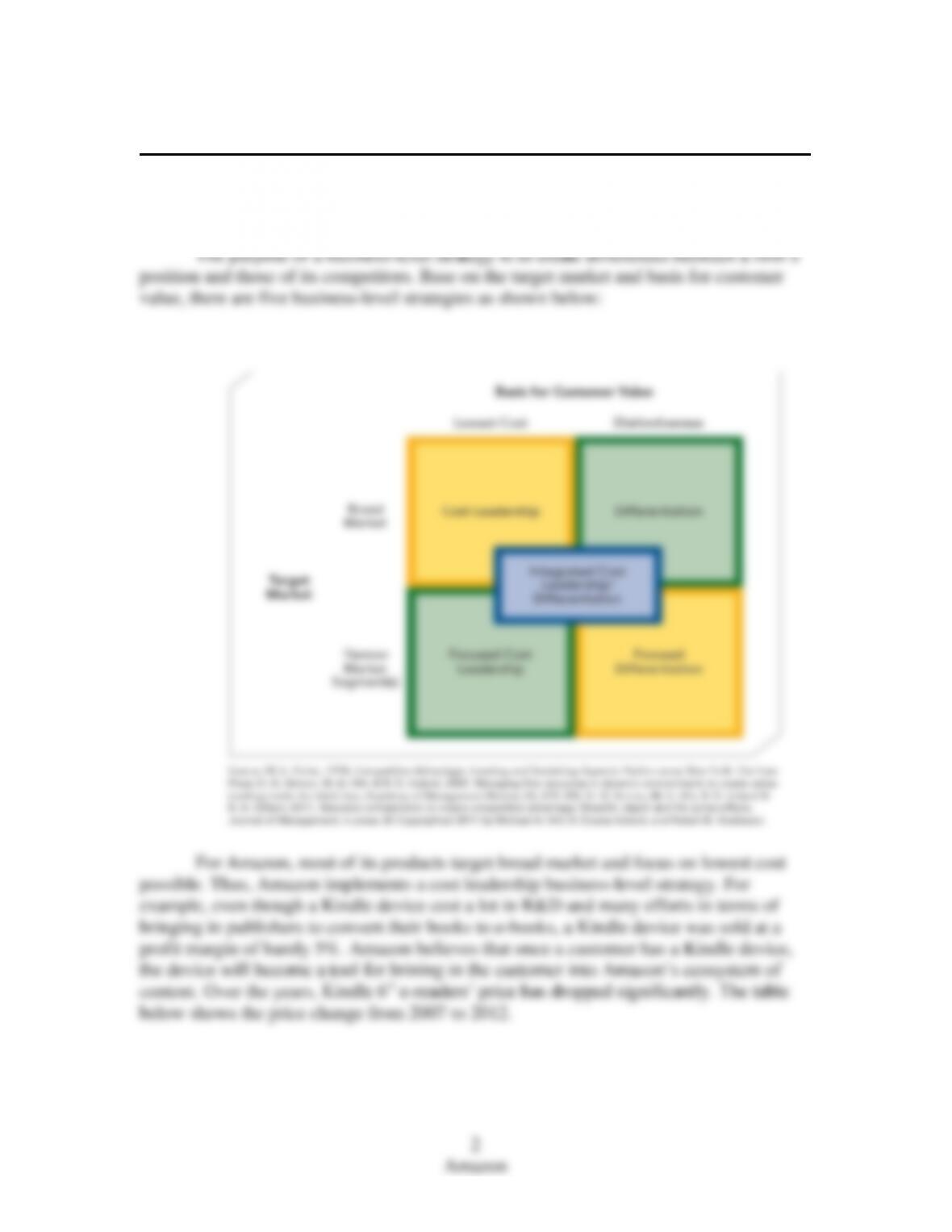
The key of implementing a cost leadership business-level strategy for Amazon is
to offer relative standardized products with features acceptable to most customers at the
lowest competitive price. In order to remain a cost leader, Amazon has employed process
innovations that facilitate extremely efficient production and distribution methods. It has
also successfully controlled production costs and overheads and minimized costs of sales
and service. Bases on Porter’s five forces of competition, the analysis is as below:
» The threats posed by new entrants: The treat is high because Amazon
usually is the leader in innovation and also the first mover in many
products. For example, soon after Kindle was introduced, Barnes &
Noble also came out with a similar product called the Nook. Apple
also released the iPad, which was proven to be very successful.
» The power of suppliers: Because Amazon is a very big online retailer,
suppliers do not have very much bargaining power. In fact, if a
supplier cannot offer a competitive price, it will eventually be driven
out of the competition.
» The power of buyers: The customer base for Amazon demands lowest
price, and most of them know how to shop online for the best price.
Thus, Amazon has to remain a cost leader in order to keep its
customers.
» Product substitutes: There are many substitutes for the products that
Amazon offers. For example, the Nook Tablets and the iPads are
substitutes for the Kindle devices.
» The intensity of rivalry among competitors: It is hard for other
companies to compete with Amazon because of Amazon’s size and
efficient distribution methods. Rivals are usually hesitant to compete
on basis of price.
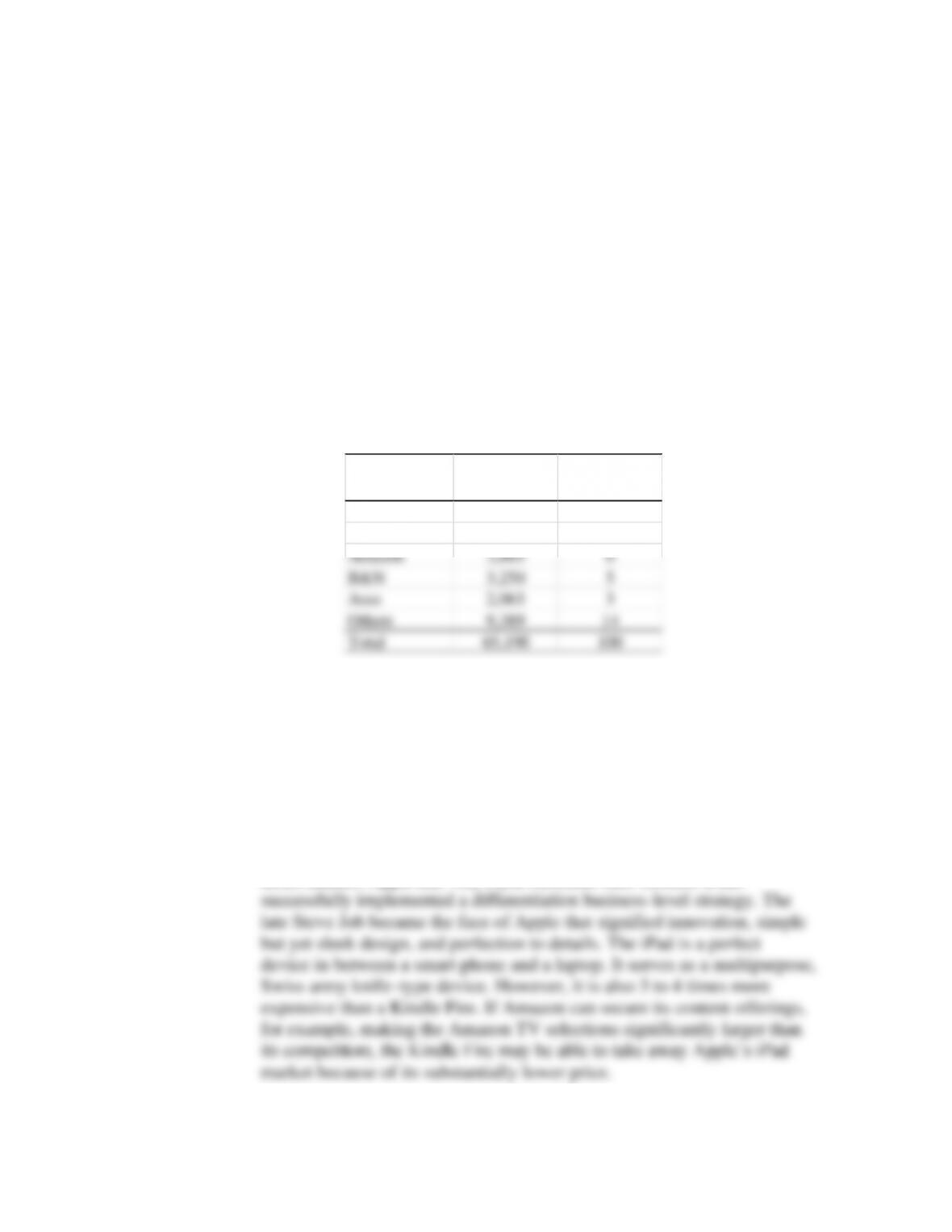
Date Price ($)
Change from
Last Release
Nov-07
399 N/A
Jun-08 399 0.00%
Dec-08 359 -10.03%
Jul-09 299 -16.71%
Jan-10 259 -13.38%
Aug-10 189 -27.03%
Feb-11 139 -26.46%
Sep-11 119 -14.39%
Apr-12 79 -33.61%
Kindle Fire: Amazon’s Heated Battle for the Tablet Market
Based on the Five Forces analysis, it will not be easy for Amazon to remain a cost
leader unless Bezos continues to innovate and cut cost. The main issues with
implementing a cost leadership business-level strategy are obsolescence, cost reductions,
and imitation. In order for Amazon to remain a cost leader, it will need to constantly
improve its products and services, and come out with newest technology and solutions; at
the same time, Amazon has to offer all these at a very competitive price.
• How does Amazon’s Kindle Fire strategy stand up against competitive rivalry in
the industry?
The Kindle Fire was previewed in 2011, and it came preloaded with a modified
version of the Google Android OS. It has 7” color LCD touch screen, a Wi-Fi radio, a
powerful dual-core processor, a fixed 8 GB of internal storage, and a free cloud storage.
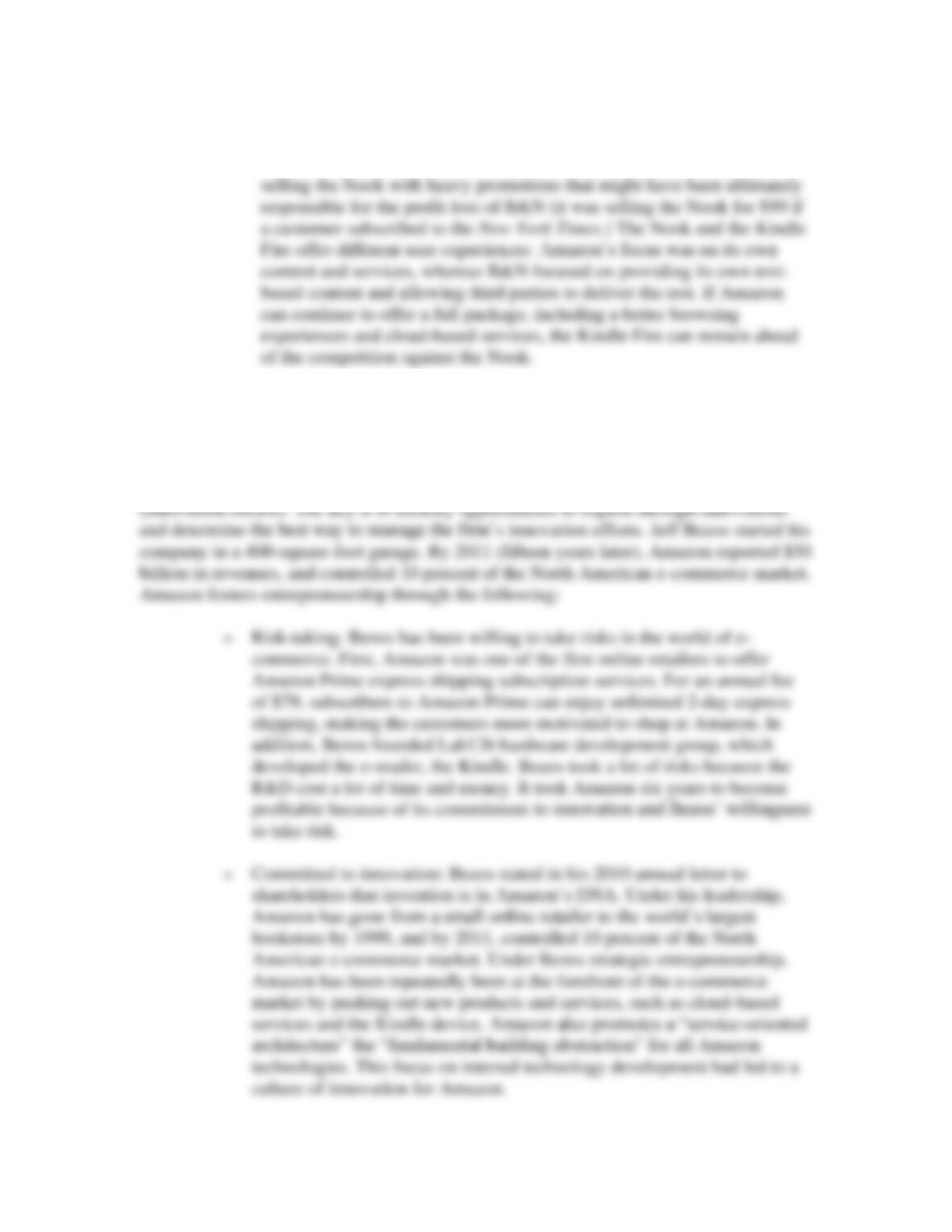
In 2011, the global top media tablet brands are:
As the table demonstrated above, Amazon’s Kindle devices do not even compete
well against Apple’s iPads. Kindle Fire’s direct competitors are the Nook Tablets by
B&N, and the iPad 2 by Apple. Apple has been extremely successful in terms of the
tablet market. The iPad 2 is bigger than a Kindle Fire (in terms of screen size) but thinner
than a Kindle Fire (though also heavier). A Kindle Fire targets media junkies, children
and mobile gamers, and higher education. How does amazon compete against Apple and
B&N? » The Kindle Fire against the iPad: The iPad was the first mover in the
tablet market. Apple has very royal customer base because it has
Brand
Shipment (in
Millions)
Market
Share (%)
Apple
40,493 62
Samsung 6,110 9
Amazon 3,885 6
B&N 3,250 5
Asus 2,063 3
Others 9,389 14
Total 65,190 100
Kindle Fire: Amazon’s Heated Battle for the Tablet Market
5
Amazon
» The Kindle Fire against the Nook: The Nook and the Kindle Fire are very
similar in terms of the hardware specifications. However, B&N was
• Describe the entrepreneurial characteristics of Amazon. How has Bezos
promoted innovation within the organization?
Strategic entrepreneurship is composed of entrepreneurial actions (exploiting
found opportunities in the external environment) through a strategic perspective
Kindle Fire: Amazon’s Heated Battle for the Tablet Market
6
Amazon
» Proactive in creating opportunities rather than waiting to respond to
opportunities created by others: As described above, Amazon was in the
front of innovation and created its own opportunities by offering new
services and products. Amazon has a long history of investing in emerging
opportunities years ahead of revenues or profitability.
STRATEGY
• Is the current strategy for the Amazon’s Kindle Fire suitable for the existing
market? What recommendations can be made to address strategic concerns and
safeguard Amazon’s growth and market share?
7
Amazon
1. Challenging leading competitors: Amazon’s leading competitor, Apple, is
known to bringing the best personal computing, mobile communication,
2. Innovation: Amazon needs to invest heavily in R&D, with a broadly defined
3. Personalization: Amazon can offer users the opportunity to turn the Internet
into a unique and personal online portal by displaying specific content, pages,