13
Chapter 5: Target Markets: Segmentation, Evaluation, and Positioning
CLASS EXERCISES
Class Exercise 1: Segmentation Variables
The objective of this class exercise is to gain a thorough understanding of segmentation variables by
designing a target market for a new retail operation.
Prompt for Students:
You have just received a sizable inheritance. After giving part of it to charity, you have $500,000
remaining to begin a new retail operation in your local area. What kind of operation will you open?
1. What market or segment of a market exists in your area with unfulfilled needs or wants?
2. Briefly describe the nature of the operation you would open to meet the needs of a specific market
segment(s).
a. Good or service?
b. Price range?
c. Location?
3. Will you use a concentrated or a differentiated targeting strategy? Why?
4. What segmentation variables will be useful in describing your target market(s)? Why?
Answers:
1. Other ways of asking this question are “What kinds of retail stores do you wish were available
2. Students could spend the entire class period on this question, so encourage them to be brief. An
3. The answer to this question will depend on the type of product being offered, but students often
4. This question should take up the majority of the exercise time. Ask students to look carefully at each
Class Exercise 2: Segmentation Variables in Different Industries
14
Chapter 5: Target Markets: Segmentation, Evaluation,
and Positioning
This exercise is designed to get students to think in terms of segmentation variables discussed in the
chapter. For example, what demographic, geographic, psychographic, or lifestyle variables could have
been used to segment the market for baby food (variable 2)? Lifestyle segmentation variables could
include:
1. Consumers who want nothing but all-natural ingredients
2. Upscale consumers who want gourmet baby food
3. Time-conscious consumers who need instant or quick meals for their babies
Many other combinations are possible. Encourage students to be creative and imaginative. As with most
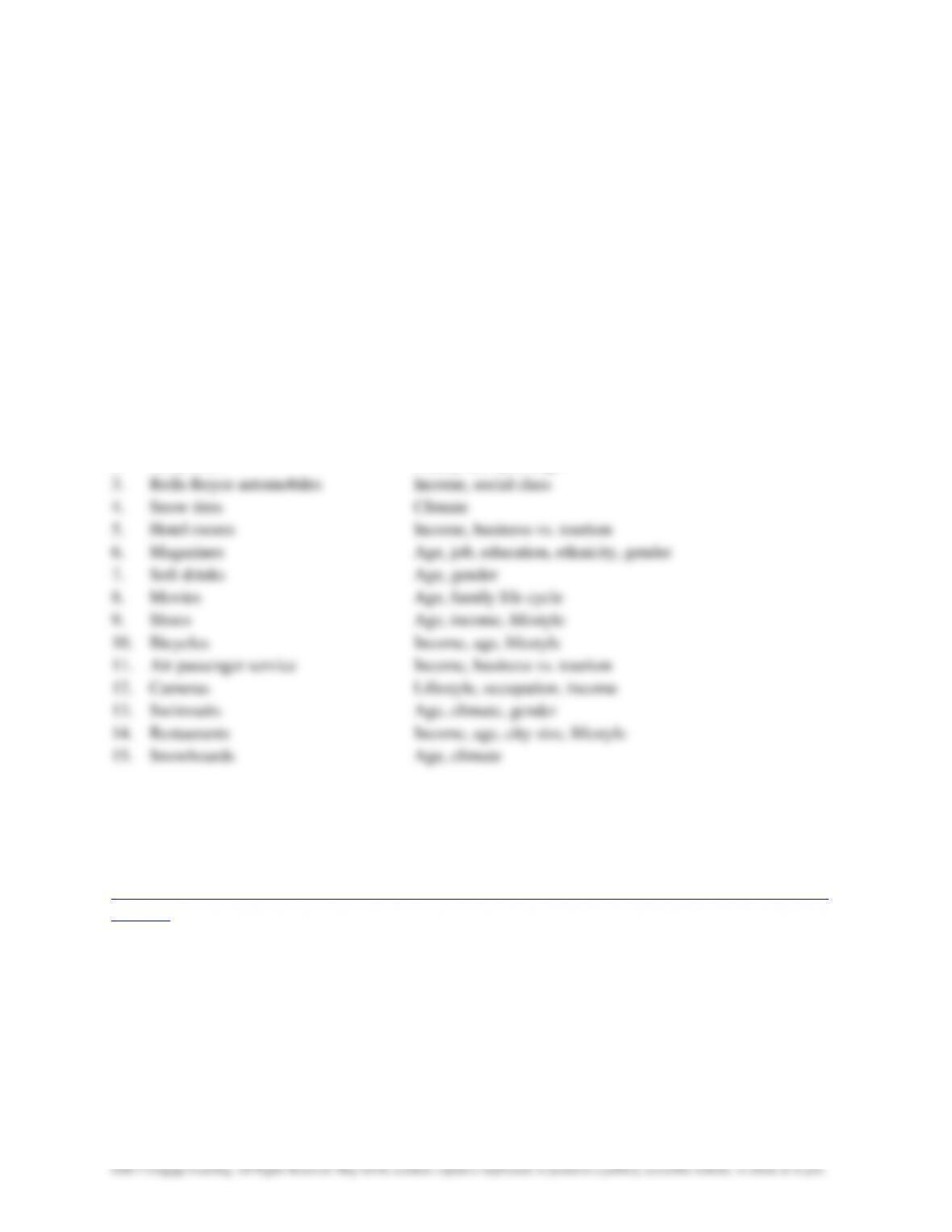
exercises, there are no right or wrong answers. The following list includes variables or characteristics that
could be used to segment markets for specific products.
Question
Answers
1.
Recreational vehicles (RVs)
Age, income
2.
Baby food
Family life cycle, age
3.
Rolls Royce automobiles
Income, social class
4.
Snow tires
Climate
5.
Hotel rooms
Income, business vs. tourism
6.
Magazines
Age, job, education, ethnicity, gender
7.
Soft drinks
Age, gender
8.
Movies
Age, family life cycle
9.
Shoes
Age, income, lifestyle
10.
Bicycles
Income, age, lifestyle
11.
Air passenger service
Income, business vs. tourism
12.
Cameras
Lifestyle, occupation, income
13.
Swimsuits
Age, climate, gender
14.
Restaurants
Income, age, city size, lifestyle
15.
Snowboards
Age, climate
Class Exercise 3: Demographics
Go to:
http://www.claritas.com/MyBestSegments/Default.jsp?ID=20&SubID=&pageName=ZIP%2BCode%2B
Look-up
Enter the 5 digit zip code for your school. Take students through a review of the area as seen through the
Prizm at claritas.com.
As an optional homework assignment, students could profile their hometowns through this free service
and discuss the findings. Students could discuss whether they think the findings are valid or not and why.

15
Chapter 5: Target Markets: Segmentation, Evaluation, and Positioning
CHAPTER QUIZ
1. Miller Brewing does not consider teenagers to be a part of the beer market because they lack the
__________ to buy beer.
a. money
b. desire
c. interest
d. authority
e. willingness
2. In the _______________, experts create initial forecasts, submit them to the company for averaging,
and have the results returned to them so they can make individual refined forecasts.
a. regression analysis
b. time series analysis
c. Delphi technique
d. expert forecasting survey
e. trend analysis
3. If a company markets its products to different countries, it is using a(n) __________ targeting
strategy to segment the total market.
a. undifferentiated
b. concentrated
c. stratified
d. differentiated
e. homogeneous
4. Occupation, family size, and family life cycle are all __________ variables for segmenting consumer
markets.
a. behavioristic
b. demographic
c. geographic
d. psychographic
e. usage
16
Chapter 5: Target Markets: Segmentation, Evaluation,
and Positioning
ANSWERS TO ISSUES FOR DISCUSSION AND REVIEW
1. What is a market? What are the requirements for a market?
2. In your local area, identify a group of people with unsatisfied product needs who represent a
market. Could this market be reached by a business organization? Why or why not?
3. Outline the five major steps in the target market selection process.
Although marketers may employ several methods for target market selection, they generally follow a
4. What is an undifferentiated strategy? Under what conditions is it most useful? Describe a
present market situation in which a company is using an undifferentiated strategy. Is the
business successful? Why or why not?
Students’ answers to the rest of the question may vary.
5. What is market segmentation? Describe the basic conditions required for effective
segmentation. Identify several firms which use market segmentation.
17
Chapter 5: Target Markets: Segmentation, Evaluation, and Positioning
Market segmentation is the process of dividing a total market into groups, or segments, that consist
Students’ answers to the rest of the question may vary.
6. List the differences between concentrated and differentiated strategies, and describe the
advantages and disadvantages of each.
The main difference between the concentrated strategy and the differentiated strategy of market
segmentation is that the concentrated strategy directs marketing efforts toward a single market using
7. Identify and describe four major categories of variables that can be used to segment consumer
18
Chapter 5: Target Markets: Segmentation, Evaluation,
and Positioning
markets. Give examples of product markets that are segmented by variables in each category.
The four major categories of variables that can be used to segment consumer markets are:
• Demographic variables—demographic characteristics that marketers commonly use include
8. What dimensions are used to segment business markets?
9. Define geodemographic segmentation. Identify several types of firms that might employ this
type of market segmentation, and explain why.
Geodemographic segmentation clusters people by zip codes or neighborhood units based on lifestyle
10. What is a market segment profile? Why is it an important step in the target market selection
process?
©2017 Cengage Learning. All Rights Reserved. May not be scanned, copied or duplicated, or posted to a publicly accessible website, in who le or in part.
11. Describe the important factors marketers should analyze to evaluate market segments.
After analyzing the market segment profiles, a marketer should be able to narrow his or her focus to
several promising segments that warrant further analysis. Marketers should examine sales estimates,
12. Why is a marketer concerned about sales potential when trying to select a target market?
©2017 Cengage Learning. All Rights Reserved. May not be scanned, copied or duplicated, or posted to a publicly accessible website, in whole or in part.
13. Why is selecting appropriate target markets important for an organization that wants to adopt
the marketing concept philosophy?
14. What is a sales forecast? Why is it important?
155. What are the two primary types of surveys a company might use to forecast sales? Why would
a company use an outside expert forecasting survey?
The two primary types of surveys a company might use to forecast sales are the customer forecasting
survey and the sales force forecasting survey. In the first type, marketers ask customers what types
©2017 Cengage Learning. All Rights Reserved. May not be scanned, copied or duplicated, or posted to a publicly accessible website, in who le or in part.
166. Under what conditions are market tests useful for sales forecasting? What are the advantages
and disadvantages of market tests?
177. Under what conditions might a firm use multiple forecasting methods?
22
Chapter 5: Target Markets: Segmentation, Evaluation,
and Positioning
ANSWERS TO DEVELOPING YOUR MARKETING PLAN
The information obtained from the following questions should assist you in developing various aspects of
your marketing plan. Develop your marketing plan online using the Interactive Marketing Plan at
www.cengagebrain.com.
1. What type of targeting strategy is being used for your product? Should a different
targeting strategy be employed?
2. Select and justify the segmentation variables that are most appropriate for segmenting the
market for your product. If your product is a consumer product, use Figure 5.3 for ideas
regarding the most appropriate segmentation variables. If your marketing plan focuses on a
business product, review the information in the section entitled “Variables for Segmenting
Business Markets.”
3. Discuss how your product should be positioned in the minds of customers in the target market
relative to the product positions of competitors.
23
Chapter 5: Target Markets: Segmentation, Evaluation, and Positioning
COMMENTS ON VIDEO CASE 5: MIKE BOYLE WANTS CUSTOMERS
WHO WANT TO TRAIN
Summary
This case discusses Mike Boyle Strength and Conditioning (MBSC), a gym founded by entrepreneur
Mike Boyle for people who want to actively train. Mike Boyle had worked as a trainer for professional
sports teams for several years, so he frequently saw how people often join gyms with good intentions but
then lose their motivation. Boyle wanted to create a gym that would offer social support and professional
advice, but that would target those who wanted to actively train and attain their fitness goals. MBSC
tailors its services differently depending upon age as well as how active the individual is in specific
sports. Even those who aren’t athletes appreciate MBSC as a resource for taking their fitness to the next
level. Today, Boyle’s customers range in age from 11 to 80.
Questions for Discussion
1. Which demographic variables does MBSC use in segmenting the market for its services? Be
specific.
Mike Boyle Strength and Conditioning (MBSC) uses age as one variable for segmentation. It
2. Which psychographic and behavioristic variables does MBSC use, and why?
3. Would you recommend that MBSC use an undifferentiated strategy, a concentrated
strategy, or a differentiated strategy to market its services? Explain your answer.