
Chapter 7: The Marketing Plan
CHAPTER 7: THE MARKETING PLAN
CHAPTER OUTLINE
Spotlight: Checkerboard Ltd.: Building a Bigger Share of a Shrinking Market
(http://swww.checkernet.com)
1) What Is Small Business Marketing
LO1: Describe small business marketing.
i) Small business Marketing – business activities that direct the creation,
development, and delivery of a bundle of satisfaction from the creator to the
targeted user
ii) Core product/service – The fundamental benefit or solution sought by customers
iii) Actual product/service – The basic physical productand/or service that delivers
those benefits
iv) Augmented product/service – The basic productand/or service plus any extra or
unsolicited benefits to the consumer that may prompt a purchase
a) Marketing Philosophies Make a Difference
i) Three different marketing perspectives
(1) Production-oriented philosophy – emphasizes the product as the single most
important part of the business
(2) Sales-oriented philosophy – emphasizes pushing the product
(3) Consumer-oriented philosophy – centers on the consumer and his/her needs
b) A Consumer Orientation—The Right Choice
i) This philosophy is most consistent with long-term success
ii) Why don’t all firms adopt a consume orientation when the benefits seem so
obvious?
(1) State of competition
(2) Weak in marketing ability
(3) Too focused on the present
iii) Market analysis – The process of locating and describing potential customers
iv) Marketing mix – The combination of product, pricing, promotion, and distribution
activities
2) The Formal Marketing Plan
LO2: Identify the components of a formal marketing plan.
a) Market Analysis
i) Customer profile – A description of potential customers in a target market
ii) Actual sales forecast – should include the most likely, best case, and worst case
scenarios
b) The Competition
i) Existing competitors – key management personnel profiles, competitors’ overall
strengths and weaknesses
ii) Existing related products or those possibly in the pipeline
iii) SWOT Analysis
c) Marketing Strategy

Chapter 7: The Marketing Plan
i) Market analysis and information on competition provide the basis of the
marketing strategy
ii) A good marketing management system should include:
(1) Online marketing strategies, including website development and support
(2) Social media and content management
(3) Public relations planning and crisis management
(4) Standard startup marketing packages
(5) Tested direct mail programs
iii) Marketing mix should be addressed (the 4 “Ps”)
(1) Product/service
(2) Place (distribution activities)
(3) Pricing
(4) Promotion
iv) The Product/Service Section
(1) Name of product and/or service
(2) Name of business
(3) Why they were selected
(4) Packaging should be presented via drawings
(5) Register names selected (business and/or product/service)
(6) Customer service plans
(7) Unique features of product
(8) Intellectual property – original intellectual creations, including inventions,
literary creations, and works of art, that are protected by patents or copyrights
v) Place—The Distribution Section
(1) The process of getting the product to the consumer
(2) Exporting issues
vi) The Pricing Section
(1) At minimum price must cover the cost of bringing it to customers
(2) Check competitors prices
(3) Develop a break-even computation
(4) Other issues such as niche
vii) The Promotion Section
(1) Should describe the approach to creating customer awareness of
product/service
(2) Why customers will be motivated to buy
3) Marketing Research for the Small Business
LO3:Discuss the nature of the marketing research process.
a) The Nature of Marketing Research
i) Marketing Research- The gathering, processing, interpreting, and reporting of
market information
ii) Estimate projected costs and compare costs with benefits
b) Steps in the Marketing Research Process
i) Step One: Identifying the Informational Need
ii) Step Two: Searching for Secondary Data – market information that has been
previously compiled
c) Step Three: Collecting Primary Data

(1) Primary data – new market information that is gathered by the firm
conducting the research
(2) Observational Methods
(a) Oldest form of research
(b) Mystery shopping
(c) Internet
(d) Major industry trade shows
(1) Questioning Methods
(a) Surveys – mail, telephone the Web, personal interview
(b) Questionnaire – pre-test before using When desiging a questionnaire keep
in mind the following:
(i) Ask questions that relate to the issue under consideration.
(ii) Select the form of quesiotn, such as open-ended and multiple choice,
that is most appropriate for the subject and the conditions of the
survey.
(iii)Carefully consider the order of the questions.
(iv) Ask the more sensitive question near the end of the questionnaire.
(v) Carefully select the words in each question.
(vi) Pretest the questionnaire by administering it to a small sample of
respondents who are representative o the group to be surveyed.
d) Step Four: Interpreting the Data Gathered – Must be transformed into usable
information
4) Understanding Potential Target Markets
LO4: Define market segmentation, and discuss its related strategis.
i) Market – a group of customers or potential customers who have purchasing power
and unsatisfied needs. Three ingredients to this definition:
(1) A market must have buying units, or customers.
(2) Customers in a market must have purchasing power.
(3) A market must contain buying units with unsatisfied needs.
a) Market Segmentation and Its Variables
i) Market segmentation – The division of a market into several smaller groups with
similar needs
ii) Segmentation variables –The parameters used to distinguish one form of market
behavior from another
i) Benefit variables – The specific characteristics that distinguish market segments
according to the benefits sought by customers
ii) Demographic variables – The specific characteristics that describe customers and
their purchasing power
b) Marketing Strategies Based on Segmentation Considerations
i) The Unsegmented Strategy (mass marketing) – a strategy that defines the total
market as the target market (see Exhibit 7.3)
ii) The Multisegment Strategy – A strategy that recognizes different preferences of
individual market segments and develops a unique marketing mix for each
iii) The Single-Segment Strategy – A strategy that recognizes the existence of several
distinct market segments but focuses on only the most profitable segment
5) Estimating Market Potential
Chapter 7: The Marketing Plan
LO5: Explain the different methods of forecasting sales.
a) The Sales Forecast
i) Prediction of how much of a product or service will be purchased within a given
market during a specified time period
ii) Differing periods of time
iii) Essential component of business plan because is critical to assessing the
feasibility of a new venture
b) Limitations of Forecasting
i) Used less frequently by small businesses – inexperience along with a new idea
causes difficulty in forecasting situation
ii) Business manager may be unfamiliar with methods of quantitative analysis;
quantitative methods have proven value in forecasting
iii) Forecasting process unfamiliar to management team
c) The Forecasting Process
i) The Starting Point
(1) Breakdown process (chain-ratio method) – begins with a larger-scope variable
and works down to the sales forecast
(2) Buildup process – all potential buyers in a target market’s submarkets are
identified and then the estimated demand is added up
ii) The Predicting Variable
(1) Direct forecasting – sales is the estimated variable
(2) Indirect forecasting – variables related to sales are used to project future sales
ADDITIONAL DISCUSSION QUESTIONS
1. What is the scope of small business marketing? What do you think the
differences in marketing might be if you were a manager in a large
corporation?
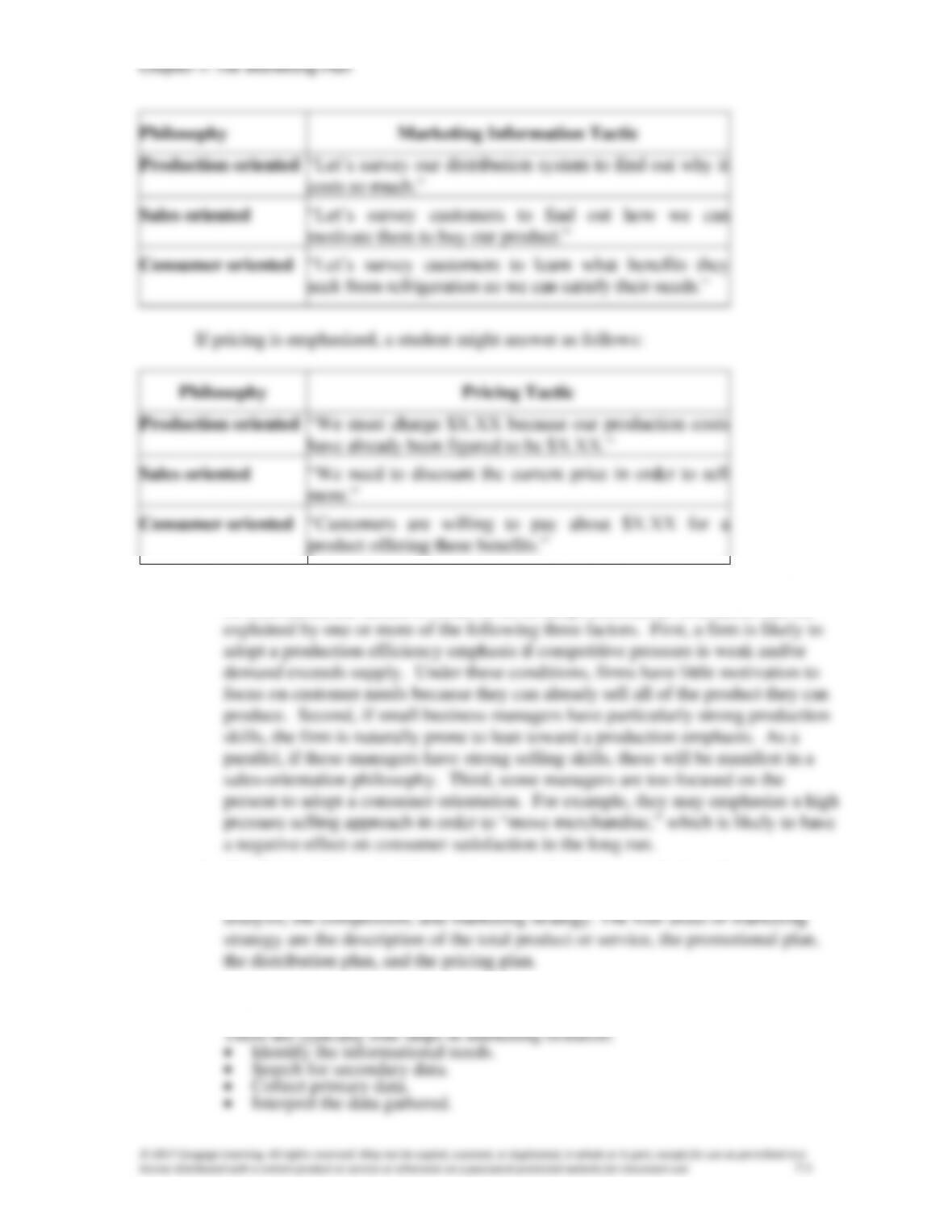
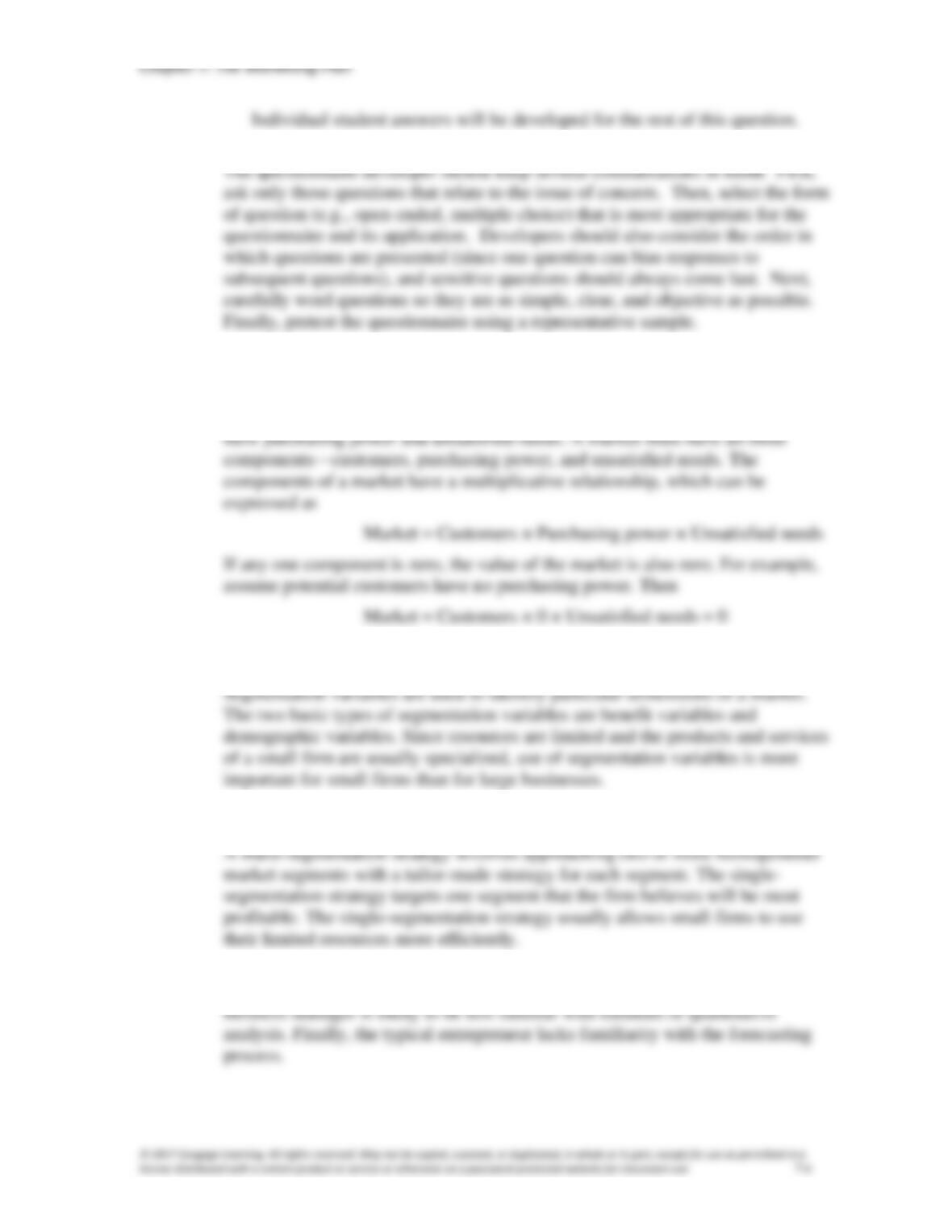
2. How do the three marketing philosophies differ? Select a product and discuss
marketing tactics that could be used to implement each philosophy.
The philosophies differ in the degree of emphasis placed on the consumer and the
© 2017 Cengage Learning. All rights reserved. May not be copied, scanned, or duplicated, in whole or in part, except for use as permitted in a
license distributed with a certain product or service or otherwise on a password-protected website for classroom use. 7-6
6. What are the major considerations in designing a questionnaire?
7. Briefly explain the three components of the definition of a market, as presented
in this chapter.
A market has been defined as a group of customers or potential customers who
8. What types of variables are used for market segmentation? Would a small firm
use the same variables as a large business? Why or why not?
9. Explain the difference between a multi-segment strategy and a single-segment
strategy. Which one is more likely to be appealing to a small firm? Why?
10. Explain why forecasting is used more widely by large firms than by small ones.
First, forecasting circumstances in a new business are unique. Second, a small
Chapter 7: The Marketing Plan
SUGGESTED ANSWERS TO YOU MAKE THE CALL EXERCISES
Situation 1
1. What factors should business owners consider when deciding to manage their
own website and online sales versus contracting for the service?
Students should brainstorm a list of benefits and risks.
2. Taylor Stitch has both a bricks and mortar store and an online store. What are
the advantages and disadvantages of this strategy?
Situation 2
1. How do you think Alden found out about Revinate? Given all the online
companies that might help your business connect with your customers, how
would you choose one?
2. Do you report your experiences with businesses on any social networks? Why
or why not?
Students will have individual answers to these questions.
Situation 3
1. Identify a minority group to which you do not belong. What steps could you
take to learn about that market segment in order to sell the consumers a
product or service?
2. Suppose your small business were contacted by a company in another country
that wanted to sell your products in its market. What would you want to know
about that market before going into it? Choose any country (other than the
United States) and determine what changes you would have to make to your
marketing plan to adjust to the different culture.
SUGGESTED SOLUTION TO CASE 7: READYMADE MAGAZINE
1. How does ReadyMade communicate the demographics of its reader base to
advertisers who want to see specific statistics about ReadyMade’s target
market?
2. What sort of segmentation does ReadyMade use when it markets to businesses
and investors?
3. What ideas do you have that would help ReadyMade reach out to new
subscribers without alienating its loyal base?