
Chapter 6 : The Business Plan: Visualizing the Dream
CHAPTER 6: THE BUSINESS PLAN: VISUALIZING THE DREAM
CHAPTER OUTLINE
Spotlight: Maternova
(http://www.maternova.net)
1) An Overview of the Business Plan
LO1: Explain the purpose and objectives of business plans.
i) Business Plan – a document that outlines the basic concept underlying a business
and describes how that concept will be realized. Consider personal aspirations
before beginning
ii) Three key elements that should be in every business plan
(1) A logical statement of a problem and its solution
(2) A significant amount of cold, hard, evidence
(3) Candor about the risks, gaps, and other assumptions that might be proved
wrong.
iii) A business plan, if done well, is a tool to be used by company insiders for
direction and to aid in the development of relationship with outsiders who could
help the company achieve its goals.
2) Will Writing a Plan Make a Difference?
LO2: Give the rationale for writing (or not writing) a business plan when starting a
new venture.
i) Business plan is NOT the business
ii) Entrepreneur must find the right balance between planning and becoming
operational
iii) Business plans offer no guarantee of success
iv) Business plans are models that help focus on important issues and activities for
the new venture and prepare for the future
v) Business plans matter to outsiders, especially important in getting financing
vi) Enhances the venture’s credibility, effective selling tool with prospective
customers and suppliers as well as investors
a) The Balance Between Planning and Executing
i) Some business environments might be too turbulent for extensive planning and
enough information might not be available.
ii) Planning can be a problem if timing is critical, but should not be used as an easy
excuse not to write one
iii) A shortage of capital might limit planning
b) What Form Will the Business Plan Take?
i) The Short Plan – A short form of a business plan that presents only the most
important issues and projections for the business
ii) The Comprehensive Plan – A full business plan that provides an in-depth analysis
of the critical factors that will determine a firm’s success or failure, along with all
the underlying assumptions
3) Begin with the Business Model

Chapter 6 : The Business Plan: Visualizing the Dream
LO3: Explain the concept and process for developing a firm’s business model.
a) What Is a Business Model?
i) A business model explains in a systematic and clear way how a business will
generate profits and cash flows.
b) Developing a Business Model
i) Revenue model—Common models
(1) Volume or unit-based revenue model
(2) Subscription/membership revenue model
(3) Advertising-based revenue model
(4) Licensing revenue model
ii) Actual revenue streams
(1) Single stream, where a firm’s revenues come from a single product or service
(2) Multiple streams, where a business realizes revenues from a combination of
multiple products and services
(3) Interdependent streams, where a company’s revenues come from selling one
or more products and/or services as a way to generate revenues from other
products and/or services, such as printers and printer cartridges
(4) Loss leader, where one or several revenue streams are sold at a loss in order to
create sales in a profitable revenue stream
iii) Key questions for future sales estimates
(1) Who are your most likely customers?
(2) How are they different from the general population?
(3) What events will trigger the need or desire for your type of product or service?
(4) When will these events occur? Can they be predicted?
(5) How will customers make decisions on whether or not to buy your product or
service?
(6) What will be the key decision factors?
(7) How will your product or service compare to that of the competition on these
key factors?
(8) Will these differences be meaningful to the customer?
(9) Are these differences known to the customer?
(10) How can your product or service be exposed to your most likely
potential customers?
iv) Cost Structures
(1) Cost structures are a component of the business model that provides a
framework for estimating a firm’s cost of goods sold and operating expenses.
(2) Fixed costs. Costs that do not vary at all with volume, such as rent expenses.
(3) Variable costs. Expenses that vary directly and proportionately with changes
in volume—for example, sales commissions.
(4) Semi-variable costs. Expenses that include both variable costs and fixed costs.
v) Key Resource Requirements—a component of the business model that provides
estimates of the types and amounts of resources required to achieve positive
profits and cash flows.
vi) Business Model Risk–a component of the business model that identifies risks in
the model and how the model can adjust to them.
4) Preparing a Business Plan: The Content and Format

Chapter 6 : The Business Plan: Visualizing the Dream
LO4: Describe the preferred content and format for a business plan.
i) You may have knowledge of a business that could be used as an example in this
section or you could choose a business plan available online to use as you work
through this section. The business plan example in Appendix A could also be used
for this purpose.
ii) The business plan should give thorough consideration to the following basic
factors (see Exhibit 6-2)
(1) The opportunity
(2) The critical resources
(3) The entrepreneurial team
(4) The financing structure
(5) The context (or external factors)
a) Cover Page
i) The cover page should contain the following information:
(1) Company name, address, phone number, fax number and website
(2) Tagline and company logo
(3) Name of contact person (preferable the president) with mailing address, phone
number, fax number, and e-mail address
(4) Date on which the business plan was prepared
(5) If the plan is being given to investors, a disclaimer that the plan is being
provided on a confidential basis to qualified investors only and it not to be
reproduced without permission
(6) Number of the copy (to help keep track of how many copies have been given
out).
b) Table of Contents
c) Executive Summary (a section of the business plan that conveys a clear and concise
overall picture of the proposed venture)
i) Synopsis (may be used rather than an Executive Summary)
ii) Narrative (may be used rather than an Executive Summary)
d) Company Description
e) Industry, Target Customer, and Competitor Analysis
f) Product/Service Plan (A section of the business plan that describes the product
to be provided and explains its merits)
g) Marketing Plan (A section of the business plan that describes the user benefits of the
product or service and the type of market that exists)
h) Operations and Development Plan (A section of the business plan that offers
information on how a product will be produced or a service provided, including
descriptions of the new firm’s facilities labor, raw materials, and processing
requirements)
i) Management Team (A section of the business plan that describes a new firm’s
organizational structure and the backgrounds of its key payers)
j) Critical Risks (A section of the business plan that identifies the potential risks that
may be encountered by an investor)
k) Offering (A section of the business plan that indicates to an investor how much
money is needed and when, and how the money will be used)

Chapter 6 : The Business Plan: Visualizing the Dream
l) Exit Strategy (a section of the business plan that focuses on options for cashing out
of the investment)
m) Financial Plan(A section of the business plan that projects the company’s financial
position based on well-substantiated assumptions and explains how the figures have
been determined Pro forma statements are projections of a company’s financial
statements for up to five years, including balance sheets, income statements, and
statements of cash flows, as well as cash budgets.
n) Appendix of Supporting Documents
i) Could include assumptions underlying the project
ii) Résumés of the management team
5) Advice for Writing a Business Plan -Offers practical advice on writing a business plan.
LO5:Offer practical advice on writing a business plan.
a) Analyze the Market Thoroughly
i) Nowhere in the business plan is it more important to provide hard evidence to
support your claims than when presenting your analysis of the market.
b) Provide Solid Evidence for Any Claims
i) Think of your assumptions and original beliefs not as facts, but as hypotheses to
be tested.
c) Think Like an Investor
i) It is essential for the entrepreneur to appreciate investors’ concerns about target
customers’ responses to a new product or service and to reach out to prospective
customers.
d) Don’t Hide Weaknesses-Identify Potential Fatal Flaws
i) Integrity matters
e) Maintain Confidentiality
i) Be cautious about divulging certain information.
f) Pay Attention to Details
i) Use good grammar.
ii) Limit the presentation to a reasonable length.
iii) Go for an attractive, professional appearance.
iv) Describe your product or service in lay terms.
6) Pitching to Investors
LO6: Explain hot to pitch to investors.
a) A pitch is verbal presentation of the business idea to investors.
b) 12 points
i) Identify the problem to be solved.
ii) Introduce your solution to the problem.
iii) Discuss your beginning traction for getting sales.
iv) Identify the target market.
v) Explain the costs of acquiring customers in your target market.
vi) Communicate the value proposition relative to competitors.
vii) Describe the basics of the revenue model.
viii) Provide financial projections, along with the assumptions.
ix) Sell the team.
x) Identify your funding needs, and explain the use of the funds.
Chapter 6 : The Business Plan: Visualizing the Dream
xi) Describe possible exit strategies—how the investors may be able to cash out.
xii) End on a high note—remind investors why your product/service/team is so great.
7) Resources for Business Plan Preparation
LO7: Identify available sources of assistance in preparing a business.
a) Computer-Aided Business Planning
b) Professional Assistance in Business Planning
i) If you choose to hire a consultant, the following suggestion may help you avoid
some costly mistakes:
(1) Get referrals.
(2) Look for a fit.
(3) Check references.
(4) Get it in writing.
8) Keeping the Right Perspective
LO7: Maintain the proper perspective when writing a business plan.
i) Writing a business plan is primarily an ongoing process and only secondarily the
means to an outcome. The process is just as important as—if not more so than—
the finished product
ADDITIONAL DISCUSSION QUESTIONS
1. What do entrepreneurs usually mean when they talk about a business plan?
There is no one correct definition of a business plan. After all, there is no one plan
2. When should you write a business plan? When might it not be necessary or even
advisable to write a plan?
A written plan helps to ensure systematic coverage of the important factors to be
Chapter 6 : The Business Plan: Visualizing the Dream
3. What are the two types of business plan? In what situation(s) would you use
each type of plan?
The two types of business plans are the summary plan and the comprehensive plan.
The summary plan is a short form of a business plan that only presents the most
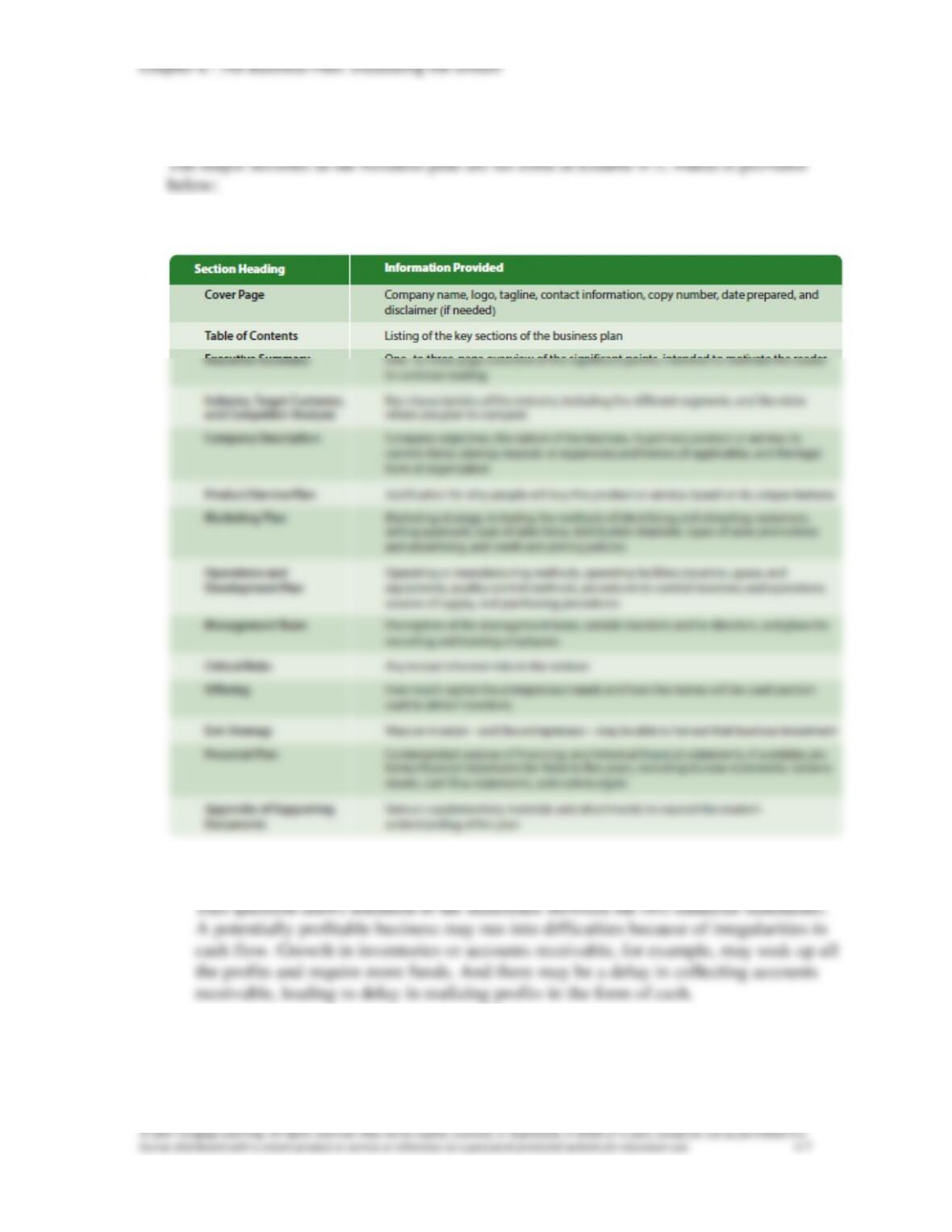
4. Why is the executive summary so important?
5. How might an entrepreneur’s perspective differ from an investor’s in terms of
the business plan?
The entrepreneur and the investor have very different interests. The entrepreneur is
Chapter 6 : The Business Plan: Visualizing the Dream
SUGGESTED ANSWERS TO YOU MAKE THE CALL EXERCISES
Situation 1
1. Why is your research thus far inadequate for what you need to know?
2. Do you think it will be difficult to find all the information you need?
3. What else might you do to find the information you need?
Situation 2
1. What would you need to know in order to answer her question?
No, a business plan is not necessary but what is critical is the implementation
2. If she decides to write a business plan, what advice would you give her?
Situation 3
1. What problems might have contributed to the firm’s poor performance?
Chapter 6 : The Business Plan: Visualizing the Dream
2. Although several problems were encountered in implementing the business
plan, the primary reason for low profits turned out to be embezzlement. Martin
was diverting company resources for personal use, even using some of the
construction material purchased by the company to build his own house. What
could Rose have done to avoid this situation? What are his options after the
fact?
He could have improved the systems for control of the company’s resources. He
SUGGESTED SOLUTION TO CASE 6: HYPER WEAR, INC.
1. Is HyperWear’s executive summary more of a synopsis or a narrative?
2. If you were an investor, would the executive summary spark your interest in the
opportunity? In other words, would you continue reading the business plan for
more details?
3. What do you like about this executive summary? What do you dislike?
4. Would you suggest that Fredenburg make any changes or additions to the
executive summary? If so, what do you suggest?