
Chapter 22: Managing The Firm’s Assets
CHAPTER 22: MANAGING THE FIRM’S ASSETS
CHAPTER OUTLINE
Spotlight: The Cutting Edge Elite
(http://www.ceenyc.com)
1) The Working Capital Cycle
LO1: Describe the working capital cycle of a small business.
i) Working-capital cycle includes a 5 step process:
(1) Step 1: Purchase or produce inventory for sale
(2) Step 2: Sell the inventory for cash or credit
(3) Step 3: Pay the accounts payable, which decreases the accounts payable and
decrease cash.
(4) Collect the accounts receivable when due
(5) Begin the cycle again
ii) Steps graphically indicated in Exhibit 22-1 Working-Capital Cycle
iii) Think of working capital as the liquid assets (cash and those soon to be converted
into cash) that are required to run grow the business.
b) The Timing and Size of Working Capital Investments
i) Failure to understand the timing and size of these investments underlies many
financial problems of small firms
ii) Exhibit 22-2 shows the chronological sequence of a hypothetical working capital
cycle.
iii) Cash conversion period represents the number of days required to complete the
working capital cycle, which ends with the conversion of accounts receivable into
cash.
c) Examples of Working Capital Management
i) Exhibit 22.3 offers an example of working capital management for two
hypothetical firms with contrasting working capital cycles.
(1) Both firms order inventory on August 31, other information differs
(2) Pokey, Inc.
(a) Must pay supplier on September 30 before reselling it on October 15
(b) Collects from customers on November 30
(c) Firm needs to find a way to finance the investment in inventory and
accounts receivable to avoid cash flow problems
(3) Quick Turn Company
(a) Must pay for inventory purchases by October 31, but sold product on
September 30
(b) Collected from customers on October 31
(c) No cash conversion period
2) Managing Cash Flows
LO2: Identify the important issues in managing a firm’s cash flows.
i) Effective cash flow management vital
ii) Core of working-capital management is monitoring cash flows

Chapter 22: Managing The Firm’s Assets
iii) Net cash flow may be determined by examining its bank account
iv) Exhibit 22.4 illustrates the Flow of Cash through a Business
v) Must distinguish between sales revenue and cash receipts (seldom the same)
vi) Cash budget essential to anticipate when cash will enter and leave the business
3) Managing Accounts Receivable
LO3: Explain the key issues in managing accounts receivable
a) How Accounts Receivable Affect Cash
(1) Have students discuss loaning $50 to a friend expecting to be paid back in 7
days. Then the friend “forgets” to pay the money back. What does that do to
the student’s individual cash flow?
i) Allowing customers to delay payment (using credit) delays the inflow of cash
ii) Total amount of customers’ credit balances is carried on the balance sheet as
accounts receivable, a current asset
iii) Typically accounts receivable become cash within 30-60 days following a sale
b) The Life Cycle of Accounts Receivable
(1) Continue the discussion with the student loan of $50. Ask the students what
happens as the length of time that they keep waiting for their $50 grows
longer.
i) Days sales outstanding (average collection period) is also called the average
collection period
(1) Determine by dividing a firm’s accounts receivable by daily credit sales
ii) Small companies are vulnerable to problems caused by slow collections
iii) Large companies typically take 60 or 90 days to pay an invoice regardless of the
credit terms stated on the invoice
iv) Credit management practices that can have a positive effect on cash flows
(1) Minimize the time between shipping, invoicing, and sending notices on
billings
(2) Review previous credit experiences to determine impediments to cash flows
(3) Provide incentives for prompt payment (granting cash discounts or charging
interest on delinquent accounts)
(4) Age accounts receivable on a monthly or even weekly basis to quickly
identify any delinquent accounts
(5) Use the most effective methods for collecting overdue accounts
(6) Use a lock box for receiving remittances
c) Accounts Receivable Financing
i) Pledged accounts receivable are used as collateral for a loan
ii) Factoring, business sells its accounts receivable to a finance company
4) Managing Inventory
LO4: Discuss the key issues in managing inventory
a) Reducing Inventory to Free Cash
i) Inventory size and handling differs for businesses such as a service company as
compared to a manufacturer or retailer
ii) Refer to Chapter 21 and inventory management techniques
b) Monitoring Inventory
i) Days in inventory is the number of days on average that a company holds
inventory

Chapter 22: Managing The Firm’s Assets
ii) Computers can provide assistance in inventory
c) Controlling Stockpiles
i) Overbuying of inventory
(1) Entrepreneur’s enthusiasm may be forecast greater demand than is realistic
(2) Customer relationship may motivate a manager to stock everything customers
want
(3) Price-conscious manager may respond to a vendor’s appeal to “buy now,
because prices are going up.”
5) Managing Accounts Payable
LO5: Explain key issues in managing accounts payable.
i) Negotiation
ii) Timing
iii) Exhibit 22.5 shows the possible settlement costs over the credit period of 30 days.
6) Cash Conversion Period Revisited
LO6: Calculate and interpret a company’s cash conversion period.
i) The time span during which the firm’s investment in accounts receivable and
inventory must be financed
ii) Key concern for any small business
7) Capital Budgeting Techniques
LO7: Discuss the techniques commonly used in making capital budgeting
decisions.
i) Capital budgeting analysis forms the framework for a company’s long-term future
development and can have a profound effect on a company’s future earnings and
growth.
a) Accounting Return on Investment
i) Technique compares the average annual after-tax profits a firm expects to receive
with the average book value of the investment
ii) Easy to calculate, but two major shortcomings
(1) Based on accounting profits rather than actual cash flows received
(2) Ignores the time value of money
b) Payback Period
i) Payback period technique measures how long it will take to recover the initial
cash outlay of an investment
ii) Many managers and owners use this technique in evaluating investment decisions
c) Discounted Cash Flows
i) Discounted cash flow (DCF) techniques compare the present value of future cash
flows with the investment outlay
ii) Net present value (NPV) estimates the current value of the cash that will flow into
the firm from the project in the future and deducts the amount of the initial outlay
iii) Internal rate of return (IRR) estimates the rate of return that can be expected from
a contemplated investment
5) Capital Budgeting Practices in Small Firms
LO8: Describe the capital budgeting practices of small firms.
i) An increasing number of small business owners use some form of quantitative
measure to assess a capital investment
Chapter 22: Managing The Firm’s Assets
ii) Many are attempting to forecast future case flows
iii) Only a small number rely on discounted cash flow techniques
ADDITIONAL DISCUSSION QUESTIONS
1. List the events in the working-capital cycle that directly affect cash and those
that do not. What determines the length of a firm’s cash conversion period?
Working-capital management primarily involves management of three assets—
cash, accounts receivable, and inventories—and two sources of short-term debt—
2. What are some examples of cash receipts that are not sales revenue? Explain
how expenses and cash disbursements during a month may be different.
Cash receipts that are not sales revenue include money obtained by borrowing,
3. How may a seller speed up the collection of accounts receivable? Give examples
that may apply to various stages in the life cycle of receivables.
The seller may speed up the billing process by sending invoices promptly—an
4. Suppose that a small firm could successfully shift to a just-in-time inventory
system—an arrangement in which inventory is received just as it is needed.
How would this affect the firm’s working capital management?
5. How do working capital management and capital budgeting differ?
Working-capital management has more to do with the short-term, day-to-day
evaluation are needed.
6. Compare the different techniques that can be used in capital budgeting
analysis.
All the techniques attempt to answer one general question: Do the future benefits
7. What does net present value measure?
8. Define internal rate of return.
Internal rate of return is the rate earned on an investment or project. It is the rate
9. a. Find the accounting return on investment for a project that costs $10,000, will
have no salvage value, and has expected annual after-tax profits of $1,000.
b. Determine the payback period for a capital investment that costs $40,000 and
has the following after-tax profit. (The project outlay of $40,000 will be
depreciated on a straight-line basis over seven years to a zero salvage value.)
Chapter 22: Managing The Firm’s Assets
© 2017 Cengage Learning. All rights reserved. May not be copied, scanned, or duplicated, in whole or in part, except for use as permitted in a
license distributed with a certain product or service or otherwise on a password-protected website for classroom use. 22– 6
5 6,500
6 6,000
7 5,000
a. Accounting return on investment = ($1,000 [$10,000 + 0]) = 0.20, or 20%
b. After-Tax Cash Cumulative
Year Profits Depreciation Flow Cash Flow
1 $4,000 $5,714 $9,714 $9,714
2 5,000 5,714 10,714 20,428
3 6,000 5,714 11,714 32,142
4 6,500 5,714 12,214 44,356
After Year 3, $7,858 (or $40,000 – $32,142) remains to be repaid, and it is paid
after 64.33% (or $7,858 $12,214) of Year 4 has elapsed. The total payback period
is 3.64 years.
10. Why would owners of small businesses not be inclined to use the net present
value or internal rate of return measurements?
Such limited use of discounted cash flow techniques probably has more to do with
the nature of the small firm itself than with the owners’ unwillingness to learn.
SUGGESTED ANSWERS TO YOU MAKE THE CALL EXERCISES
Situation 1
1. What are the advantages and weaknesses of the minimum-cash-balance
practice?
The advantages are the ability to pay bills promptly and the chance to eliminate
2. There is a saying “If it ain’t broke, don’t fix it.” In view of the firm’s present
success in paying bills promptly, should it be encouraged to use a cash budget?
Be prepared to support your answer.
The firm should be encouraged to use a cash budget in order to maximize its
Situation 2
1. Is offering a cash discount the equivalent of a bribe?
2. How would a cash discount policy relate to bad debts?
If payment that otherwise would be postponed can be encouraged to come in
3. What cash discount policy, if any, would you recommend?
In answering this question, the first step should be to examine the credit policies
4. What other approaches might be used to improve cash flow from receivables?
Situation 3
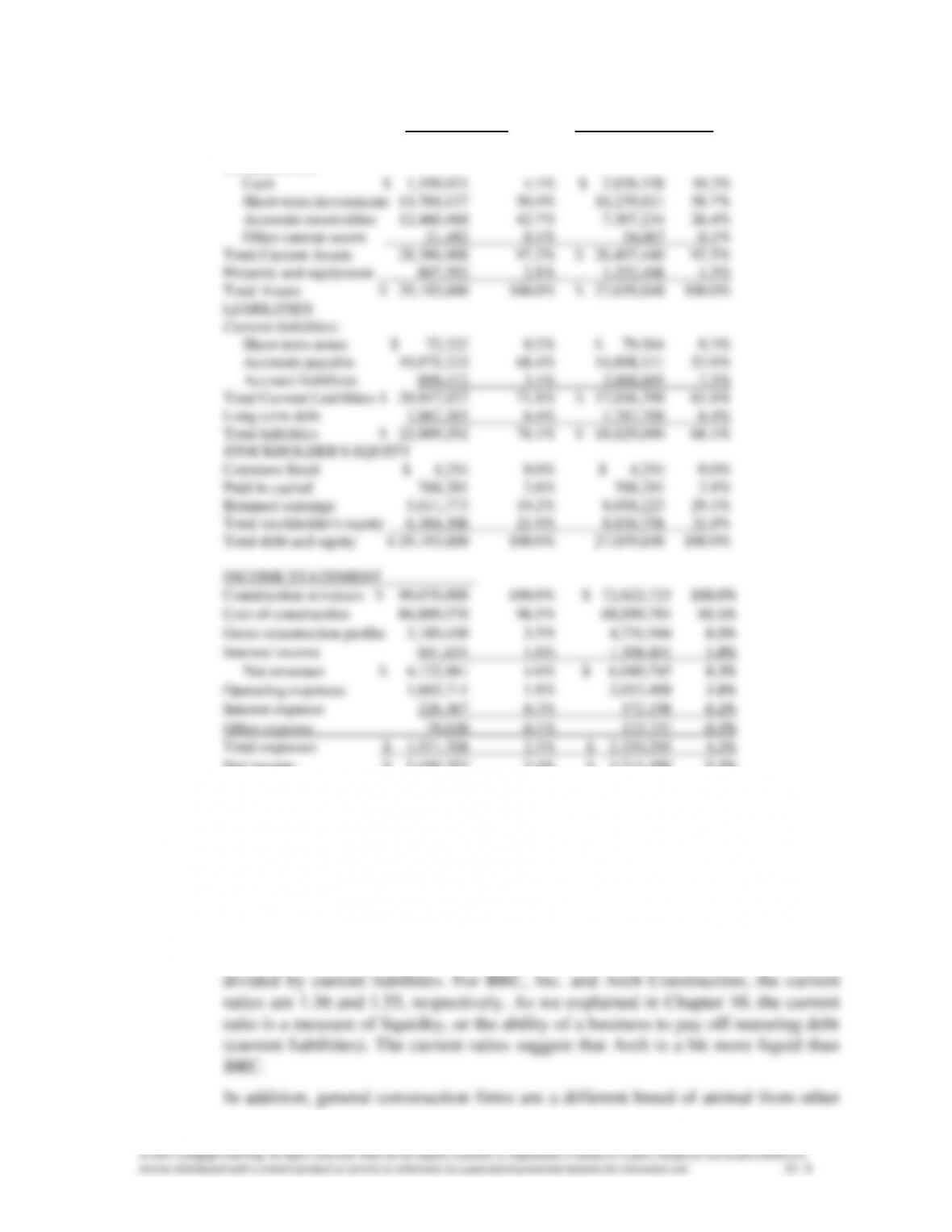
1. Based on the information in the balance sheets, what do you notice about the
nature of the general contracting business in terms of their working capital?
How are the two companies alike, and how do they differ?
Chapter 22: Managing The Firm’s Assets
BALANCE SHEET BRC, Inc. Arch Construction
ASSETS
Current assets:
Net income $ 2,150,353 2.4% $ 3,711,450 5.1%
2. Have a general contractor explain to you what the financial statements say about
this type of business.
A firm’s net working capital is equal to its current assets less its current liabilities.
It can also be expressed in relative terms as the current ratio, which is current assets
Chapter 22: Managing The Firm’s Assets
© 2017 Cengage Learning. All rights reserved. May not be copied, scanned, or duplicated, in whole or in part, except for use as permitted in a
license distributed with a certain product or service or otherwise on a password-protected website for classroom use. 22– 9
companies when it comes to working capital. First, the assets for a construction
company are almost all cash and marketable securities (government securities and
CD’s). For one thing, they have to carry significant cash and near cash to be bonded
when bidding on a construction job. Secondly, they have little in the way of
inventories, which are the least liquid current assets. In the case of BRC and Arch,
about 90 percent of their assets are in cash and marketable securities.
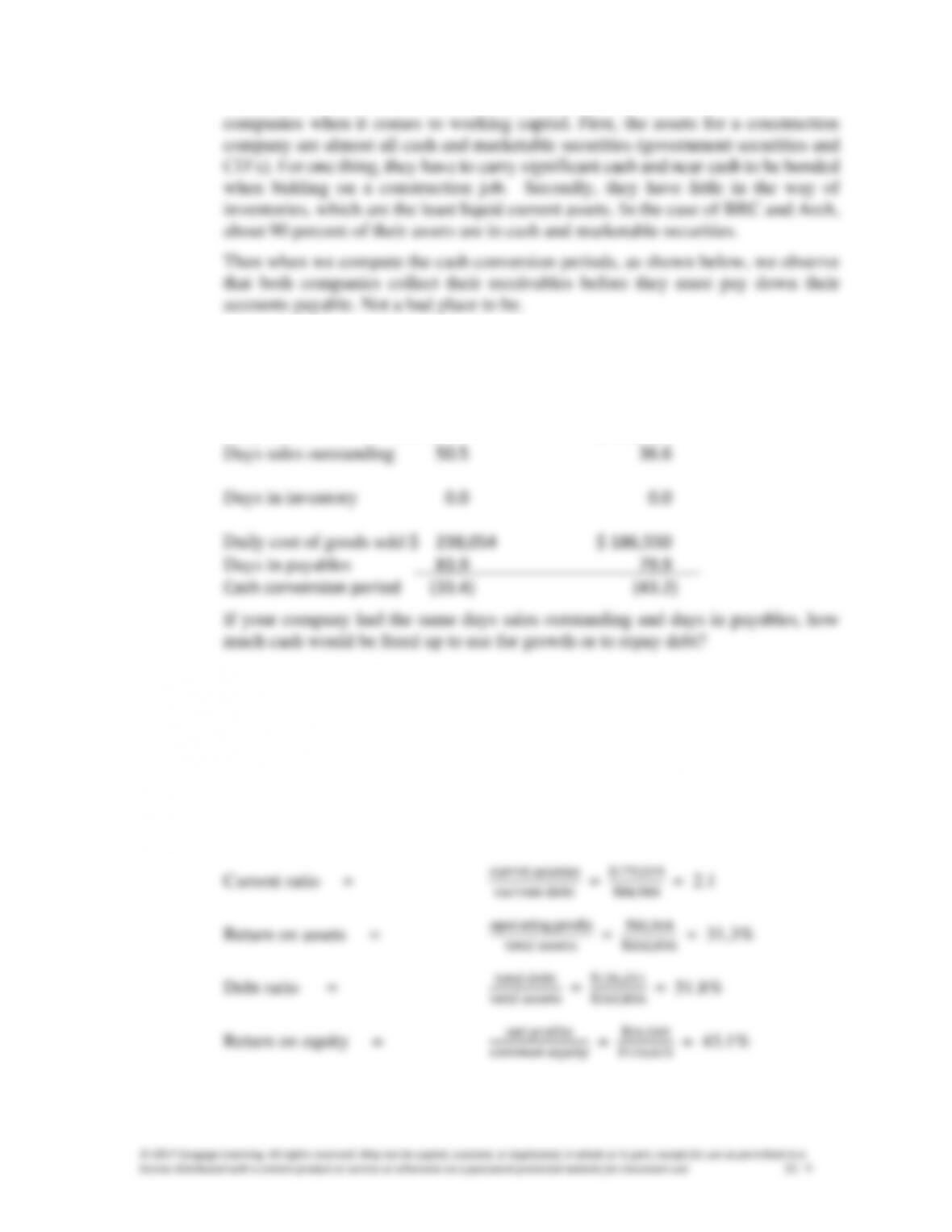
Then when we compute the cash conversion periods, as shown below, we observe
that both companies collect their receivables before they must pay down their
accounts payable. Not a bad place to be.
3. Compute the cash conversion period for each company and interpret your
findings.
Daily sales $ 246,767 $ 199,514
SUGGESTED SOLUTION TO CASE 22: PEARSON AIR CONDITIONING &
SERVICE
1. Evaluate the overall performance and financial structure of Pearson Air
Conditioning & Service.
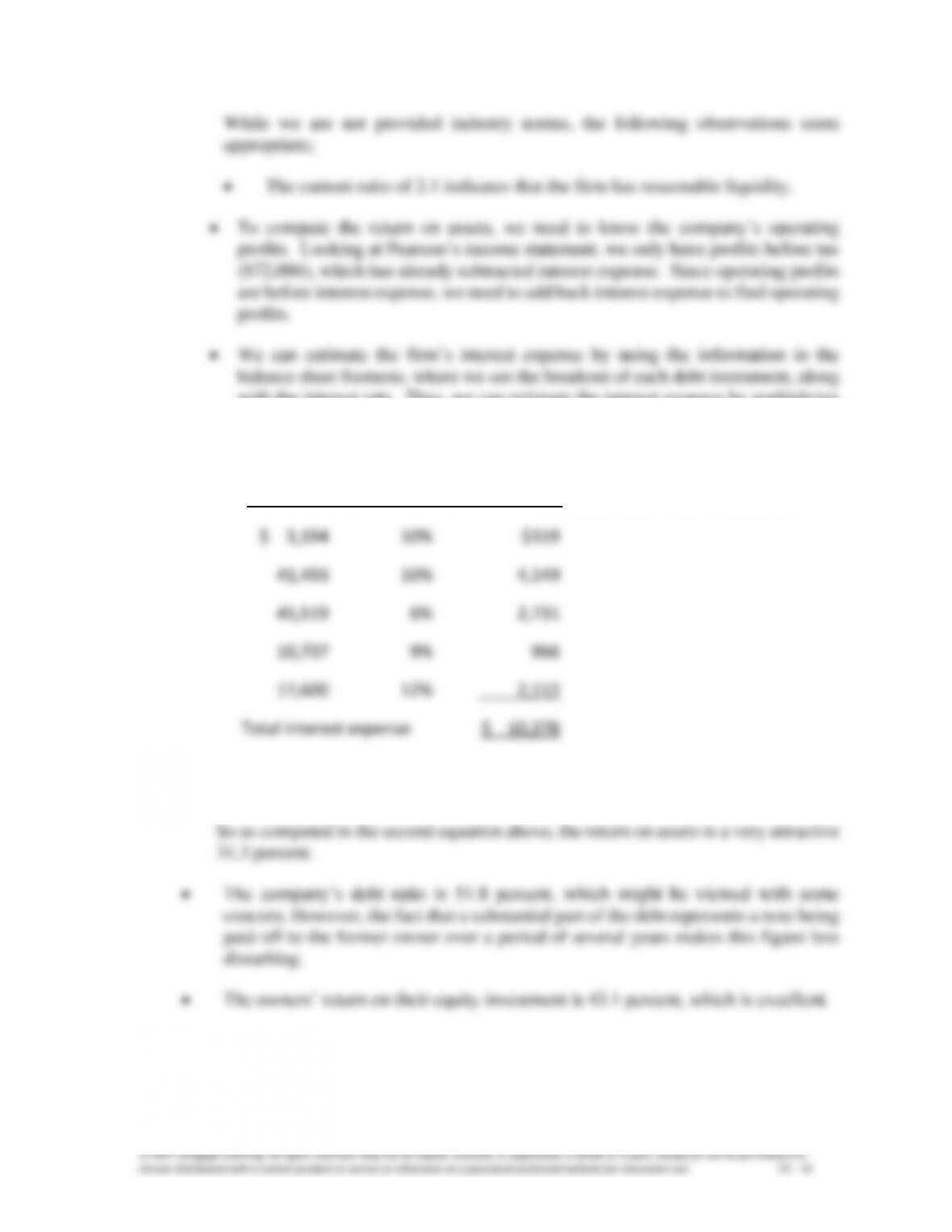
The following ratios come from Chapter 10, which help us evaluate a firm’s
performance.
Chapter 22: Managing The Firm’s Assets
© 2017 Cengage Learning. All rights reserved. May not be copied, scanned, or duplicated, in whole or in part, except for use as permitted in a
license distributed with a certain product or service or otherwise on a password-protected website for classroom use. 22– 10
While we are not provided industry norms, the following observations seem
appropriate;
• The current ratio of 2.1 indicates that the firm has reasonable liquidity.
• To compute the return on assets, we need to know the company’s operating
profits. Looking at Pearson’s income statement, we only have profits before tax
($72,086), which has already subtracted interest expense. Since operating profits
are before interest expense, we need to add back interest expense to find operating
profits.
• We can estimate the firm’s interest expense by using the information in the
balance sheet footnote, where we see the breakout of each debt instrument, along
with the interest rate. Thus, we can estimate the interest expense by multiplying
the interest rate by the amount of debt outstanding. That is,
Debt Interest Interest
Principal Rate Expense
Given that operating profits equals profit after tax ($72,086)plus interest expense
($10,278), then operating profits would be $82,364 ($82,364 = $72,086 + $10,278).
2. What are the strengths and weaknesses in this firm’s management of accounts
receivable and inventory?
Chapter 22: Managing The Firm’s Assets
The fact that the firm has experienced no significant losses from bad debts indicates
that control of accounts receivable has been reasonably successful. However,
management of receivables could be improved. These accounts were not aged. The
firm’s accountant should be directed to age the accounts so that the manager has a
3. Should the firm reduce or expand the amount of its bank borrowing?
Bank borrowing is costly during periods of high interest rates. Profits can be
4. Evaluate Pearson’s management of accounts payable.
Pearson is apparently taking advantage of all credit being offered by suppliers.
However, their failure to take cash discounts is costly when calculated in terms of
Chapter 22: Managing The Firm’s Assets
© 2017 Cengage Learning. All rights reserved. May not be copied, scanned, or duplicated, in whole or in part, except for use as permitted in a
license distributed with a certain product or service or otherwise on a password-protected website for classroom use. 22– 12
terms are those offered by York—30 days to pay. The most severe terms are those
offered by General Electric: payment after receipt of products.
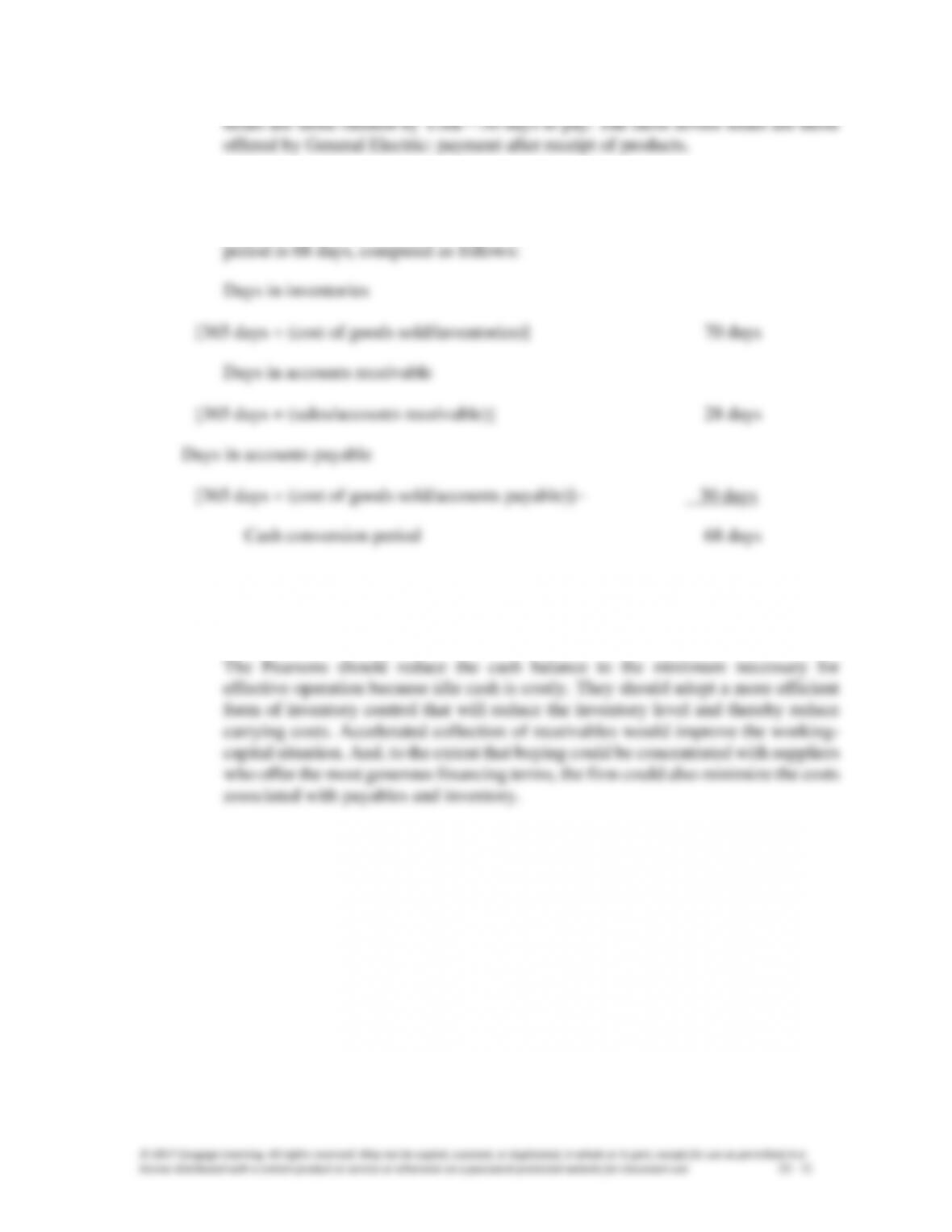
5. Calculate Pearson’s cash conversion period. Interpret your computation.
The cash conversion period equals the days in inventory plus the days in accounts
receivable less the days in accounts payable. For Pearson, the cash conversion
6. How could Pearson Air Conditioning & Service improve its working-capital situation?
To answer this question, we must summarize a number of points discussed above.