
Chapter 12: A Firm’s Sources of Financing
CHAPTER 12: A FIRM’S SOURCES OF FINANCING
CHAPTER OUTLINE
Spotlight: Emmy’s Organics
(http://emmyorganics.com)
1) Firm Characteristics and Sources of Financing
LO1: Describe how a firm’s characteristics affect its available financing sources.
i) Four basic firm characteristics significantly affect how a business is financed:
(1) The firm’s economic potential
(2) The size and maturity of the company
(3) The nature of its assets
(4) The personal preference of the owners with respect to the trade-offs between
debt and equity.
a) Firm’s Economic Potential
i) One firms with a high rate of return on investment create value for the investor.
b) Company Size and Maturity
i) The size and maturity of a company have a direct bearing on the types of
financing available.
ii) Larger and older firms have access to bank credit that may not be available to
younger and smaller companies.
c) Nature of Firm’s Assets
i) A banker considers two types of assets when evaluating a loan:
(1) Tangible assets
(2) Intangible assets
d) Owner Preference for Debt or Equity
i) Should an owner finance with debt or equity or a mix of the two?
2) Debt or Equity Financing?
LO2: Evaluate the choice between debt financing and equity financing.
a) Potential Profitability
i) Rate of return on investment important to owners
ii) Return on Assets
iii) Return on Equity
iv) General rule – as long as a firm’s rate of return on its assets (operating profits
divided by total assets) is greater than the cost of the debt (interest rate), the
owners’ rate of return on equity will increase as the firm uses more debt
b) Financial Risk
i) Debt is risky
ii) Equity is less demanding
c) Voting Control
i) Degree of control retained by owners
ii) Equity financing means giving up part of the firm’s ownership and releasing some
control
iii) Debt increases risk but allows owner to retain full ownership
3) Sources of Early Financing

Chapter 12: A Firm’s Sources of Financing
LO3: Identify the typical sources of financing used at the outset of a new venture.
i) Exhibit 12-4 Sources of Funds
a) Personal Savings
i) Imperative to have some personal investment in the business
ii) Banker unlikely to loan venture funds if the entrepreneur doesn’t risk personal
money
b) Friends and Family
i) Second likely place to obtain funding
ii) Accept only if that person will not be hurt financially to any significant extent if
the entire amount is lost
iii) These people often expect to provide advice when they invest
iv) Make agreements in writing to protect personal relationships
c) Credit Cards
i) Requires no justification of the use of the money
ii) Must be extremely self-disciplined to avoid becoming overextended
iii) Goal should be to use as method of payment not source of credit
4) Bank Financing
LO4: Discuss the basic process for acquiring and structuring a bank loan.
i) Bankers primarily make business loans in one of three forms: lines of credit,
terms loans, and mortgages
a) Types of Loans
i) Lines of Credit – an informal agreement between a borrower and a bank as to the
maximum amount of funds the bank will provide at any one time.
(1) Revolving credit agreement
ii) Term Loans – Money loaned for a 5 – 10-year term, corresponding to the length
of time the investment will bring in profits.
iii) Mortgages
(1) Chattel mortgage – a loan for which items of inventory or other movable
property serve as collateral.
(2) Real estate mortgage – a long-term loan with real property held as collateral
b) Understanding a Banker’s Perspective
i) A banker has three fundamental priorities when making a loan:
(1) Recouping the principal of the loan.
(2) Determining the amount of income the loan will provide the bank.
(3) Helping the borrower be successful and then become a larger customer.
ii) In making a loan decision, a banker gives serious consideration to the five C’s of
credit. (Discuss these in terms of how a student might finance a car. How are
these relevant to them?)
(1) Character
(2) Capacity
(3) Capital
(4) Conditions
(5) Collateral
iii) Effective presentation to bank helpful when requesting money

(1) Include three years of firm’s historical financial statements, pro forma
financial statements including timing and amounts of the debt repayment,
personal financial statements showing borrower’s net worth
c) Selecting a Banker
i) The location factor limits the range of possible choices of banks; banks interested
in home communities
ii) Banks’ lending policies are not uniform
d) Negotiating the Loan
i) Interest Rate
(1) Prime Rate – the interest rate charged by commercial banks on loans to their
most creditworthy customers.
(2) LIBOR (London Interbank Offered Rate) – the interest rate charged by
London banks on loans to other London banks.
(3) Basis point is 1/100th of one percent; then 200 basis points are the same as 2
percent.
ii) Loan Maturity Date
(1) Short term
(2) Long term
iii) Repayment Schedule
(1) Balloon payment – a very large payment required about halfway through the
term over which payments were calculate, repaying the loan balance in full.
iv) Loan Covenants – bank-imposed restrictions on a borrower that enhance he
chance of timely repayment
(1) Business may be required to provide financial statements on a monthly or
quarterly basis
(2) Bank may limit managers’ salaries an prohibit any personal loans from the
business to the owners
(3) Bank may put limits on various financial ratios to assure loan payments
(4) Borrower will normally be required to personally guarantee the firm’s loan
(a) Limited liability – restriction of an owner’s legal financial responsibilities
to the amount invested in the business.
5) Business Suppliers and Asset-Based Lenders
LO5: Explain how business relationships can be used to finance a small firm.
a) Accounts Payable (Trade Credit)
i) Credit extended by suppliers important to a startup
ii) Amount available depends on type of business and supplier’s confidence in the
firm
b) Equipment Loans and Leases
i) Equipment loan – an installment loan from a seller of machinery used by a
business
ii) Leases
c) Asset-Based Lending
i) Asset-based loan – a line of credit secured by working capital assets
ii) Factoring – obtaining cash by selling accounts receivable to another firm
iii) Purchase-order financing obtaining cash from a lender who, for a fee, advances
the amount of the borrower’s cost of goods sold for a specific customer order

6) Private Equity Investors
LO6: Describe the two types of private equity investors who offer financing to small
firms.
a) Business Angels
i) Private individuals who invest in others’ entrepreneurial venture
ii) Informal venture capital – funds provided by wealthy private individual to high-
risk ventures
iii) Investments relatively small (often to companies with fewer than 20 employees)
iv) May also contribute know-how to new businesses
v) Often found through contacts with business associates, accountants, and lawyers
vi) Guy Kwasaki in The Art of the Start
(1) Make sure the investors are accredited
(2) Make sure they’re sophisticated
(3) Don’t underestimate them
(4) Understand their motivation
(5) Enable them to live vicariously
(6) Make your story comprehensible to the angel’s spouse
(7) Sign up people the angel has heard of
(8) Be nice
b) Venture Capital Firms
i) Formal venture capitalists – individuals who form limited partnerships for the
purpose of raising venture capital from large institutional investors
ii) Receives the right to own a percentage of the entrepreneur’s business
iii) Few small companies, especially startups, ever receive this kind of funding
7) Crowdfunding
LO7: Describe how crowdfunding can be used by some small businesses to raise
capital.
i) Crowdfunding is the process of raising very small investments from a large
number of investors. There are four basic approaches to crowdfunding:
(1) Donations
(2) Rewards
(3) Pre-purchases
(4) Equity investing
ii) Two popular crowdfunding websites:
(1) Kickstarter
(2) Indiegogo
iii) Equity crowdfunding website:
(1) Seedinvest
8) The Government
LO8: Distinguish among the different government loan programs available to
small companies
a) The Small Business Administration (SBA) does not loan money but serves as a
guarantor of loans through five basic programs
i) The 7(A) Loan Guaranty Program –a loan program that helps small companies
obtain financial through a guaranty provided by the SBA
Chapter 12: A Firm’s Sources of Financing
ii) The Certified Development Company (CDC) 504 Loan Program – An SBA loan
program that provides long-term financial for small businesses to acquire real
estate or machinery and equipment
iii) The 7(M) Microloan Program – An SBA loan program that provides short-term
loans of up to $35,000 to small businesses and not-for-profit child-care centers.
iv) Small Business Investment Companies (SBICs) – Privately owned banks,
regulated by the SMA, that provide long-term loans and/or equity capital to small
businesses.
v) The Small Business Innovative Research (SBIR) Program – An SBA program
that helps to finance companies that plan to transform laboratory research into
marketable products.
b) State and Local Government Assistance
c) Community-Based Financial Institutions – a lender that uses funds from federal,
state, and private sources to provide financial to small businesses in low-income
communities.
9) Where Else to Look
LO8: Explain when large companies and public stock offerings can be sources of
financing.
a) Large Corporations- provide funds when their self-interest is involved
b) Stock Sales- made to outside individual investors through either private placement or
public sales
i) Private placement – the sale of a firm’s capital stock to select individuals
ii) Public Sale (going public)
(1) Initial public offering (IPO) – the issuance of stock to be traded in public
financial markets
(2) Common stock may be sold to underwriters
ADDITIONAL DISCUSSION QUESTIONS
1. How does the nature of a business affect its sources of financing?
Four basic factors determine how a firm is financed. First, the economic potential
2. How is debt different from equity?
© 2017 Cengage Learning. All rights reserved. May not be copied, scanned, or duplicated, in whole or in part, except for use as permitted in a
license distributed with a certain product or service or otherwise on a password-protected website for classroom use. 12– 6
3. Explain the three trade-offs that guide the choice between debt financing and
equity financing.
The three factors are potential profitability, financial risk, and voting control.
4. Assume that you are starting a business for the first time. What do you believe
are the greatest personal obstacles to obtaining funds for the new venture?
Why?
For younger entrepreneurs, age is most likely the greatest personal obstacle. Also,
5. If you were starting a new business, where would you start looking for capital?
Answers will vary with each student. However, many students will probably
mention friends and family as sources because these people are easier to talk with
6. Explain how trade credit and equipment loans can provide initial capital
funding.
Trade credit is funding extended by suppliers when they sell merchandise on
7a. Describe the different types of loans made by a commercial bank.
Line of credit is an informal agreement or understanding between the borrower
Chapter 12: A Firm’s Sources of Financing
© 2017 Cengage Learning. All rights reserved. May not be copied, scanned, or duplicated, in whole or in part, except for use as permitted in a
license distributed with a certain product or service or otherwise on a password-protected website for classroom use. 12– 7
mortgage represents a long-term source of debt capital. Mortgages are of two
types: chattel mortgages, for which items of inventory or other moveable property
serve as collateral, and real estate mortgages, which are long-term loans with real
estate held as collateral.
7b. What does a banker need to know in order to decide whether to make a loan?
In making a loan decision, a banker always considers the “five C’s of credit”: (1)
the borrower’s character, (2) the borrower’s capacity to repay the loan, (3) the
capital being invested in the venture by the borrower, (4) the conditions of the
© 2017 Cengage Learning. All rights reserved. May not be copied, scanned, or duplicated, in whole or in part, except for use as permitted in a
license distributed with a certain product or service or otherwise on a password-protected website for classroom use. 12– 8
8. Distinguish between informal venture capital and formal venture capital.
The federal government provides financial assistance primarily through the SBA
9. In what ways does the federal government help with initial financing for small
businesses?
10. What advice would you give an entrepreneur who was trying to finance a
startup?
Answers to this question can vary widely, but those offered should conform to the
issues highlighted in the chapter.
SUGGESTED ANSWERS TO YOU MAKE THE CALL EXERCISES
Situation 1
1. What is your impression of Bernstein’s perspective on raising capital “to get to
the next level”?
2. What advice would you offer Bernstein as to both appropriate and
inappropriate sources of financing in his situation?
Chapter 12: A Firm’s Sources of Financing
© 2017 Cengage Learning. All rights reserved. May not be copied, scanned, or duplicated, in whole or in part, except for use as permitted in a
license distributed with a certain product or service or otherwise on a password-protected website for classroom use. 12– 9
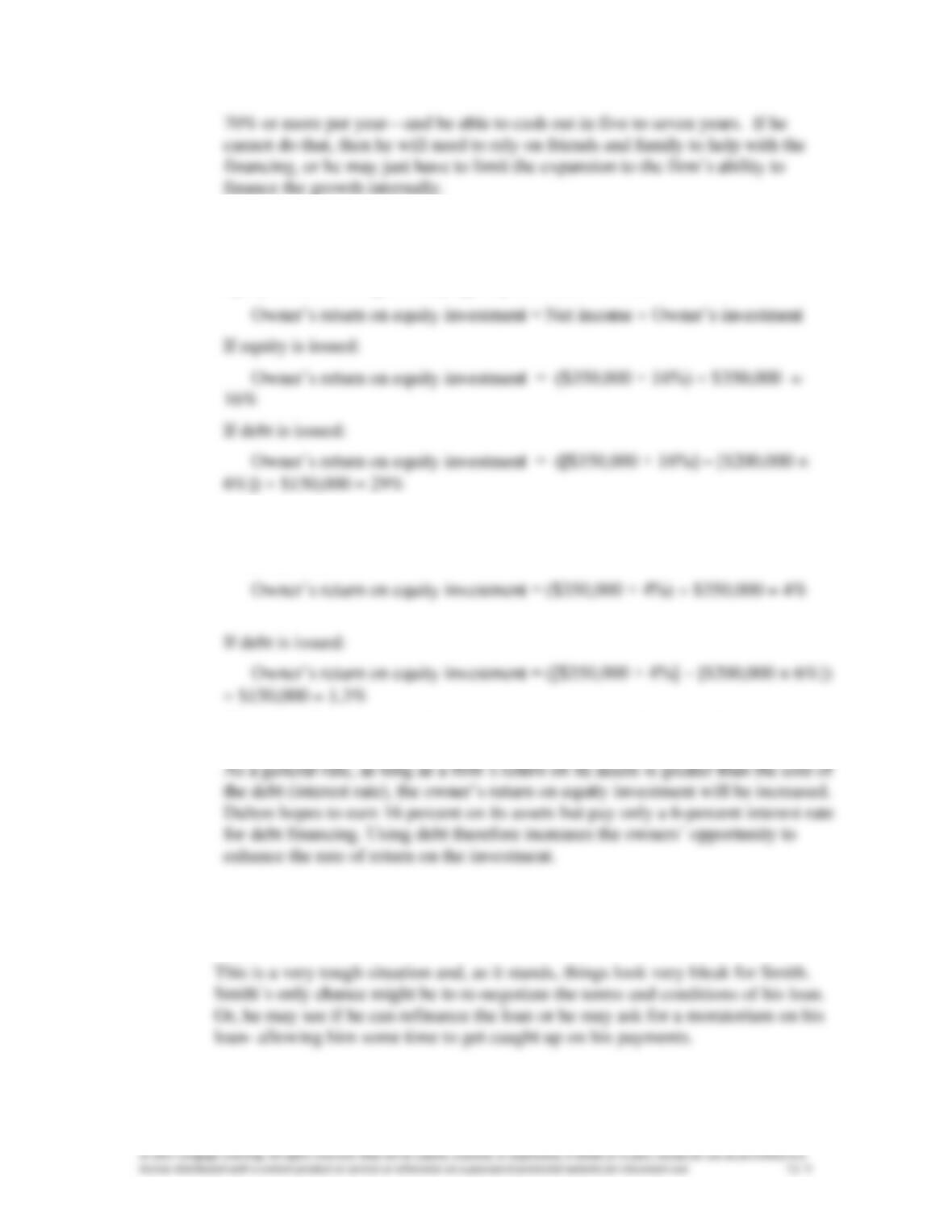
70% or more per year—and be able to cash out in five to seven years. If he
cannot do that, then he will need to rely on friends and family to help with the
financing, or he may just have to limit the expansion to the firm’s ability to
finance the growth internally.
Situation 2
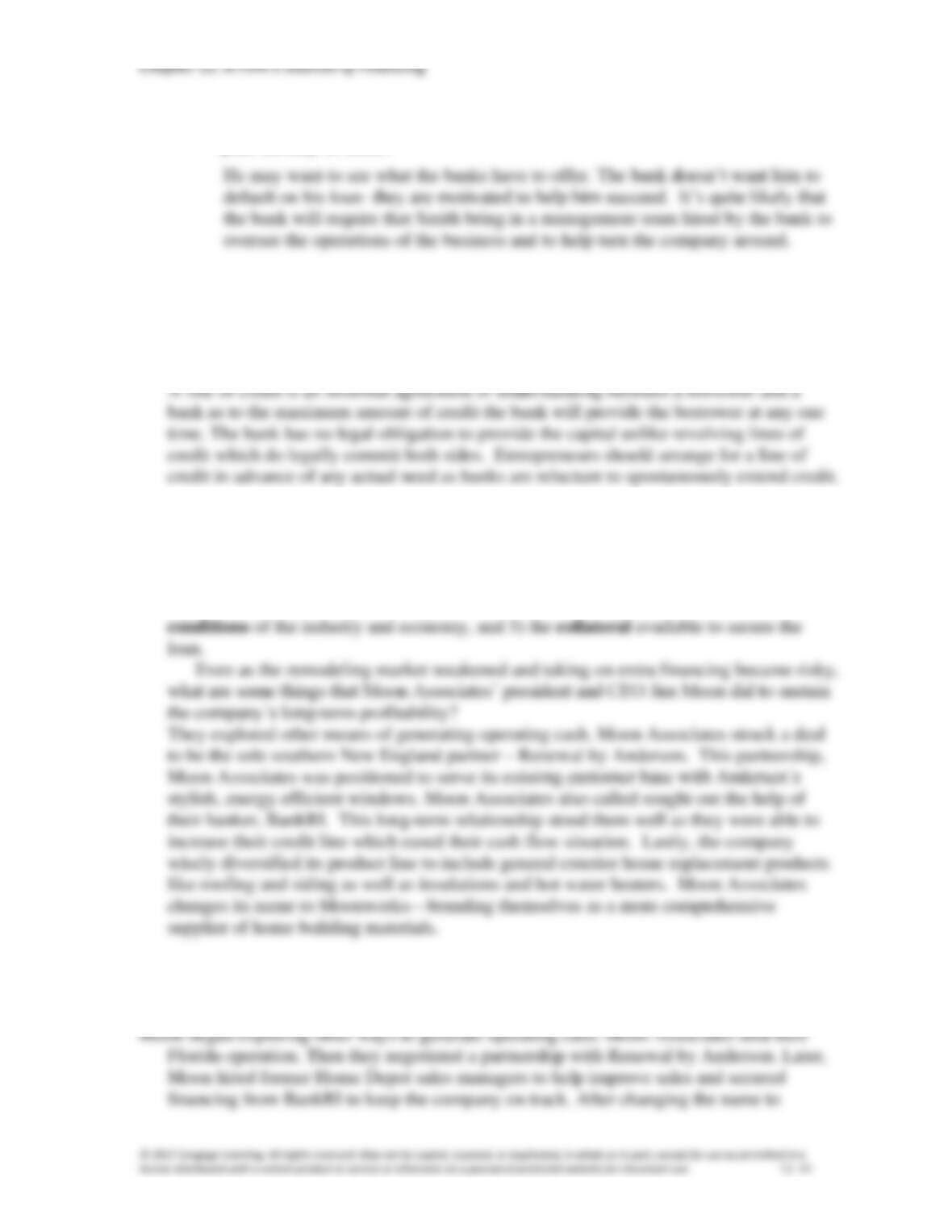
1. Compare the two financing options in terms of projected return on the owner’s
equity investment. Ignore any effect from income taxes.
2. What if Dalton is wrong and the company earns only 4 percent in operating
income on total assets?
If equity is issued:
3. What should Dalton consider in choosing a source of financing?
He has to compare the firm’s expected return on its assets with the interest rate.
Situation 3
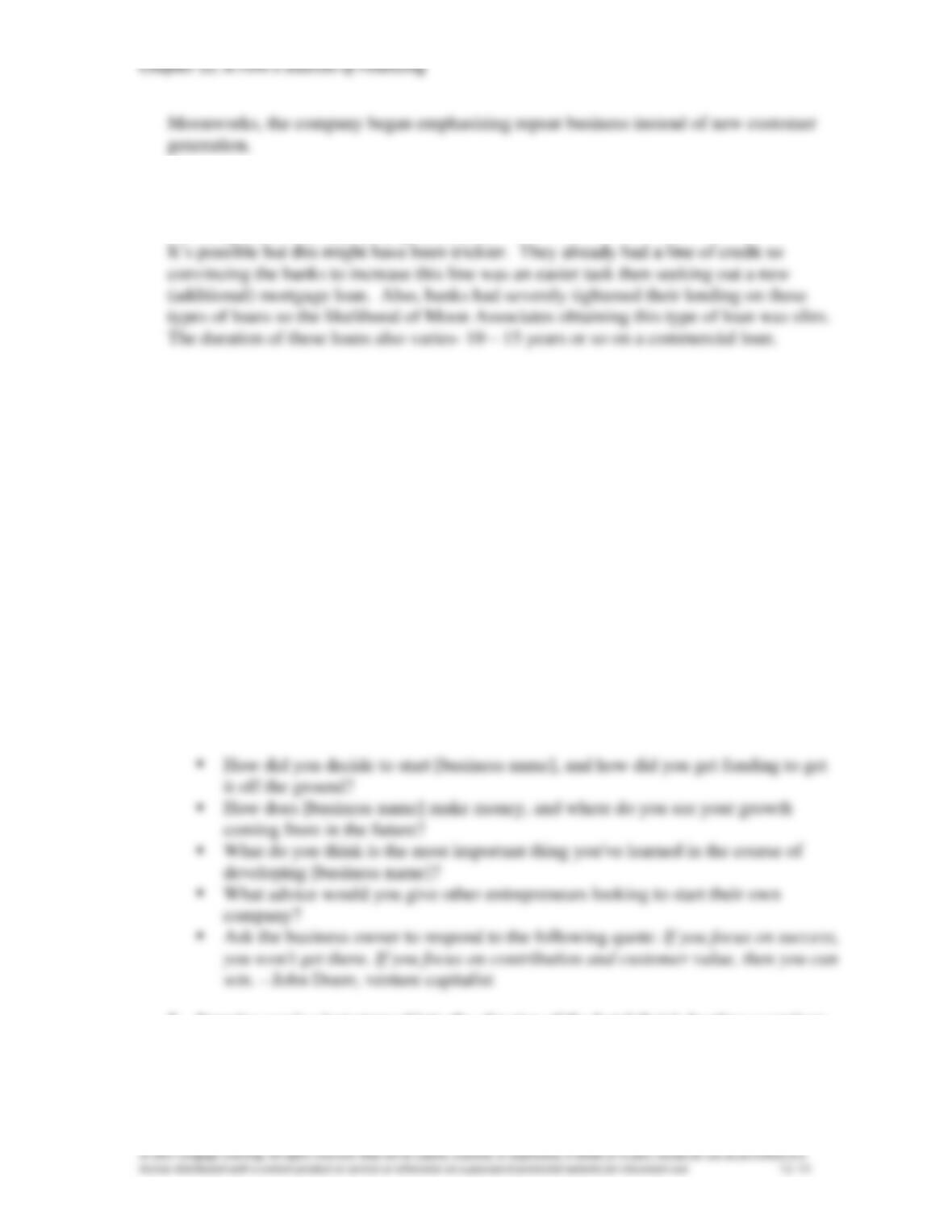
1. What guidance will you give Smith in negotiating with the bank?
2. Why might you advise him not to go into a meeting with bank officers with a
plan already in mind?
SUGGESTED SOLUTION TO CASE 12: MOONWORKS
1. Describe what a line of credit involves, and explain the legal obligation of a bank to
provide capital with a line of credit.
2. On what three priorities might BankRI representative Matt Weiner have based the
decision to extend Moon Associates’ line of credit or offer additional financing? What
are the “five C’s of credit”?
The five C’s of credit are: 1) the borrower’s character, 2) the borrower’s capacity to
repay the loan, 3) the capital being invested in the venture by the borrower, 4) the
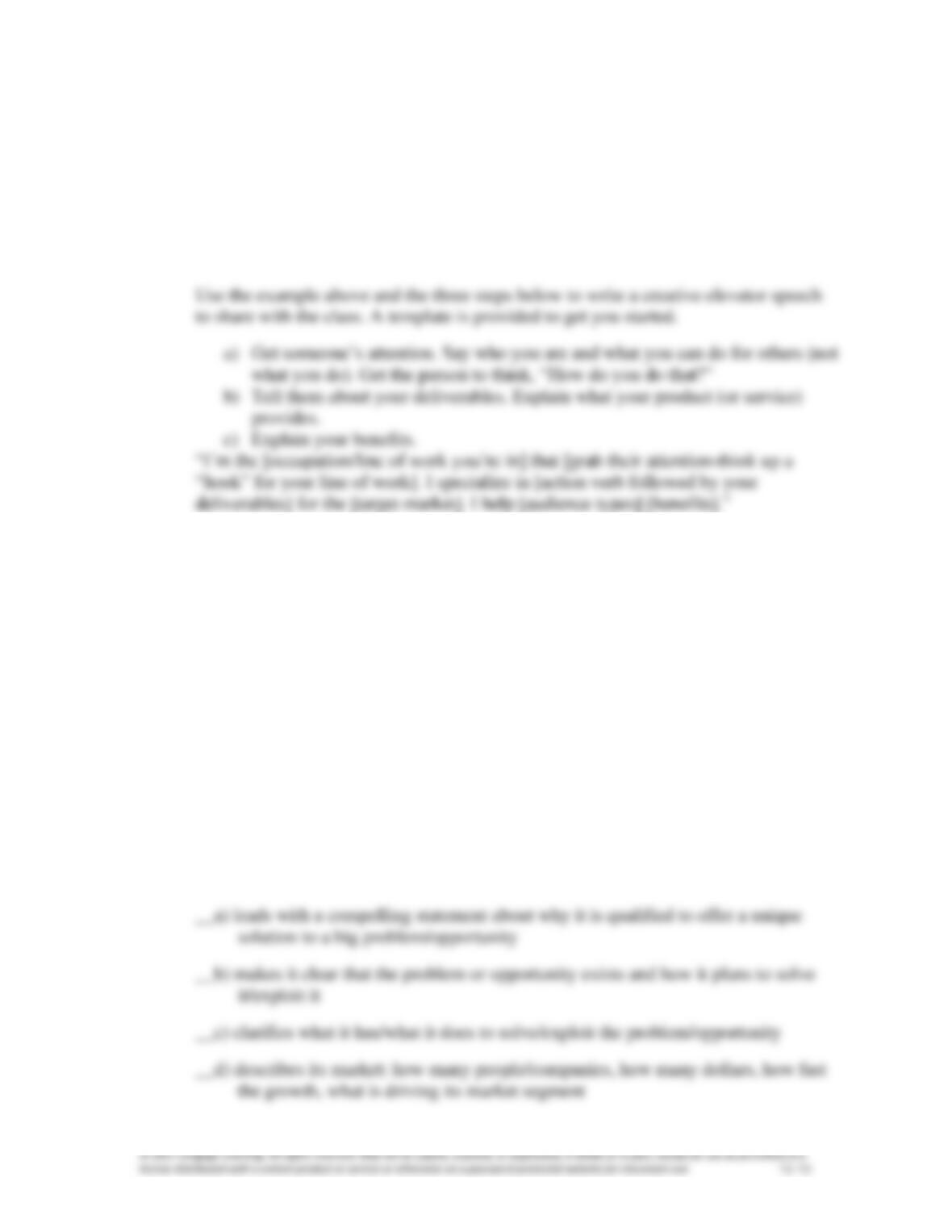
3. Even as the remodeling market weakened and taking on extra financing became risky,
what are some things that Moon Associates’ president and CEO Jim Moon did to
sustain the company’s long-term profitability?
© 2017 Cengage Learning. All rights reserved. May not be copied, scanned, or duplicated, in whole or in part, except for use as permitted in a
license distributed with a certain product or service or otherwise on a password-protected website for classroom use. 12– 11
4. Could Moon Associates have obtained the needed capital to not only keep the company
running but expand its Renewal by Andersen line through a mortgage loan? If so, for
how long could such a loan be financed?
ADDITIONAL ACTIVITIES
Purpose: The purpose of the first activity is to give students the opportunity to
interview an entrepreneur within the context of the case material. By investigating
other entrepreneurs’ decisions, students will become aware of their own
entrepreneurial feelings and tendency. The second and third activities help students
streamline the message they deliver when looking for business opportunities or
funding.
Setting it up: Each activity can be done individually, but you can also opt to send
students out to conduct interviews in pairs. The second activity can be used as the
basis of short class presentations. The third activity requires some Internet research,
which you can assign before the next class session and then have students share their
results with the class or in small groups.
1. Arrange for an interview with the owner of a start-up business in your community.
Ask the following questions and share your results with the class.
2. Imagine you’ve just stepped into the elevator of the hotel that is hosting a seminar
you’re attending, “Funding for Continued Growth: Investors Meet One-on-One
with Entrepreneurs.” The venture capitalist you really, really wanted to talk to
about your business venture gets in at the same time. You have about 20 seconds to
make a good impression. “Thank goodness for Jay,” you think. Jay is a friend who
Chapter 12: A Firm’s Sources of Financing
runs an animal training center. Jay always begins business introductions by saying,
“Hi, I’m Jay Doe. I help pet-owners raise likeable pets. I work with people who
want to avoid letting bad behaviors come between them and their friends, but don’t
know where to start. As a result of working with me, my clients say they enjoy their
pets so much more.” Jay encouraged you to plan out your elevator speech, a 15–
second introduction of yourself and your company, before coming to the event.
You take a semi-deep breath and start with, “Hello, my name is…”
3. Jay also encouraged you to have a business plan ready (yours is 30 pages). The
venture capitalist you just met in the elevator gave you her business card, but she
asked you to send over only your executive summary. She’s going to review it and
then call to arrange a time to meet and discuss how she can help you grow your
business. Good thing you have an executive summary that is clear, concise, and
compelling; you really want to make a good first impression and “sell” your
business idea.
Search the Internet for two examples of executive summaries (use the key words
“example executive summary” to get started). Print them out and then compare the
executive summaries you found to the components of an excellent executive
summary listed below. Rate each executive summary from 1 to 5, using a template
like the one below, with 1 indicating that the summary does not incorporate the key
components and 5 for a stellar example of one of the key components. Where
applicable, label the portion of the executive summary with the corresponding letter
of the component it meets.
The executive summary for [business name]:
© 2017 Cengage Learning. All rights reserved. May not be copied, scanned, or duplicated, in whole or in part, except for use as permitted in a
license distributed with a certain product or service or otherwise on a password-protected website for classroom use. 12– 13