
Chapter 11: Forecasting Financial Requirements
CHAPTER 11: FORECASTING FINANCIAL REQUIREMENTS
CHAPTER OUTLINE
Spotlight: GSM Nation: The Need to Manage Growth (http://www.gsmnation.com)
1) The Purpose of Financial Forecasting
LO1: Describe the purpose of financial forecasting.
a) Purpose of pro forma financial statements
i) Statements that project a firm’s financial performance and condition
ii) Purpose to answer three questions
(1) How profitable can you expect the firm to be, given the projected sales levels
and the expected sales-expense relationships?
(2) How much and what type of financing (debt or equity) will be needed to
finance a firm’s assets?
(3) Will the firm have adequate cash flows? If so, how will they be used? If not,
where will the additional cash come from?
iii) Projecting financials a challenge
2) Forecasting Profitability
LO2: Develop a pro forma income statement to forecast a new venture’s profitability
a) Graphic presentation of an Income Statement (Exhibit 11-1)
i) Amount of sales
ii) Cost of goods sold
iii) Operating expenses
iv) Interest expense
v) Taxes
Provide students with a blank income statement. Using the form, have students
indicate personal forms of income (work and/or other sources) and expenses that
could be used on the statement. Then have them forecast their income and
expenses for the next month. Ask them why they might want to know their income
and expenses from one month to the next. Have them keep their copy for the rest
of the discussion.
3) Forecasting Asset and Financing Requirements
LO3: Determine a company’s asset and financing requirements using a pro forma
balance sheet
Have students make a list of the items they own and what they owe. They can list such
assets as a car, their textbooks, etc. They may owe a loan on their car and a loan for their
tuition. Compare these to assets and liabilities for a business.
i) Concerns
(1) Working capital – cash,, accounts receivable, and inventory required in day-
to-day operations
(2) Net working capital – current assets less current liabilities
(a) Tendency in small firms to underestimate the amount of capital the
business requires (undercapitalizing)

Chapter 11: Forecasting Financial Requirements
ii) Limited amount of working capital makes forecasting more important due to less
room for error
iii) Must also consider owner’s personal financial situation
iv) Understanding relationship between firm’s projected sales and its assets vital
a) Determining Asset Requirements
i) Asset needs tend to increase as sales increase, therefore firm’s asset requirements
are often estimated as a percentage of sales
(1) Percentage-of-sales technique – method of forecasting asset and financing
requirements
(2) Important to understand the asset portion of balance sheet
b) Determining Financing Requirements
i) Principles governing financing of firms
(1) The more assets a firm needs, the greater the firm’s financial requirements
(2) A firm should finance its growth in such a way as to maintain adequate
liquidity
(a) Liquidity – degree to which a firm has working capital available to meet
maturing debt obligations
(b) Current ratio – measure of a company’s relative liquidity, that compares a
firm’s current assets to its current liabilities on a relative basis
(3) The amount of total debt that can be used in financing a business is limited by
the amount of funds provided by the owners
(a) Debt ratio – measure of the fraction of a firm’s assets that are financed by
debt, determined by dividing total debt by total assets
(4) Some types of short-term debt maintain a relatively constant relationship with
sales
(a) Spontaneous debt financing – short-term debts, such as accounts payable,
that automatically increase in proportion to a firm’s sales
(5) Equity ownership in a business comes from two sources
(a) Investments the owners make in the business
(b) Profits retained within the company rather than being distributed to
owners (retained earnings)
(i) Line of credit – a short-term loan
4) Forecasting Cash Flows
LO4: Forecast a firm’s cash flows.
Have students create a list of items they would like to purchase for themselves in the next
six months. They have them indicate how much these items cost. Ask them how they
would like to pay for these items. If the items are very expensive, they need to decide
whether they really need them and if they need them, how will they be able to pay for
them. The concept of setting up a budget to be able to pay for items by either borrowing
or saving ahead is an important one for a business owner. For example, if the business
would like to expand in the future, they need to be preparing for that expansion.
a) Pro Forma Statement of Cash Flows
i) Change from working with historical numbers to projections of numbers
ii) Exhibit 11-4 Pro Forma Cash Flow Statements for D&R Products, Inc.
b) The Cash Budget
Chapter 11: Forecasting Financial Requirements
i) A listing of cash receipts and cash disbursements usually for a relatively short
time period, such as a weekor a month
ii) Exhibit 11-5 Three-Month Cash Budget for D&R Products, Inc., for January-
March
5) Use Good Judgment When Forecasting
LO5: Provide some suggestions for effective financial forecasting
a) Financial Forecast Suggestions
i) Develop realistic sales projections
ii) Build projections from clear assumptions about marketing and pricing plans
iii) Do not use unrealistic profit margins
iv) Don’t limit your projections to an income statement
v) Provide monthly data for the upcoming year and annual data for succeeding years
vi) Avoid providing too much financial information
vii) Be certain that the numbers reconcile—and not by simply plugging in a figure
viii) Follow the plan
ix) Don’t foregt that you have to live
ADDITIONAL DISCUSSION QUESTIONS
1. What determines a company’s profitability?
2. Discuss how asset and financing requirements might differ among a retail
business, a service company, and an information system-based venture.
3. Why is it important to consider an entrepreneur’s personal finances when
conducting the short- and long-term financial forecasts of a firm?
4. Describe the process for estimating the amount of assets required for a new
venture.
Chapter 11: Forecasting Financial Requirements
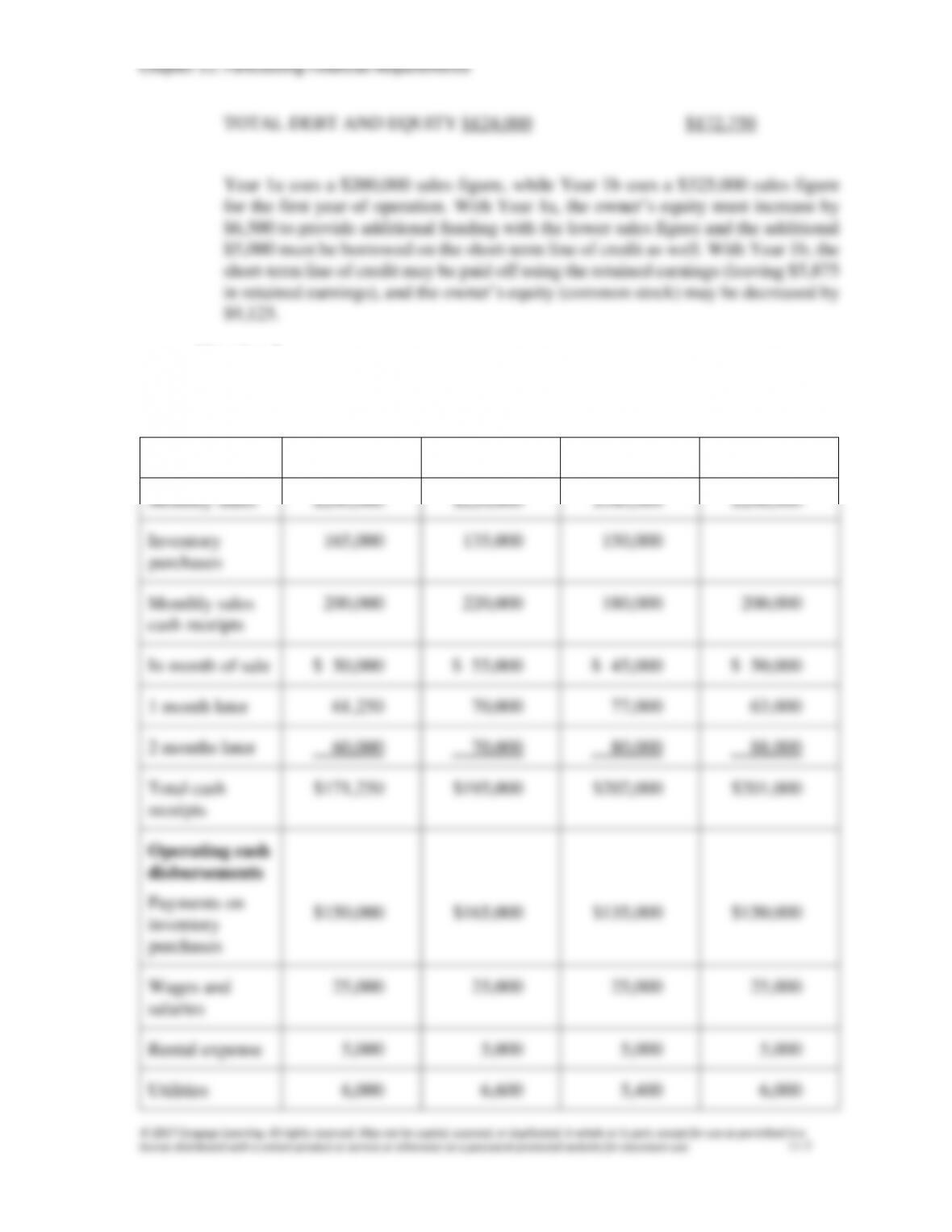
Adding an additional $5,000 to the short-term line of credit:
Year 1a Year 1b
Assets
Debt Liabilities and Equity
Accounts payable $ 16,000 $ 26,000
© 2017 Cengage Learning. All rights reserved. May not be copied, scanned, or duplicated, in whole or in part, except for use as permitted in a
license distributed with a certain product or service or otherwise on a password-protected website for classroom use. 11-7
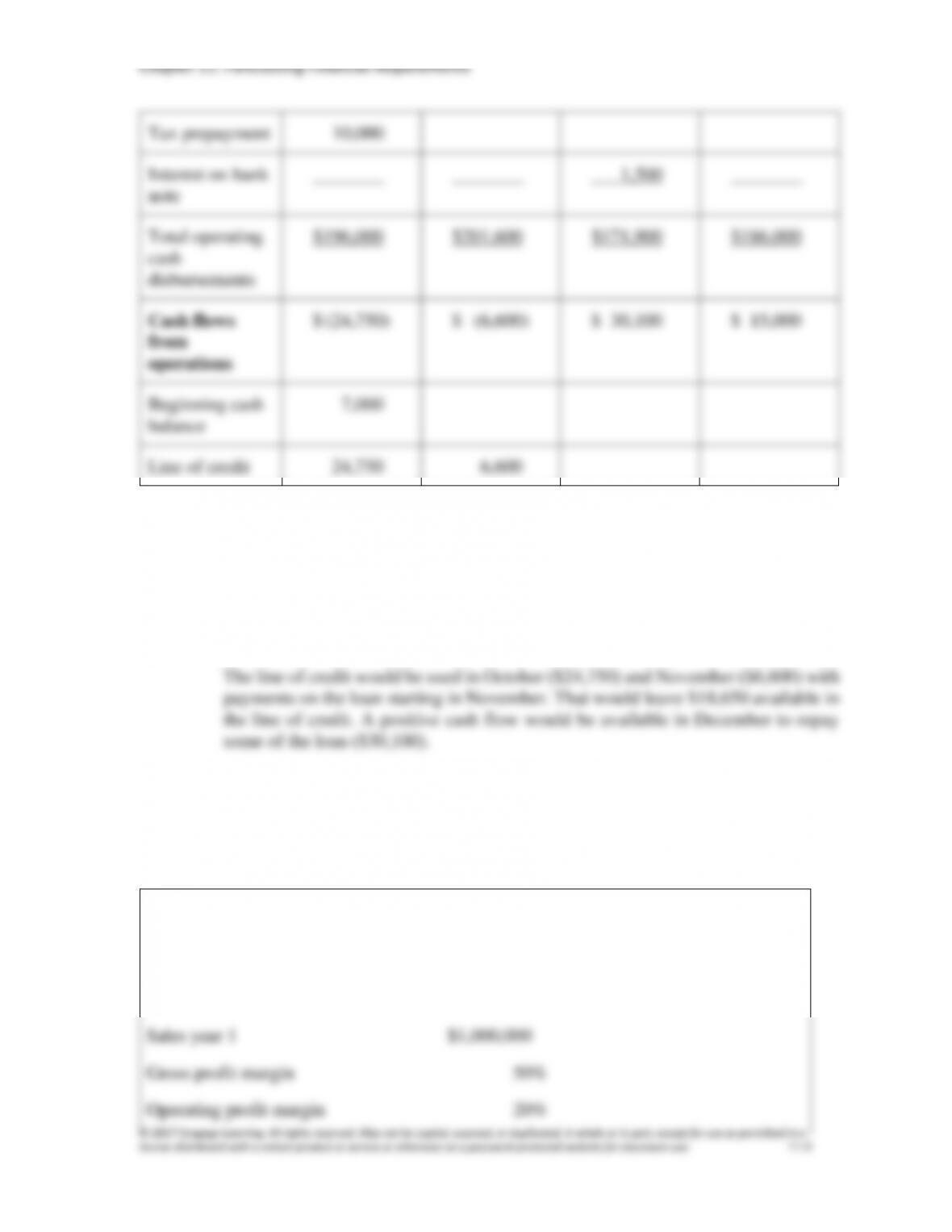
1. Prepare a monthly cash budget for the three-month period ending in December.
October
November
December
January
Monthly Sales
$200,000
$220,000
$180,000
$200,000
Inventory
purchases
165,000
135,000
150,000
Monthly sales
cash receipts
200,000
220,000
180,000
200,000
In month of sale
$ 50,000
$ 55,000
$ 45,000
$ 50,000
1 month later
61,250
70,000
77,000
63,000
2 months later
60,000
70,000
80,000
88,000
Total cash
receipts
$171,250
$195,000
$202,000
$201,000
Operating cash
disbursements
Payments on
inventory
purchases
$150,000
$165,000
$135,000
$150,000
Wages and
salaries
25,000
25,000
25,000
25,000
Rental expense
5,000
5,000
5,000
5,000
Utilities
6,000
6,600
5,400
6,000
Chapter 11: Forecasting Financial Requirements
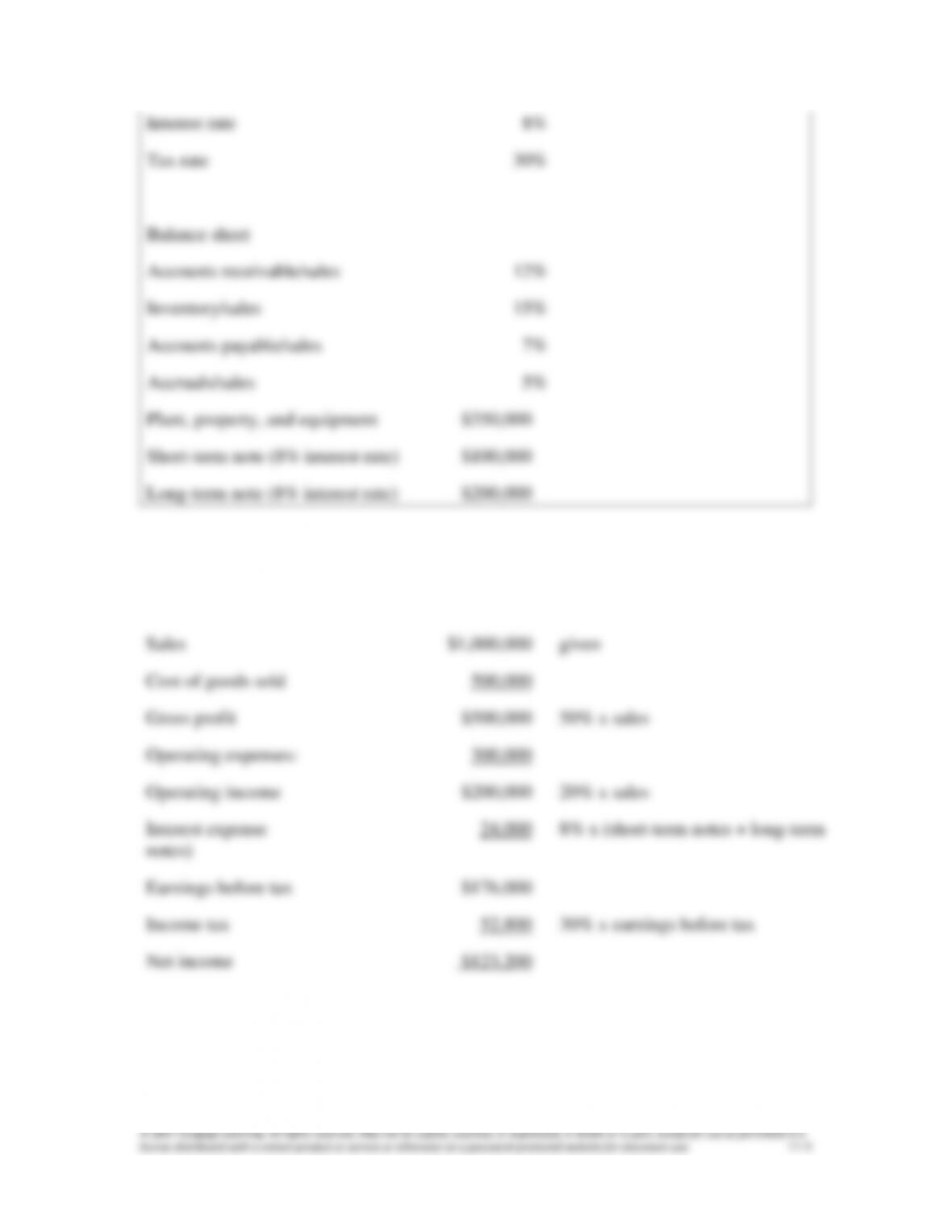
PRO FORMA INCOME STATEMENT
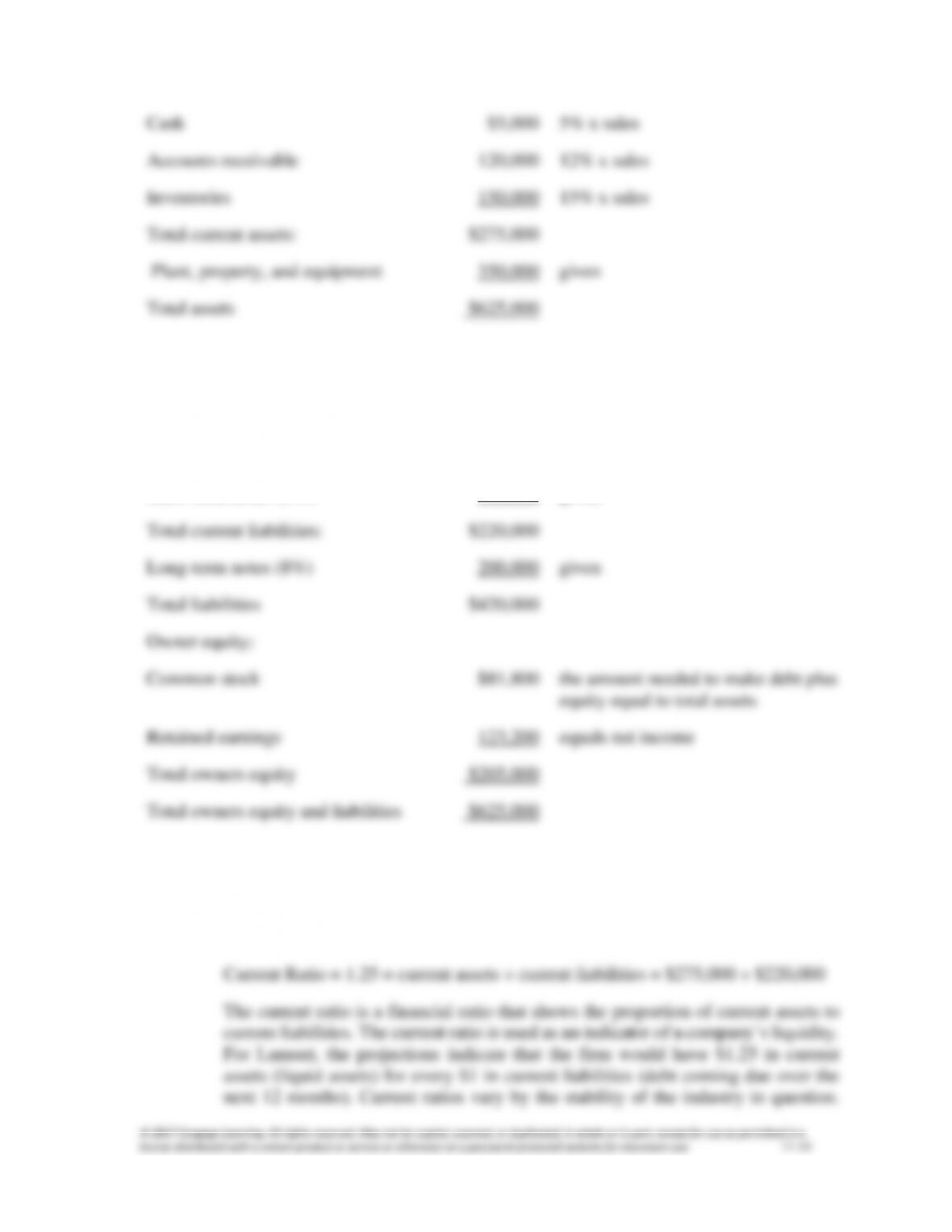
PROFORMA BALANCE SHEET
Current assets:
Chapter 11: Forecasting Financial Requirements
Chapter 11: Forecasting Financial Requirements
Thus, we would want to compare Lamont’s current ratio to similar firm, such as
SUGGESTED SOLUTION TO CASE 11: ASHLEY PALMER CLOTHING, INC.
Note to instructor: The quantitative solution to the case is provided in an excel spreadsheet
on the instructior website. If you have any questions, feel free to email or call Bill Petty at
bill_petty@baylor.edu; office 254-710-2260; cell 254-723-6742.
1. Prepare proforma income statement and balance sheet for 2014.
The solution for the proforma 2014 balance sheet and income statement relies
on the assumptions made by Jantz and Palmer, as shown in the spreadsheet.
Specifically,
assets needed in 2014.
2. Computing financial ratios
The financial ratios for 2011 – 2013 and the proforma ratios for 2014 show the
following:
1. The firm has improved its liquidity, as evidenced by increases in the current
3. Preparing statements of cash flows
1. Looking at the cash flow statements, we see that the cash flows from