Chapter 14
Time Series Analysis and Forecasting
Case Problem 1: Forecasting Food and Beverage Sales
1. Month 1 corresponds to January for year 1; month 2 corresponds to February for year 1; and so on.
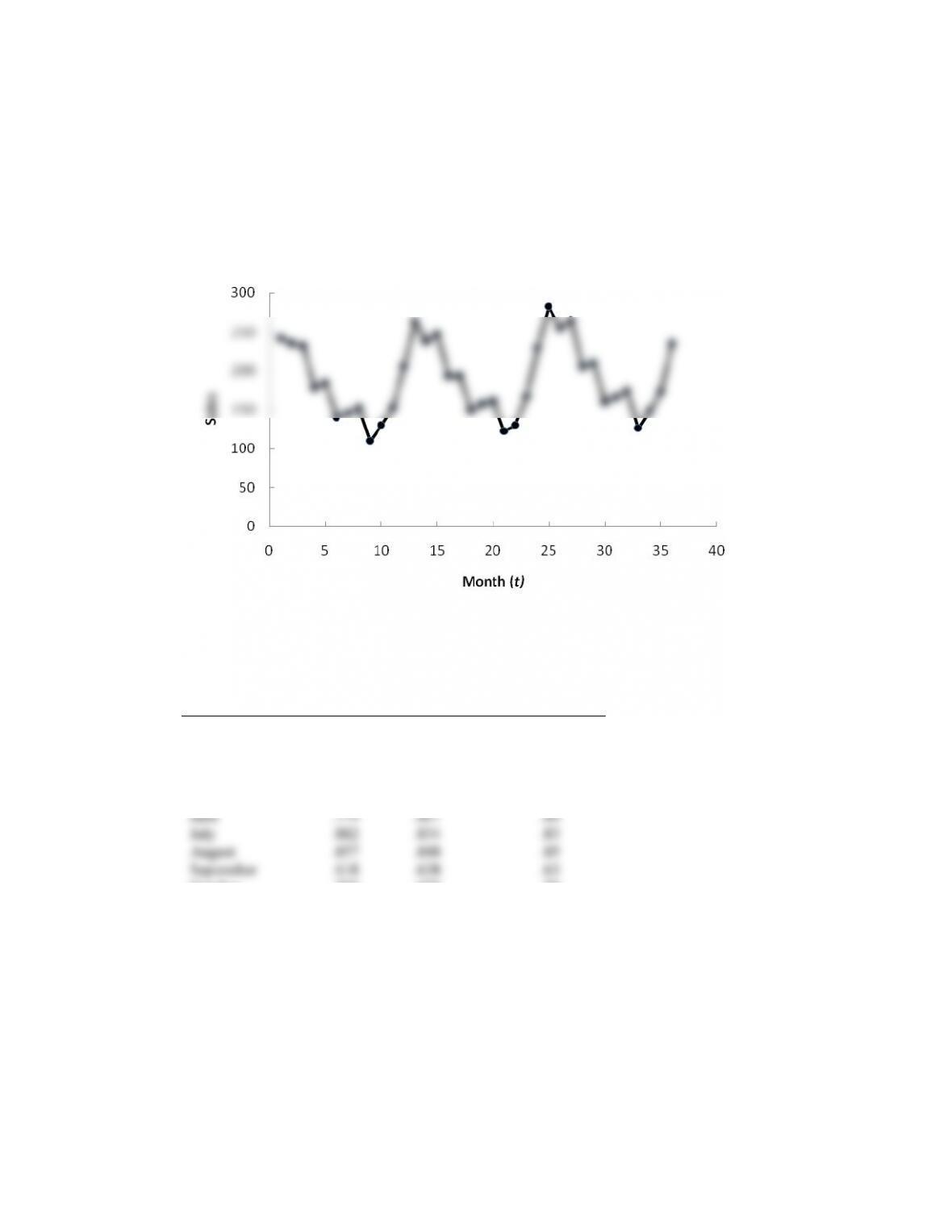
The time series plot is shown below:
The time series plot indicates a linear trend and a seasonal pattern.
2. Analysis of seasonality:
Month
Seasonal-Irregular
Component Values
Seasonal Index
January
1.445
1.441
1.44
February
1.301
1.297
1.30
March
1.344
1.343
1.34
April
1.047
1.034
1.04
May
1.044
1.054
1.05
June
.779
.801
.80
July
.882
.834
.83
August
.857
.848
.85
September
.618
.638
.63
October
.725
.675
.70
November
.843
.862
.85
December
1.137
1.180
1.16
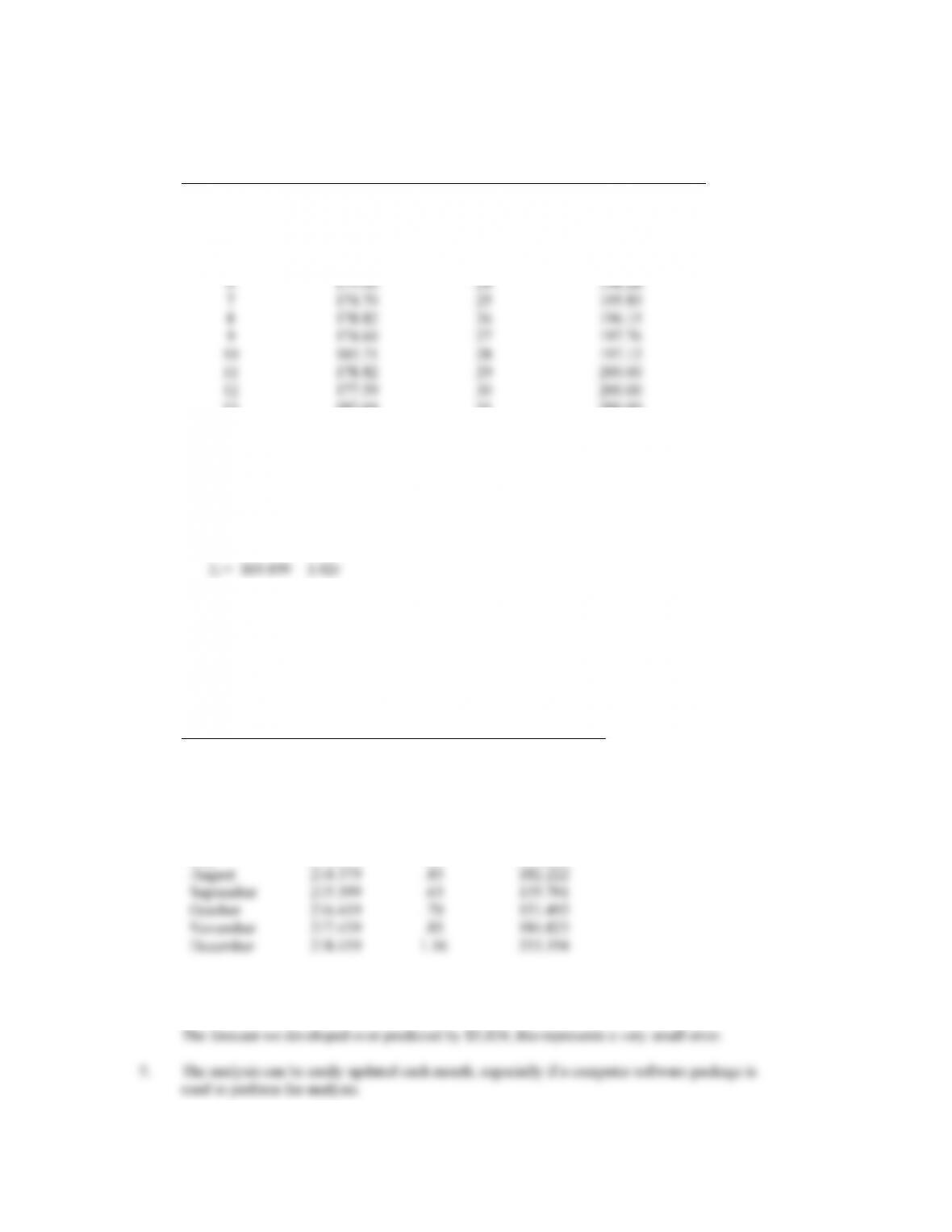
The deseasonalized time series is shown below:
t
Deseasonalized Sales
t
Deseasonalized Sales
1
168.06
19
189.16
2
180.77
20
189.41
3
173.13
21
193.65
4
171.15
22
185.71
5
175.24
23
196.47
6
175.00
24
198.28
7
174.70
25
195.83
8
178.82
26
196.15
9
174.60
27
197.76
10
185.71
28
197.12
11
178.82
29
200.00
12
177.59
30
200.00
13
182.64
31
200.00
14
183.08
32
204.71
15
184.33
33
200.00
16
185.58
34
211.43
17
183.81
35
203.53
18
186.25
36
202.59
The trend line fitted to the deseasonalized time series is
3. Sales forecasts
Forecast for Year 4
Using Tt = 169.499 + 1.02t
Month
Trend
Forecast
Seasonal
Index
Monthly
Forecast
January
207.239
1.44
298.424
February
208.259
1.30
270.737
March
209.279
1.34
280.434
April
210.299
1.04
218.711
May
211.319
1.05
221.885
June
212.339
.80
169.871
July
213.359
.83
177.088
August
214.379
.85
182.222
September
215.399
.63
135.701
October
216.419
.70
151.493
November
217.439
.85
184.823
December
218.459
1.16
253.194
4. Forecast error = $295,000 – $298,424 = -$3,424
Case Problem 2: Forecasting Lost Sales
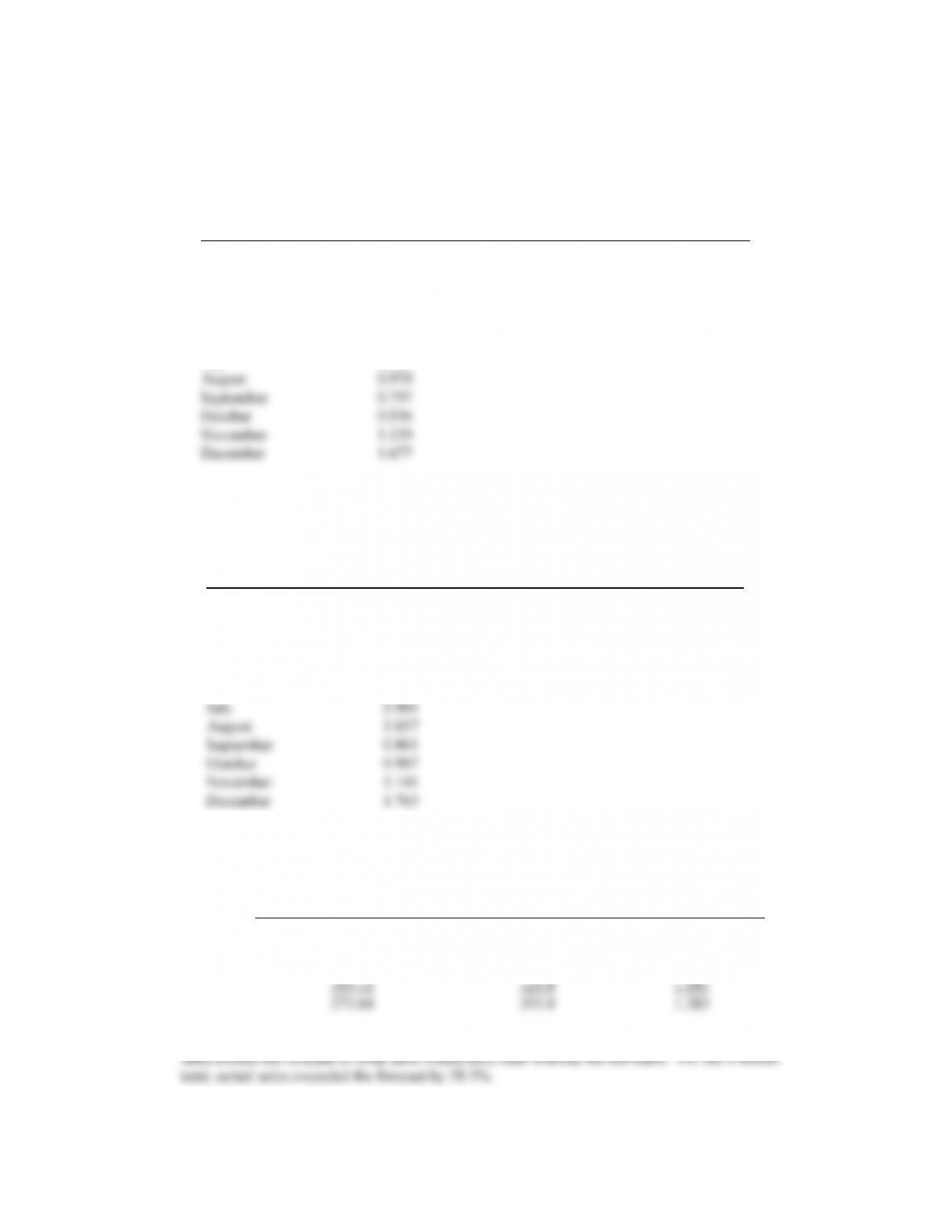
1. The data used for the forecast is the Carlson sales data for the 48 months preceding the storm. Using
the trend and seasonal method, the seasonal indexes and forecasts of sales assuming the hurricane
had not occurred are as follows:
Month
Seasonal Index
Month
Forecast ($ million)
January
0.957
September
2.16
February
0.819
October
2.54
March
0.907
November
3.06
April
0.929
December
4.60
May
1.011
June
0.937
July
0.936
August
0.974
September
0.797
October
0.936
November
1.119
December
1.677
2. The data used for this forecast is the total sales for the 48 months preceding the storm for all
department stores in the county. Using the trend and seasonal method, the seasonal indexes and
forecasts of county-wide department store sales assuming the hurricane had not occurred are as
follows:
Month
Seasonal Index
Month
Forecast ($ million)
January
0.773
September
50.55
February
0.813
October
53.20
March
0.976
November
66.78
April
0.935
December
103.11
May
0.989
June
0.924
July
0.901
August
1.017
September
0.861
October
0.907
November
1.141
December
1.763
3. By comparing the forecast of county–wide department store sales with actual sales, one can determine
whether or not there are excess storm-related sales. We have computed a “lift factor” as the ratio of
actual sales to forecast sales as a measure of the magnitude of excess sales.
Forecast Sales ($ million)
Actual Sales ($ million)
Lift Factor
50.55
69.0
1.365
53.20
75.0
1.410
66.78
85.2
1.276
103.11
121.8
1.181
273.64
351.0
1.283
From the analysis a strong case can be made for excess storm related sales. For each month, actual
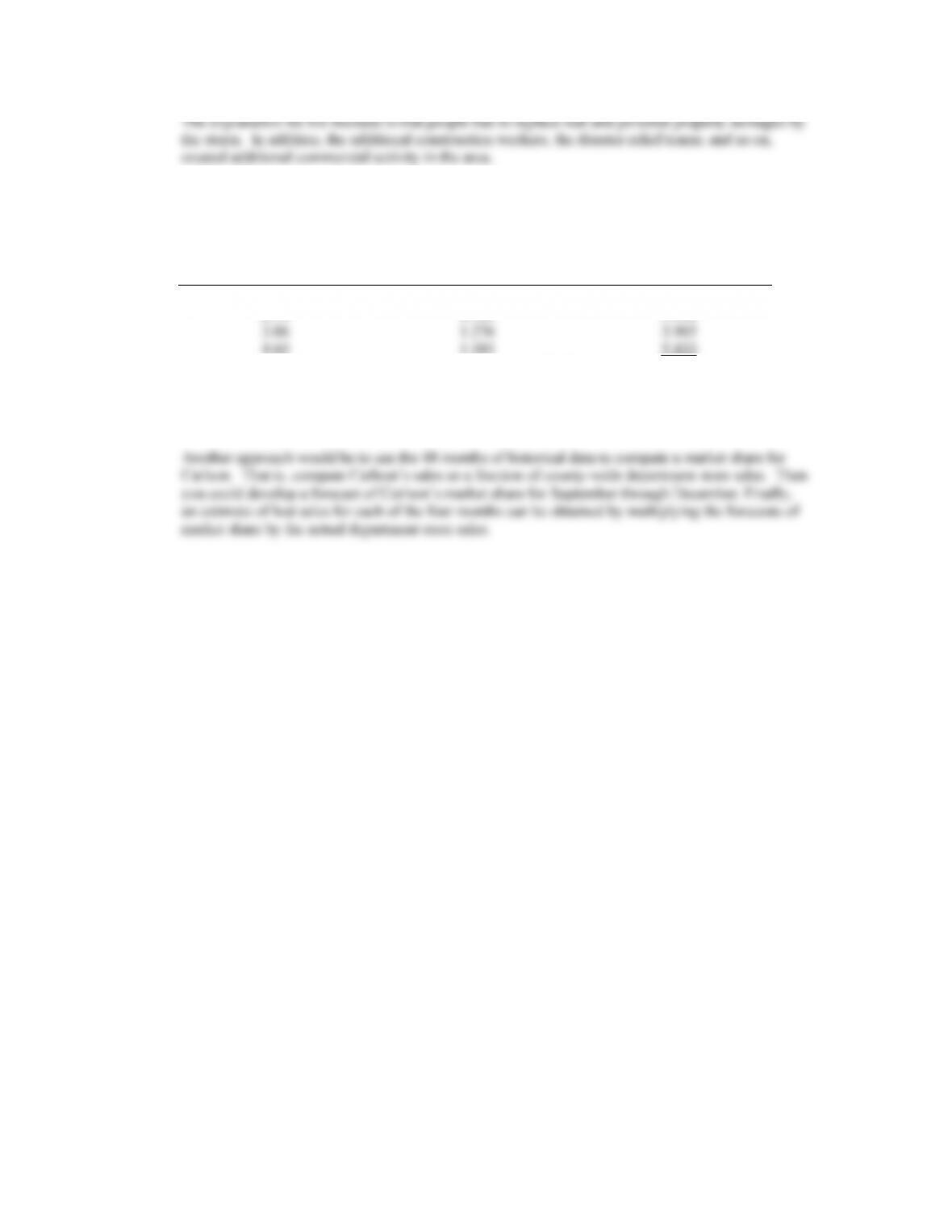
4. One approach would be to use the forecast of what sales would have been without the hurricane and
then multiply by the lift factor to account for the excess storm-related sales. Such an estimate of lost
sales is developed below:
Forecast ($ million)
Lift Factor
Lost Sales ($ million)
2.16
1.365
2.948
2.54
1.410
3.581
3.06
1.276
3.905
4.60
1.181
5.433
Total
15.867
Based on this analysis, Carlson Department Stores can make a case to the insurance company for a
business interruption claim of $15,867,000.