Instructor’s Manual for Leadership: Theory, Application, Skill Development, 6e 63
© 2016 Cengage Learning. All Rights Reserved. May not be copied, scanned, or duplicated, in whole or in part, except for
use as permitted in a license distributed with a certain product or service or otherwise on a password-protected website
for classroom use.
B. Leadership Style (Slide 4-37)
Leaders can analyze their situation and better understand how these three characteristics substitute or neutralize
their leadership style and thus can provide the leader and followership most appropriate for the situation.
C. Changing the Situation
Like Fiedler suggested, leaders can change the situation rather than their leadership style. Thus, substitutes for
leadership can be designed in organizations in ways to complement existing leadership, to act in leadership
absence, and to otherwise provide more comprehensive leadership alternatives.
D. Research Criticism, and Applications (Slide 4-38, Key Points on Slide 4-39)
Research has found support for some aspects of the theory, but other aspects have not been tested or supported.
Therefore, it is premature to assess the validity and utility of leadership substitutes theory.
WORK APPLICATION 4-6
Identify your present or past manager. Can the characteristics of followers, task,
and/or the organization substitute for this leader? In other words, is his or her
leadership necessary? Explain.
Self-Assessment 4-2
Your Personality and Contingency Leadership Theories
If you want students to complete the Self-Assessment exercises throughout the
book, you may want to tell students and spend a little time talking about them.
LEARNING OUTCOMES AND ANSWERS
The chapter summary is organized to answer the learning objectives for Chapter 4. They are also found at the end of
the chapter and can be used as short answer questions on exams.
These learning outcomes are included in the test bank in the conceptual section.
1. State the major difference between behavioral and contingency leadership theories, and explain the
behavioral contribution to contingency theories.
Behavioral theories attempt to determine the one best leadership style for all situations. Contingency leadership
2. Describe the contingency leadership theory variables.
The contingency leadership variables used to explain the appropriate leadership style are the leader, followers,
3. Identify the contingency leadership model styles and variables.
The contingency leadership model styles are task and relationship. The variables include (1) the leader–follower
4. State the leadership continuum model major styles and variables.
The two major continuum leadership model styles are boss-centered and subordinate-centered. The variables
5. Identify the path-goal leadership model styles and variables.
The path-goal leadership model styles include directive, supportive, participative, and achievement-oriented.
64 Instructor’s Manual for Leadership: Theory, Application, Skill Development, 6e
© 2016 Cengage Learning. All Rights Reserved. May not be copied, scanned, or duplicated, in whole or in part, except for
use as permitted in a license distributed with a certain product or service or otherwise on a password-protected website
for classroom use.
6. State the normative leadership model styles and the number of variables.
7. Discuss the major similarities and differences between the behavioral and contingency leadership
theories.
The primary similarity between these theories is that their leadership styles are all based on the same two
8. Compare and contrast four major differences among the four contingency leadership models.
Using Exhibit 4.12, the first difference is in the number of leadership styles used in the four models, which
ranges from 2 (contingency) to 7 (continuum). The second difference is in the number of contingency variables
9. List which leadership models are prescriptive and descriptive, and explain why they are classified as
such.
The contingency and normative leadership models are prescriptive models, because they specify exactly which
10. Explain substitutes and neutralizers of leadership.
REVIEW QUESTION ANSWERS
These review questions are included in the test bank in the conceptual section.
1. What is the difference between a theory and a model?
A leadership theory is an explanation of some aspect of leadership; theories have practical value because they
are used to better understand, predict, and control successful leadership. The leadership theory explains the
2. What are the contingency leadership variables are common to all of the theories?
3. How does the global economy relate to contingency leadership?
Contingency leadership states that to be successful the leader must use the appropriate style to fit the followers
4. What are the two continegency leadership theory leadership styles?
5. Do the three situational favorableness factors of the contingency leadership model (Exhibit 4.3) fit in only
one of the three variables (follower, leader, situation) of all contingency leadership variables (Exhibit
4.1)? Explain.
Instructor’s Manual for Leadership: Theory, Application, Skill Development, 6e 65
© 2016 Cengage Learning. All Rights Reserved. May not be copied, scanned, or duplicated, in whole or in part, except for
use as permitted in a license distributed with a certain product or service or otherwise on a password-protected website
for classroom use.
6. What is the difference in the outcomes of the contingency leadership and the continuum leadership
models and that of the path-goal model?
The contingency and continuum leadership models are concerned with maximizing performance, while the
7. What are the three subordinate and environmental situational factors of the path-goal model?
The three subordinate situational variables include (1) authoritarianism, (2) locus of control, and (3) ability. The
8. What are the path-goal theory leadership styles?
9. What are the normative leadership theory leadership styles?
10. What is the primary difference between the contingency leadership model and the other leadership
models (leadership continuum, path-goal, and normative leadership)?
11. What are the three substitutes for leadership?
CRITICAL THINKING ANSWERS
Applications may also be used as class discussion questions, or written assignments to develop communication
skills.
These communication skills questions are included in the test bank in the application section.
1. Do you agree with Fiedler’s belief that people have one dominant leadership style and cannot change
styles? Explain. (Slide 4-8)
2. Do you believe that more managers today are using more boss- or subordinate-centered leadership
styles? (Slide 4-18)
3. Do you agree that time is an important situational factor to consider in selecting a leadership style for the
situation? Explain. (Slide 4-31)
4. The normative leadership model is the most complex. Do more variables improve the model? (Slide 4-33)
5. One group of authors believes that Fiedler’s contingency leadership model is the model best supported by
research. However, a different author believes that it is the normative leadership model. Which model do
you believe is best supported by research? Why? (Slide 4-36)
6. Which contingency leadership theory do you think is the best? (Slide 4-44)
7. Which contingency leadership theory do you actually plan to use, and how? If you don’t plan to use any,
give a detailed reason for not wanting to use any of the models. (Slide 4-44)
66 Instructor’s Manual for Leadership: Theory, Application, Skill Development, 6e
© 2016 Cengage Learning. All Rights Reserved. May not be copied, scanned, or duplicated, in whole or in part, except for
use as permitted in a license distributed with a certain product or service or otherwise on a password-protected website
for classroom use.
CONCEPT APPLICATION ANSWERS
There are similar questions in the test bank in the application section.
Concept Application 4-1 Contingency Leadership Theory
NOTE: The Contingency model in Exhibit 4.3 must be used to get to the answers by answering the three questions
on the top of the model to get to the last two columns where the two answers are.
h/A 1. 8/Task-oriented. Q1 relations are poor (rude). Q2 the task is unstructured (departments are different),
and Q3 power is weak (HR staff only advise and assist line managers). Task-oriented leadership is
appropriate.
Concept Application 4-2 Leadership Continuum
d 6. 4 – The leader has presented a tentative decision subject to change.
Concept Application 4-3 Path-Goal Leadership
a 11. Directive. With a new group it is important to start by making sure all members know what the job is
and how to do it.
CASE ANSWERS
Foxconn Technology Group
1. Which leadership style would Fiedler say Li Chang uses?
2. Using Exhibit 4.3, Fiedler’s contingency leadership model, what situation and leadership style are
appropriate for the production department and for the custom design department?
In the production department, Chang had (1) good relations, (2) the task was repetitive, and (3) his power was
3. Why isn’t Chang doing an effective job in the design department?
4. What would Fiedler and Kerr and Jermier recommend that Chang do to improve performance?
Instructor’s Manual for Leadership: Theory, Application, Skill Development, 6e 67
© 2016 Cengage Learning. All Rights Reserved. May not be copied, scanned, or duplicated, in whole or in part, except for
use as permitted in a license distributed with a certain product or service or otherwise on a password-protected website
for classroom use.
They would recommend changing the situation, not the leadership style. If Chang develops a good relationship
5. Which of the two basic continuum leadership styles would Tannenbaum and Schmidt recommend for the
manager of the design department?
6. Which path-goal leadership style would House recommend for the manager of the design department?
Cumulative Case Questions
7. Describe Chang’s personality based on the Big Five model of personality (Chapter 2). How does Chang’s
personality influence his leadership style?
Chang is high on surgency, low on agreeableness, low on adjustment (emotionally stable), conscientious, and
8. How is Chang’s leadership style and behavior affecting employee needs and motivation (Chapter 3)?
CASE EXERCISE AND ROLE-PLAY
Chang is unable, but willing, to do a good job. Thus, the most appropriate normative leadership style is the consult
individually style. Gou should make Chang aware that she is using the wrong leadership style for the situation.
Chang needs to be told about the participative leadership style and how to use it with her employees, and she will
need follow-up help to make her a successful manager again.
VIDEO CASE ANSWERS
Leadership at McDonald’s
1. As a leader in the first years of McDonald’s, what kind of normative leadership style do you think Ray
Kroc likely used? Explain your answer.
Kroc most likely used the decide and consult group leadership participation styles as a leader in the first years
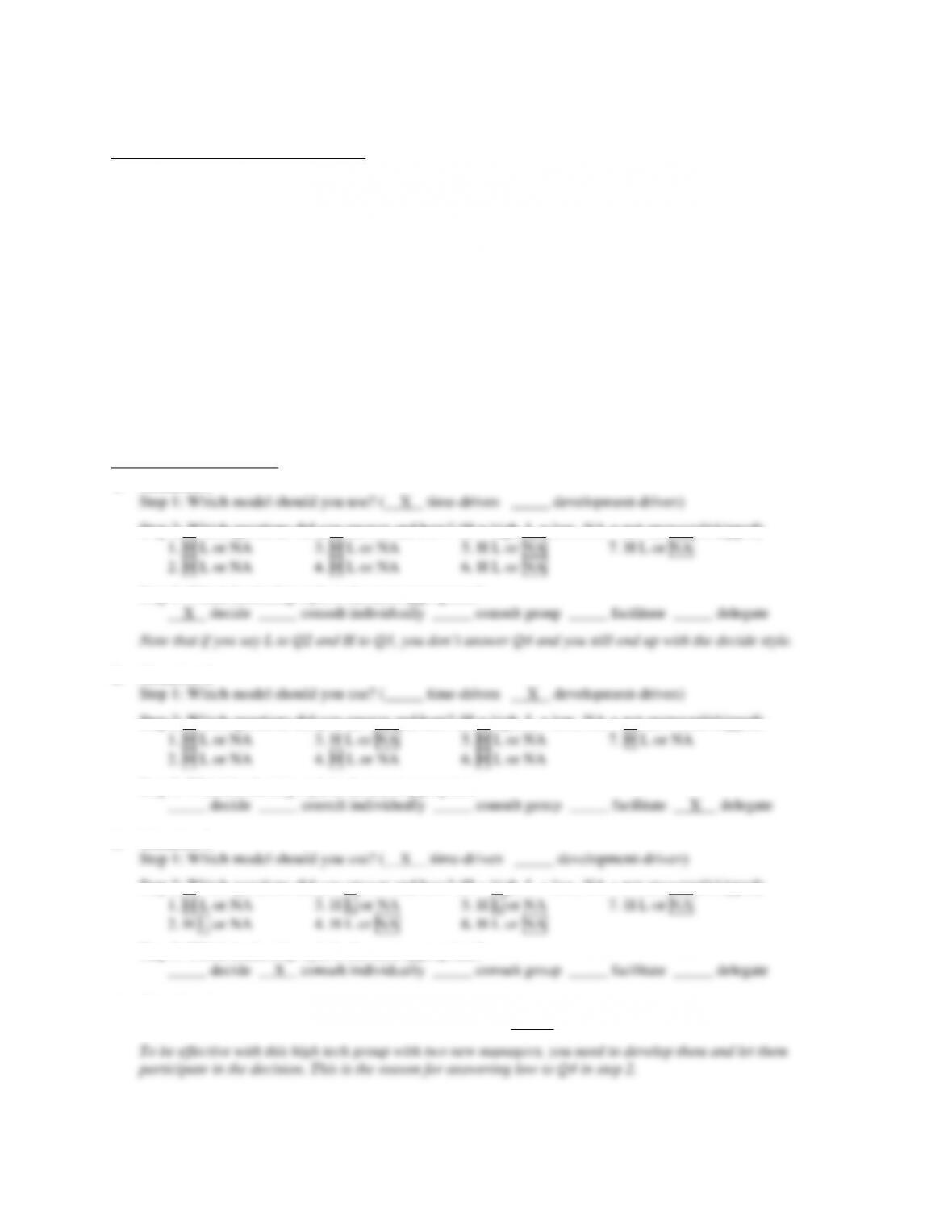
2. What are the benefits of a corporate leadership strategy?
A corporate leadership strategy defines the overall leadership goals of the company. In this way, all employees
Self-Assessment 4-3
Determining Your Preferred Normative Leadership Style
This is used with Developing Your Leadership Skills Exercise 1.

68 Instructor’s Manual for Leadership: Theory, Application, Skill Development, 6e
© 2016 Cengage Learning. All Rights Reserved. May not be copied, scanned, or duplicated, in whole or in part, except for
use as permitted in a license distributed with a certain product or service or otherwise on a password-protected website
for classroom use.
DEVELOPING YOUR LEADERSHIP SKILLS EXERCISE 4-1 IDEAS AND ANSWERS
Identifying Normative Leadership Styles
Total Time (5–30 minutes)
Select the total time you want to spend on this exercise in class and then select one of the three options.
Answers for Situations 1–12 of Self-Assessment 3
1. a. S4 DL
2. a. S2 C
3. a. S4 DL
4. a. S2 C
5. a. S1 D
6. a. S4 DL
7. a. S2 C
8. a. S3 F
9. a. S3 F
10. a. S1 D
11. a. S1 D
12. a. S4 DL
© 2016 Cengage Learning. All Rights Reserved. May not be copied, scanned, or duplicated, in whole or in part, except for
use as permitted in a license distributed with a certain product or service or otherwise on a password-protected website
for classroom use.
DEVELOPING YOUR LEADERSHIP SKILLS EXERCISE 4–2 IDEAS AND ANSWERS
Using the Normative Leadership Models
The exercise takes an Applying the Concept, which has a skill element, and makes it a skill-development exercise by
having groups discuss how to use the model in groups of 2–3.
Total Time (25– 40 minutes)
The amount of time you spend on this exercise is dependent on whether you choose to state the answers for the four
situations or lead a discussion on each situation.
Recommended approximate time for a 30-minute period:
8:00 Procedure 1 10 minutes
8:10 Procedure 2 15 minutes
8:25 Conclusion 3 minutes
8:28 Apply It 2 minutes
8:30
Decision-Making Answers
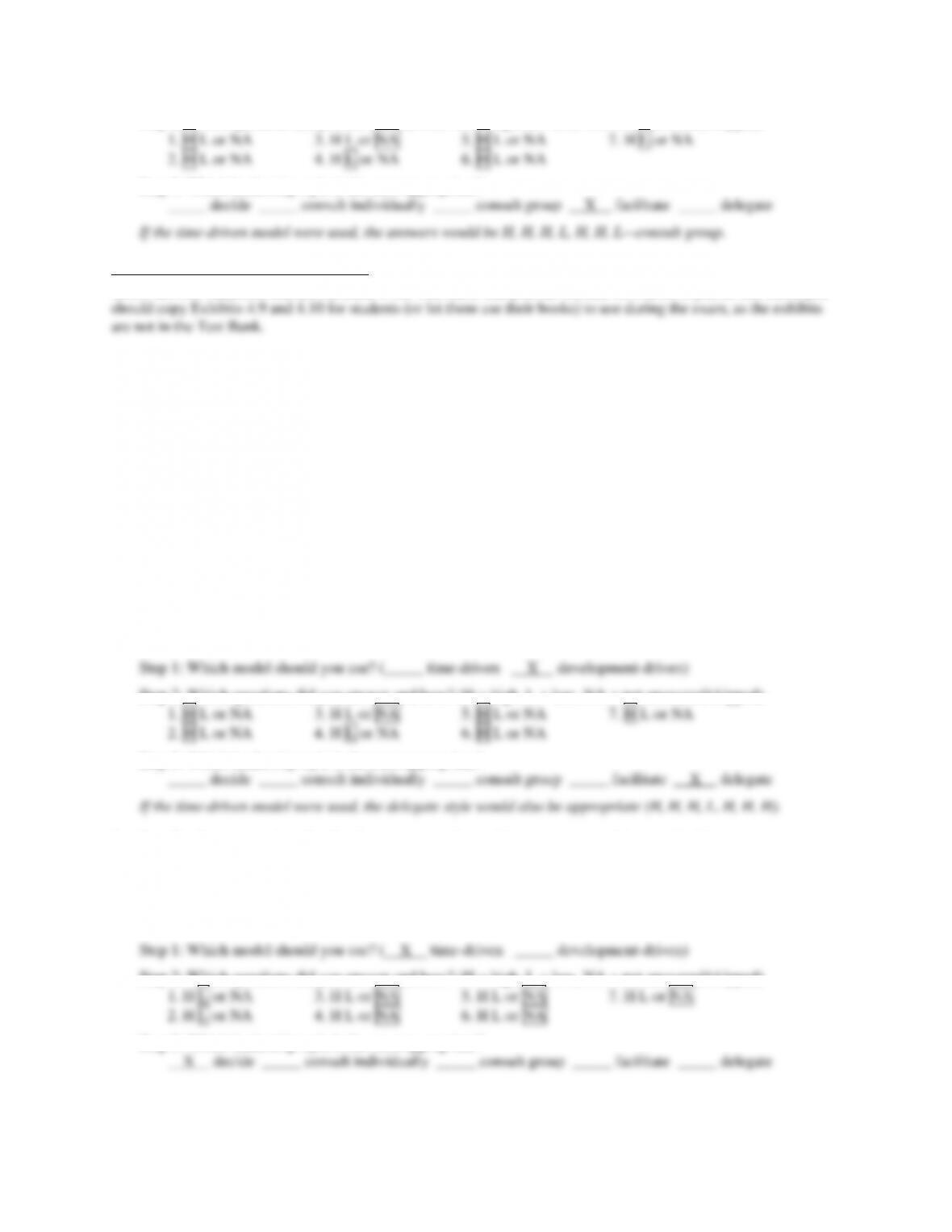
1. Situation 1
Step 2: Which questions did you answer and how? (H = high, L = low, NA = not answered/skipped)
Step 3: Which leadership style is the most appropriate?
2. Situation 2
Step 2: Which questions did you answer and how? (H = high, L = low, NA = not answered/skipped)
Step 3: Which leadership style is the most appropriate
3. Situation 3
Step 2: Which questions did you answer and how? (H = high, L = low, NA = not answered/skipped)
Step 3: Which leadership style is the most appropriate?
4. Situation 4
Step 1: Which model should you use? (_____ time-driven X development-driven)
70 Instructor’s Manual for Leadership: Theory, Application, Skill Development, 6e
© 2016 Cengage Learning. All Rights Reserved. May not be copied, scanned, or duplicated, in whole or in part, except for
use as permitted in a license distributed with a certain product or service or otherwise on a password-protected website
for classroom use.
Step 2: Which questions did you answer and how? (H = high, L = low, NA = not answered/skipped)
Step 3: Which leadership style is the most appropriate?
Testing on Skill-Development Exercise 2
Below are two situations that are included in the Test Bank that you can include on exams. If you do use them, you
1. Production manager. You are an experienced competent manager of a production department. A new potential
customer offered to buy a large quantity of your product for a reasonable price. The offer is open for a few days,
which gives you time for input into the decision if you want it. To fill the new order, your employees would
have to work nights and weekends for three weeks. The company has no union and cannot force employees to
work overtime. However, your department members work well together, they have a very good performance
record, and they like to participate in decision making. Which primary leadership style would you use to make
the decision to take the order or not?
Step 1: Which model should you use? (_____ time-driven _____ development-driven)
Step 2: Which questions did you answer and how? (H = high, L = low, NA = not answered/skipped)
1. H L or NA 3. H L or NA 5. H L or NA 7. H L or NA
2. H L or NA 4. H L or NA 6. H L or NA
Step 3: Which leadership style is the most appropriate?
_____ decide _____ consult individually _____ consult group _____ facilitate _____ delegate
Solution
Step 2: Which questions did you answer and how? (H = high, L = low, NA = not answered/skipped)
Step 3: Which leadership style is the most appropriate?
2. Fast-food manager. As a fast-food manager, you have a high turnover rate. You need to hire two new
employees soon as you are short-handed now. You have five applicants. Your employees are the typical high
school students who work part time and then eventually quit for better jobs, or when they finish school, get full-
time jobs or to go on to college.
Solution
Step 2: Which questions did you answer and how? (H = high, L = low, NA = not answered/skipped)
Step 3: Which leadership style is the most appropriate?

Instructor’s Manual for Leadership: Theory, Application, Skill Development, 6e 71
© 2016 Cengage Learning. All Rights Reserved. May not be copied, scanned, or duplicated, in whole or in part, except for
use as permitted in a license distributed with a certain product or service or otherwise on a password-protected website
for classroom use.
Self-Assessment 4-4
Your Leadership Continuum and Path-Goal Leadership Styles
If you want students to complete the Self-Assessment exercises throughout the
book, you may want to tell students and spend a little time talking about them.