Shelter Rule
Under the shelter rule, the transferor of an instrument passes on all of his rights. When a holder in due
course transfers an instrument, the recipient acquires all the same rights even if he is not a holder in
due course himself.1
Real Defenses: valid against both a holder
and a holder in due course
Personal Defenses: valid only against a
holder
Forgery
Bankruptcy
Being Underage
Alteration
Duress
Mental incapacity
Illegality
Fraud in the execution
Breach of contract
Lack of consideration
Prior payment
Unauthorized completion
Fraud in the inducement
Non-delivery
Real Defenses vs. Personal Defenses
Question: Why are both real and personal defenses valid against a holder; but only real defenses
are valid against a holder in due course? What is the difference between real and personal
defenses?
Answer: Real defenses deal with fundamental challenges to the basic validity of the instrument
itself. These are challenges that render the instrument void from the beginning–as if it had never
Question: In the discussion of personal defenses in the text (p.547), why is Ross a “mere holder,”
and not a holder in due course?
Answer: A holder in due course must take an instrument in good faith, for value, without notice of
The Fundamental “Rule” of Commercial Paper, Revisited
If, at the beginning of class, you asked students to name examples of commercial paper that they have
used in the last month, you may want to ask the following question now.
Question: Does the holder of this commercial paper have an unconditional right to be paid?
Answer: To answer this question, students would have to decide:
Is the paper negotiable?
1 Section 3-203(b).

Claims in Recoupment
A claim in recoupment is not the same as a defense, but it has a similar impact. It means that the issuer
subtracts (i.e., “sets off”) any other claims he has against the initial payee from the amount he owes on
the instrument.
A claim in recoupment is valid against a holder but not against a holder in due course.
Consumer Exception
A consumer credit contract is one in which a consumer borrows money from a lender to purchase
goods and services from a seller who is affiliated with the lender..
Case: Antuna v. Nescor, Inc.2
Facts: Steven Vlohotis was a salesman for NESCOR, a home improvement company. He convinced
the Antunas to sign a consumer credit contract with NESCOR to install vinyl siding and windows. The
contract provided that the Antunas would pay for the improvements in installments. NESCOR assigned
the contract to First Consumer Credit, LLC, which reassigned it to The Money Store (TMS). In keeping
with FTC requirements, the contract contained the following language: “Any holder of this consumer
credit contract is subject to all claims and defenses which the debtor could assert against the Seller of
the goods or services pursuant hereto or with the proceeds hereof.”
Connecticut law (the Act) provides that, “No home improvement contract shall be valid or
enforceable against an owner unless it is entered into by a registered salesman or a registered
contractor.” The NESCOR salesman, Vlohotis, was not registered.
Unhappy with NESCOR’s work, the Antunas stopped making payments under the contract. TMS
filed suit, seeking to foreclose on their house. The Antunas moved for summary judgment, arguing that
TMS could not enforce the contract because it was not a holder in due course.
Issue: Does TMS have the right to foreclose on the Antunas’ home? Was TMS a holder in due course?
Excerpts from Judge Shortall’s Decision: In employing Vlohotis to call on the plaintiffs as its
salesman NESCOR was performing an illegal act, one explicitly prohibited. Accordingly, the court
finds that NESCOR’s material noncompliance with [the statute] renders the home improvement
contract invalid and unenforceable and precludes it from enforcing the consumer credit contract against
the plaintiffs.
The plaintiffs are seeking summary judgment against TMS on its counterclaim, which seeks to
foreclose upon the plaintiffs’ home because of their default under the consumer credit contract now
held by TMS. They argue that summary judgment is appropriate because NESCOR’ s violation of the
Act bars any recovery by TMS.
It is only by giving consumers like the plaintiffs a shield against enforcement of these consumer
credit contracts that the Act’s declaration that a contract is invalid and unenforceable has any meaning.
The language appearing in the consumer credit contract held by TMS, viz., that the contract is “subject
to all claims and defenses which” the plaintiffs could assert against NESCOR is mandated in all such
contracts by the FTC to prevent the seller of goods from cutting off the consumer’s right to assert
claims and defenses against the seller’s assignee. So, in this case, where the Act, itself, gives the
plaintiffs the right to defend against enforcement of the home improvement contract, the language in
the consumer credit contract held by TMS gives them the same right as against TMS.
Accordingly, because the TMS is subject to those same claims and defenses under the very
language of its contract with the plaintiffs, TMS may not enforce the consumer credit contract it holds
by foreclosing on the plaintiffs’ property for nonpayment.
The plaintiffs’ motion for summary judgment is granted.
2 2002 Conn. Super. LEXIS 1003, SUPERIOR COURT OF CONNECTICUT, 2002
Holding: Summary judgment is granted for Johnson. The purpose of the Act is to prevent the seller of
goods or service provider from cutting off the consumer’s right to assert claims and defenses against
the seller’s or provider’s assignee. NESCOR’s material noncompliance with the Act renders the home
improvement contract invalid and unenforceable and precludes it from enforcing the consumer credit
contract against the plaintiffs.
Additional Case: Scott v. Mayower Home Improvement Corp.3
Facts: Mary Johnson signed a contract with Mayflower to perform repair work on her home for a fee
of $25,900. Mayflower arranged for Johnson to pay for this work by borrowing money from Sterling
Resources. The note she signed with Sterling had an unconscionably high price of $50,108.60 and an
interest rate of 17.98%.
Johnson alleges that Mayflower was running a scam, hiring unlicensed salespeople to target
minority neighborhoods for home repairs. Its contracts contained deceptive or incomplete
specifications and payment terms. The actual work was shoddy or incomplete, using poor quality
materials. Sterling routinely loaned money to Mayflower customers. Sterling then sold the loans
to banks and other financial institutions.
Johnson failed to make the payments due on the note and the Lender sued, moving for summary
judgment against Johnson on the grounds that, as a holder in due course, it was entitled to enforce the
note regardless of her claims against Mayflower or Sterling. She responded that, under the FTC
consumer exception rule, the Lender was not a holder in due course and therefore subject to whatever
defenses she had against Sterling or Mayflower.
Issue: Was the Lender a holder in due course?
Holding: No, summary judgment is denied for the Lender but granted for Johnson. The purpose of the
FTC Holder Rule is to protect innocent consumers from unethical merchants and their financiers. The
note that Johnson signed contained the FTC Holder notice. Therefore, the Lender was on notice and is
not a holder in due course.
Question: What was going on in this case?
Answer: Mayflower was running a scam. It would persuade minorities in poor neighborhoods to do
Question: Why didn’t Mayflower keep the note that Mary Johnson signed?
Question: Was the Lender, in the end, a holder in due course?
Question: Why did Mayflower and the Lender think they could enforce a note that contained this
language?
Suggested Additional Assignment: Writing Exercise
If you asked students to write their own mystery story modeled on the vignette that opens the chapter,
this would be an appropriate time to ask them to break into groups and share their stories with the
group. They could then select the best story from their group to read aloud to the class.
3 363 N.J. Super. 145; 831 A.2d 564; 2001 N.J. Super. LEXIS 524 SUPERIOR COURT OF NEW JERSEY, 2001
Multiple Choice Questions
1 Which of the following statements are true?
(a) A draft is always a check.
(b) A check is always a draft.
(c) A note must involve at least three people
(d) All of the above.
2 Which of the following standards are required for negotiability:
(a) The instrument must be signed by the payee.
(b) The instrument must be payable on demand.
(c) The instrument must be payable to order.
(d) None of the above.
3 Marla is not a holder in due course if she takes an instrument:
(a) believing that the underlying contract was honest, although it turned out to be dishonest.
(b) that is a consumer credit contract.
(c) that appeared commercially reasonable when made but turned out to be dishonest.
(d) All of the above.
4. CPA QUESTION In order to negotiate bearer paper, one must:
(a) indorse the paper.
(b) indorse and deliver the paper with consideration.
(c) deliver the paper.
(d) deliver and indorse the paper.
5. CPA QUESTION Bond fraudulently induced Teal to make a note payable to Wilk, to whom
Bond was indebted. Bond delivered the note to Wilk. Wilk negotiated the instrument to Monk, who
purchased it with knowledge of the fraud and after it was overdue. If Wilk qualifies as a holder in
due course, which of the following statements is correct?
(a) Monk has the standing of a holder in due course through Wilk.
(b) Teal can successfully assert the defense of fraud in the inducement against Monk.
(c) Monk personally qualifies as a holder in due course.
(d) Teal can successfully assert the defense of fraud in the inducement against Wilk.
Case Questions
1. Kay signed a promissory note for $220,000 that was payable to Investments, Inc. The company
then indorsed the note over to its lawyers to pay past and future legal fees. Were the lawyers
holders in due course?
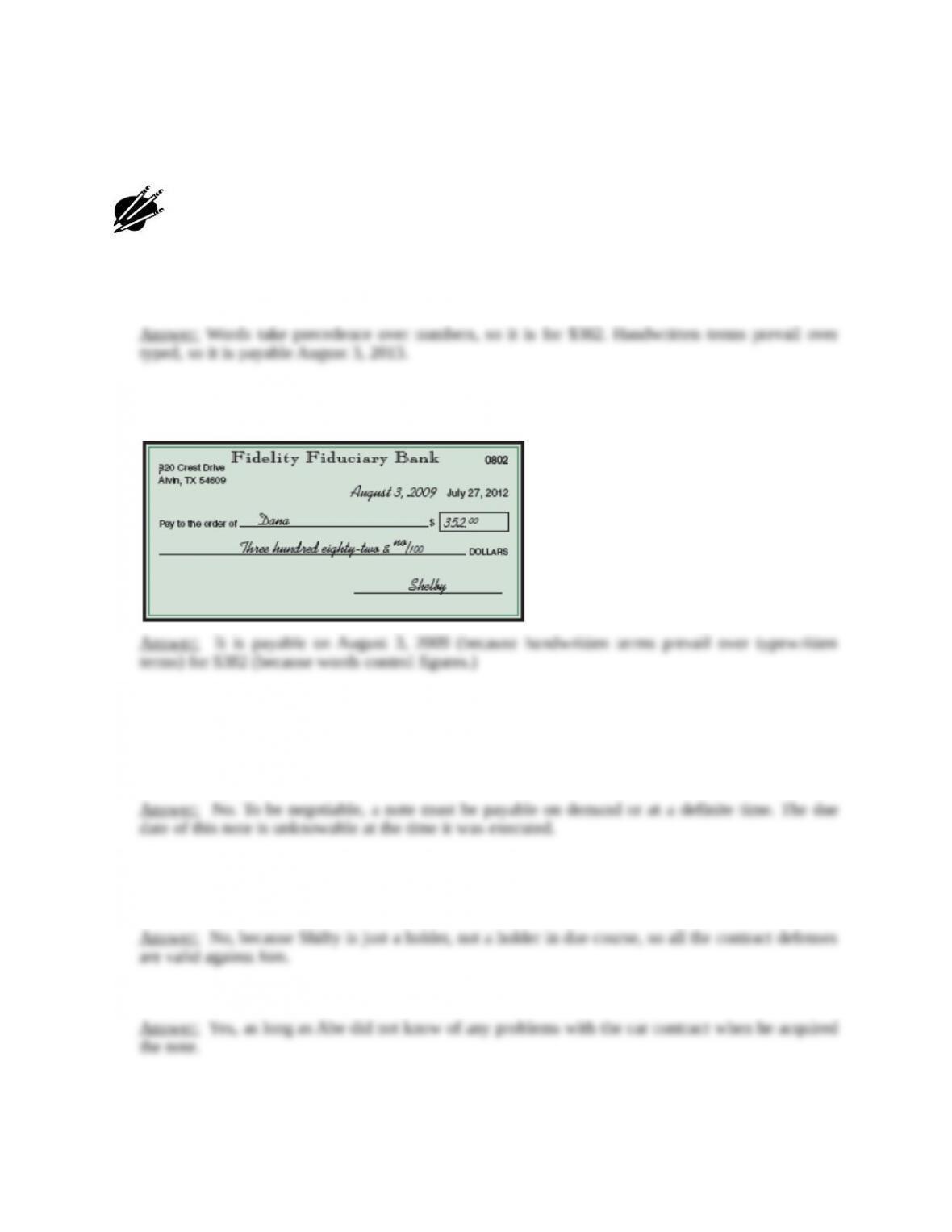
2. Shelby wrote the following check to Dana. When is it payable and for how much?
3. Teri and Jerry entered into a contract with a real estate developer that provided he would build the
house of their dreams on a lot that he owned. In payment for the property and the house, T&J
signed a promissory note which was payable, “upon closing on sale of the house to be constructed
on the below described lot or one year from the date of this Note, whichever event first occurs.” Is
this note negotiable?
4. Duncan Properties, Inc. agrees to buy a car from Shifty for $25,000. The company issues a
promissory note in payment. The car that Duncan bought is defective. If Shifty still has the note,
does Duncan have to pay it?
5. Shifty sells that note to Honest Abe for $22,000. Does Duncan have to pay Abe?
6. Abe gives the note to his daughter, Prudence, for her birthday. Is Prudence a holder in due course?
Does Duncan have to pay Prudence?
7. Tom was CEO of a company. He stole money from the company by writing a series of checks made
out to “Cash” which he deposited in his own personal account at Bank. (Please do not try this at
home.) Of course, he then spent the money. The company sued the Bank to get the money back.
Was the Bank a holder in due course?
Discussion Questions
1. Catherine suffered serious physical injuries in an automobile accident and became acutely
depressed as a result. One morning, she received a check for $17,400 in settlement of her claims
arising out of the accident. She indorsed the check and placed it on the kitchen table. She then
called Robert, her longtime roommate, to tell him the check had arrived. That afternoon, she
jumped from the roof of her apartment building, killing herself. The police found the check and a
note from her, stating that she was giving it to Robert. Had Catherine negotiated the check to
Robert?
Answer: The court held that Wagner had negotiated the check to Scherer. By indorsing the check
2. Ethics In desperate financial trouble and fearful of losing his house, Abbott asked his friend Taylor
for help. Taylor had been an officer of the Bank, so she put Abbott in touch with some of her former
colleagues there. When a $300,000 loan was ready for closing, Taylor informed Abbott that she
expected a commission of $15,000. Taylor threatened to block the loan if her demands were not
met. Abbott was desperate, so he agreed to give Gardner $4,000 in cash and a promissory note for
$11,000. On what grounds might Abbott claim that the note is invalid? Would this be a valid
defense? Even if Gardner was in the right legally, was she in the right ethically?
3. Kendall raised hogs. The Grain Company would provide him with hogs and grain and, in return, he
would sign a promissory note in an amount equal to the value of these items. Once the pigs were
grown, Kendall would sell them and repay the loan. One time, an officer of the Grain Company
asked Kendall to sign not only his own but also his wife’s name to the promissory note. Kendall did
so, but put his initials, KH, after her name to indicate that he was the one who had signed the note.
Grain Company sold this note to Bank. It turned out that the Grain Company did not actually own
the hogs it had given Kendall and the true owner took them away. Bank sued Kendall for payment
on the promissory note. Are Kendall and/or his wife liable on the note?
Answer: The court ruled that Kendall was not liable because the Bank had not taken the note in
4. On June 30, John signed a demand promissory note for $2,000 to the Camelot Country Club. The
note stated that it was being given in payment for a membership in the country club, but in fact, the
club was insolvent, its memberships had no value, and John was already a member. He was also the
club’s golf pro. John signed the note at the request of the club’s manager to enable the club to
borrow money from the National Bank. The Bank of Dallas purchased the note on July 14 and
immediately made demand. John alleged the note was overdue, and therefore the bank could not be
a holder in due course. Do you agree? What is the moral of this story?
Answer: A demand note is overdue “more than a reasonable length of time after its issue.” The
5. On October 12, James Camp agreed to provide services to Shawn Sheth by October 15. In
payment, Sheth gave Camp a check for $1,300 that was postdated October 15. On October 13,
Camp sold the check to Buckeye Check Cashing for $1,261.31. On October 14, fearing that Camp
would violate the contract, Sheth stopped payment on the check. Also, on October 14, Buckeye
deposited the check with its bank, believing that the check would reach Sheth’s bank on October
15. Buckeye was unaware of the stop payment order. Sheth’s bank refused to pay the check.
Buckeye filed suit against Sheth. Was Buckeye a holder in due course? Must Sheth pay Buckeye?
Answer: The court ruled that Buckeye was not a holder in due course. It passed the subjective
“honesty in fact” test because it is clear that Buckeye accepted the check from Camp in good faith.
However, it did not pass the objective prong of the good faith test because Buckeye did not conduct