OM5 Chapter 9: Supply Chain Design
Discussion Questions
1. Describe the three types of value (supply) chain frameworks (i.e., Exhibits 2.1, 2.3 and 9.1)
and which do you like the best. Why?
The input-output model of value (supply) chain is introduced in Exhibit 2.1 and 2.2. It is the
traditional view of a supply chain and is best at identifying inputs, resources, and
outputs/outcomes. It also includes synchronized information and feedback loops and the
Students will have different arguments as to which paradigm is best. We would argue that
when services are more than say 25 percent of your business then the pre-and
2. Suppose that a company wanted to write a mission statement for its value (supply) chain.
Such a mission statement might include statements about customers, suppliers, quality,
delivery, cost, and sustainability. What questions might you ask a company to help develop a
good mission statement? Propose an example for some industry of your choice such as
coffee, movie theater, pizza, credit card, trash/waste removal, utility or automotive service.
This question should only be assigned if you covered Chapter 4. Questions include: What is
the mission of your organization? Can you rank order your competitive priorities? What is
the order winner? What do your customers buy – goods and/or services — or a bundle of
3. Define the principal criteria that might be used for locating each of the following facilities:
ohospital – minimize distance traveled, response time, labor supply and skills,
ochemical factory – water supply, transportation availability; labor costs and skills,
ofire station – distance to business, response time, multiple communication
oelementary school – closeness to families, good highway access, convenient, safe
oregional automobile parts warehouse – transportation access, land costs, taxes,
4. Select a firm such as Taco Bell (www.tacobell.com), Bank of America
(www.bankofamerica.com), Wal-Mart (www.walmart.com), or another service-providing
organization of interest to you and write a short analysis of location and multisite
management decisions that the firm faces. What criteria do you think they use?
Most students will work in service-producing firms and this question asks them to think
about multisite management. OM value chains, processes, and decisions are far more
5. What might be some useful measures to understand and evaluate the performance of reverse
logistics?
In an article, “Why Reverse Logistics Needs to Become a Core Competency Inside Your
Supply Chain” by Dale S. Rogers, Ron Lembke, and John Benardino
[http://www.supplychain247.com/article/why_reverse_logistics_needs_to_become_a_co
re_competency/legacy_supply_chain_services], the following are suggested:
Disposition cycle time: Cycle times can be an important measure of reverse logistics. The
Amount of product reclaimed and resold: What percentage of product that moves to the
Percentage of material recycled: This metric tracks the percentage of product in the
Waste: How much product and other materials are moved to landfills, incinerated, or
Percentage of cost recovered: Is the firm maximizing the profitability of product that did
Per item handling cost: A cost-per-touch type of metric can be readily computed by
Distance traveled: Tracking average distance traveled per item is not nearly as simple as
Energy used in handling returns: This metric is used in sustainability programs. It
Total Cost of Ownership: What is the total cost of ownership related to originally
Problems and Activities
(Note: an asterisk denotes problems for which an Excel spreadsheet template on the CourseMate
Web site may be used.)
1. Identify a manufactured good and draw its reverse logistics supply chain similar to Exhibit 9.3.
Explain some of the issues in designing and managing this reverse supply chain, and whether
your manufactured good participates in some or all of the eight options such as resale,
refurbishing, remanufacturing, recycling, incineration, and so on.
Possible items students may use include: vehicle parts, used college textbooks, cell phones,
iPads, pizza box, old personal computers, tires, paper, ink cartridges, eye glasses, plastic,
2. Describe a supply chain you are most familiar with and apply the SCOR model (i.e., plan,
source, make, deliver, and return) to define and describe it. Draw a simple diagram of the value
(supply) chain using this model and describe how it works.
This is a simple exercise for getting students to understand the structure of a supply chain and
The Supply Chain Operations Reference (SCOR®) model is the product of Supply Chain
Council (SCC), an independent, nonprofit, global corporation with membership open to all
model has been used by practitioners for many years, the SCOR model provides a unique
framework that links business process, metrics, best practices and technology features into
a unified structure to support communication among supply chain partners and to improve
SCOR® helps manage a common set of business problems through a standardized
language, standardized metrics, and common business practices which accelerate business
Strategy Development – identify, instrument, and deploy supply chain strategies
Merger, Acquisition or Divestiture (companies or supply chains) – merge or split up
Supply optimization and Re-engineering – improving individual, clusters, or
Standardization, Streamlining – improve operational control and cost by
Management alignment – create standardizes management tools, reporting, and
Benchmarking – competitive assessment of qualitative and quantitative performance
Software implementation (ERP, PLM, QC) – pre-implementation definition and
3. Interview a manager for a retail store, health clinic, factory, school, emergency fire or ambulance
facility, or warehouse that was recently built in your area, and ask for an explanation of the
economic and noneconomic factors that helped determine this facility’s location.
It is interesting to see if the organization (firm, government, association, etc.) actually took a
4. Research and write a short paper (2 pages maximum) on how organizations use business
analytics in supply chain design.
Oracle has some good information on supply chain analytics (see
Oracle Supply Chain and Order Management Analytics delivers deep customer
insight into orders and inventory data that empowers organizations to make
better decisions in each of the stages across the entire supply chain
management lifecycle. By leveraging actionable and fact-based insights,
• Provide actionable information to conduct intelligent analysis of orders related to regions,
• Correlate order information with sales revenues, fulfillment performance and customer
• Maximize revenues by ensuring that enough goods are available to fill customer orders
while keeping inventory levels and costs as low as possible
• Comprehensive self-service capabilities reduce the burden on IT resources
5. For the location decision faced by Fountains Manufacturing in Solved Problem
(NUMBER?) in this chapter, determine the ranges of annual production for which would
each location be best. (Hint: Use break-even analysis by developing equations for the total
cost at each location as a function of the annual production. You might wish to consider
using a data table in the Excel template to evaluate total costs for a range of production
volumes.)
Total Costs Loc. 1 Loc. 2 Loc. 3
Location 1 always has a higher cost than location 2 since both the fixed and variable costs
6.* Cunningham Products is evaluating five possible locations to build a distribution center.
Data estimated from the accounting department are provided below. The annual production
is estimated to be 30,000 units.
a. Which location provides the least cost?
For each location, the total cost is equal to the fixed cost plus the variable cost per unit times
the annual volume.
Location 1: Total cost = 75,000 + 19.34x
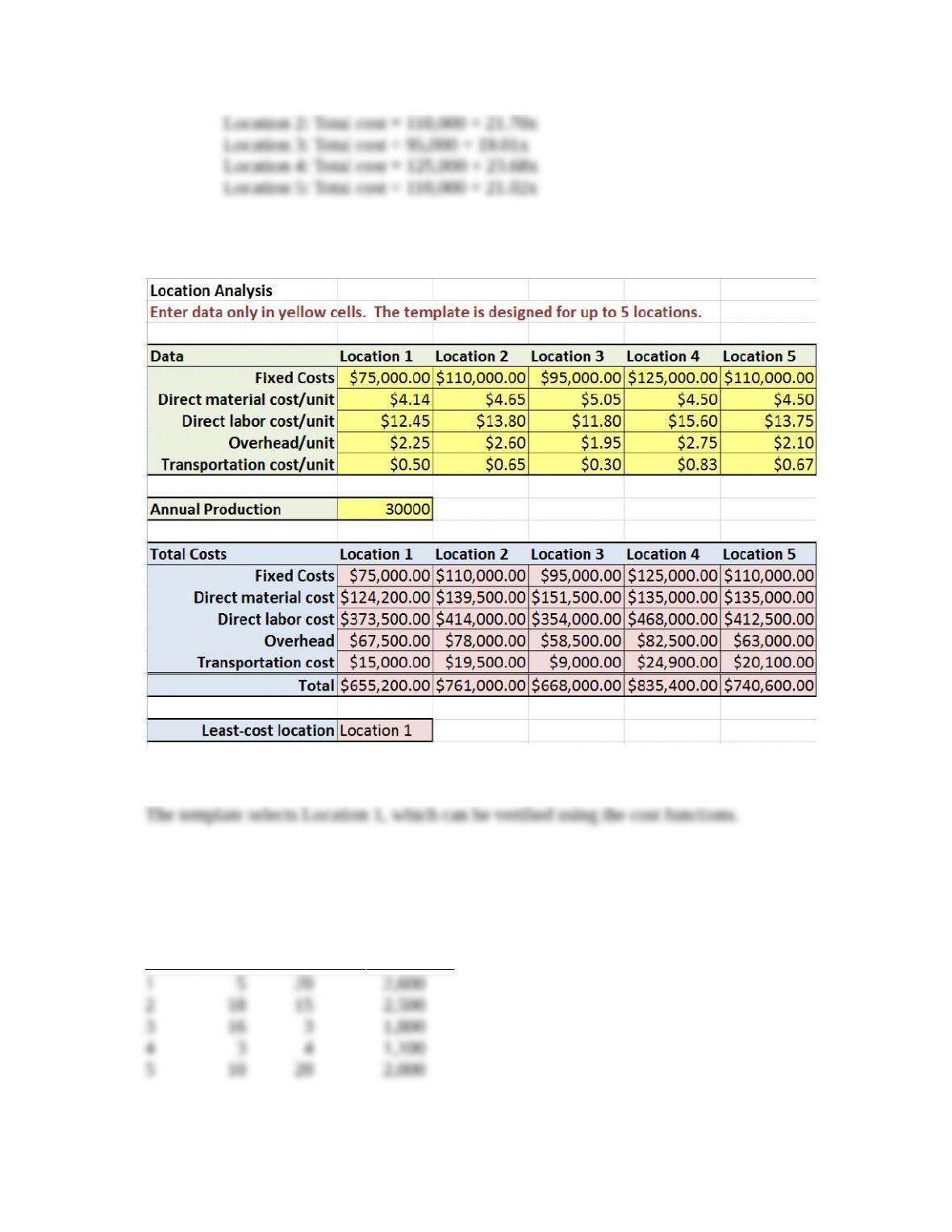
The Excel template Location Analysis computes this easily. As you can see, the least cost
location is #3.
b. For what range of demand would each location be best?
7.* Given the location information and volume of material movements from a supply point to
several retail locations for Bourbon Hardware, find the optimal location for the supply point
using the center-of-gravity method.
Location
Retail Coordinates Material
Outlet x y Movements
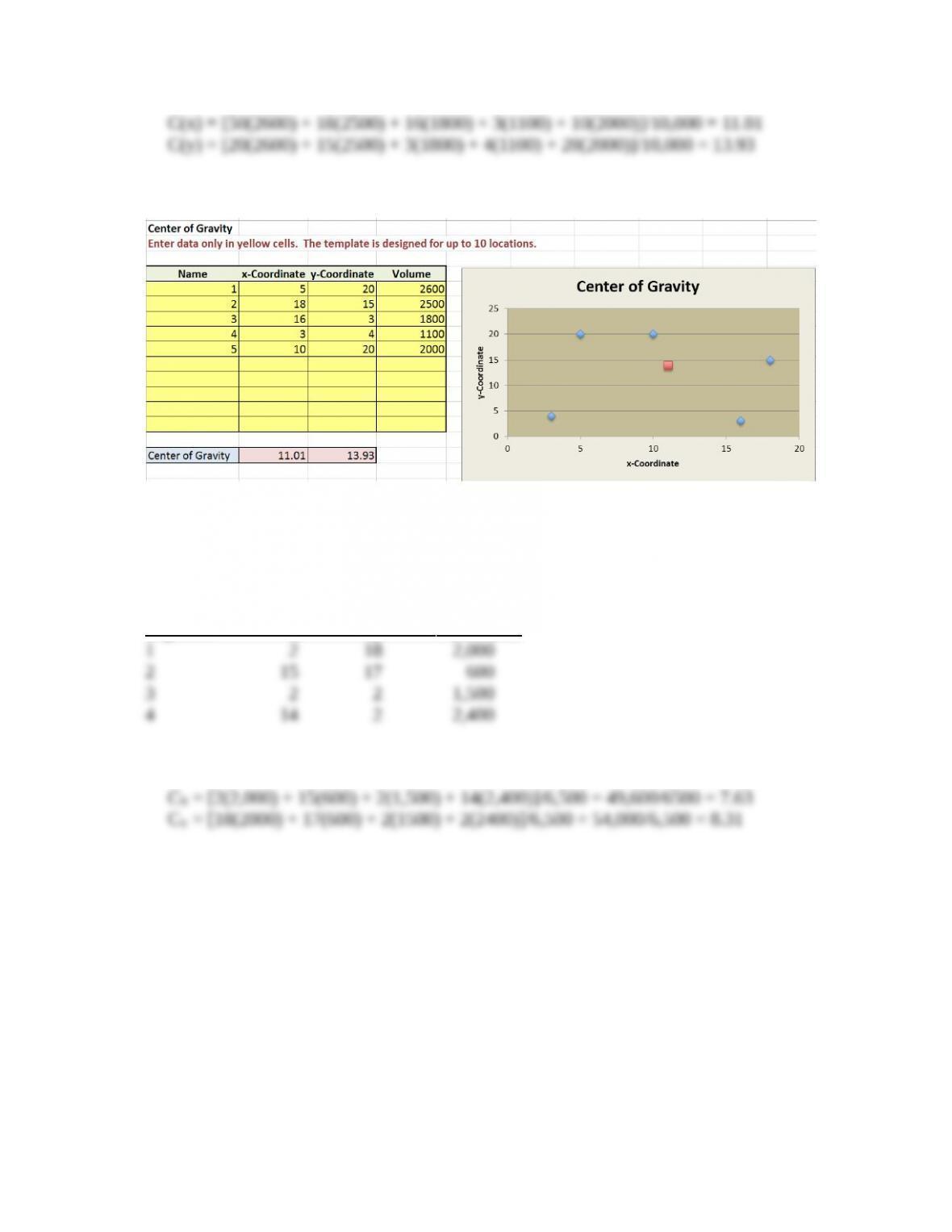
The Excel template Center of Gravity may be used to find the optimal location:
8.* The Davis national drugstore chain prefers to operate one outlet in a town that has four
major market segments. The number of potential customers in each segment along with the
coordinates are as follows:
Location
Market Coordinates Number of
Segment x y Customers
Which would be the best location by the center-of-gravity method?
The Excel template Center of Gravity may be used to find the optimal location:
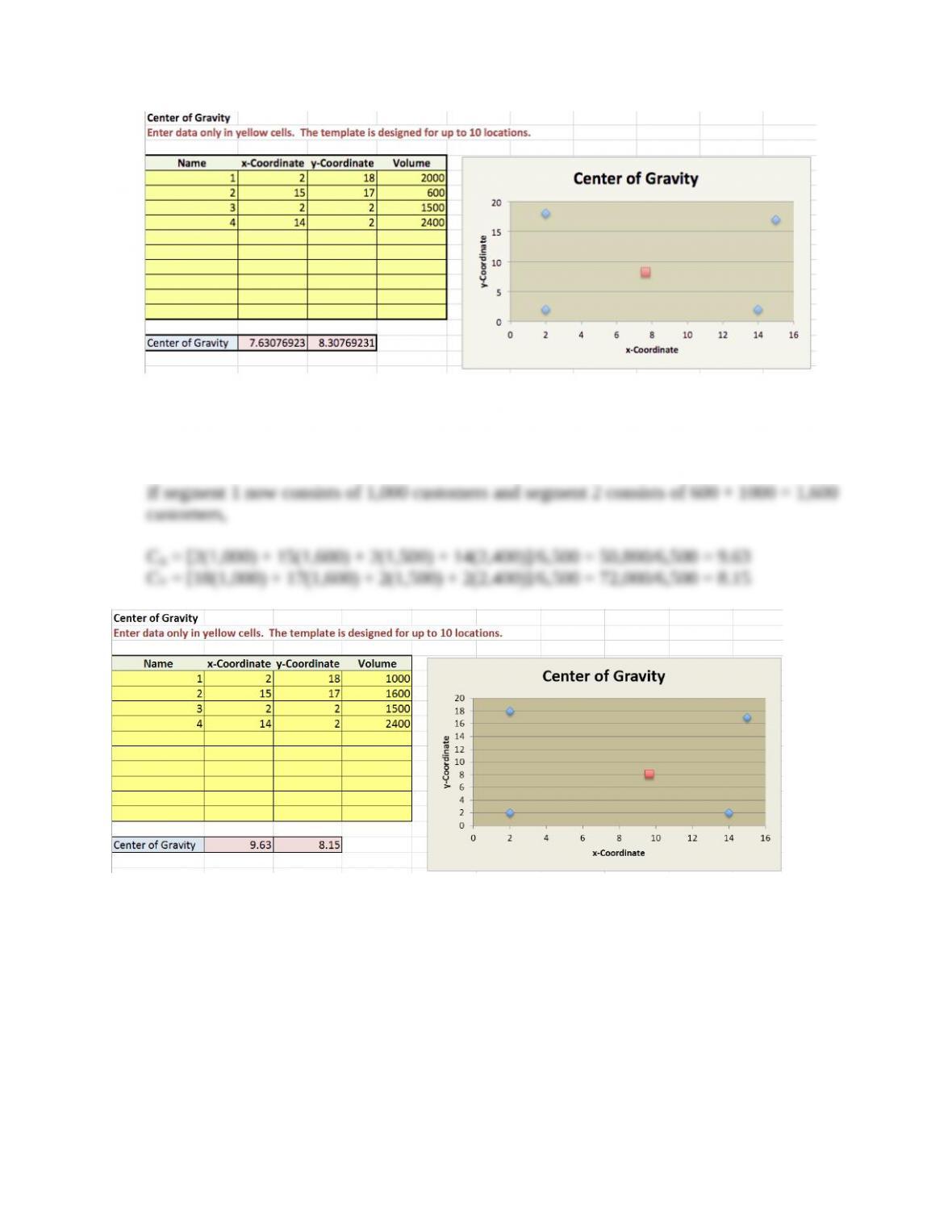
9.* For the Davis drugstore chain in Problem 8, suppose that after five years, half the customers
from segment 1 are expected to move to segment 2. Where should the drugstore shift,
assuming the same criteria are adopted?