OM5 Chapter 5: Technology and Operations Management
Discussion Questions
1. Describe at least one application of modern technology in each of these service industries:
a. Financial services
b. Public and government services
How does your example application improve things, or does it?
These should be easy to identify with a bit of literature or web-based research. Hotels, for
example, use electronic keys that improve patron security while a one-person automated
2. Describe a situation where self-service and technology help create and deliver the customer
benefit package to the customer. Provide examples of how such a system can cause a defect,
mistake or service upset.
An automatic picture kiosk is an example of where technology and customer labor create
hard copy prints. Kodak, for example, has a freestanding kiosk where you put in your digital
3. Discuss each of these statements. What might be wrong with each of them?
a. “We’ve thought about computer integration of all our manufacturing functions, but when
b. “We’ve had these computer-controlled robots on the line for several months now, and
c. “Each of my manufacturing departments is authorized to invest in whatever technologies
d. “I’m glad we finally got that CAD system,” the designer said, a computer-generated
blueprint in hand. “I was able to draw these plans and make modifications right on the
a. Today, labor accounts for only a fraction of total expense in many industries.
Traditional cost justification techniques cannot always be used. Instead of measuring
b. Reprogramming robots can cause inefficient downtime on the line. If
c. Components selected in isolation may perform a specific function well, but
d. The manufacturing engineering department has to re-input specifications and
4. Identify one low and one highly scalable organization and explain why it is so.
Facebook, eBay, and Monster.com are highly scalable businesses. That is, the cost to serve
one additional customer is close to zero or extremely low incremental (variable) costs. Low
5. What challenges do companies face when trying to implement e-commerce business plans
and strategies? What can they learn from the WebVan experience?
We learn from the Webvan experience that (a) low scalability, (b) inadequate true demand,
and (c) inflated views of demand based on excessive advertising are a lethal combination that
Problems and Activities
(Note: an asterisk denotes problems for which an Excel spreadsheet template on the CourseMate
Web site may be used.)
1. Research and write a short paper (maximum of two typed pages) on the impact of electric
cars on the three dimensions of sustainability.
The lead-in to the chapter describes some of the issues regarding electric cars as follows.
Ford Motor Company and Toyota, an unlikely couple, recently agreed to jointly develop the
next generation of gas-electric hybrid systems for pickup trucks and SUVs. Toyota has built
A Google search on “electric cars” reveals over 500,000 hits and the following pros and cons
of electric cars from
http://www.bankrate.com/financing/cars/pros-and-cons-of-electric-cars/
Pros:
•Cheap fuel. Nissan estimates it will cost approximately $2.75 at average utility rates to
charge its Leaf from empty to full. The Leaf has a range of around 100 miles, a
•Less frequent maintenance. Because they don’t have to deal with the heat and force
•Tax credits. Buyers of electric vehicles can get a significant tax credit from the federal
•Cleanliness. Leaving aside the environmental benefits, which are considerable, an
all-electric car means freedom from a substance that can be really messy: oil. If
Cons:
•Short range. Current battery technology can’t yet match the energy stored in a regular
•High sticker prices. The subcompact Leaf retails at $32,780 before federal tax credits,
$25,280 after. In contrast, the slightly bigger Nissan Sentra will cost you around
•No used option. Bankrate readers love their used cars, because they can offer a way out
•Few independent mechanics. I spoke to a mechanic I know over the weekend, and we
got on the topic of upsides and downsides to electric cars. He said one major sticking
•Less existing infrastructure. It’s not uncommon to see a gas station on every corner, but
•Expensive home chargers. Unless you want to wait eight hours or more to “fill up your
•Skimpy safety record. It’s still too early for manufacturers and auto safety regulators to
•Battery uncertainty. Just like the batteries in your iPod or laptop, the large, expensive
Read more: Pros and cons of electric cars | Bankrate.com
http://www.bankrate.com/financing/cars/pros-and-cons-of-electric-cars/#ixzz1r0h49eKG
2. Identify and describe (maximum of two typed pages) two apps for your cell phone or
electronic reader and how they improve your productivity and quality of life?
A Google search results in over 11 million hits on “cell phone apps” so students have plenty
to write about, not to mention their own personal use of apps. Personal technology has had a
3. Identify and describe (maximum of one typed page) a service encounter where technology
helps create and deliver the service in total or in part. What hard and soft technology most
likely is involved?
Many examples can come to mind. For instance, reserving a hotel room relies mostly on the
hotel’s computer system to identify whether a room is available, process a credit card, etc.
4. Research radio frequency identification devices (RFID) and provide examples of how they
are or might be used to improve productivity in operations.
A Google search results in over 65 million hits on “RFID” so students have plenty to write
about. RFID has been one of the hottest topics in recent years and numerous articles can be
5. Find at least two new applications of modern technology in businesses that are not discussed
in this chapter. What impacts on productivity and quality do you think these applications
have had?
Current business literature is the best source for examples. Students should consider how the
technology affects the rate of production and whether it can enhance quality in all aspects of
the customer experience. Students will focus on obvious technology like ATMs and
6. Investigate the current technology available for laptop computers, cell phones, iPods or
iPads. Select two different models and compare their features and operational characteristics,
as well as manufacturer’s support and service. Briefly explain how you might advise (a) a
college student majoring in art, and (b) a salesman for a high-tech machine tool company in
selecting the best device for his or her needs. (maximum of two typed pages)
Consumer Reports (www.ConsumerReports.org) is good web site to see the criteria the
experts use. For example, Consumer Reports rates laptop computers on many criteria such as
7. Research and write a short paper about how business analytics or
advances in information systems influence the use of technology and
decision making in operations management.
ERP and CRM systems use many business
analytic methods to support decision making
8. Identify and describe (maximum of two typed pages) a business that uses ERP to manage its
value chain (if possible, draw a picture of key elements of the value chain such as sourcing,
production, shipping, sales, billing, and so on). What benefits and challenges does ERP bring
to this business?
Many companies use ERP software. One web site, matthewlefevre.com, lists dozens of them,
including ALCOA, Briston Myers Squibb, Chevron, DHL, General Mills, Procter & Gamble,
9.* Suzy’s Temporary Employee (STE) business, located in a big city, can do an on-line criminal
background check in-house for $1.64 per search with a fixed cost of $24,000. A third party
on-line security firm offered to do a similar security search for $8.00 per person with an
annual service contract with STE. If STE’s forecast is 3,000 searches next year, should STE
continue to do the search in-house or accept the third party offer? What other criteria are
important in making this decision?
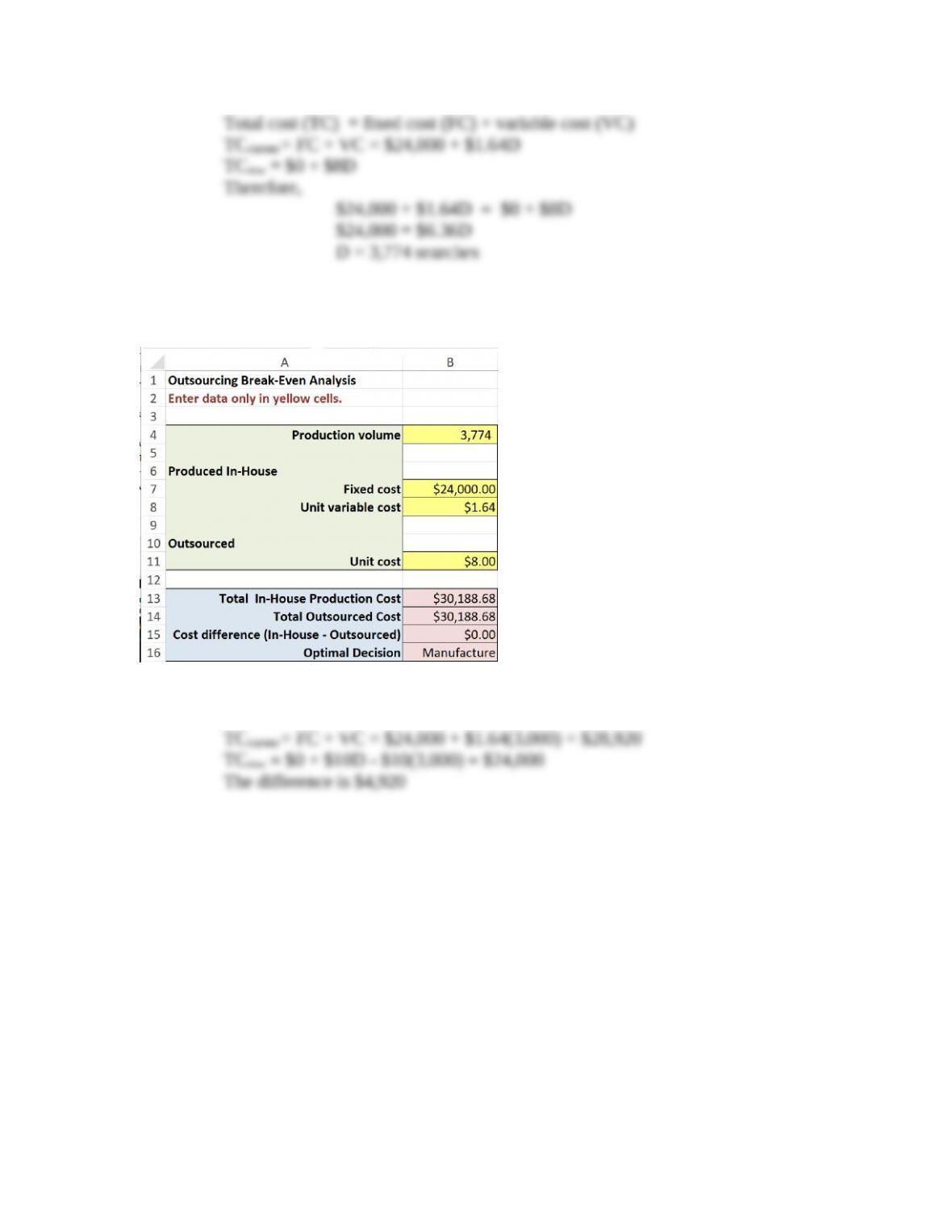
The break-even point may also be found using the Excel Break-Even template and the Goal
Seek tool:
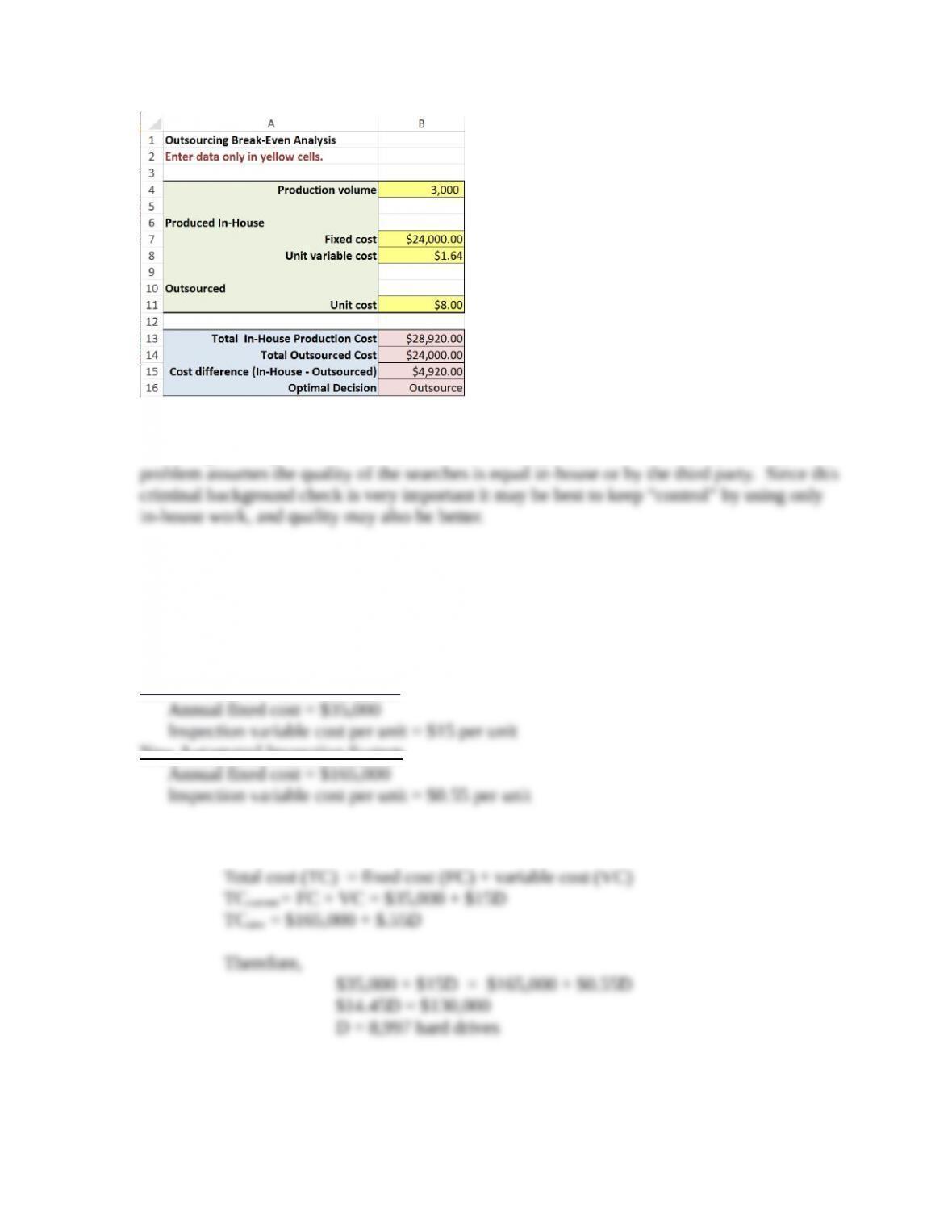
Since the demand forecast of 3,000 searches is less than the breakeven quantity, STE should
outsource the work. Also, STE saves $4,920 by outsourcing.
The spreadsheet template Break-Even can be used to verify this:
Other criteria include the risk/difficulty to STE being in an annual service contract and
escalating search prices over time (i.e., $10/search1st year, $10.50/search 2nd year, etc.). The
10.* A manager of Paris Manufacturing that produces computer hard drives is planning to lease a
new automated inspection system. The manager believes the new system will be more
accurate than the current manual inspection process. The firm has had problems with hard
drive defects in the past and the automated system should help catch these defects before the
drives are shipped to the final assembly manufacturer. The relevant information follows.
Current Manual Inspection System
New Automated Inspection System
Suppose annual demand is 8,000 units. Should the firm lease the new inspection system?
From an economic perspective the breakeven volume is 8,997 hard drives. If D = 8,997 we
are indifferent to the two inspection systems assuming quality is equivalent. If D is less than