OM4 C10 IM
10. For the Solved Problem on processing driver’s licenses at the Archer County
Courthouse in this chapter, if 40 drivers are to be processed each hour, how many
clerks and typists should be hired assuming a 80 percent target utilization rate?
Utilization (U) = Demand Rate/[Service Rate*Number of Servers] (7.2)
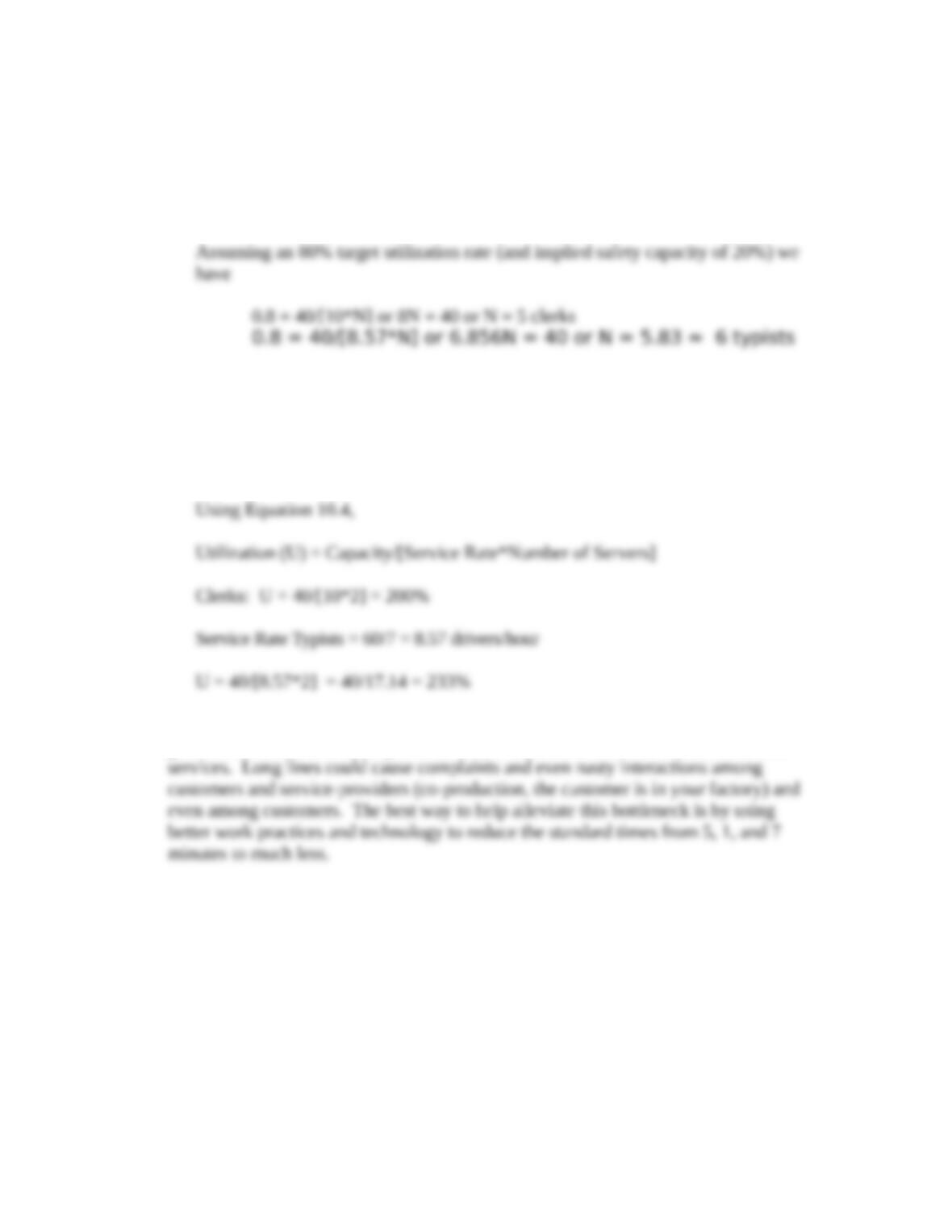
11. Due to county and state budget cuts Archer County Courthouse now has only two
clerks and two typists and expects to process 40 drivers/hour. What is the current
labor utilization of each labor type and where is the bottleneck in this three-stage
process? What is the impact of your analysis on customer service? How might the
job and process design be improved?
Both clerks and typists are understaffed now (they need about 5 clerks and 6 typists
given our answers and assumptions to 10b). Customers will wait for driver license
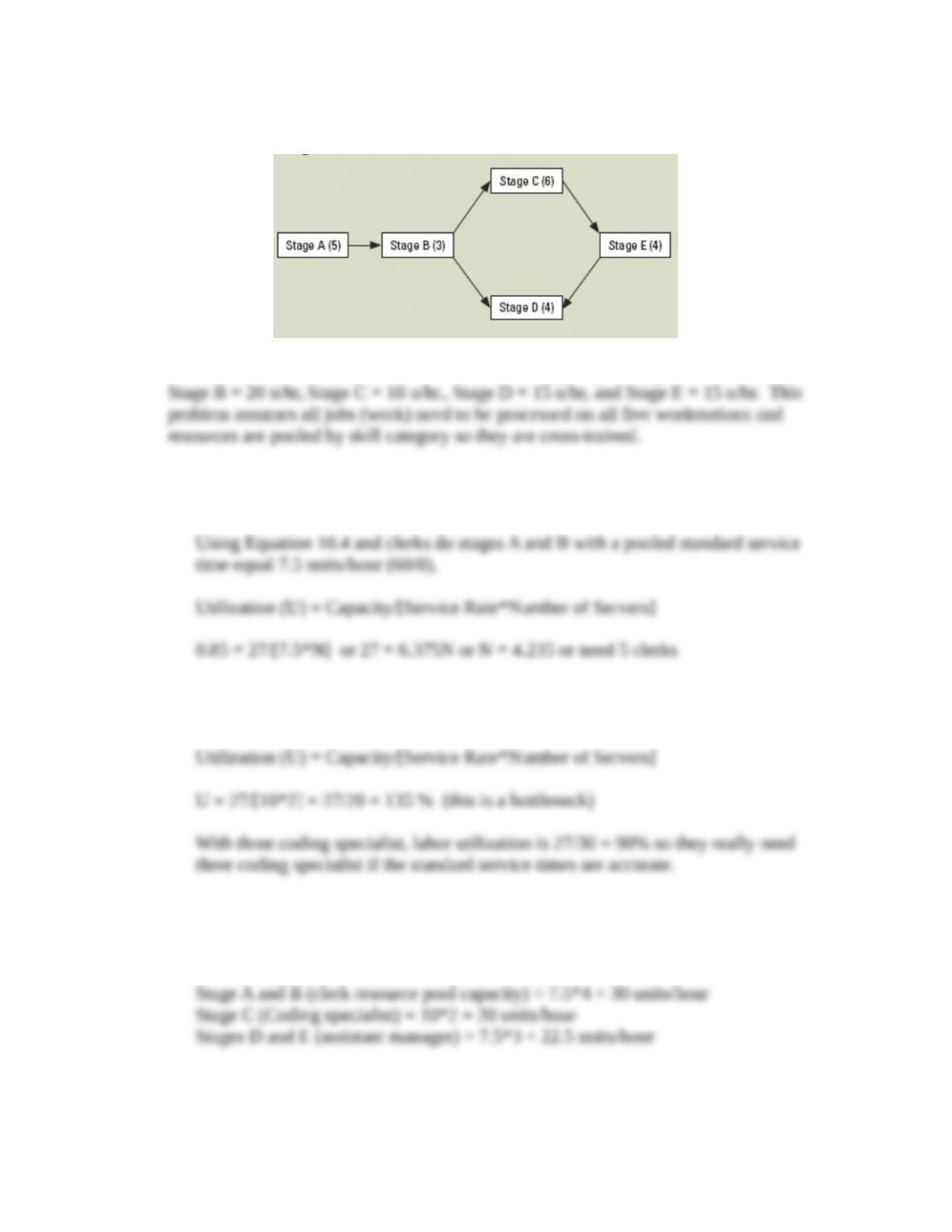
12. You have just been promoted to manage the process defined by the five stages A to E
below. After three months on the job you realize something is not right with process
capacity because your employees experience big pile-ups of work, things take too
long to be processed, the opportunity for error is increasing, and the entire process is
approaching chaos. Do a capacity analysis of this process. The numbers in
parentheses (#) are the time in minutes to complete one unit of work. Demand on the
process averages 27 units per hour and each unit must be worked on by all five
stages. Administrative clerks complete Stages A and B. The assistant manager
completes Stages D and E. Processing times per stage can be combined when labor is
assigned two or more stages (i.e., the resources are pooled). The coding specialist
takes care of Stage C.
1
OM4 C10 IM
Since demand is in units per hour we find that the capacity of Stage A = 12 units/hour,
(a) How many administrative clerks should be hired, assuming a target utilization for
them of 85 percent?
(b) What is the current labor utilization of the coders if two coding specialists are
currently on duty?
(c) What is the total process (output) capacity in units per hour for the five stage
process A to E assuming 4 administrative clerks, 2 coding specialist, and 3
assistant managers are on duty?
2
OM4 C10 IM
(d) Where do any bottlenecks exist and what do you recommend to improve this
process?
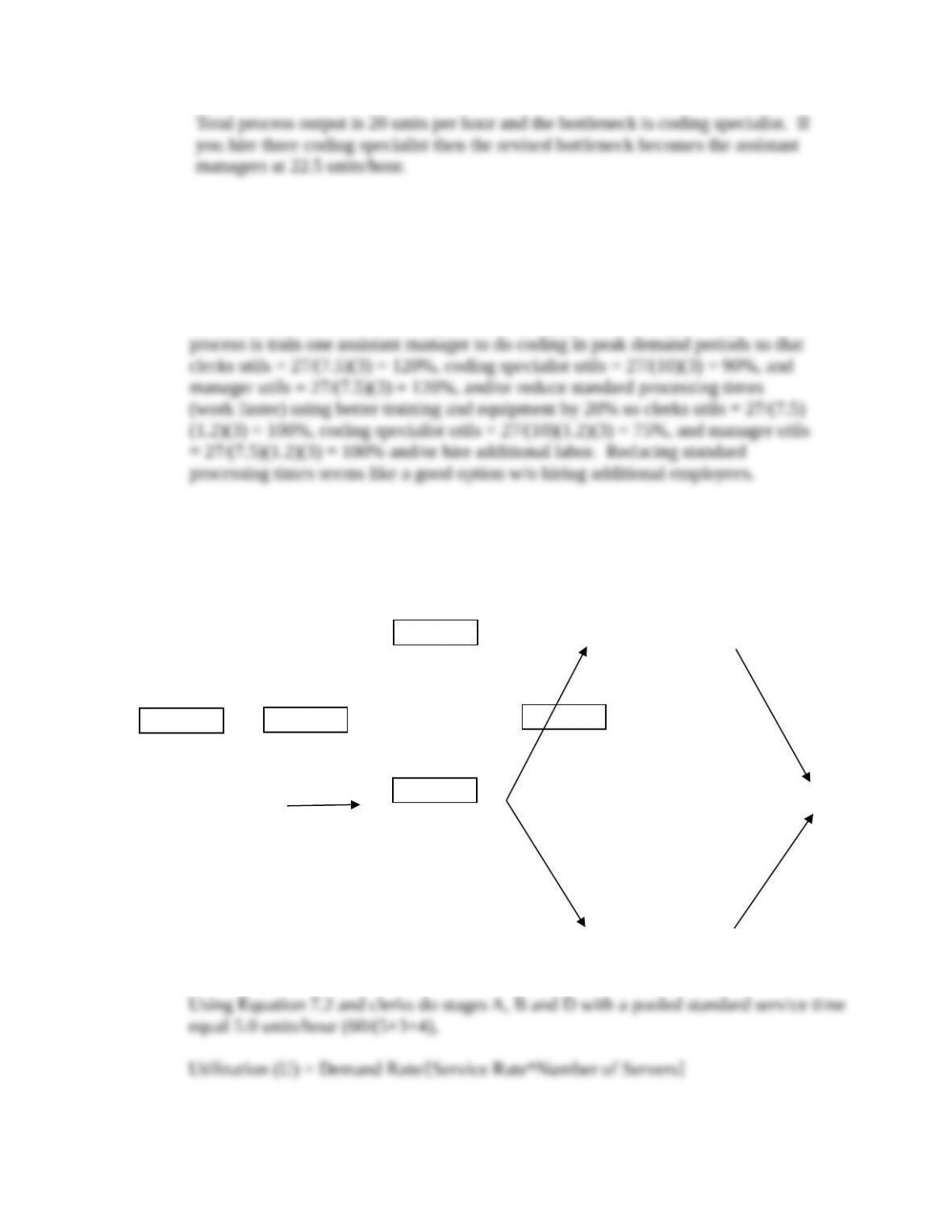
Given the staffing levels in (c), coding specialists are the bottleneck but
administrative clerks are a close second. The four assistant managers have a
current labor utilization of 90% (Utils = 27/(7.5)(4) = 0.90. Ways to improve the
13. Perform a capacity analysis using the process structure defined in Problem #8 with
the following changes. Demand on the process has increased to 36 units per hour and
each unit must be worked on by all five stages. The administrative clerk(s) complete
Stages A, B and D. The assistant manager completes Stage E. The coding specialist
takes care of Stage C.
a. How many administrative clerks should be hired assuming a target utilization for
them of 90 percent?
3
Stage B
(3)
Stage A
(5)
Stage D
(4)
Stage C
(6)
Stage E
(4)
OM4 C10 IM
b. What is the current labor utilization of the coders if four coding specialists are
currently on duty?
Utilization (U) = Demand Rate/[Service Rate*Number of Servers]
c. What is the total process (output) capacity in units per hour for the five-stage
process A to E assuming 7 administrative clerks, 4 coding specialists, and 3
assistant managers are on duty?
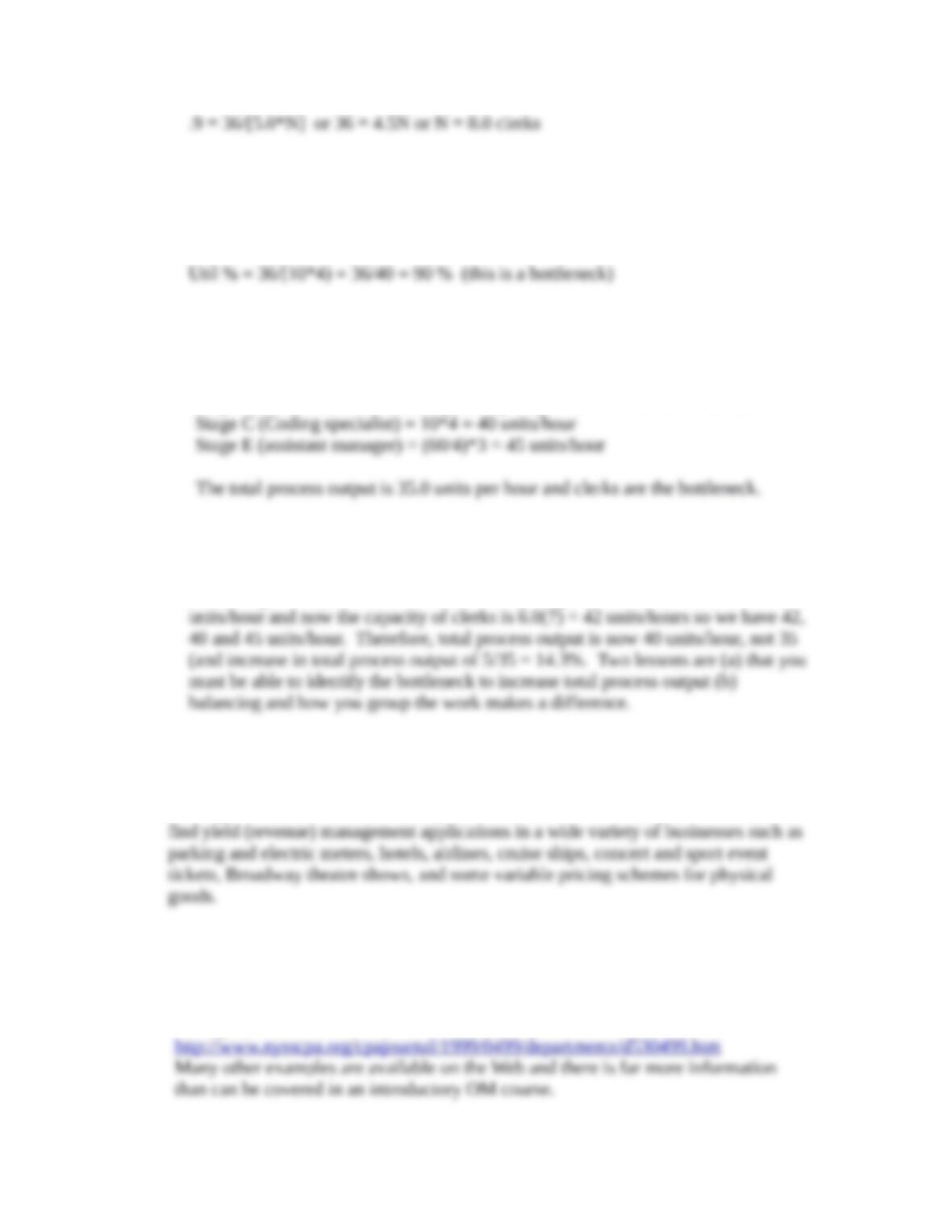
Stage A, B and D (clerk resource pool capacity) = 5.0*7 = 35.0 units/hour
d. Where’s the bottleneck(s) and what do you recommend to improve this process?
We can reallocate the work and try to get a better work load balance, reduce
processing times (increase units/hour) for say Stage A, B and D from 5.0 to 6.0
14. Research and write a short paper (two pages maximum) on two examples of revenue
management applications not in the text and explain how they help organizations.
A Google search on “revenue management” results in 47 million hits. Students will
15. Research and write a short paper (2 pages maximum) on how an organization has
applied the Theory of Constraints.
A Google search reveals about 3 million hits. One interesting example is hand tied
fishing flies at:
4

OM4 C10 IM
Case Teaching Note: David Christopher, Orthopedic Surgeon
Overview
David Christopher is an orthopedic surgeon who currently works 11 hour days four days
a week and finds it difficult to estimate his workload and whether he needs to hire
additional surgeons. The entire case focuses on setup and processing time in a
professional service business. The objective is to get students out of the manufacturing
factory and into a service business where the same principles and models help estimate
workload. Some very interesting class discussion is possible about the role of
setup/changeover time in this job shop situation. This is a good case for a major team
write-up and management report and/or student presentation.
Note: Make sure you explain how to handle setup time in this professional medical office
before the students do the case (as explained in the textbook, instructor’s manual, and
case analysis that follows).
Case Questions and Brief Answers
1. What is their current weekly workload?
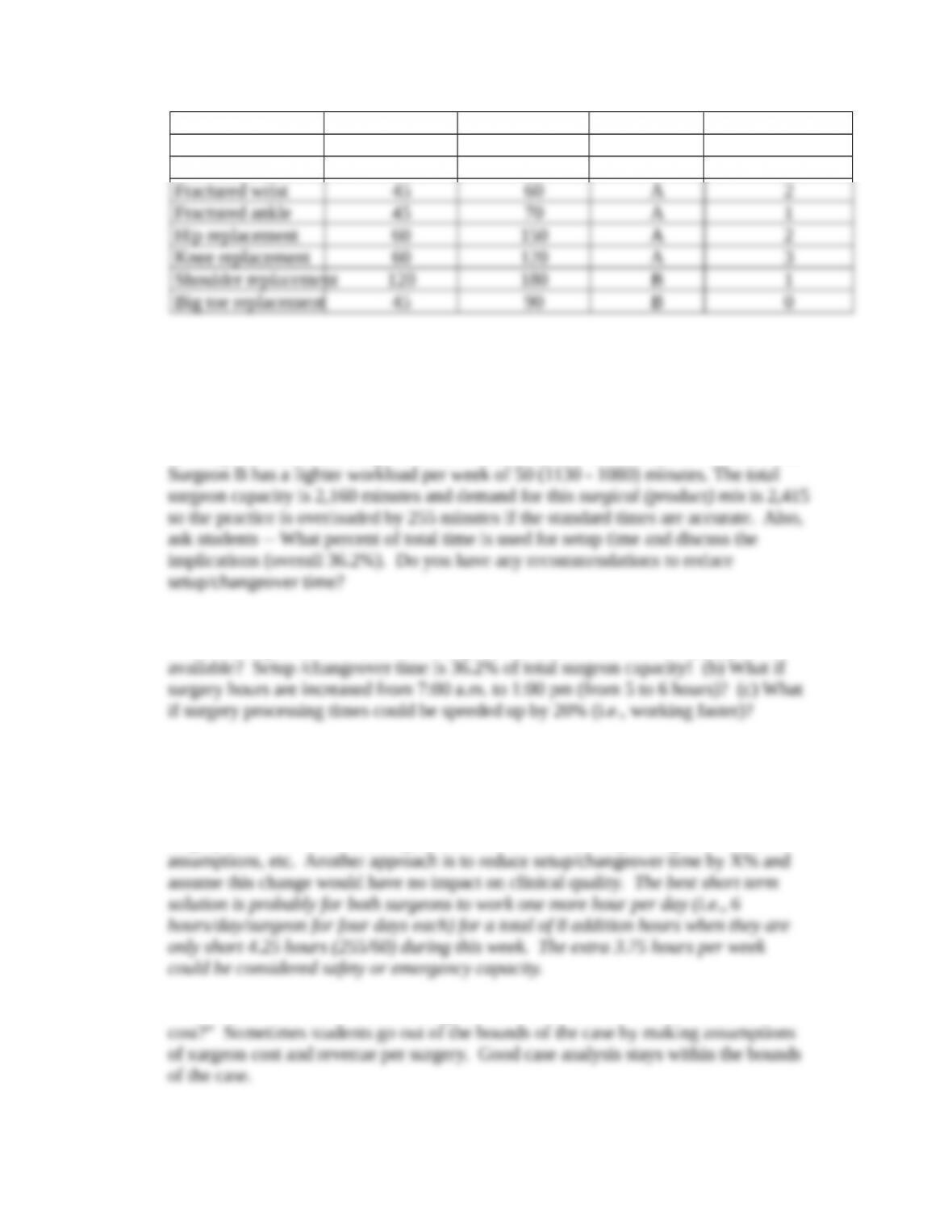
First, the instructor should go over the case Exhibit 10.8 with the students. What
insights do you gain from inspecting this exhibit? For one thing Dr. Christopher
Setup time includes the time to clean up the room and surgery crew from the previous
Is driving Dr. Christopher’s setup/changeover time close to zero like they do in
Japanese automobile factories a good idea? The answer is no–driving a stamping
Orthopedic
Surgery
Procedure
Surgeon
Changeover
Time
(minutes)
Surgery
Time
(minutes)
Surgeon
Identity
Demand
(No. of Patients
Scheduled
this Week)
5
OM4 C10 IM
Achilles tendon repair 20 30 B 3
ACL ligament repair 20 60 B 4
Fractured hip 45 80 A 0
Orthopedic Surgeons One-Week Surgery Workload (case data in yellow changed in OM3
from previous OM editions)
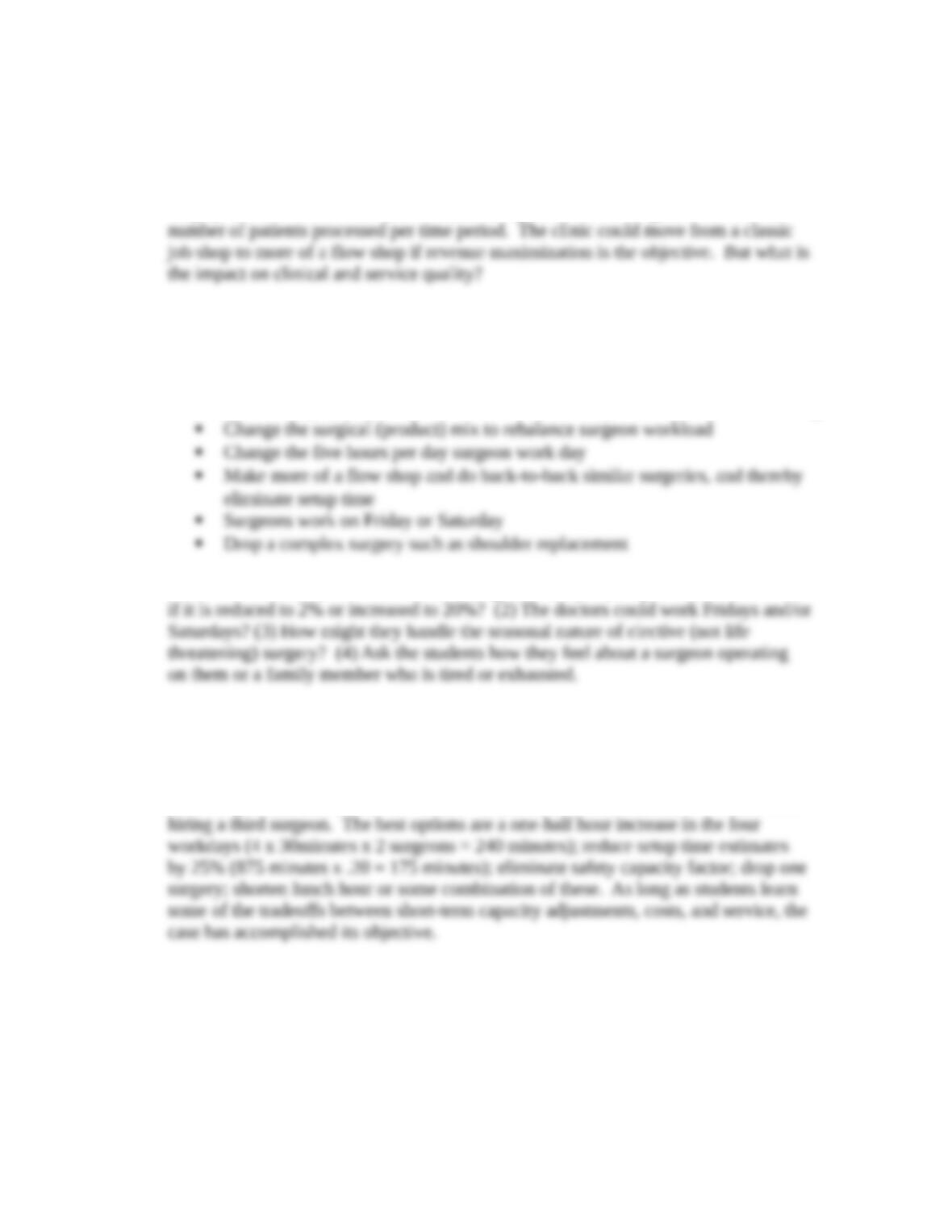
The spreadsheet that follows indicates that the two surgeons are short 255 minutes for
this week’s work or about one-quarter of a surgeon. So, they do not need to hire a
3rd surgeon. However, Surgeon A is overloaded by 205 minutes (1285 – 1080) while
Example “what if” scenarios you may want to try using a spreadsheet include: (a)
What if changeover time was reduced by one-half, how much more capacity is
2. Should they hire more surgeons, and if so, how many?
There is no need to hire a 3rd surgeon now. However, both surgeons are slightly
overloaded during the week. One solution to balance the workload is to move one
surgery from A to B. Which surgery students move varies depending on their
If a student wants to hire an extra surgeon here – ask students “What would this
6
OM4 C10 IM
3. What other options and changes could they make to maximize patient throughput and
surgeries, and therefore revenue, yet not compromise on the quality of medical care?
By reducing changeover time or speeding up the surgeries themselves the orthopedic
surgery clinic could do more patients (assuming demand is strong) and increase the
Typical options include:
Reduce setup times (work smarter)
Reduce processing (run) times (work faster)
Move a surgery procedure from an overworked surgeon to an underworked surgeon
Other issues to discuss include the following: (1) Safety capacity is set at 10%. What
4. What are your final recommendations? Explain your reasoning.
Given the analysis and assumptions in the spreadsheet they are 255 minutes short or
about one-quarter of a surgeon. There is no need to hire a third surgeon. The case
does not provide information on “future” demand so students should not recommend
Teaching Plan
1. What insights do you gain from inspecting the case exhibit?
2. Is driving Dr. Christopher’s setup/changeover time close to zero like they do in
Japanese automobile factories a good idea?
3. What is their current weekly workload?
7
OM4 C10 IM
4. Should they hire more surgeons, and if so, how many?
5. What other “what if” questions should we ask and answer?
6. What other changes could they make to maximize patient throughput and
surgeries, and therefore revenue, yet not compromise on the quality of medical
care?
7. What are your final recommendations?
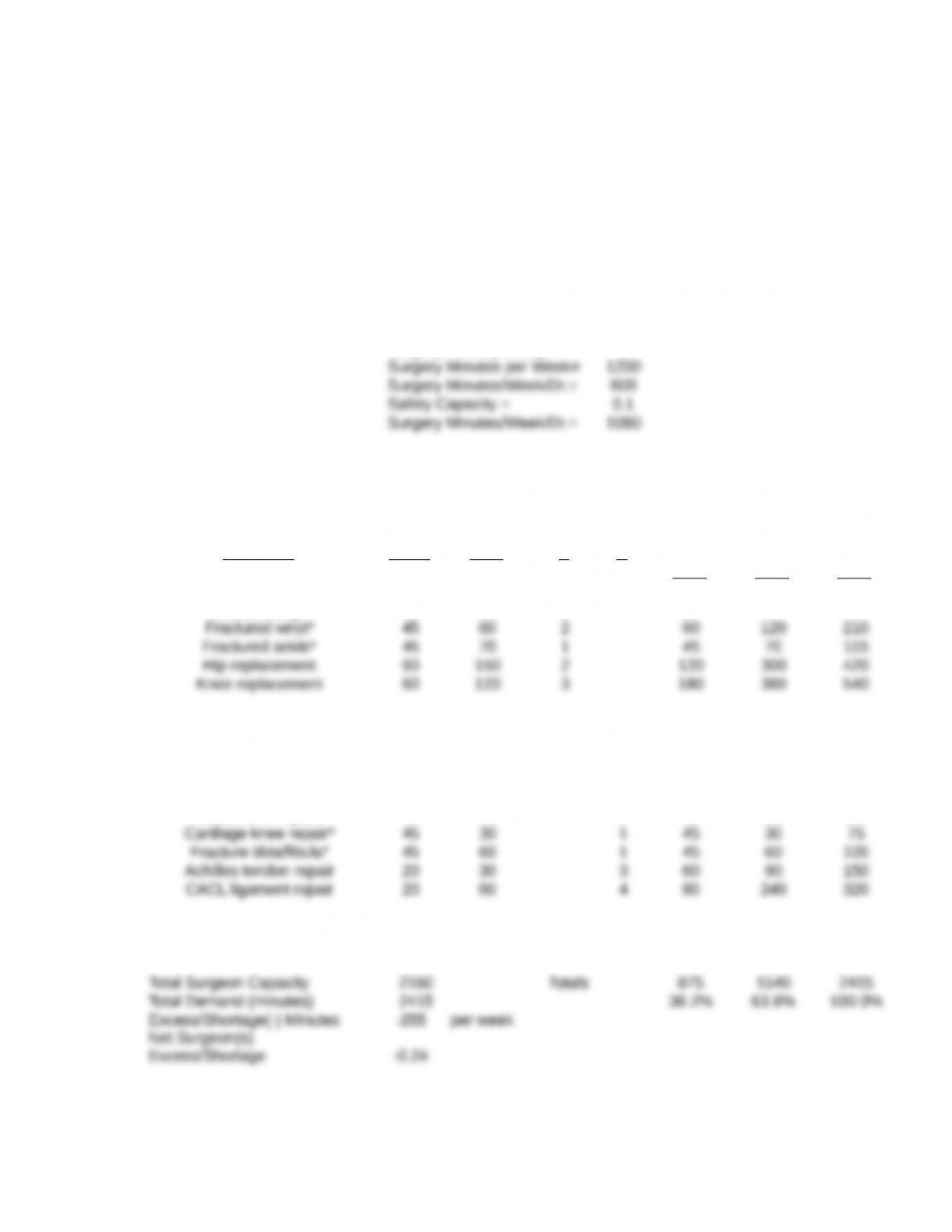
OM3 David Christopher Base
Case Number of Surgeons = 2
Days per Week = 4
Surgery Hours per Day = 5
Number of
Orthopedic Surgeon Mini-Case Patients
Scheduled
Today Total
Surgery Setup Process Dr. Dr. Total Total Setup &
Procedure Times Time A B Setup Process Process
Time Time Time
Fractured hip* 45 80 0 0 0 0
*changed for OM3 435 850 1285
33.9% 66.1% 100.0%
Shoulder replacement* 120 180 1 120 180 300
Big toe replacement 45 90 0 0 0 0
Rotator cuff repair* 45 45 2 90 90 180
440 690 1130
38.9% 61.1% 100.0%
8
OM4 C10 IM
9