CHAPTER 9
TRAINING AND DEVELOPMENT
A. OVERVIEW
This chapter addresses the benefits and difficulties of employee training and
development (T&D) programs. T&D are unavoidable strategic issues due to rapid
shifts in technology that result in premature obsolescence; the trend of job
redesign which redefines work in broader responsibilities and often involves
self-managed teams; increased merger and acquisition activity that demands
fluidity of integration; and the globalization which requires a sensitivity to
cultural and linguistic issues. T&D are both long-term strategies; involve long
term investments and short term costs, which may not have immediate visible
results; and involve viewing the employee as a resource to be cultivated and
nurtured. Employees who have had training or learning experiences that
emphasize a more holistic understanding of operations are more flexible, leading
to greater organizational flexibility and fewer management layers. Planning and
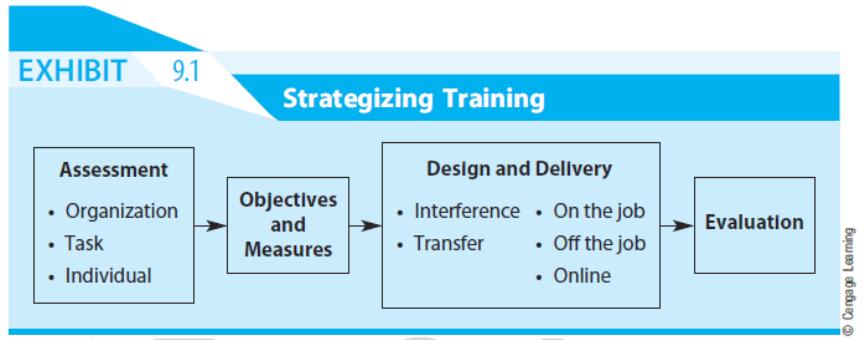
strategizing training can be broken into four steps: needs assessment; establishing
objectives; training delivery; and evaluation. Reinforcement of positive employee
activity should follow, which may be difficult if the training unit is not an
integrated part of the larger HR strategy.
B. LECTURE OUTLINE
I. OPENING CASE – Using training to Rebrand Sofitel Hotels looks
at how the increased competition in the luxury hotel industry resulted in
Sofitel’s decision to differentiate itself by creating a unique customer
experience. To achieve this more than 25,000 Sofitel employees across 40
countries received extensive training on how to “create a sense of luxury”
for guests. Guest satisfaction and employee retention have been
significantly positively affected.
II. INTRODUCTION
T&D represents the ongoing investment in employees as assets with
initiatives designed to increase that value through employees acquiring
knowledge and skills (employee training), as well as through learning with
a more long term approach to employee careers and the organizational
strategy (employee development). Organizations now largely favor the
term “learning” over training, because learning implies continual growth
and development, emphasizing results rather than process. The threat of
obsolescence as technology shifts rapidly; the design shift of jobs toward
broader skill requirements and responsibilities; the fluid integration
required for successful merger and acquisition; and the globalization of
business all require an eye to T&D for a successful business. See New
Employee Training at Black and Decker and Boot Camp at MicroStrategy
examples. An increasing number of job applicants are evaluating
employers based on the kinds of training and development opportunities

offered.
I. BENEFITS OF TRAINING AND DEVELOPMENT
A. Employees with a more ‘holistic’ understanding of the company are
more flexible, and can take on a greater range of responsibilities.
B. Reducing management layers and making employees themselves
more accountable for results.
C. Benefits are long term as opposed to short term, and may not be
immediately visible.
II. PLANNING AND STRATEGIZING TRAINING
A. Training needs to be planned and strategized. A model for the
planning of training is presented in Exhibit 9.1.
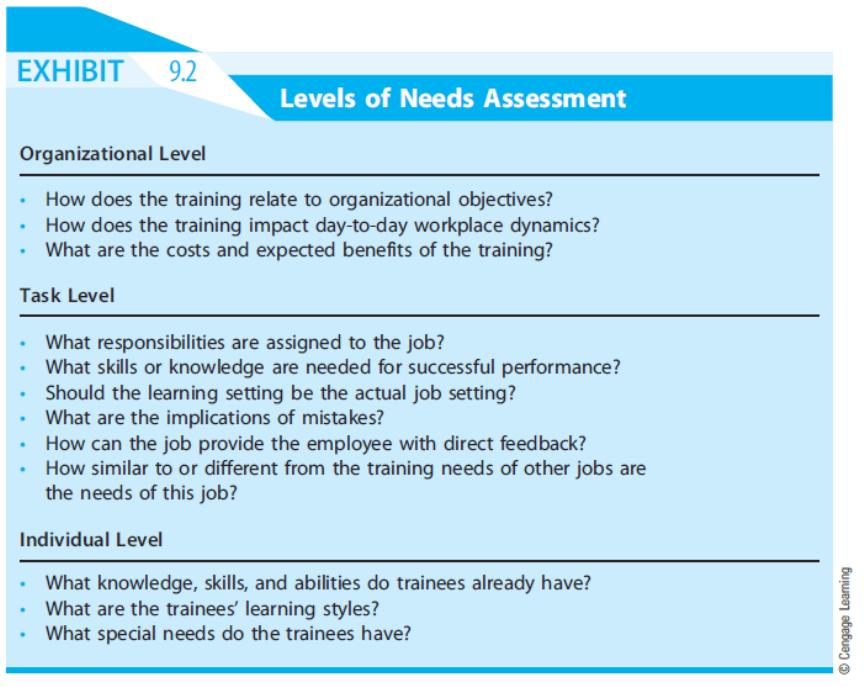
B. Needs Assessment involves determining why the training is
required. See summary in Exhibit 9.2: LEVELS OF
NEEDS ASSESSMENT.
1. Organizational – Training considered within the context of
the politics, culture, structure, and strategy of the
whole.
2. Task – Training considered in relation to specific duties and
responsibilities for jobs.
3. Individual – Considers the people to be trained.
C. Objectives are set based on assessed needs and should be described
in specific measurable terms considering desirable employee
behavior as well as the results expected to follow. Vague
objectives are difficult to measure and progress cannot be
determined. Objectives can be augmented by a close study of
performance management and performance deficiencies for a
given company.
D. Design and Delivery runs into interference and transfer issues.
1.Interference results when previously learned behaviors block the
learning process. Stress also causes individuals to revert into
conditioned behaviors. The broad organizational context must be
considered: politically, culturally, and structurally. Blocking is not
merely a problem on an individual level and training must occur in
a supportive organizational environment to be effective.
2.Transfer becomes a problem when it is inhibited by workers
being trained in an environment that is vastly different from the
one they are to work in. To combat transfer problems, training
programs should simulate actual working conditions as closely as
possible. On-the-job training is also very effective. See
Computer-Based Training at Qualcomm and E-Learning at EMC
Corporation examples.
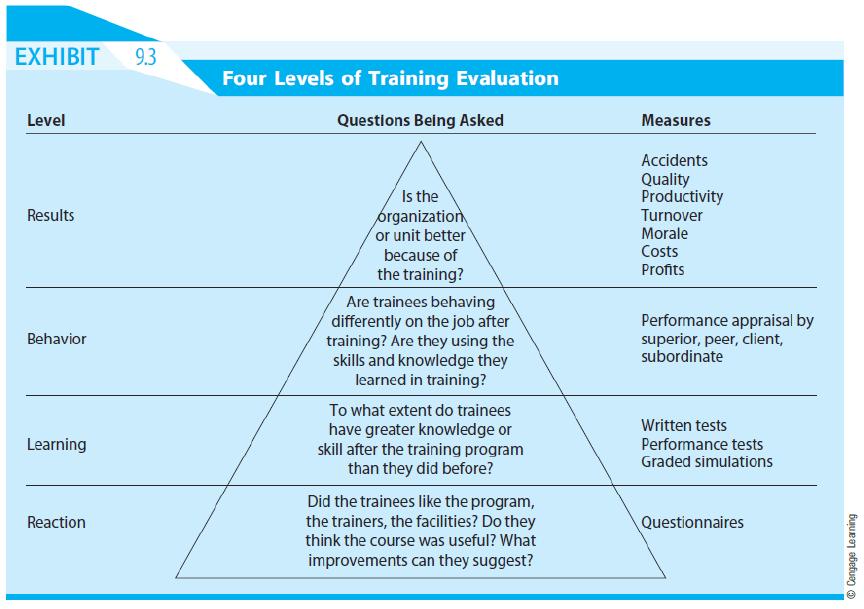
E. Evaluation provides feedback on training effectiveness and
allows determination of future training strategies,
including: modifying; retaining the status

quo; or removing a training program entirely. The
four level hierarchy popular for training evaluation can
be seen in Exhibit 9.3: FOUR LEVELS OF
TRAINING EVALUATION.
1. Reaction measures whether employees liked the training,
trainers and facilities, and is usually conducted through
questionnaire. Positive results here do not necessarily
indicate positive results elsewhere.
2. Learning measures employee knowledge after training
against knowledge previous to training. If there is no
change here, performance cannot be expected to have been
enhanced.
3. Behavior is a measure of what employees do on the job
after training. If there is no observable change,
performance cannot be expected to have been enhanced.
4. Results measures overall outcomes of training on
productivity, efficiency, quality, customer service,
etc. Results are rarely immediate, and while
results-based measures are economically significant,
undue reliance on them may cause preemptive
termination of training programs that do not
produce immediate measurable results.
III. ORGANIZATIONAL DEVELOPMENT
Training programs focus on individual skill acquisition and development
to improve productivity as well as assist in obtaining strategic
objectives. In a rapidly changing global environment, organizations much be
able to change in response by undertaking larger-scale changes. Such
activities constitute organizational development which focuses on the
entire organization rather than individual employees.
OD initiatives usually focus on organizational processes and/or culture
and might include culture change, facilitating mergers and
acquisitions, organizational learning, knowledge management, process
improvement, and organization design and structure. They look at the
organization from the macro perspective, utilizing a systems approach
to appreciate the interrelatedness of functions and processes. This is
frequently accomplished through the establishment of an
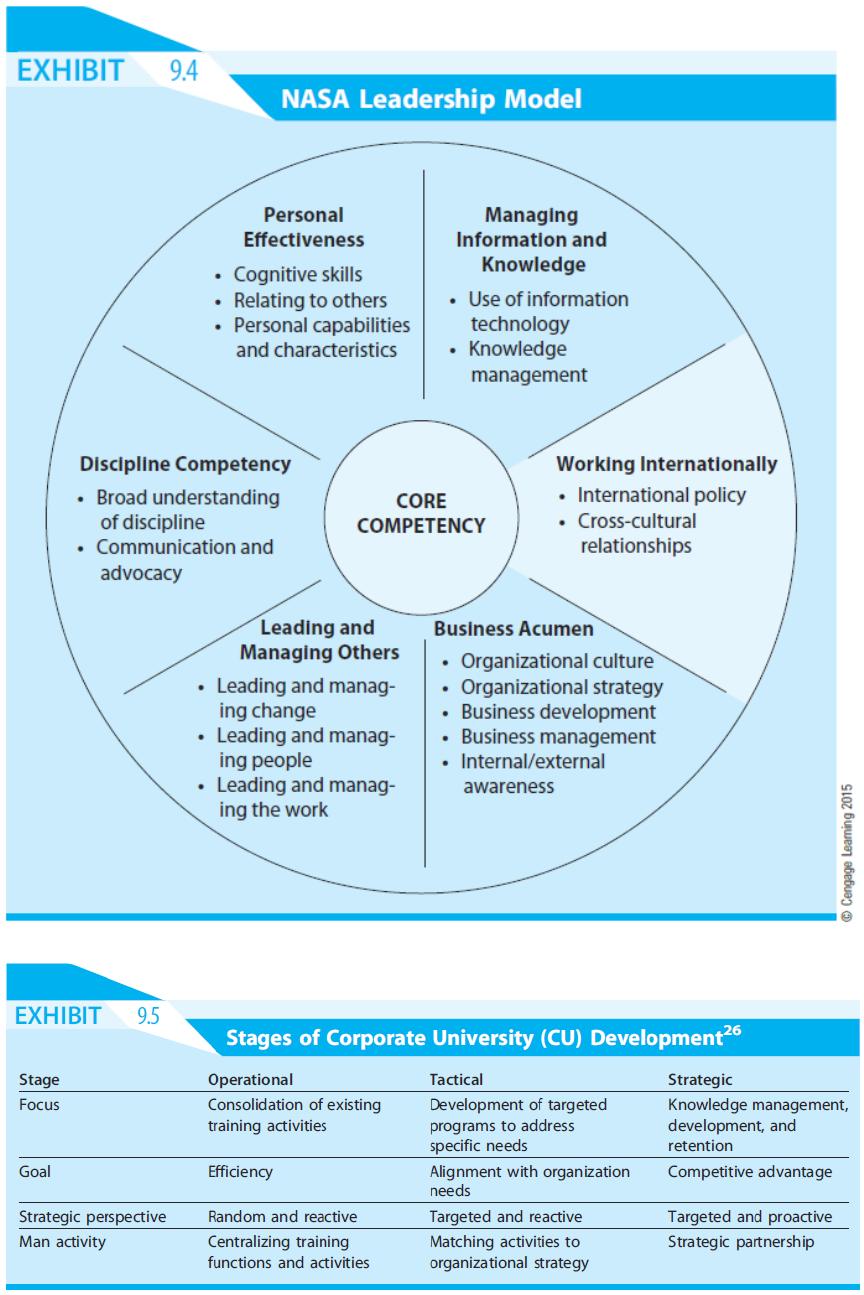
in-house corporate university. See Leadership Development at
Virgin Atlantic Airlines and Liverpool Virtual University examples.
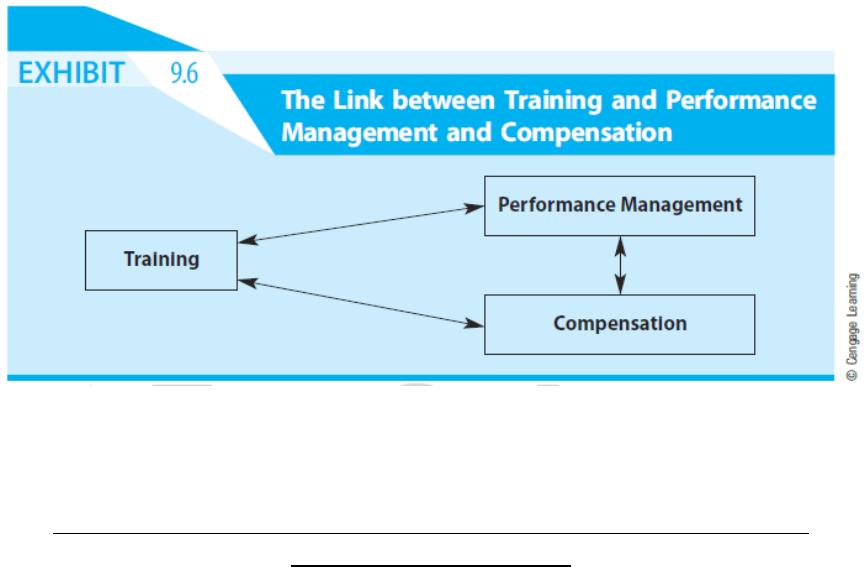
IV. INTEGRATING TRAINING WITH PERFORMANCE MANAGEMENT
SYSTEMS
Reinforcement of training is key when employees achieve or
accomplish desired results after training is completed. In large
organizations where the training unit is autonomous and unconnected to
the greater HR plan, reinforcement is often difficult or ineffective.
Integration of HR strategies throughout the organization is key to
successful implementation of training programs. See Strategizing
Training and Performance Management at Anheuser-Busch example.
V. CONCLUSION
Training and development is a key strategic issue for organizations.
T&D activities help to ensure that employees have the skills and
experiences they need to perform at high levels as well as to facilitate the
organization’s adaptation to change in its environment
READINGS
Reading 9.1 – Confronting the Bias Against On-Line Learning in
Management Education
Many higher education leaders and faculty have adopted attitudes which marginalize
online learning, rating online courses and programs inferior to face-to-face offerings
despite having no personal first-hand experience with online learning. One survey found
80% of public university faculty with no online teaching experience believe that online
learning outcomes are inferior that those achieved face-to-face,
Externally, standards for accreditation, membership in business school organizations and
media rankings continue to measure and emphasize the amount of face-to-face
instructional time and other criteria that favor traditional classroom delivery. AACSB,
through its emphasis on learning outcomes, has acknowledged the validity of online
learning.
Academics who are critical of online delivery often view it as a means for administrators
to reduce costs and to increase managerial control over the education process. In addition
concerns have been raised relative to faculty rights, skills, and resources; pressures to
expand enrollments and reduce costs; and the lack of technical, administrative, and
financial support required to deliver quality online learning.
Lack of awareness about on-line research and practice reinforces the bias against on-line
teaching and learning. A recent article in the Harvard Business Review serves to illustrate
the way that on-line education continues to be viewed as an inferior mode of delivery.
A substantial body of research evidence indicates that there is no significant difference in
learning outcomes for students who learn online compared to those who learn in a
traditional classroom. Most comparative studies involving business courses support the
argument that students learn just as effectively online as they do in the classroom and, in
some cases, more effectively, given individual student learning styles and preferences.
Three recommendations are provided help overcome biased perceptions about on-line
education; 1) leverage the research; 2) incent and enable faculty; and 3) remove systemic
barriers.
Reading 9.2 – Becoming a Leader: Early Career Challenges Faced by
MBA Graduates
The authors surveyed MBA graduates and found that the encountered three types of
career transitions as well as four common challenges as the struggled with these
transitions.
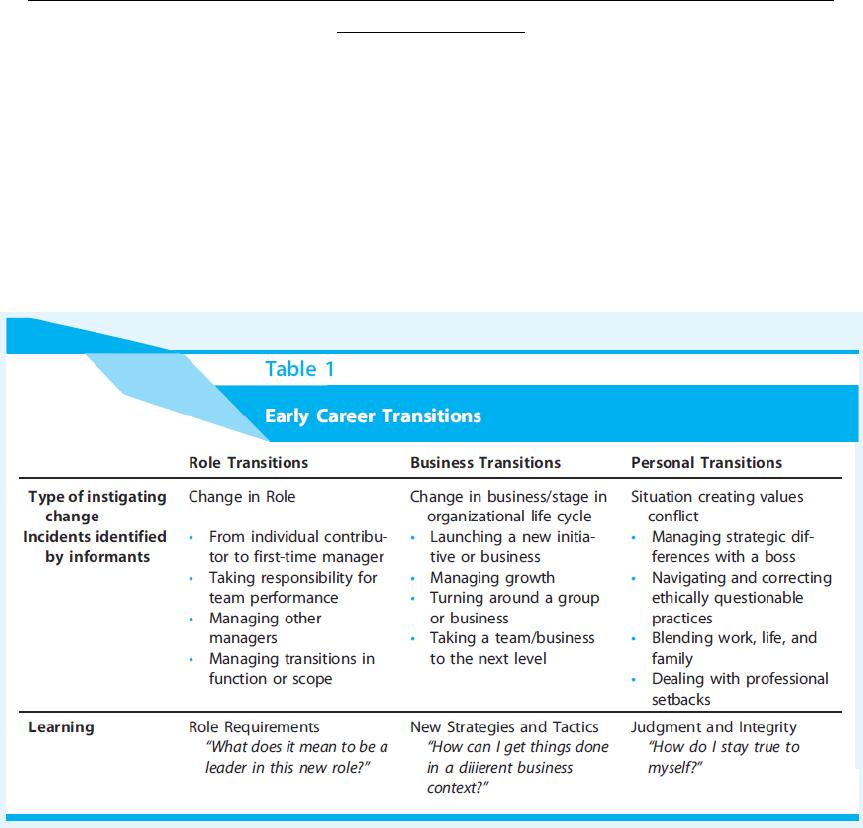
The three transitions, role, business and personal and highlighted in Table 1 and the four
challenges, managing and motivating subordinates, management relationships with peers
and bosses, development a leadership mindset, and coping with setbacks and
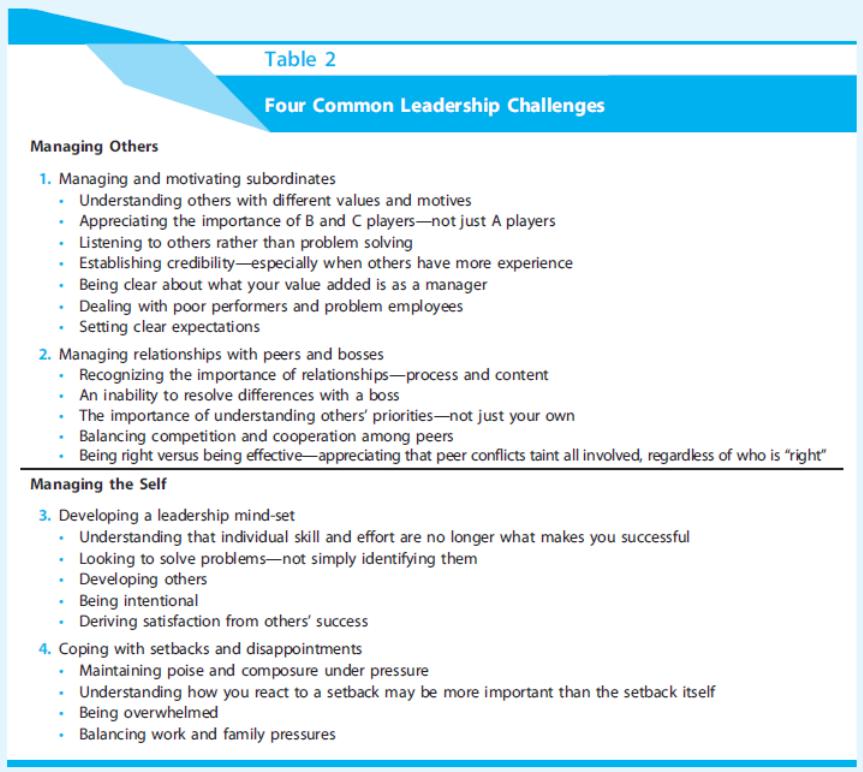
disappointments, are outlined in Table 2.