
CHAPTER 8
STAFFING
A. OVERVIEW
Staffing is a key strategic HR activity which significantly impacts organizational profitability.
Recruitment and selection issues are discussed, including interviewing, testing and references.
The outsourcing of staffing functions can present both benefits and costs to an organization, and
must be analyzed appropriately before implementing. International assignments, as well as
diversity issues, are becoming more important in managing the staffing function.
B. LECTURE OUTLINE
I. OPENING CASE – Kroger Co. improved its continuous selection process
by developing an efficient and cost-effective computer based, self administered
employee selection system that emphasizes identifying customer service oriented
individuals. Its measures of success are customer service measures, turnover rate
and employee safety.
II. INTRODUCTION
A. Staffing decisions are extremely important to the vitality and profitability
of an organization, as turnover can cost more than $10,000 per person, and
tends to rise as the level and complexity of the job increases. Job trends
that influence staffing include broader scope and responsibilities; leaner
staffing; fewer full-time employees; pay for company performance; flatter
organizations. Staffing is extremely important in the service sector in that
different skills are needed than in the manufacturing sector, and higher
turnover must be appropriately managed.
III. RECRUITING
A. Organizations must decide between temporary and permanent employees
based on projected job need, cost and employee usage
B. Outside temporary employees hired from agencies or through
subcontracting earn no benefits; cannot file for unemployment when the
job ends; can be more expensive to utilize; offer much staffing and cost
flexibility
C. Organizations can have their own in-house temporary workers that are
useful as floaters from department to department as work dictates.
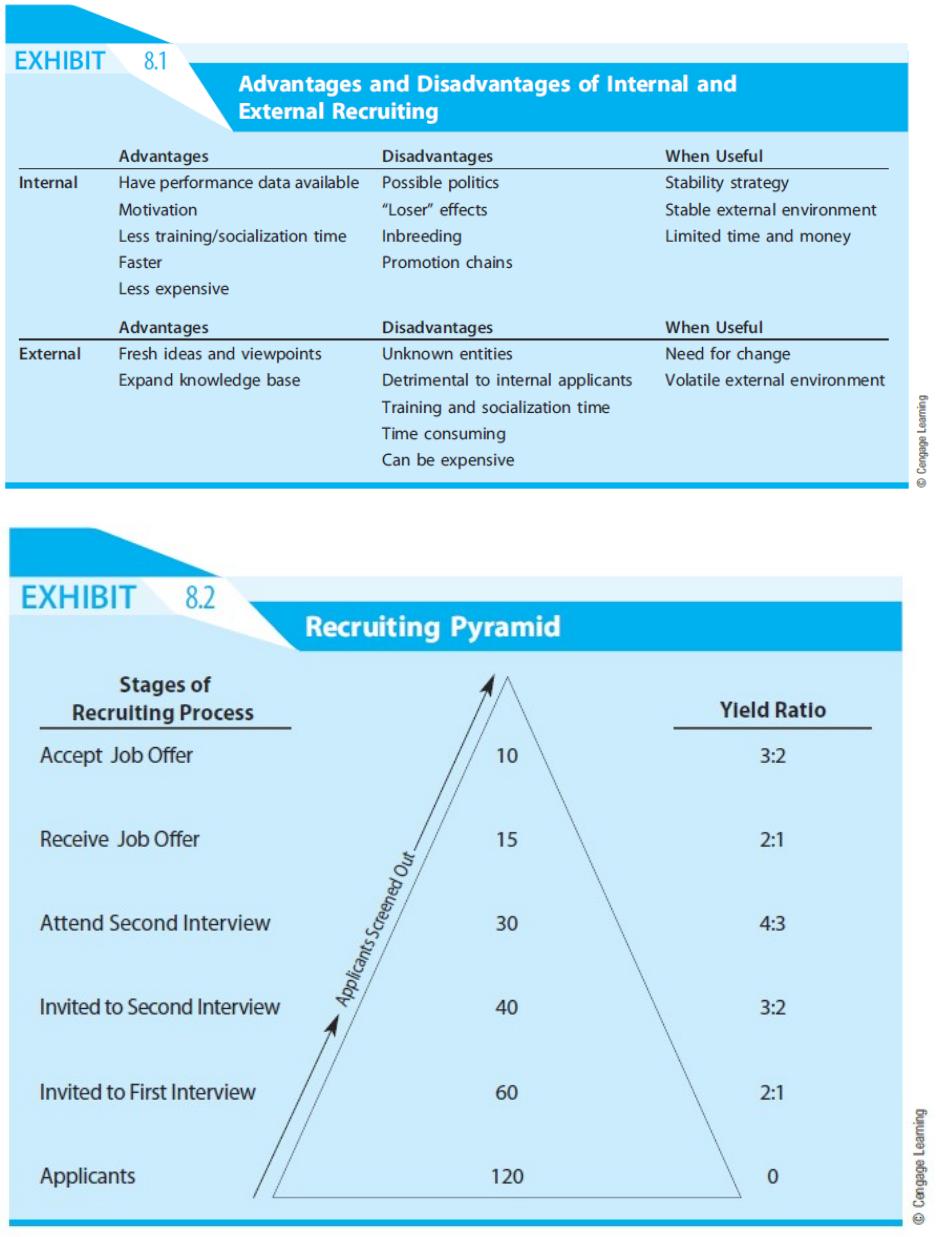
D. Exhibit 8.1: ADVANTAGES AND DISADVANTAGES OF INTERNAL
AND EXTERNAL RECRUITING. Internal recruitment affords time to
observe employee; can motivate employees; reduces training and
socialization time and costs; useful when organization is following a
stability strategy.
1. Disadvantages include chance for political/partisan actions and
dysfunctional conflict; diminished morale and performance for
those not selected; inbred staff can encourage maintenance of the
status quo and reduce creativity inefficiencies by creating multiple

vacancies. Example – Internal Recruiting at Cisco Systems.
E. External recruitment facilitates change and is useful when organizations
face change or a volatile environment.
1. Disadvantages include expense and time; longer socialization;
individuals are more of an unknown; can reduce internal morale.
2. External recruiting can utilize an active or passive approach. The
former is more strategic in nature and targets candidates who may
not be actively looking for a new position.
F. Exhibit 8.2: RECRUITING PYRAMID. HR must determine how large a
recruitment pool is needed and when to do recruitment. Can create their
own pyramid based on organizational historical data.
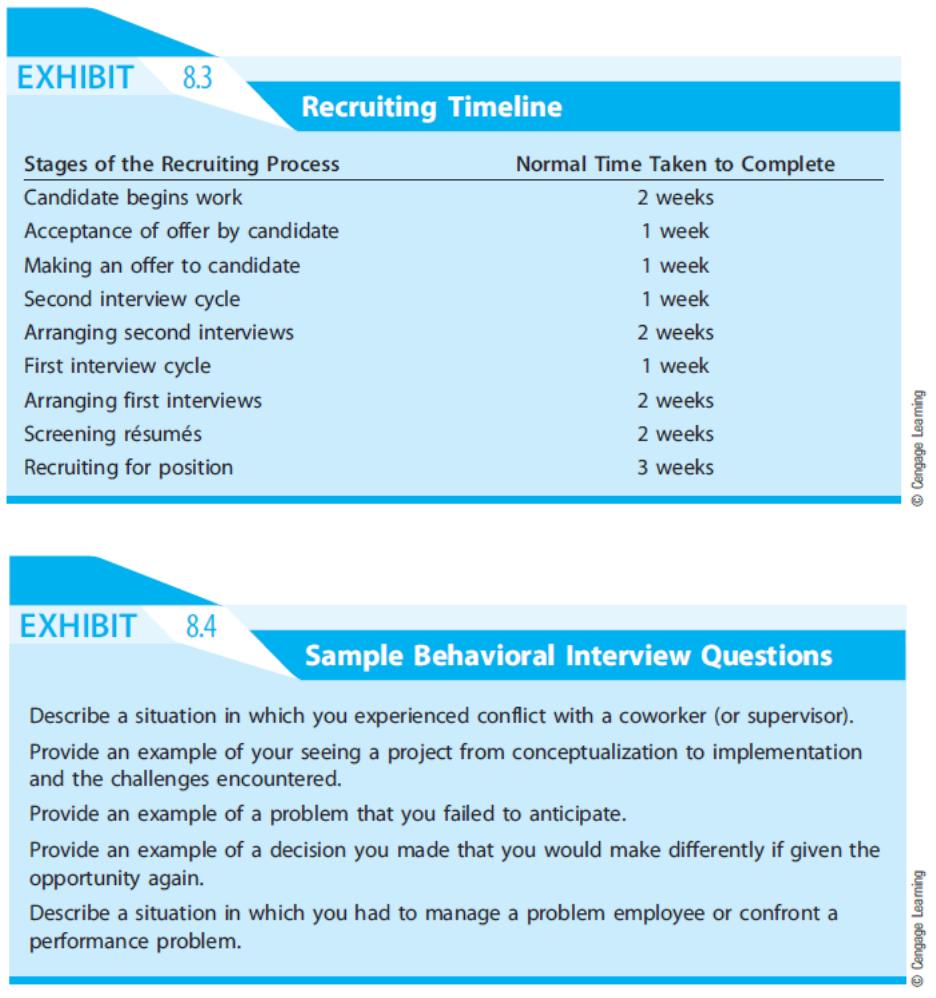
G. Exhibit 8.3: RECRUITMENT TIMELINE. Timeliness in the recruitment
process is very important.
H. Recruitment methods are often informal for smaller organizations. Larger
organizations often rely on targeted advertising in selected media.
1. The internet is increasingly important in recruiting, with 70% of
HR departments utilizing it and 75% of students recently indicated
usage. This allows for global exposure and access, reduces costs.
2. Networking is used by 78% of job seekers, but network usage is
much lower among recruiters.
3. Internships are an increasingly popular method of recruiting
entry-level employees but employers need to ensure that they do
not run afoul of any federal labor laws when employing interns.
4. See Outsourced Recruiting at Kellogg and College Recruiting via
Internships at Microsoft examples.
IV. SELECTION
A. Selection decisions can have significant economic and strategic
consequences, and thus must be made with care. Methods must be both
reliable and valid, with reliability a prerequisite for validity.
1. Reliability refers to the consistency of the measurement being
made across time and across evaluations. 100% reliability is rare,
as too many factors can impact assessment. Low reliability often
comes from two sources:
a. Deficiency errors occur when an important criteria for
assessment is not included.
b. Contamination errors are the result of unwanted influences,
such as time constraints on the interviewer.
2 Validity refers to whether what is being
assessed relates or corresponds to actual performance on the job,
and is critical to insure proper selection. Validity can become the
chief measure to defend discrimination allegations.
a. Content validity illustrates that the measure or criterion is
representative of actual job content and desired knowledge
needed to perform the job.
b. Empirical or criterion-related validity measure

demonstrates the relationship between certain screening
criteria and job performance.
B. Who will be involved with interviewing applicants must be
determined, and might include prospective immediate supervisors, peers
and subordinates; whether interviews will be conducted in group or
individually; and either structured or unstructured format.
1. Subjective assessments of applicant qualifications are part of the
interviewing process, with interpretation errors common,
perhaps including: similarity, contrast, first impression or
halo errors, or biases based on applicant race, gender,
religion, age, ethnicity, sexual orientation, etc.
2. Behavioral interviewing relies on the assumption that past behavior
is the best predictor of future behavior. It reduces employer
liability as it focuses on specific behaviors which are
considered essential for successful job performance. Examples
of behavioral interview questions are presented in Exhibit 8.4.
3. Virtual interviewing is becoming more popular with many
employers. It is more cost and time-effective than
in-person interview and is more personable than a telephone
screening interview.
C. Testing appropriateness and timing in the screening process
must be decided, with work sample and trainability tests common and
helpful in presenting a realistic job preview. Other testing might include
personality testing, although it has been successfully challenged in court;
physical testing, usually after a job offer in order to comply with the
Americans with Disabilities Act; honesty testing, which has declined in
usage since passage of Employee Polygraph Protection Act of 1988; drug
testing has been challenged in courts, but there is no federal
right-to-privacy statutes that prohibit testing of on or off the job drug use
by employees; personality testing should be utilized with extreme caution;
physical testing can be conducted only after a job offer has been made.
Establishing job-relatedness is critical for any kind of testing.
C. Checking of references should include other individuals than those named
by the applicant. Increasing liability for libel, slander and defamation of
past employees has resulted in more organizations refusing to comment on
past employees, other than to verify employment, dates, position held and
salary history.
D. Many employers are now using social media sites to check candidate
backgrounds. This practice can be risky for a number of reasons.
V. INTERNATIONAL ASSIGNMENTS
Selection of employees for overseas assignments can be difficult, as many such
assignments fail. Technical ability, a traditional selection criterion for overseas
assignments, is necessary, but not sufficient in this selection process.
Interpersonal and acculturation abilities of both employees and their families are
critical, with lack of ability to adapt one of the most common reasons for failure

of international assignments.
VI. DOCUMENTATION OF EMPLOYMENT ELIGIBILITY
Extra caution has to be made when hiring foreign-born employees to ensure the
legitimacy of any documentation they might provide. This is particularly
true for low-skilled workers who may have limited English language
abilities. There is no widespread reliable system for verification. If documentation is
suspect but later found to be valid, employers can face unlawful
discrimination charges. Supply of and demand for low-skilled workers almost
necessitates the hiring of foreign-born workers. For those foreign-born workers
who have not obtained citizenship, employers must first prove that there are no
domestic workers with the requisite skills available.
VII. NEW TRENDS IN STAFFING
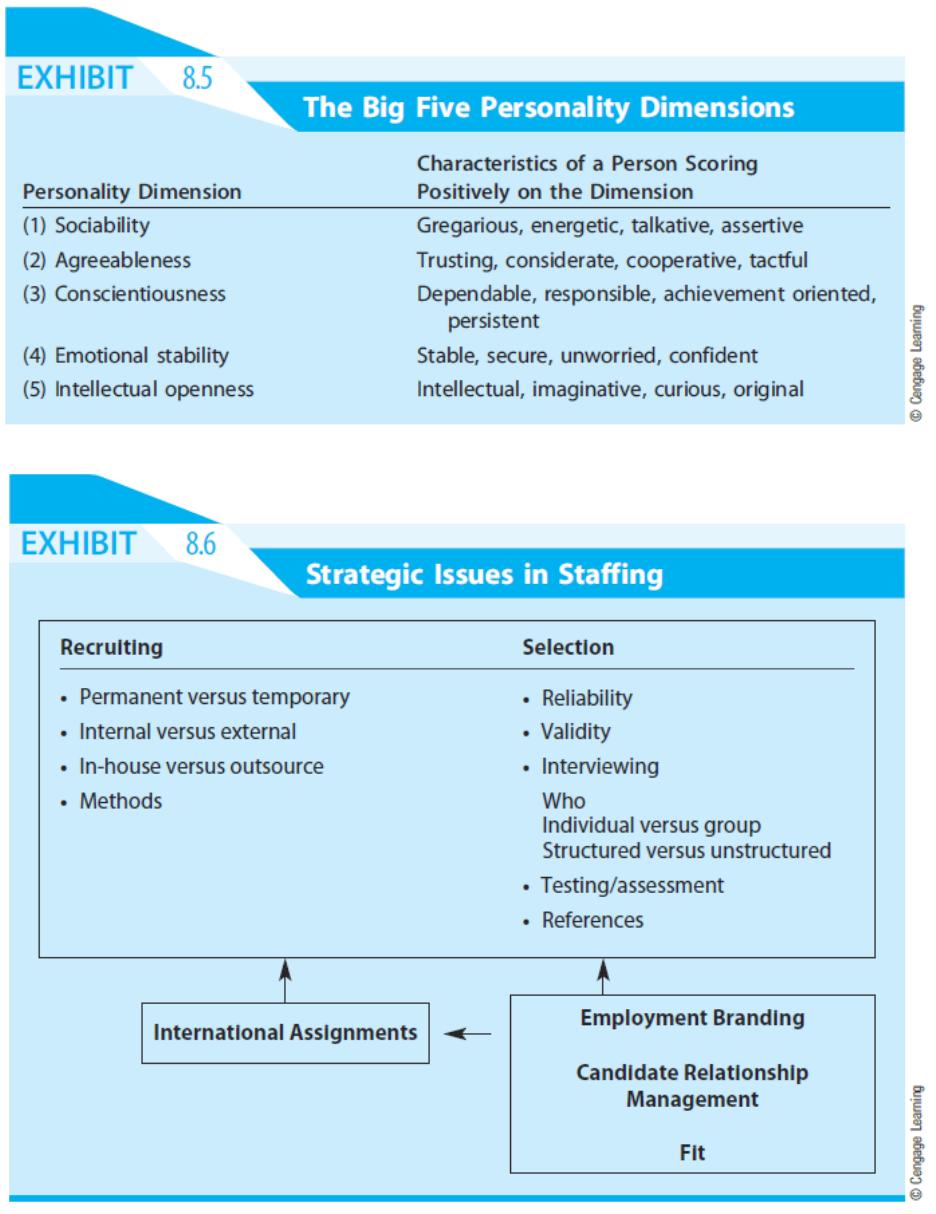
Employment branding – creation of an image which allows prospective
employees to view the organization in a certain way and aid in
recruitment. Example – Employment Branding at W. L. Gore.
Candidate relationship management – building a relationship with prospective
employees which transcends a specific hiring cycle and process to keep
interest high among high-potential employees. Example – Candidate
Relationship Management at Whirlpool.
Applicant/organization fit –employers going beyond skills and experiences to
determine whether applicant interpersonal styles and preferences
appropriately matched with organization culture.
VIII. CONCLUSION
The staffing function is critical to employing individuals who are capable and
desire to contribute to organizational mission. Effective staffing strategy requires
in-depth planning for efficient recruiting to generate a qualified applicant pool.
Exhibit 8.6 covers STRATEGIC ISSUES IN STAFFING. Deficient staffing will
impair HR programs and policies.

READINGS
Reading 8.1 – Temporary Help Agencies and the Making of a New Employment
Practice
This article discusses the evolution of the use of temporary employees and temporary help
agencies. Traditionally this labor market consisted almost exclusively or married women, often
with some family care responsibilities, who lacked viable alternatives for employment.
Temporary employment has evolved to become more widespread and normalized with almost 3
million temporary employees hired each day. The use of temporary employees has evolved from
a stop-gap means of filling a job to a strategic staffing choice available to organizations.
Uncertainty around demand for a company’s products or services can result in employer
reluctance to hire permanent employees. Employees can also use such temporary assignments to
build their skills and resumes and for networking, in addition to “sampling” a job and/or
employer prior to make a full commitment of “permanent” employment. Temps today are split
approximately 50% by gender and also found at all levels of organizations, including senior/
executive management.
The growth and evolution of the temp industry can be traced to the strategized efforts of the
temporary employment industry. Aggressive marketing of services, release of employer liability
for workers, the promotion of the advantages of such flexible workforce expansion and
contraction and public relations aimed at media perceptions and portrayals of the industry and
temps workers in general all contributed to how temporary employment was considered. Temp
agencies themselves developed operational standards of selective recruitment, extensive
screening and stronger efforts to ensure “fit” between assignments and employees.
Reading 8.2 – Assessment Instruments for the Global Workforce
One of the greatest challenges faced by global employers is selection of employees for overseas
assignments. Assessment of competencies and readiness of potential employees for foreign
assignments is essential to ensure that appointments are successful for both the employee and the
employers. The costs of failed international assignments, both monetary and non-monetary, are
astronomical hence, careful selection procedures are paramount.
Factors, beyond technical competence, which are related to success in global business include
1. Action orientation (conscientiousness)
2. Flexibility
3. Emotional stability
4. Openness (open-mindedness)
5. Sociability (extraversion, agreeableness)
6. Cultural empathy (cultural sensitivity, cultural intelligence)
Successful global managers need “global competence,” defined as
1. Knowledge of one’s own and other pertinent cultures
2. Recognition of specific differences between cultures
3. Understanding of how culture influences behavior in the workplace
4. Ability to empathize with, adapt to and/or manage differences, as expressed in business
structures, systems and priorities, within multicultural work environments
Instruments are available to assess global managers’ adaptability as well as to facilitate their
development
Instruments available to assess adaptability
• Cross-Cultural Adaptability Inventory (CCAI)
• International Assignment Profile (IAP)
• International Personnel Assessment tool (iPASS) Canada
• Overseas Assignment Inventory (OAI)
• Multicultural Personality Questionnaire (MPQ) Netherlands
• Self-Assessment for Global Endeavors (SAGE)
Instruments available to assess competence
• Global Candidate Assessment (GCA 360°)
• Intercultural Development Inventory (IDI)
• Survey on Intercultural (Relocation) Adaptability (SIA, SIRA)
Instruments available to assess Intercultural Awareness
• Argonaut Assessment (AA) U.K.
• Cultural Mapping and Navigation© Assessment Tool (CMNAT) U.A.E.
• Cultural Orientation Indicator (COI)
• Culture in the Workplace Questionnaire (CWQ)
• Intercultural Awareness Profiler (IAP) Netherlands
• Peterson Cultural Style Indicator (PCSI)
Instruments available to assess Intercultural Coaching
• Intercultural Readiness Check (IRC) Netherlands
• The Spony Profiling Model (SPM) U.K.
• The International Profiler (TIP) U.K.
No assessment instrument by itself can ensure success. Assessment needs to be considered in
tandem with specific performance history and interviews with the employee, co-workers,
supervisors, subordinates and family members.