CHAPTER 7
EMPLOYMENT LAW
A. OVERVIEW
This chapter provides an overview of U.S. employment law, particularly from the federal
point of view. These laws are often complex and ambiguous, thus employers must be
diligent in their efforts to protect individuals in their workplace by ensuring that HR
practices are in sync with applicable laws. Equal Employment Opportunity Commission
(EEOC) is charged with enforcement. Affirmative action also provides for employment
discrimination remedies, although they are often controversial and can result in reverse
discrimination. The basic tenets and challenges of sexual harassment management are
also discussed.
B. LECTURE OUTLINE
I. OPENING CASE – Racial Harassment at Lockheed Martin. The EEOC
facilitated a settlement with the Fortune 100 corporate and world’s largest military
contractor which paid $2.5 million to an employee who had complained about
racial discrimination and harassment and terminated four coworkers, including the
supervisor, who perpetrated the harassment. Lockheed was also required to
provide annual anti-discrimination training to all employees and prepare special
annual reports to the EEOC regarding any allegations of discrimination which
were handled in-house.
II. INTRODUCTION
Employers are faced with adhering to complex, and often ambiguous,
employment laws. Enforcement of employment law can be costly and
time-consuming, but necessary to protect the employer and employees. This
chapter primarily deals with federal laws that protect individuals from unfair
treatment in the workplace. Employment law requires HR practices that fit within
the context of applicable laws in order to avoid significant costs (both monetary
and reputation) of non-compliance.
III. EMPLOYMENT-AT-WILL
Doctrine developed as part of British common law which states the employment
relationship should be a private matter between employee and employers,
terminable by either part at any time for any reason or no reason whatsoever.
Applies to the majority of the workforce in the United States with the major
exceptions of 1) a collective bargaining agreement, 2) an express written contract,
3) terms of implied contracts, 4) judicially determined “public policy exceptions”
and 5) federal, state and local statutes which prohibit discrimination in
employment against given specified protected classes.
IV. SCOPE OF LAWS

Federal employment laws apply to all 50 states and other jurisdictions. State and
local laws add another layer – and these laws often differ from federal laws.
Employers often “discriminate” by noting a distinction of an applicant (such as
prior experience or education level). Discrimination is not illegal unless
Congress, or other governmental bodies, defines such actions as illegal and
determines a “protected class.”
V. FEDERAL ANTI-DISCRIMINATION LAWS
A. Civil Rights Act of 1866 – gave all citizens the right to enter in to
contracts as “white citizens”. However, there was no enforcement or
remedies for unjust treatment. Congress passed Civil Rights Act of 1871,
giving individuals the right to sue for deprivation of civil rights under
terms of the 1866 act.
B. Equal Pay Act of 1963 – prohibits wage discrimination based on
sex or gender for jobs that require equal skill, effort and responsibility, and
are performed under similar working conditions. Realistically, women
still make 70-75 cents on the dollar of their male counterparts, primarily
due to four exclusions in the law. These include a bona fide seniority
system; differences in quality of performances; piece rate pay plans;
factors other than sex.
C. Civil Rights Act of 1964 – often referred to as “Title VII,” this act
prohibits employment discrimination based on race, color, religion, sex
and national origin, including hiring, firing, promotion, transfer,
compensation, training. Applies to all private employers with 15 or more
employees; state/local governments; colleges/universities; employment
agencies; and labor unions. Established EEOC to oversee Title VII.
Examples – Racial Discrimination at Coca-Cola and Sex Discrimination at
Novartis.
D. Age Discrimination in Employment Act of 1967 – prohibits
employment discrimination against people over 40; prohibits setting of
mandatory retirement age, except in some occupations dealing with public
safety. Applies to all Title VII employers and federal government.
Example – Age Discrimination at 3M.
E. Rehabilitation Act of 1973 – prohibits discrimination by
organizations. With federal contracts. Employee must be “otherwise
qualified” for the job. Provides for “reasonable accommodations”, usually
decided case-by-case.
F. Pregnancy Discrimination Act of 1978 – prohibits employment
discrimination against pregnant employees. Pregnancy must be treated like
any other medical disability. Employer cannot refuse to hire pregnant
person, or provide health insurance that does not cover pregnancy.
G. Americans with Disabilities Act of 1990 – extends 1973
Rehabilitation Act. Covers all public and private employers with 15 or
more employees. Seen as ambiguously worded and open to interpretation,
resulting in much litigation with a wide latitude of outcomes. The ADA

was amended in 2009 (ADA Amendments Act of 2008) and expanded
both the protection offered for individual with disabilities as well as the
definition of who would be covered under the ADA. Example –
Employees with Disabilities at IBM.
H. Civil Rights Act of 1991 – extends 1964 act by extension to federal
government employees; allows for compensatory and punitive damages;
heavier burden of proof on employer; extraterritorial enforcement; has
resulted in increase of Title VII filings with EEOC.
I. Family and Medical Leave Act of 1992 – provides for up to 12
weeks of unpaid leave for the birth, adoption, or serious illness of a child
family member or the employee. Covers organizations with 50+
employees. Provides for employees to return to same or equivalent
position. Not as generous as European laws, perhaps due to
cultural/family perspective differences. Challenges abound as state leave
laws are often more generous than the FMLA, expressly cover medical
conditions which are not included under the FMLA and vary from state to
state.
J. Genetic Information Nondiscrimination Act of 2008 – prohibits the
use of genetic information in decisions related to health insurance and
employment. Employers need to utilize extreme caution in collecting
information about employees which could give rise to a GINA claim.
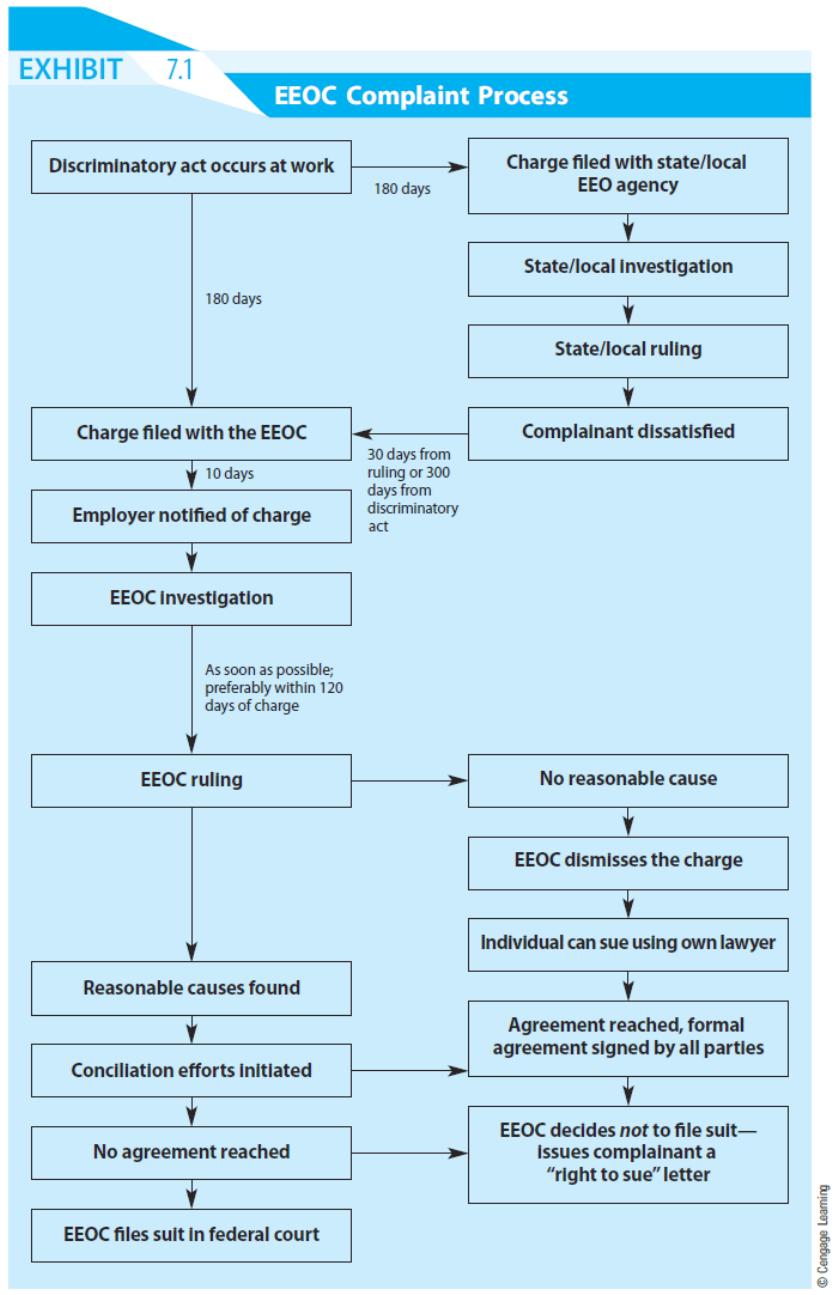
VI. ENFORCEMENT OF FEDERAL LAWS UNDER THE EEOC – Exhibit
7.1: EEOC COMPLAINT PROCESS.
A. In general, a complainant must first establish disparate treatment or
impact, which shifts the burden to the employer to provide a legally
justifiable, nondiscriminatory reason for the action in question.
B. Four ways an employer can rebut a prima facie case are through
showing job-relatedness; a bona fide occupational qualification; bona fide
seniority system; or “business necessity.”
VII. AFFIRMATION ACTION
A. Executive order requires affirmative action plans from
organizations with 100 or more employees and $50,000 or more in federal
contracts in order to assure that the workforce is representative of the
society where the business operates.
B. Presupposes enforcement is necessary in order to treat fairly
individuals of protected classes and to rectify past injustices
C. Is controversial in that “reverse discrimination” often occurs, but
proponents argue its necessity because society will not dismiss from
consideration personal characteristics that are not job related.
D. Affirmative action plans are filed with the Department of Labor,
and contain four separate sections: utilization analysis; availability
analysis; problem identification; corrective action.
VIII. SEXUAL HARASSMENT
A. Court decisions affirm that same or opposite sex sexual harassment
is a form of sexual discrimination under Title VII.
B. One of the more challenging aspects of legal compliance; claims
are often subjective in nature – uses “reasonable person” standard
C. Sexual harassment claims can be costly from a money, public
relations and employee morale points of view.
D. Key concepts include advances of an unwelcome nature – behavior
is considered offensive and inappropriate; nature of harassment – quid pro
quo or hostile environment; pattern or isolated incident?; was relationship
consensual?; allegations must be provable and verifiable.
E. Sexual Harassment at Dial example.
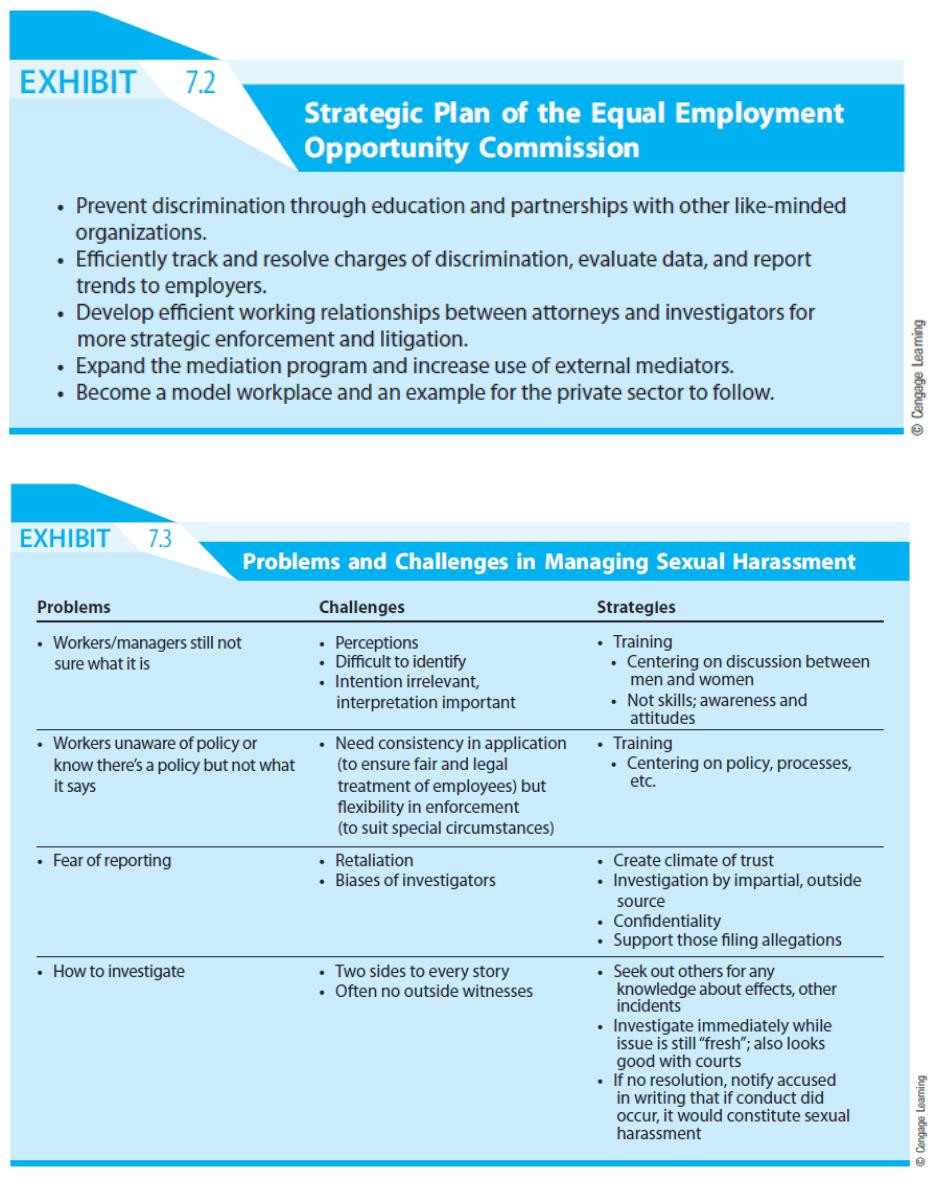
F. Problems in managing sexual harassment include:
workers/managers are not aware of what sexual harassment is; not aware
of sexual harassment policy or what it says; employees often fear
retaliation for reporting; how best to investigate. Exhibit 7.3:
PROBLEMS AND CHALLENGES IN MANAGING SEXUAL
HARASSMENT.
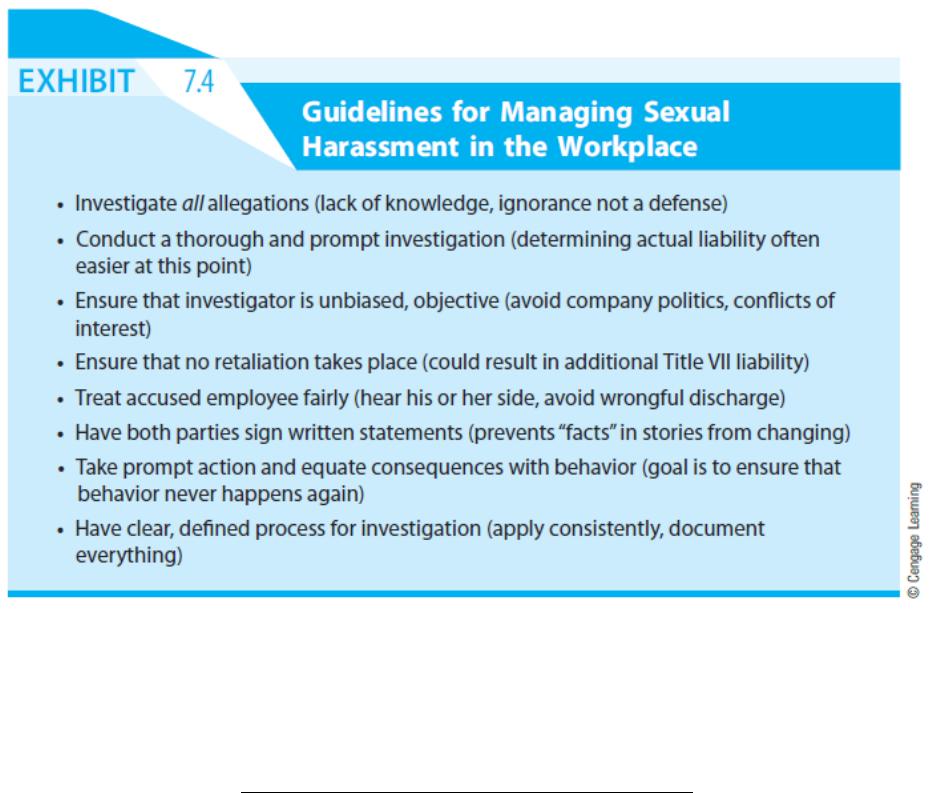
G. Exhibit 7.4: GUIDELINES FOR MANAGING SEXUAL
HARASSMENT IN THE WORKPLACE. Mainly, have an unbiased,
thorough investigation that ensures fair treatment and no retaliation; apply
processes and policies consistently and document everything; take prompt
action. Example – Sexual Harassment at Tyson Foods.
H. Complications abroad – not all cultures recognize sexual
harassment
IX. TRENDS IN EMPLOYMENT LITIGATION
A. Blatant to subtle discrimination
B. Use of electronically produced and stored evidence
C. Increasing complaints of employer retaliation
D. More expeditious employer settlements
E. Use of employment practice liability insurance (EPLI)
F. Language rules in the workplace
X. CONCLUSION
A. Employment laws are numerous, complex and ambiguous, with many
managers uninformed or ill-prepared to manage.
B. Decentralized decision making processes often put line managers in
position to interpret, administer employment law.
C. Employment law is likely the most difficult HR concept to manage.
READINGS
Reading 7.1 – In Defense of Preference
This reading reflects on the principle that ability, qualifications and merit, independent of race,
national origin or sex, should be the guide in employee selection and promotion, as well as
admission to selective higher education programs. According to the author, the reality is that
strict adherence to the principle would result in very few African Americans getting jobs,
admissions and contracts. This is largely due to significantly different levels of educational
performance (and other indicators used in selection processes) between black and white students.
If true color-blindness criteria are employed, then the result may be the effective exclusion of
African Americans from “…positions of influence, wealth and power.” The author asserts that
we are finally seeing the majority sentiment against preferences emerge, basically due to changes
in the makeup of the Supreme Court; circuit court rulings, and backlash to Californian efforts
through Proposition 209 to insert into the state constitution wording of the Civil Rights Act of
1964 (which bans discrimination on the basis of race, national origin or sex).
The reading particularly looks at the influence of affirmative action on admissions to selective
higher education programs. The history of affirmative action and preferences at the University
of Texas Law School is chronicled, along with related legislative and court actions. Across the
U.S. black students still lag behind white students on the SAT test, prompting some institutions
to institute new admissions criteria that de-emphasizes such testing, and other criteria that might
limit black students meeting admissions requirements. Thus, the author questions in a
tongue-in-cheek way whether qualifications at the time of admission really matter.
Many may have believed that decades of compliance to anti-discrimination laws and affirmative
action should have erased gaps between blacks and whites, but the author suggests they have not.
Most would agree that banning of preference would be a bad idea along many fronts, and that
diversity brought to select institutions of higher education by black students is critical. Thus,
there appears to be a strong argument that elimination of preferences would mean de facto
exclusion of blacks from selective higher education, perhaps not something our society wants to
contemplate.
Reading 7.2 – The Management of Organizational Justice
Organizational justice refers to the
extent to which employees feel that
they are being treated fairly in
organizations. It has been shown to
correlate with greater trust and
commitment, improved job
performance, better citizenship
behavior, improved customer service
and satisfaction and reduced conflict.
Organizational justice is a process
which needs to be actively managed.
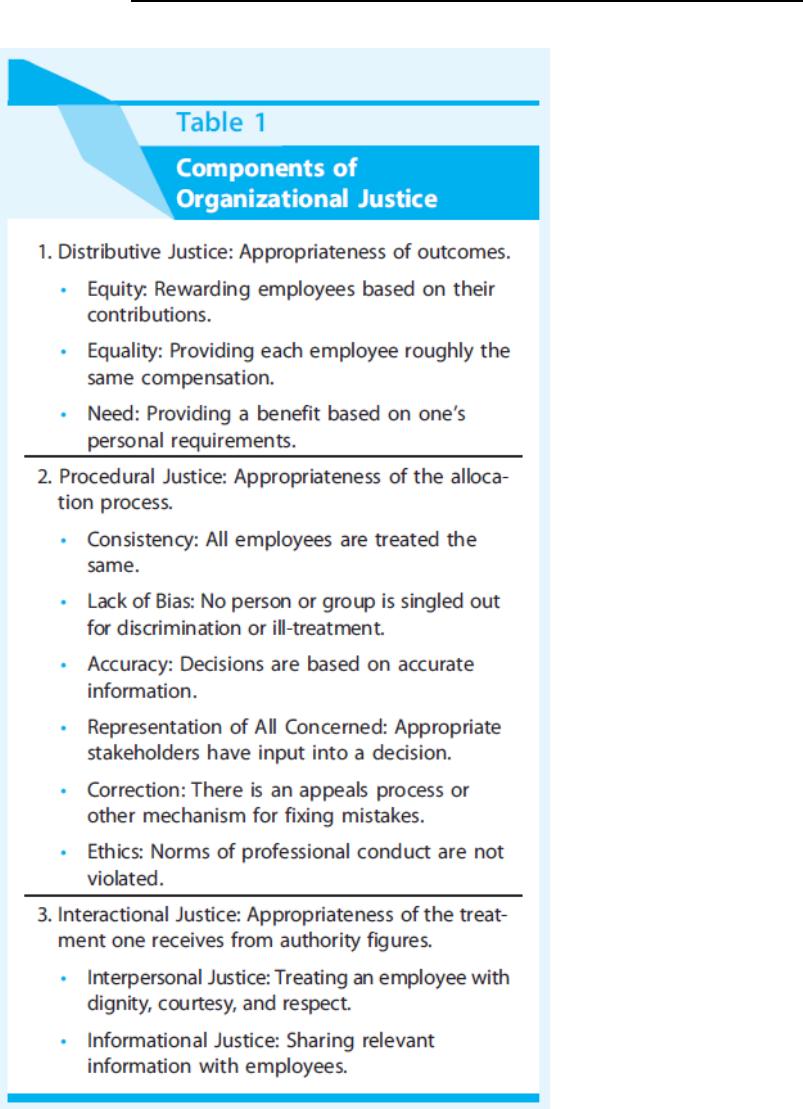
There are three components of justice
Distributive justice – the
appropriateness of outcomes
Procedural justice – the
appropriateness of allocation
processes
Interactional justice – the
appropriateness of how
employees are treated by
superiors
Table 1 illustrates the individual
components of each of these types of
justice
Perceptions of justice are influenced
by
selection procedures
compensation and reward systems
conflict resolution techniques
downsizing activities
performance management systems