
CHAPTER 6
DESIGN AND REDESIGN OF WORK SYSTEMS
A. OVERVIEW
This chapter discusses the importance of proper design and redesign of work systems.
Job duties and characteristics are taken into account when jobs are designed.
Environmental and organizational change can serve as a catalyst to redesigning work
systems. Organizational change can be difficult, and may be resisted by some, but must
be managed effectively to facilitate organizational performance. Outsourcing of some
HR functions can make sense for organizations, and can bring a higher profile to HR
managers as they assume less operational and more strategic duties. Certain critical HR
functions should remain internal to the organization.
B. LECTURE OUTLINE
I. OPENING CASE – JOHNSONVILLE SAUSAGE
Based in Kohler, WI, Johnsonville is a family-owned business which involves its
“members,’ as opposed to employees in all aspects of its business. All employees
are required to learn about the entire business from the time of hire, largely
facilitated by a series of workshops which cover everything from company
history and culture to understanding financial statements and how the work of
individual teams effects profitability. Individual members are even empowered
to shut down the production line at any time, without supervisor approval, if
they sense any kind of problem. Monthly bonuses are tied into production and
profitability goals. Annual turnover rate is 8% compared to the meatpacking
industry average of 20%
II. DESIGN OF WORK SYSTEMS
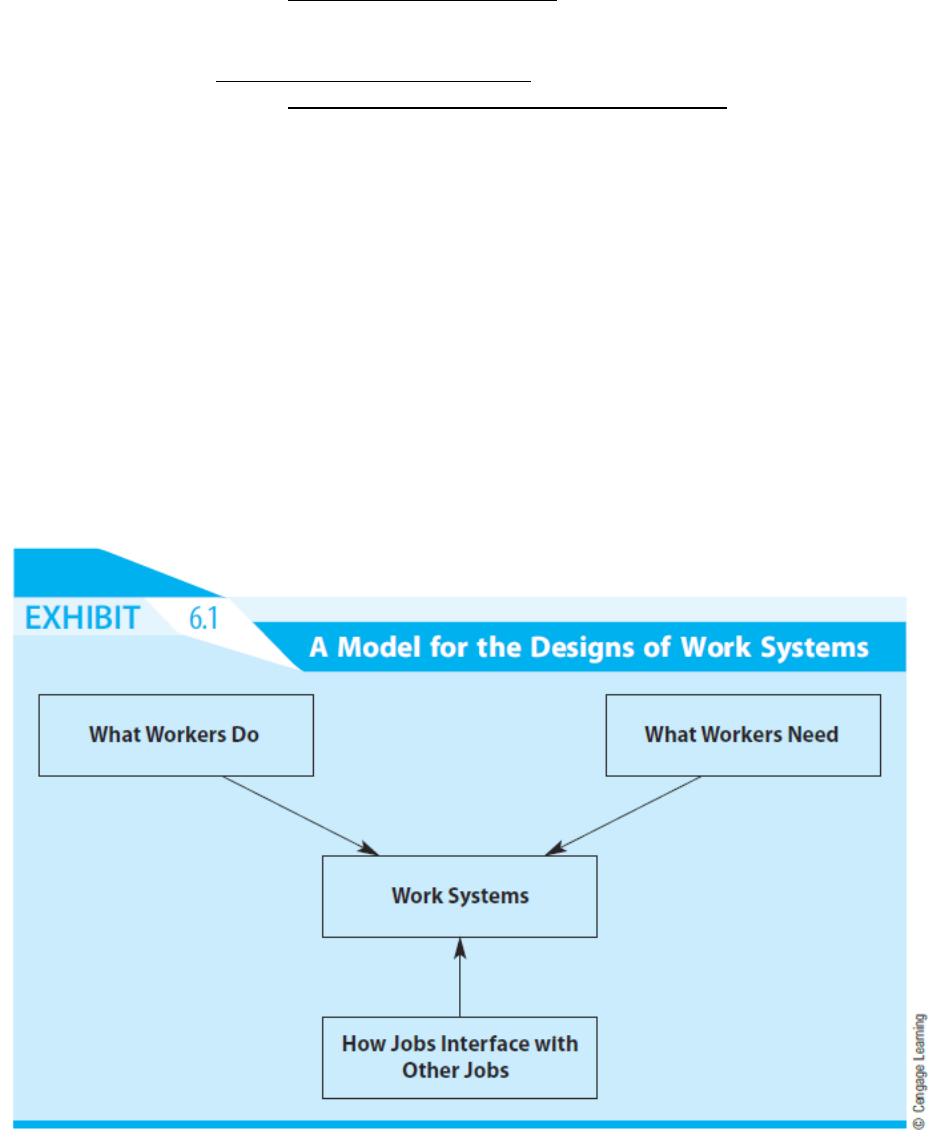
A. A MODEL FOR THE DESIGN OF WORKSYSTEMS (Exhibit 6.1)
presents three considerations for decision makers: what workers do, what
workers need, and how jobs interface with other jobs within the
organization.
B. One of the more challenging tasks is allocating specific tasks and job
responsibilities to employees. Employees should have sufficient work to
keep them both productive and motivated. However, employees should
not be overwhelmed by their jobs.
C. Assess the skills, knowledge, and abilities required by the
organization to design jobs and work systems. Work systems should
constantly be assessed and evaluated to ensure that organizational
objectives are achieved.
D, Job specialization allows workers to specialize in particular tasks
and gain competence, but can result in creating jobs that are boring and
monotonous for employees. Job specialization is appropriate for
organizations that require high levels of efficiency and minimization, but
also for organizations that employ workers who do not seek to grow and
be challenged.

E. Job enlargement increases the number of tasks, activities, or jobs
to alleviate boredom of specialized work. This does not necessarily
provide employees with more responsibility.
F. Job rotation rotates workers across different specialized positions
within the organization. This helps employees develop through exposure
to different roles and functions. HR executives need to “learn the
business” by participating in and learning about the organization and its
various units.
G. Job Enrichment increases the responsibility of employees, who
become accountable for their own performance. Vertical loading is the
process of reassigning responsibilities of supervisors to employees.
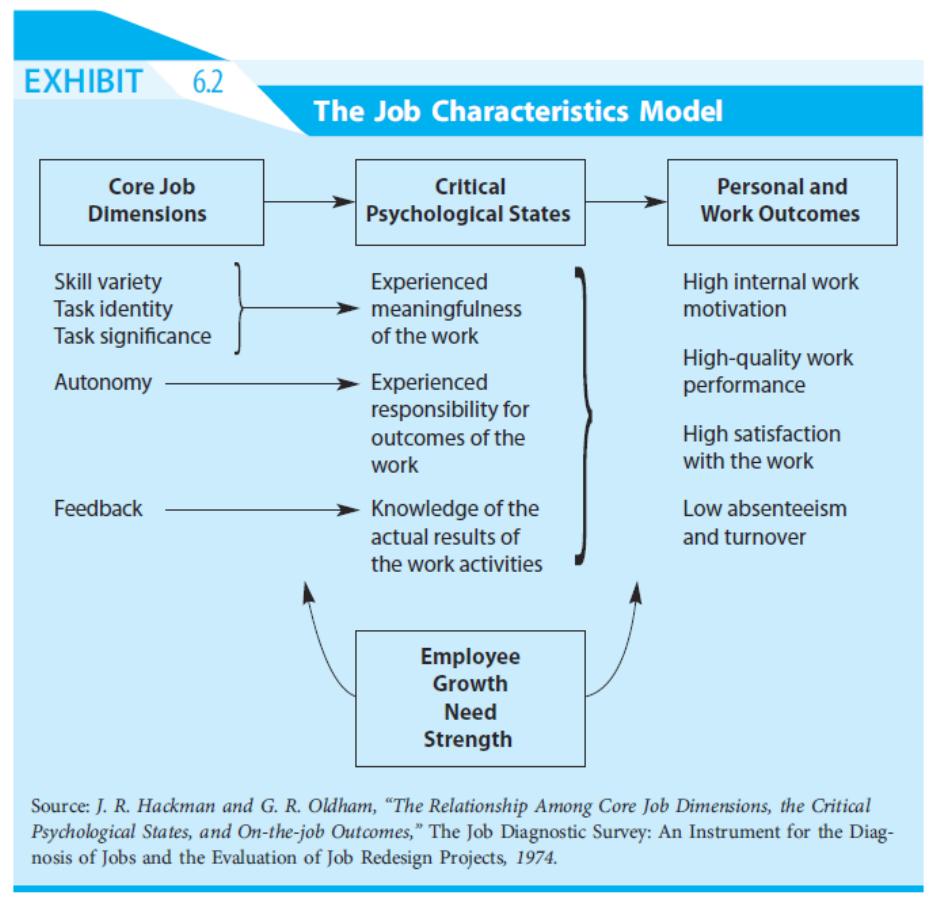
H. Exhibit 6.2 THE JOB CHARACTERISTICS MODEL which
describes core job dimensions associated with certain critical
psychological states and personal/work outcomes.
I. Increasing emphasis being placed on competencies and
competency models. Difficult and time-consuming to develop but
adaptable to changes in the organization’s strategy and can have specific
behavioral components built in.
J. Design of work systems needs to consider what workers want or need to
ensure that they are motivated, productive and happy. Demographics and
lifestyles of the labor market have changed. Employees no longer have
generic needs, with worker needs varying across different age groups,
genders, races, religions, abilities, sexual orientation and marital status.
This creates a significant challenge for allocating work in organizations.
K. Work/life balance is important to employees, and must be recognized by
the organization. Employers that do not allow employees to have balance
will find that the workers are less committed and may also suffer from
burn out. Employers are establishing stress management, along with
physical health and wellness programs, to ensure that employees retain
an essential balance among their life activities. Flexible Work at State
Street example.
L. Representation, or “voice” is important in work systems design, ensuring
employees have sufficient voice to allow them to contribute their
expertise. Systems for employee input are motivational, allowing
utilization of existing capabilities by encouraging employees to get
involved in work-related issues.
M. Workplace safety ensures work systems and jobs designed so employees
can perform their jobs without any undue risks.
N. Three traditional types of task interdependence:
1. pooled – individual employees can work independently of each other in
performing tasks, but utilize some coordination of their activities.
2. sequential – individual depends on the timely completion of quality
work from another coworker.
3. reciprocal – employees process work so that its flow is not predictable
and spontaneous to suit an immediate situation. Employees need to be
flexible and are often a team, with joint and shared responsibility.
III. STRATEGIC REDESIGN OF WORK SYSTEMS

A. Redesign of work systems represents one of the most radical yet common
changes taking place in organizations from an HR perspective.
B. Reengineering of jobs is necessary in order to respond to, among other
things, changes in technology and the increased use of teams and project
groups.
C. Matrix organization structure being utilized with increasing frequency.
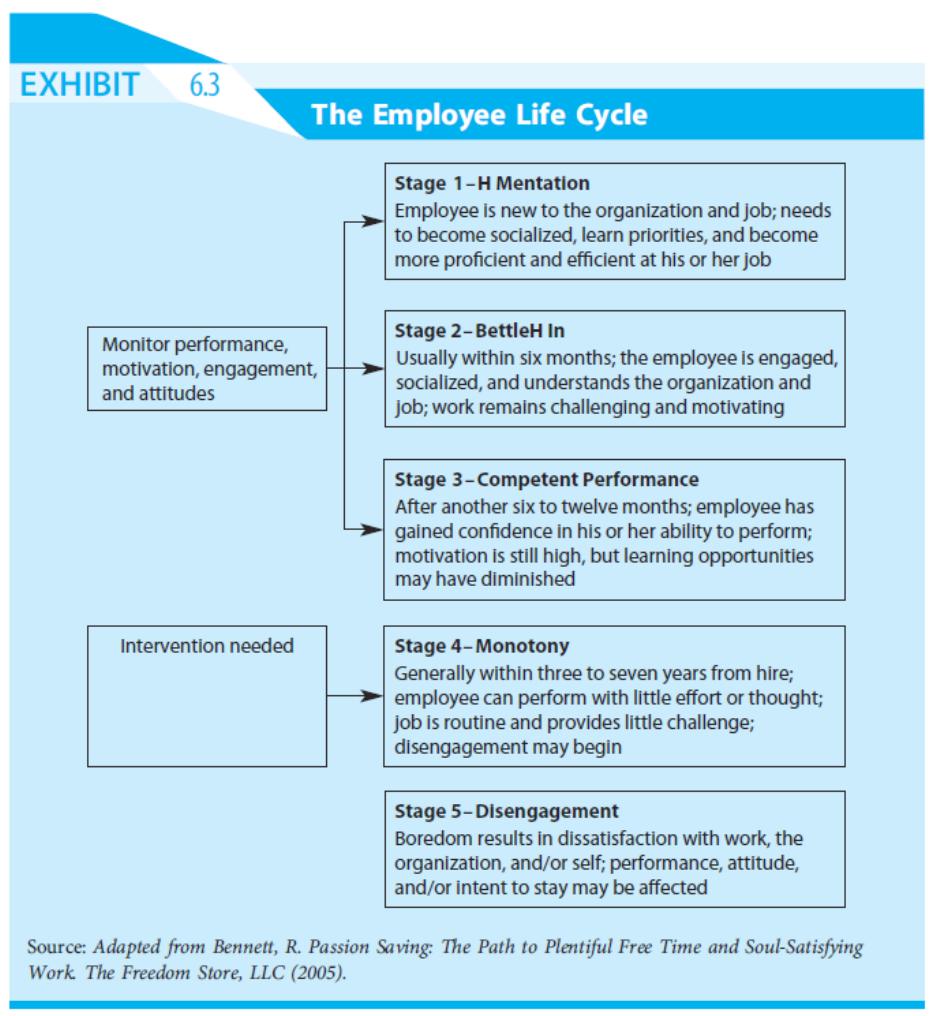
D. Employees typically go through a life cycle, presented in Exhibit 6.3
which addresses critical psychological and motivational states which
may affect performance and productivity.
E. Outsourcing involves contracting non-core work activities to
outside specialists, hopefully for less than it costs to do the work
in-house.
F. 75 percent of organizations outsource at least one HR function.
This is a benefit for HR because it allows HR staff to focus more on
strategic issues.
G. Outsourcing contractors can provide cost savings relative to labor,
though they are limited by laws that mandate minimum wages and/or by
forces of supply and demand relative to market value of certain skills and
competencies.
H. Offshoring involves exporting of tasks and jobs to countries
where labor costs are significantly less than costs in the United States.
These jobs are often computer programming, back-office accounting, and
customer service call centers. Offshoring has presented a challenge to
organizations via means of managing virtual global teams. It is a
controversial practice.
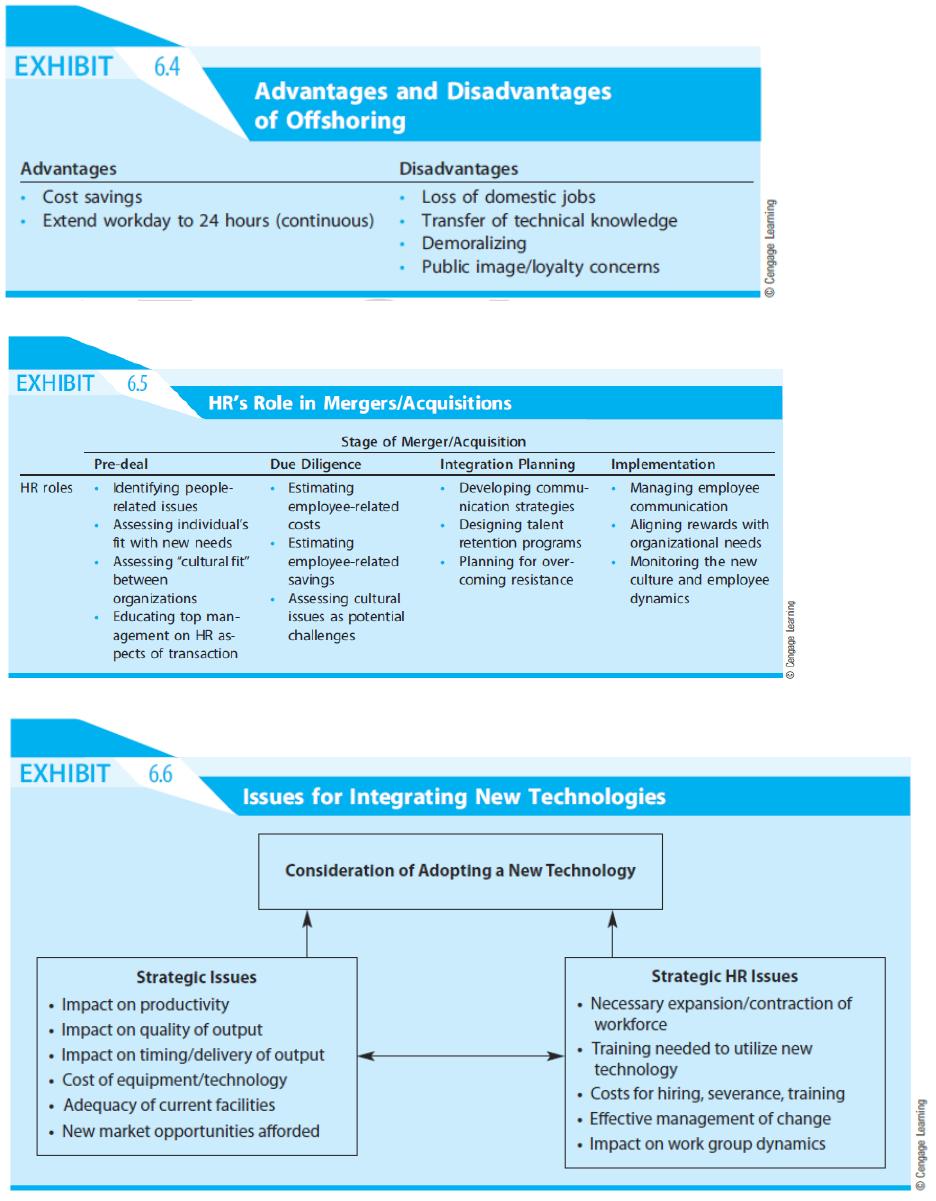
I. Exhibit 6.4 presents some of the advantages and disadvantages of
offshoring.
V. MERGERS AND ACQUSISITIONS
A. Merger and acquisition activity has grown substantially over the
years, and requires significant HR activity to support the transitions
involved. See The Human Side of Creating AOL Time Warner
example.
B. Exhibit 6.5: HR’S ROLE IN MERGERS/ACQUISITIONS, which
examines the role of HR before the deal, during the due diligence
process, as part of integration planning and implementation.
VI. TECHNOLOGY
A. Impact of Technology – constant advances in technology and work
processes pressure HR administrators to balance financial
consideration of technology adoption with a number of specific
strategic HR issues
B.
Exhibit 6.6 ISSUES FOR INTEGRATING NEW
TECHNOLOGIES
1. Strategic Issues – Impact on productivity; quality, timing
and delivery of output; equipment/technology costs; adequacy of current facilities; new market
opportunities

2. Strategic HR Issues – Necessary workforce expansion and
contraction; training; hiring/severance/training costs; effective change management; work
group dynamics impact
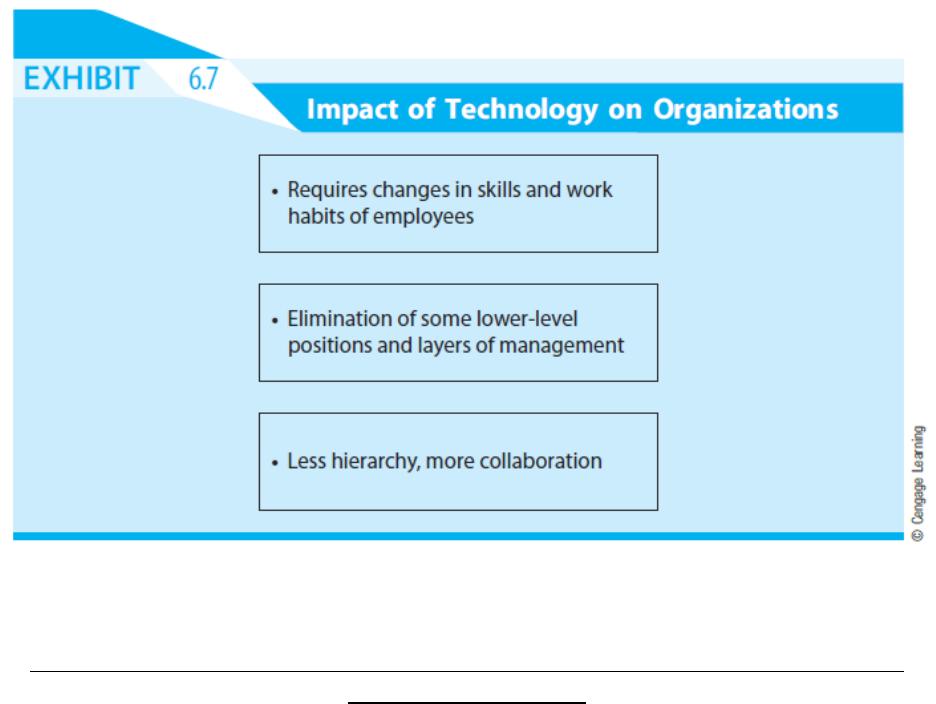
C. Exhibit 6.7 IMPACT OF TEACHNOLOGY ON ORGANIZATIONS
Technology impacts how work is organized and the organizational
structure, requiring changes in employee work habits and
skills; elimination of some lower level positions and layers of
management; less hierarchy and more collaboration
XLIX HR ISSUES AND CHALLENGES RELATED TO TECHNOLOGY – Technology
has created three new areas of HR concern
1. Telework – 19.6 million Americans in 2000 and growing strongly.
Benefits include: useful as a retention aid/organization can retain investment in person; creates
recruiting flexibility; increase in production. Limitations include: lack of “face time”; must
develop a clear performance measurement system; how many and which employees will be
offered/required to use telework; expense; liability issues; technological feasability assessment
required. Examples – Telework at Deloitte, the U.S. Patent and Trademark Office and at Merrill
Lynch
2. Employee Surveillance and Monitoring – employees often use work time
for personal business and entertainment, with an increasing number of employers implementing
electronic monitoring of employee activity, such as tracking Internet usage. Can create serious
privacy concerns, influence employee morale and loyalty. See the Electronic Communications
Privacy Act of 1986.
3. E-HR – range and scope of HR e delivery has expanded greatly. Time
Warner Cable uses kiosks at its many locations to deliver HR services. City of Dallas uses
direct deposit or issues debit cards instead of paychecks. American Airlines “Jetnet” program
greatly reduces costs, provides time-saving conveniences.
4. Social Networking – employers can reap benefits of social networking to
promote communication, particularly among remote workers. Can be done through public
social networking sites such as facebook or on an organization’s in-house intranet. Example –
Social Networking at Capital One and at 7-Eleven.
VII. UNDERSTANDING CHANGE
A. Pressure to change can be a constant force in organizations. Change
initiatives are often met with resistance.
B. Costs of change can encourage resistance. Change involves
disrupting the status quo and entering areas of uncertainty, and involves
commitment of resources that could be deployed otherwise.
C. Failure to perceive any benefits for themselves adds resistance to
change for those involved with and impacted by the change efforts.
D. Risk and the uncertainty inherent in doing something differently
also encourage resistance to change. There is no assurance that change
will result in higher performance, greater efficiency, better working
conditions, or improved morale.
E. Poor coordination and communication can reduce the acceptance
of change. Managers often refrain from informing workers about new
projects and programs that are being considered or developed.
Misinformation not refuted by managers can result in the departure of
employers who may sense a threat to their jobs.
VII. MANAGING CHANGE
A. Promote benefits to users. Work redesign strategies need to
consider the employee perspective on how changes will improve work
and organizational life for them.
B. Promote and invite participation. This helps create buy-in to the changes.
C. Two-way communication facilitates change. Employee input is
not only motivating and beneficial, but communicating with employees
also fosters an atmosphere of trust and allows the organization to
determine where resistance might lie prior to implementation of change,
rather than after.
VIII. CONCLUSION
A. The changing nature of work requires organizations to strategically
manage change as part of work design and redesign.
B. Organizational restructuring is risky, with no guarantee of success.
C. Successful job restructuring involves:
1. Skills training and continuous learning
2. Increased employee participation
3. Flattened organizational structures
4. Labor-management partnership
5. Compensation linked to performance
READINGS
Reading 6-1: Using Outsourcing for Strategic Competitiveness in Small and
Medium-sized Firms
Outsourcing originated in the manufacturing sector but has spread and is growing widely in the
service sector. 80% of Fortune 500 organizations outsource into a $386 billion annual market.
Most outsourcing has been done by larger firms yet small and medium-sized organizations can
take advantage of outsourcing to enhance their competitive advantage.
An outsourcing matrix is presented which considers organizational activities by strategic
importance (core or non-core) as well as by outsourcing role (supplementary or
complementary). Supplementary outsourcing is that which leads to the replacement of an
activity being conducted within the firm while complementary outsourcing leads to supporting
an activity being done within the firm so that its delivery become more effective. The
outsourcing matrix hence provides three opportunities for outsourcing, as presented in Figure 1.
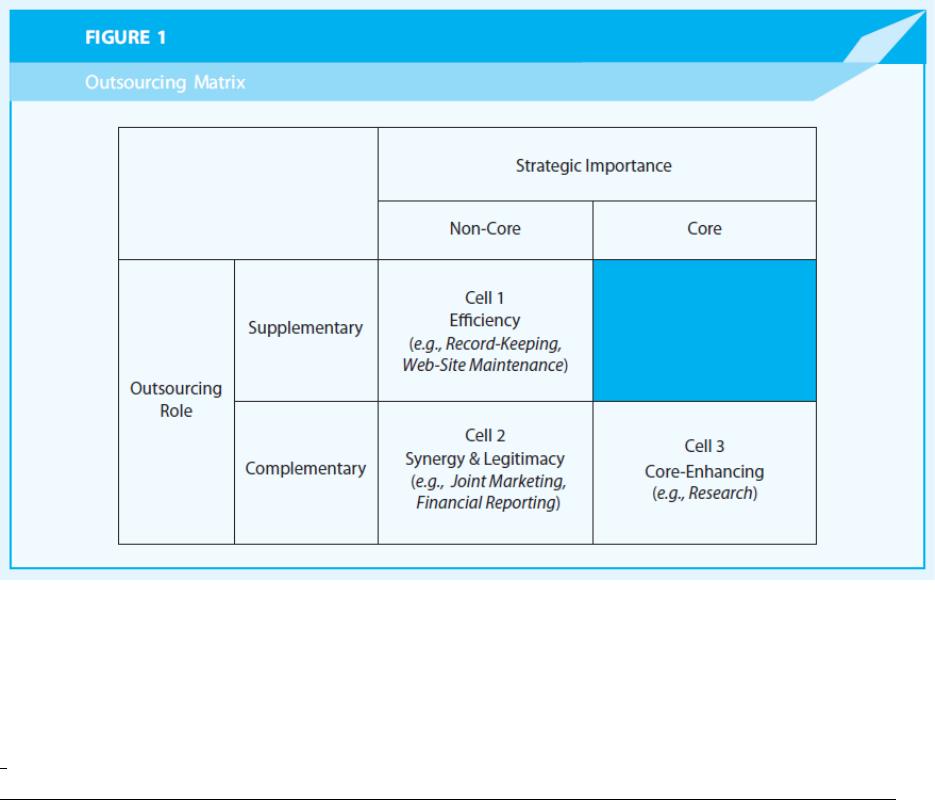
Cell 1 outsources non-core supplementary activities and provides enhanced efficiency
Cell 2 outsources non-core complementary activities and provides synergy and legitimacy
Cell 3 outsources core complementary activities and enhances activities of strategic importance
Cell 3 outsourcing is more risky than that of Cells 1 or 2
Reading 6-2: Monitoring Employee E-mails: Is There Any Room for Privacy?
This reading explores the justifications for employers’ e-mail monitoring along with an analysis
of supporting statutory and case law, Web-based private e-mails, and international implications
of e-mail monitoring. It also provides evidence of work outcomes of e-mail monitoring
regarding employee attitudes and behaviors such as organizational commitment, job
satisfaction, and performance.
Employers generally assume the expense and effort associated with monitoring employee
e-mails for three reasons; (a) protecting the firm from liability risks, (b) protecting company
assets, and (c) ensuring job performance.
Employees and employee advocates have raised privacy concerns around this monitoring but, to
date, employers have prevailed in every case in which they have been accused of violating
employee privacy rights. This is true even when employees access web-based e-mail accounts
at work on employer-provided equipment. However, attempts to monitor personal e-mail
accounts accessed through personally-owned telecommunications devices may run afoul of the
Electronic Communications Privacy Act of 1986.
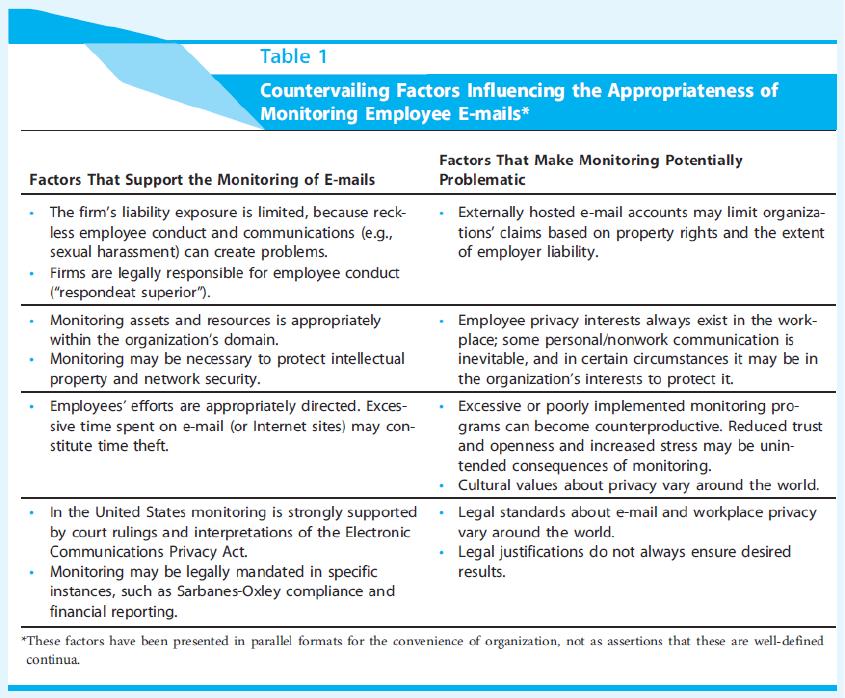
An interesting challenge for multinational employers is the different social norms regarding
privacy in other countries. Employers can face more stringent conditions on monitoring
employee e-mail and different cultural expectations about privacy, particularly in the European
Union. For example, in the United States, privacy can be viewed as a commodity, meaning that
it can be bartered away when individuals feel it is in their interests to do so. In Europe,
however, privacy is viewed as more fundamental, something that persons cannot be induced to
forfeit.
There can also be behavior and performance consequences associated with monitoring.
Monitoring could affect employee feelings of trust toward the employer and result in feelings of
degradation, stress and frustration. This, in turn, can effect employee engagement and
commitment, leading to increased voluntary turnover and decreased performance.
In sum, e-mail monitoring needs to carefully consider the ultimate impact it will face on
employee attitudes, behavior and performance in addition to both legal mandates and ethical
considerations. Even though domestic employees find limited to no legal protection for claims
of invasion of privacy, the ultimate impact on the trust relationship between employees and
employers and its consequences can be significant.