
CHAPTER 4
THE EVOLVING/STRATEGIC ROLE OF HUMAN RESOURCE MANAGEMENT
A. OVERVIEW
This chapter discusses the evolution of the role and activities of HR managers.
Traditional views of HR roles are more restrictive and tend to rely on the HR function in
more of a personnel approach. However, strategic HR policies and practices can be
critical to organization success and even survival. Barriers to successful implementation
of strategic HR practices are introduced, with most revolving around the short-term
approach to capital performance, and various perceptions held by management, both HR
and otherwise.
B. LECTURE OUTLINE
1. OPENING CASE – Netflix
Netflix uses a very nontraditional approach to HR. Company executives
realized early on that the marketplace in which they competed for talent was
extremely competitive. As a result, Netflix tried to create a company culture
and work environment which was conducive to attracting and retaining the
creative types of individuals it sought.
Work rules and presence are very relaxed and employers are given the freedom
to work when and where they choose. Even vacation policy is absent with
employees allowed to take as much or as little vacation as they choose at their
own discretion. These policies reflect performance expectations of getting the
job done in the manner best suited for individual employees.
INTRODUCTION
“The development of a consistent, aligned collection of practices, programs and
policies to facilitate the achievement of the organization’s strategic objectives” is
the key to strategic human resource management. This philosophy is consistent
with taking a long-term, strategic view of the HR function.
2. STRATEGIC HR AT GENERAL ELECTRIC
GE’s success relies heavily on the belief that the HR function is a critical,
driving factor in performance worldwide. HR executives are expected to
understand components critical to organizational success, including finance,
marketing and operational issues. A comprehensive Human Resource
Leadership Program (HRLP) is in place, encompassing extensive training and
hands-on rotational assignments. An environment that treats HR managers as
strategic partners is relevant, allowing full contribution to the business
3. STRATEGIC HR VERSUS TRADITIONAL HR
1. The role of HR management is evolving, with old school “personnel
department” actions of record keeping, file maintenance and other clerical
functions behind us. In the world of strategic HR, company objectives
must be translated into specific people management systems. This

requires a focus that is more strategic and less operational in nature.
Such a shift in philosophy requires considering the implications of
corporate strategy for all HR systems, although specific approach and
process will vary across organizations and no one “best practices”
approach exists.
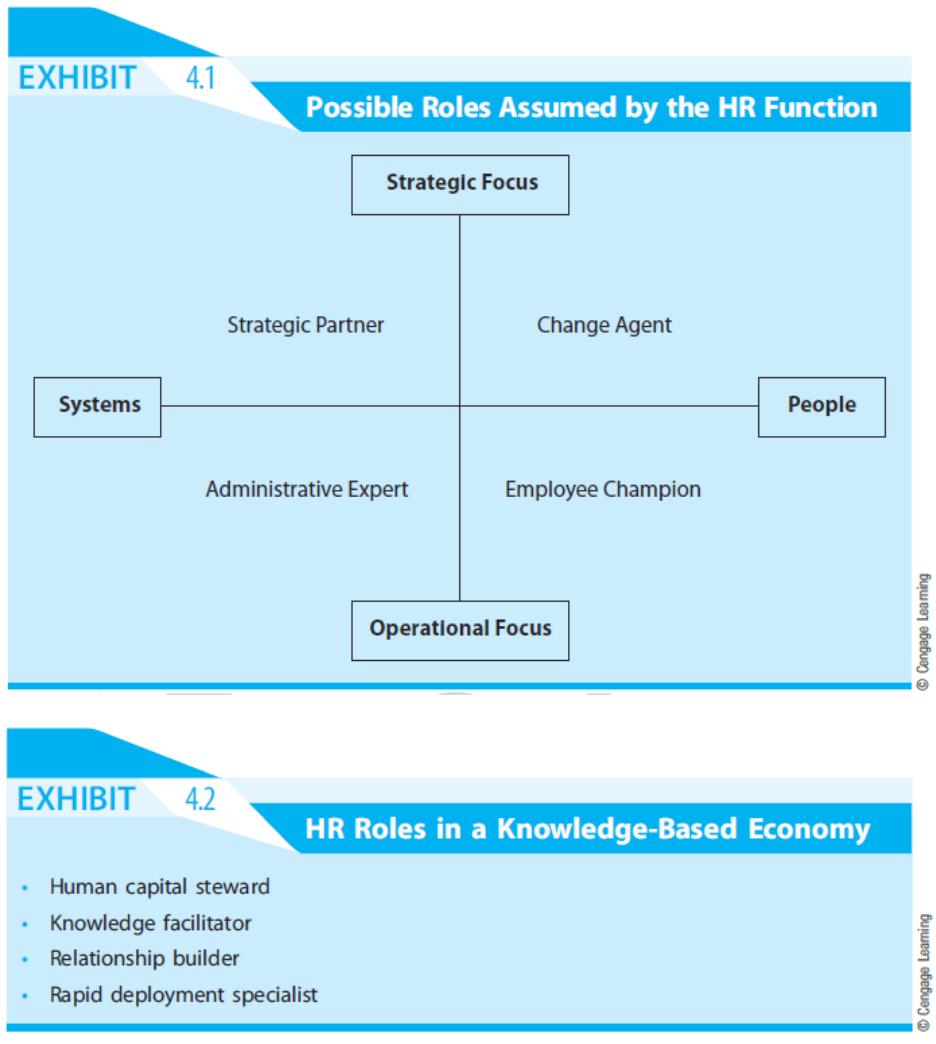
2. Possible roles assumed by the HR function include strategic partner,
change agent, administrative expert and employee champion.
3. The “HR Roles at Mercantile Bank” example outlines a shift in HR
functions to a strategic approach. This evolved through streamlined work
processes, eliminating unnecessary activities, reevaluating technology
and outsourcing non-strategic functions.
4. HR roles in a knowledge based economy include
1. human capital steward
2. knowledge facilitator
3. relationship builder
4. rapid deployment specialist.
5. Critical strategic HR competencies include
1. Strategic contribution
2. Business knowledge
3. Personal credibility
4. HR delivery
5. HR technology
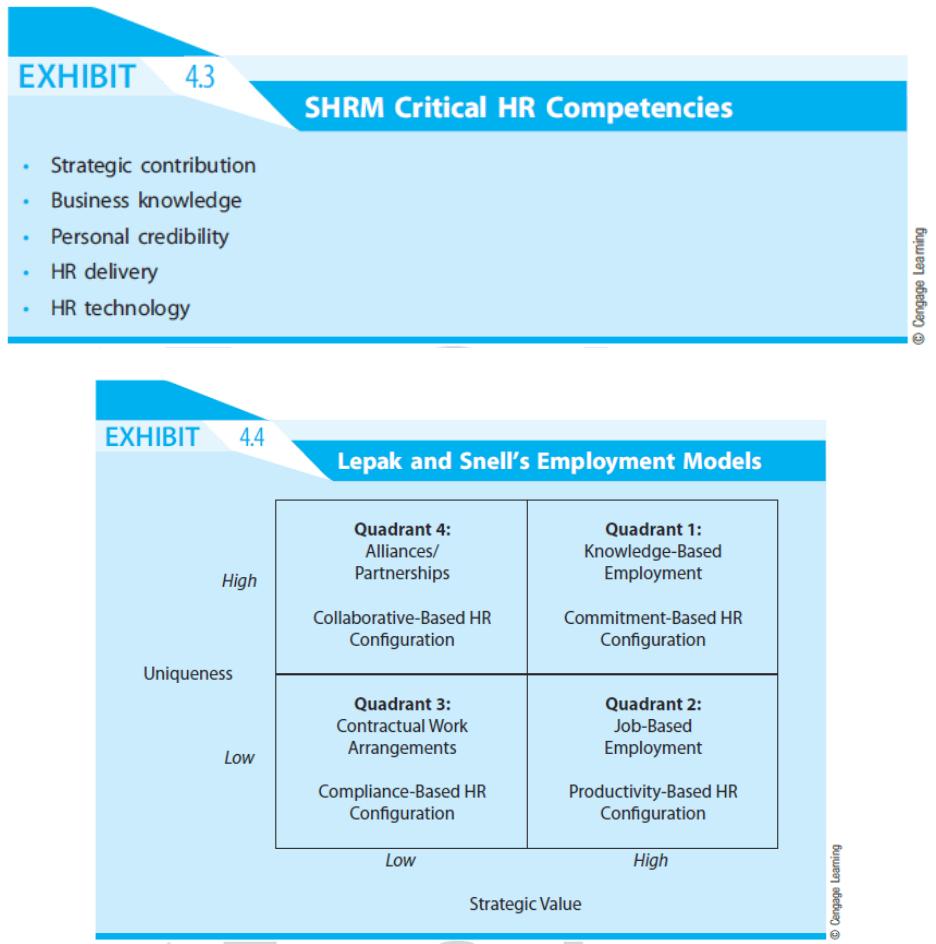
6. Lepak and Snell’s Employment Model (Exhibit 4.4) considers the
strategic value and uniqueness of human capital. As the strategic value
of human capital increased, so did the likelihood that the organization
would employ it internally rather than externally. The more unique the
human capital, the more likely it will contribute to competitive
advantage. Model components include
1. Knowledge Based Employment-Commitment Based HR
Configuration
2. Job Based Employment-Productivity Based HR
Configuration
3. Contractual Work Arrangement-Compliance Based HR
Configuration
4. Alliances/Partnerships-Collaborative Based HR
Configuration
7. The “Strategic Human Resource Management at Southwest Airlines”
example illustrates unique HR practices follow from a unique corporate
culture, including the “FUN” and “LUV” concepts.
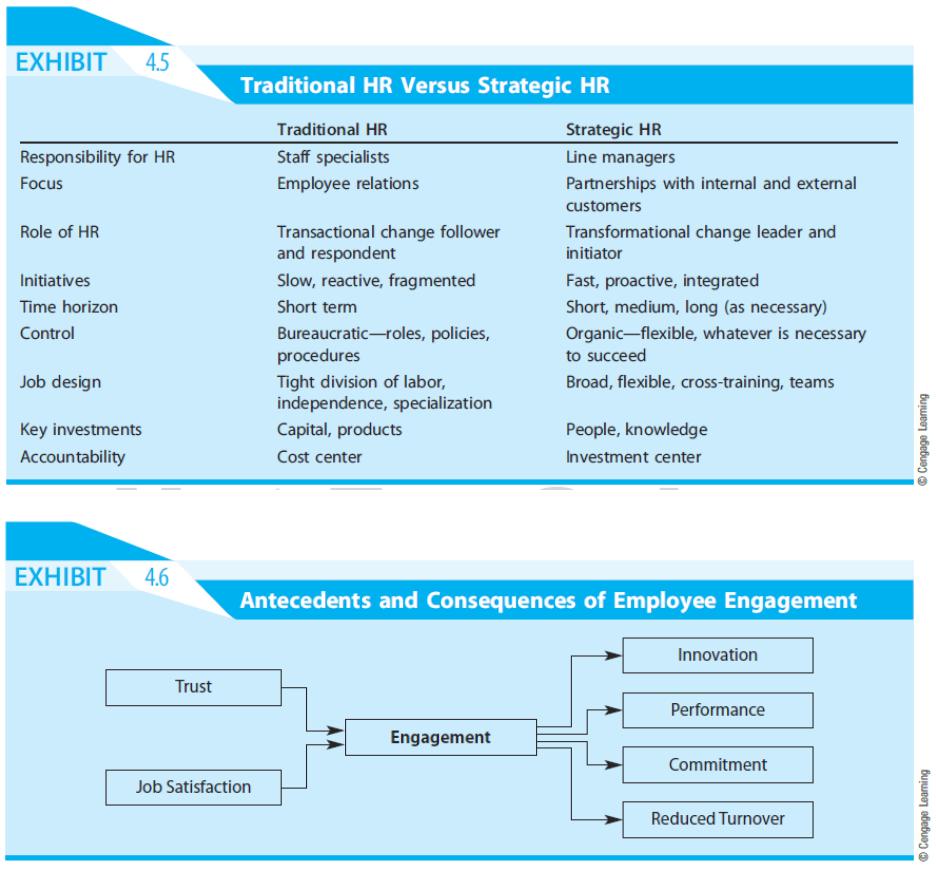
8. Exhibit 4.5 – TRADITIONAL HR VERSUS STRATEGIC HR.
Traditional HR sees an organization’s key assets as its capital, products,
brand name, technology and investment strategy. Strategic HR views key
investments as people, their knowledge, skills and abilities.
9. Employee Engagement at Aetna – discusses how Aetna, on the verge of
bankruptcy, engaged employees in a downsizing strategy which
refocused the organization on key values, developed a means for assessing
employee engagement and developed a succession planning program.
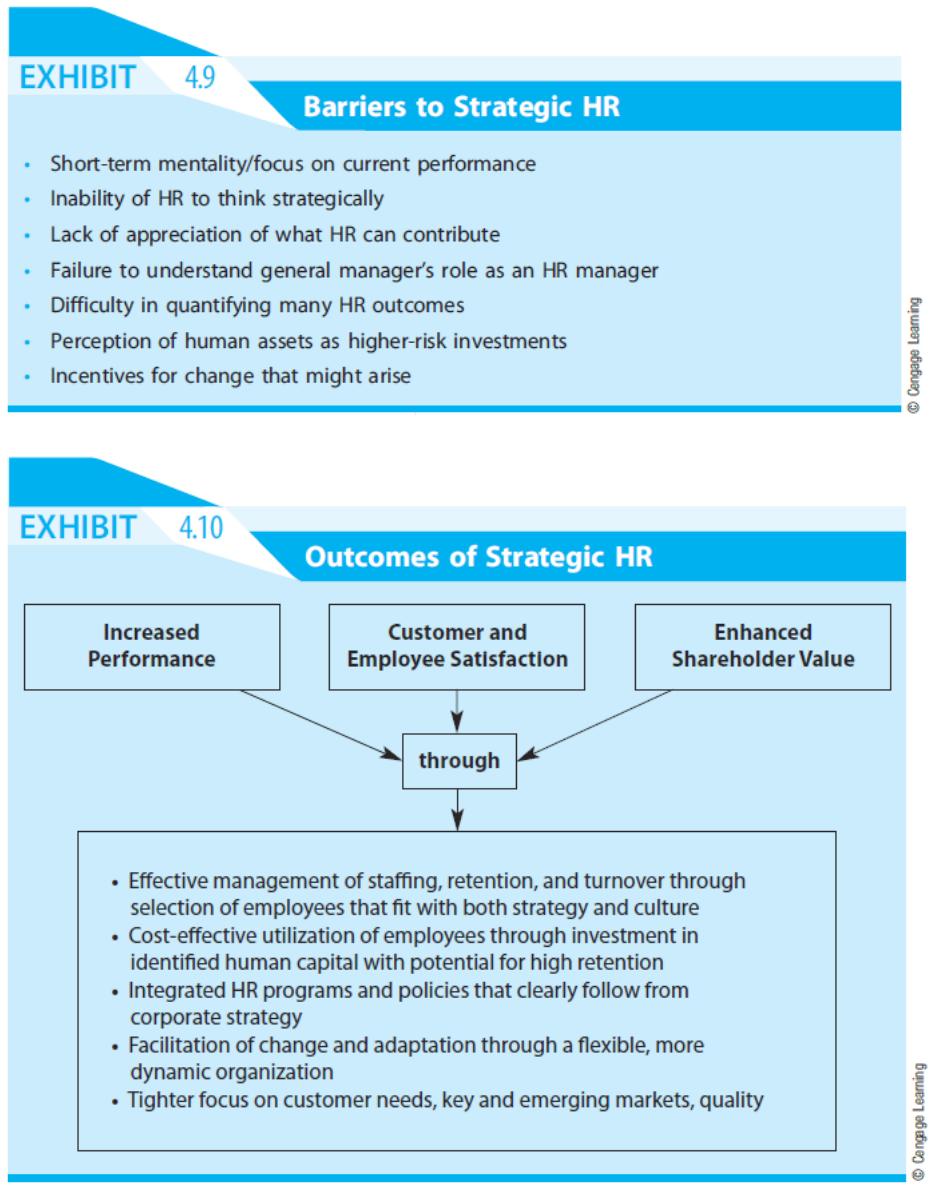
4. BARRIERS TO STRATEGIC HR (Exhibit 4.9)
Although strategic HR makes sense intuitively, many organizations have
a difficult time implementing for many reasons: organizational culture,
history, values and management practices can act as disincentives for
change initiatives. Common barriers to strategic HR implementation
include:
1. The short-term approach taken by most organizations to
performance, performance evaluation and compensation,
which follows the short-term approach taken by capital
stakeholders
2. HR managers often have a difficult time thinking
strategically, often due to insufficient training to
understand the whole organization and its challenges
across functional areas.
3. Senior managers often lack appreciation for HR as a
strategic partner
4. Functional managers often do not see themselves as HR
managers, a requirement of the strategic HR approach.
5. Difficulty in quantifying outcomes and benefits of HR
programs
6. Human assets are not owned by the organization, and
therefore may be perceived as having a higher risk than
capital assets
7. Resistance to change may follow introduction of strategic
HR initiatives, and there may be few incentives to change
5. Exhibit 4.10 – OUTCOMES OF STRATEGIC HR
1. Increased performance
2. Customer and employee satisfaction
3. Enhanced shareholder value
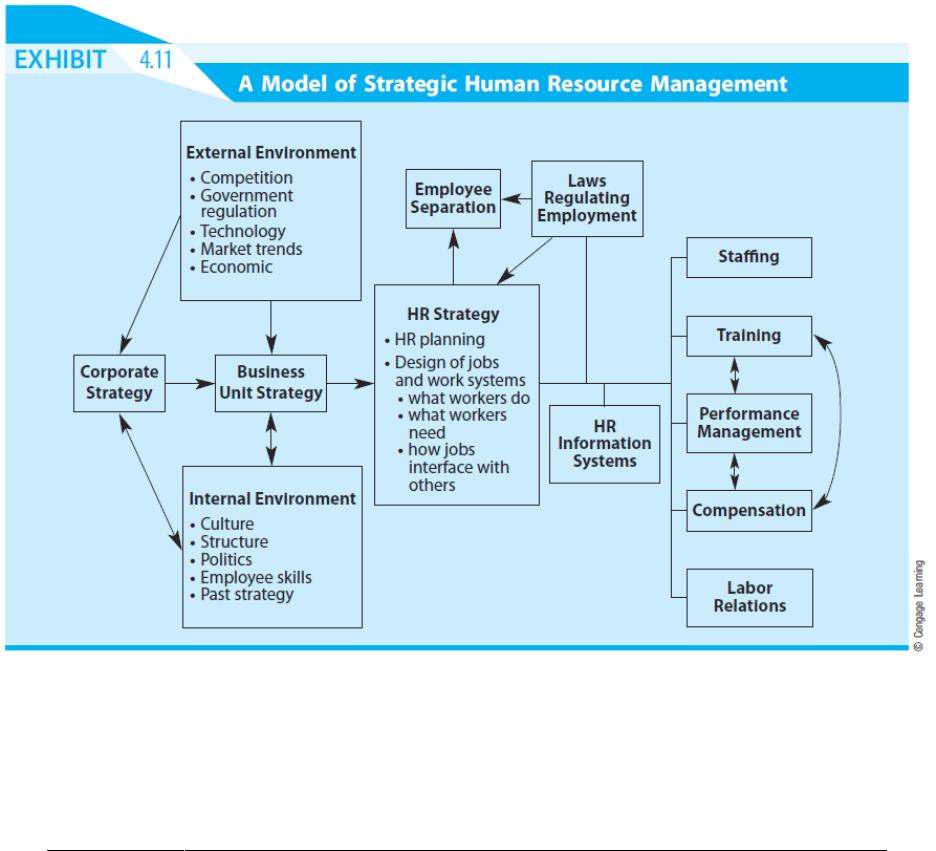
6. Exhibit 4-11 – A MODEL OF STRATEGIC HUMAN RESOURCE
MANAGEMENT. This model provides the framework for the rest of the book.
7. CONCLUSION
1. Top management often does not realize the value that strategic HR can
provide benefits to the organization. Senior HR managers also may not
realize themselves how they can contribute to their organizations
strategically. Lack of a holistic approach limits the ability of HR
managers to contribute to high level strategic thinking. HR managers
must appreciate that a strategic approach can provide three critical
outcomes: increased performance; enhanced customer service and
employee satisfaction; and enhanced shareholder value. These outcomes
are accomplished through effective management of the staffing, retention
and turnover processes through selection of employees that fit the
strategy and culture of the organization; cost effective utilization of
investment in identified human capital with the potential for high returns;
integrated HR programs and policies that clearly follow corporate
strategy; facilitation of change and adaptation; and tighter focus on
customer needs, key and emerging markets and quality.
2. Strategic Reorganization of the HR Function General Motors and
Strategic Reorganization of the HR Function at Wells Fargo Bank
examples, one following a centralized and one a decentralized approach
to HR within the context of the organization’s strategy.
READINGS
Reading 4.1 – Distinctive Human Resources are Firm’s Core Competencies
This article takes a counterpoint to the “best practices” approach to superior management
performance. The authors contend that there is no one set of best practices, and there should be
a substantial fit between HR practices and business strategies. People management practices
are the drivers to create distinctive competencies and business strategies. Pairs of firms in
various divergent industries are examined, with each pair employing different HR strategies
based upon different corporate strategies. Despite competing in the same industry using
different approaches, each organization was successful because its HR practices were well
suited to its overall strategy. Industries and organizations analyzed in each include:
Professional Sports – San Francisco 49ers and Oakland Raiders
Retailing – Sears and Nordstrom
Professional Services – Boston Consulting Group (BCG) and McKinsey & Company
Business Schools – Harvard and Wharton (University of Pennsylvania)
Financial Services – Chubb and AIG
Shipping – Federal Express (Fed Ex) and United Parcel Service (UPS)
Food and Beverages – Coke and Pepsi
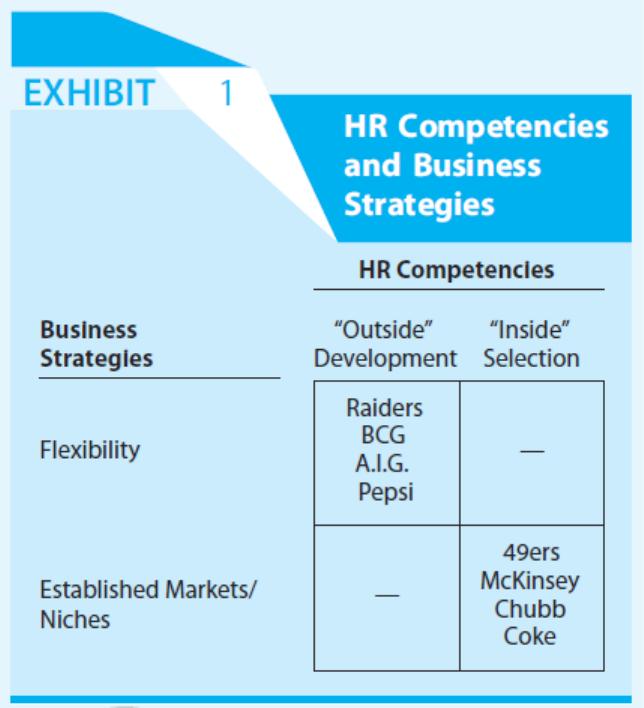
Details in this paired comparisons approach clearly demonstrate the critical relationship
between business strategies and employment practices. Organizations increasingly feel
pressured to be flexible and anticipate change. Organizations employing strategic flexibility in
search of new market opportunities do not always develop employee competencies and skills
from within. Conversely, organizations that compete for dominance in an established market or
niche often employ specific capabilities developed and rewarded internally and through
supportive cultures and operating systems. The fact that employment practices are hard to
change helps explain and support the basic notion that core competencies should drive business
strategies, and not vice versa. New business strategy development supported by existing
management practices and competencies are perhaps easier to develop than new practices and
competencies that support a new strategy. The authors do not suggest that all practices are
equally good, but do suggest that for practices not central to core competencies, a best practices
approach that cuts across firms may emerge. Additionally, some management practices may
dominate others (e.g., lean production). Thus, variety in employment practices can be the
source of distinctiveness and competitive advantage.

Reading 4.2 – Employee Engagement and Commitment
This article explores the critical competitive advantage that an employer can gain from having
engaged employees. Engagement and enhanced commitment result in both higher levels of
productivity and lower levels of employee turnover.
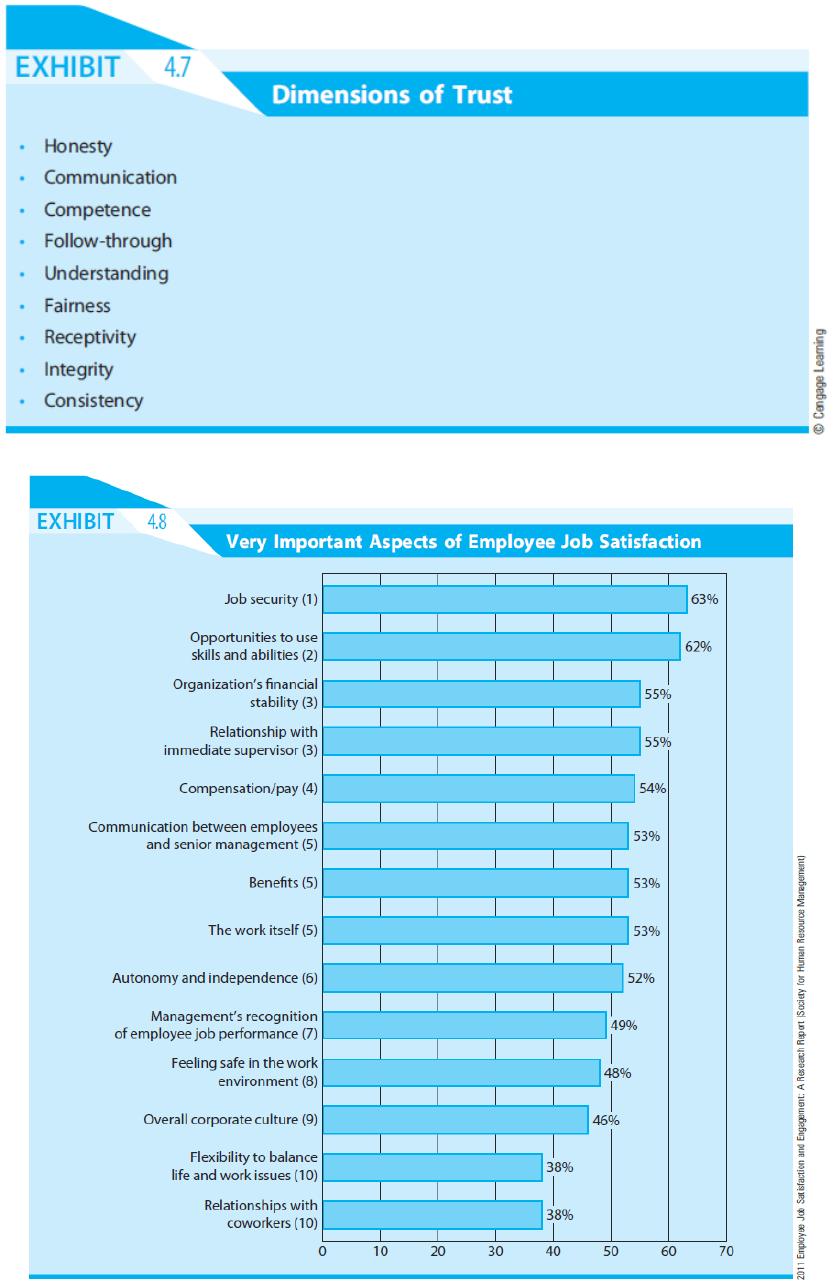
Engagement is defined differently by different organizations but the common themes center
around employee satisfaction with their work, pride in the employer, employee belief in what
they do is important and employee sense of being appreciated by the employer.
Employers usually attempt to measure engagement using the following criteria:
• Pride in employer
• Satisfaction with employer
• Job satisfaction
• Opportunity to perform well at challenging work
• Recognition and positive feedback for one’s contributions
• Personal support from one’s supervisor
• Effort above and beyond the minimum
• Understanding the link between one’s job and the organization’s mission
• Prospects for future growth with one’s employer
• Intention to stay with one’s employer
Engagement can be enhanced by various HR practices related to
Job and task design
Recruiting
Selection
Training and Development
Compensation
Performance Management