CHAPTER 2
SOCIAL RESPONSIBILITY AND HUMAN RESOURCE MANAGEMENT
A. OVERVIEW
This chapter discusses the some of the challenges face by human resource management
in responding to changes in society as well as issues related to ethics and social
responsibility.
Near-constant changes in workforce composition, skills, worker expectations and
work-life relationships require well-conceived and effectively implemented HR
practices and systems that must be continuously reviewed from a strategic point of
view. Pressure from a variety of external constituents and/or the desire to “do the right
thing” greatly influence decisions related to ethics and social responsibility and are
influenced and affected by human resource management.
B. LECTURE OUTLINE
1. OPENING CASE – Safeway
In response to escalating competition, Safeway developed a program designed to
make it an employer of choice. Given that most of its customers were female,
Safeway developed a “Championing Change for Women” program designed to
promote the development of its female employees into managers. The program
provided flexibility relative to its hours, allowing employees to achieve
work/family balance. As part of its program it also developed the Women’s
Road show, in which female executives visited various locations throughout the
country to assist with learning, networking and development.
2. WORKFORCE DEMOGRAPHIC CHANGES AND DIVERSITY
1. Demographic changes in society have greatly impacted the composition
of the workforce. In addition, numerous laws protect diverse groups in
our society from discrimination in employment Most organizations have
developed some kind of diversity management program in response to
one of both of these factors.
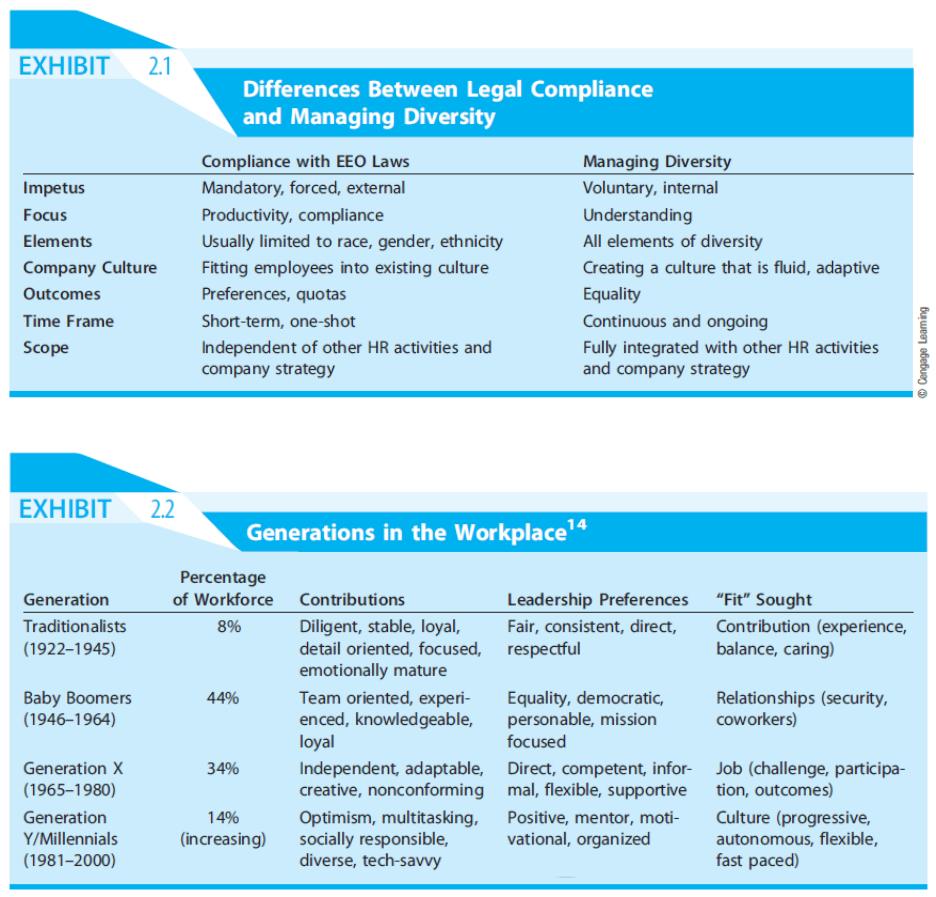
2. Diversity initiatives can be designed to ensure legal compliance or to
truly promote and encourage respect for others and differences. There is
a marked difference between a diversity programs that attempt to address
these motivations, as illustrated in Exhibit 2.1.
3. Diversity is a strategic business issue for an overwhelming majority of
organizations/employers. Pricewaterhouse Coopers has created the
position of Chief Diversity Officer which reports directly to the
Chairman of the Board.
4. Generational diversity is becoming increasingly prevalent as individuals
live and remain in the workplace longer than in previous years. Different
generations need to be able to work alongside each other in contemporary
organizations. Exhibit 2.2 illustrates some of the characteristics of
different generations found in the workplace. Retailer Abercrombie and
Fitch has developed practices which effective allow it to manage
Generation Y employees.
5. Increasing laws and company policies which prohibit discrimination
based on sexual orientation have been implemented. The ongoing
evolution of same-sex marriage has created dilemmas and challenges for
employees.
6. Individuals with disabilities are protected by the Americans With
Disabilities Act yet still suffer from stigmatization and underemployment.
Walgreens has implemented a model program to assist with the
employment of individuals with disabilities.
7. Hasbro, Texas Instruments, Intel and PepsiCo have both developed
innovative approaches for managing diversity in the workplace.
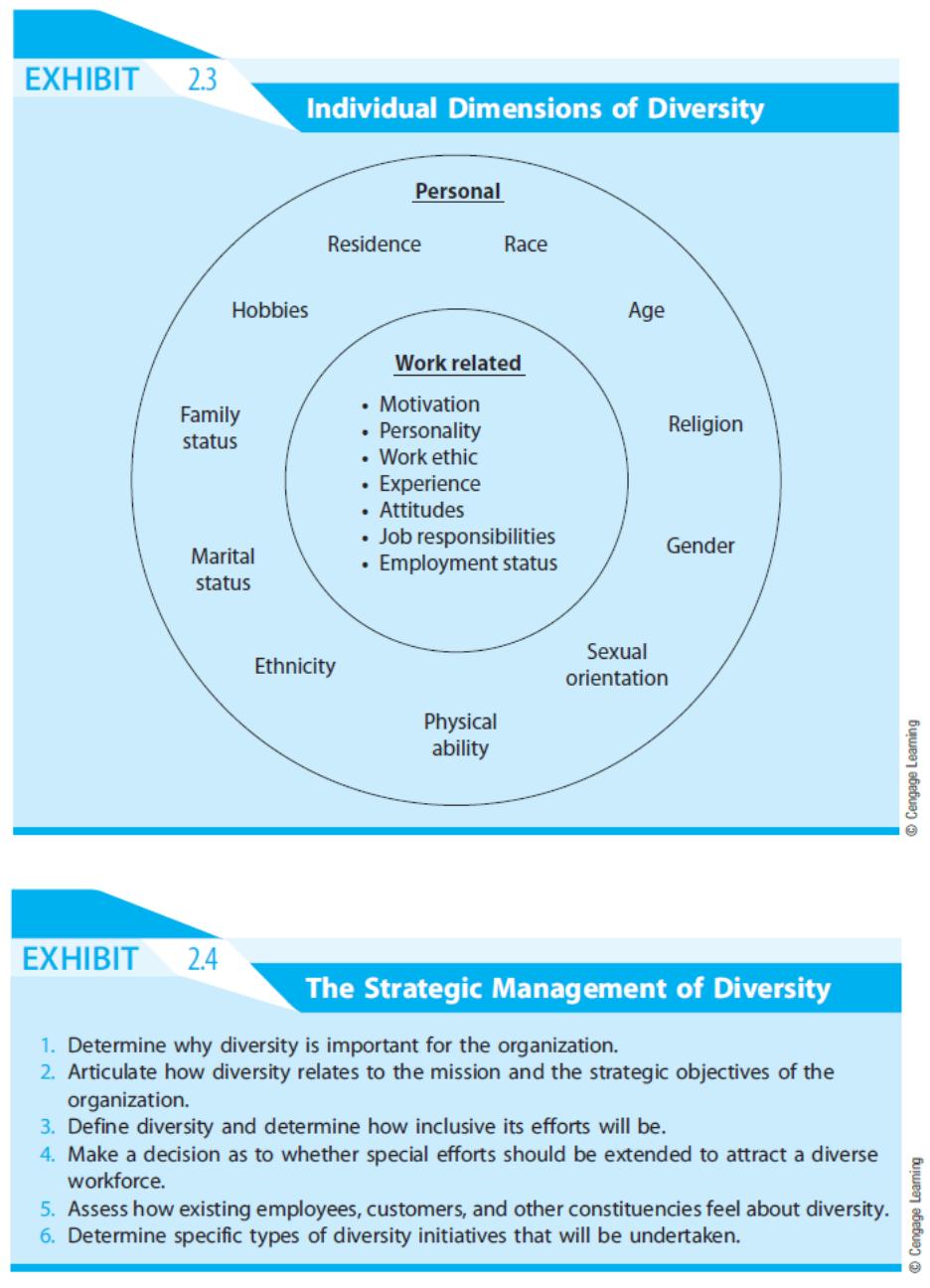
8. Other dimensions of diversity which create challenges for organizations
include the management of professionals, shifting employee loyalty and
personal and family life dynamics.
9. The development and support of affinity groups is one way in which
organizations manage and encourage diversity. Both Frito-Lay and
PepsiCo have successfully embraced this strategy with successful
business results.
3. ETHICAL BEHAVIOR
1. Many employers are now considering ethics and ethical behavior in light
of major bankruptcies, scandals and business meltdowns. However,
ethics are subject to personal values and convictions.
2. Common ethical concerns for HR include off-duty behavior, ownership of
work and non-compete clauses. These latter two issues have been dealt
with at Intel through an intraprenuership program.
3. The Sarbanes-Oxley Act of 2002 provides sweeping measures to control
deception in accounting and management practices by increasing
government oversight of financial reporting, holding senior executives
more responsible that previously and protecting whistle blowers.
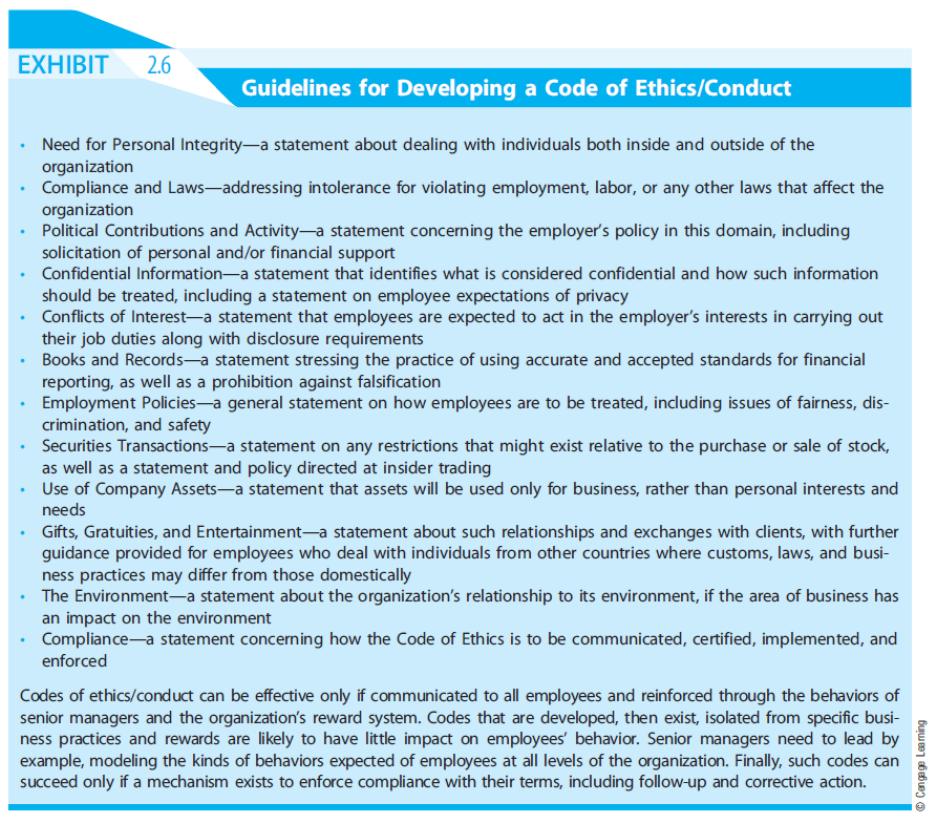
4. Many organizations and some industries have developed their own code
of ethics. The Society of Human Resource Management (SHRM) has
developed such a code for HR professionals, displayed in Exhibit 2.5.
This code presents core principles, intent and guidelines in a number of
areas, including: Professional Responsibility; Professional Development;
Ethical Leadership; Fairness and Justice; Conflicts of Interest; and Use of
Information. Exhibit 2.6 provides some guides for developing a code of
ethics or code of conduct.
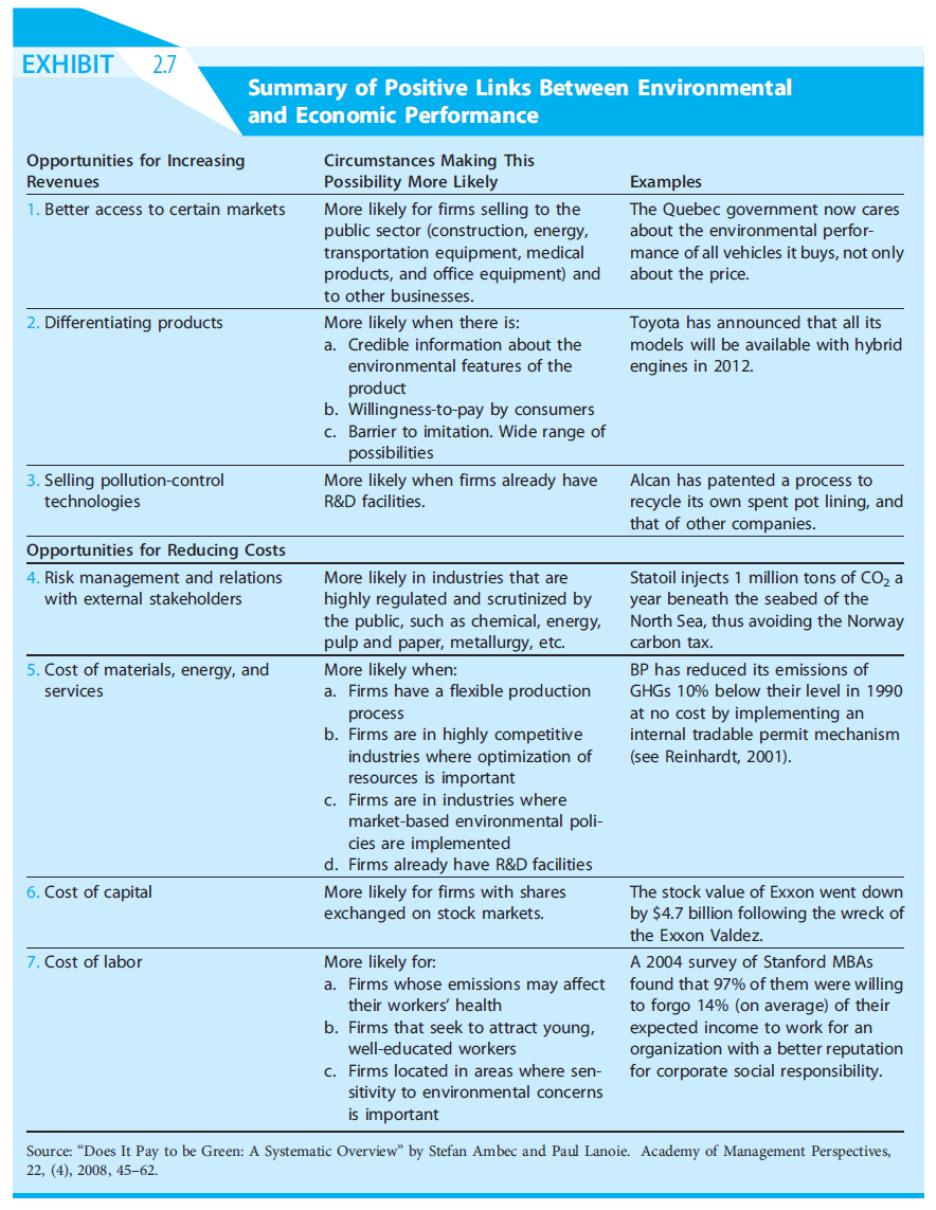
4. Corporate social responsibility in the form of sustainability involves taking a
more macro approach to managing an organization’s relationship with its
external environment. Organizations are being increasingly expected to consider
the effects of their operations, decision and business on the social and natural
environment. Exhibit 2.7 examines some of the proven positive links between
environment and economic performance. General Electric has developed a
model program related to sustainability and Gap has set standards for offshoring
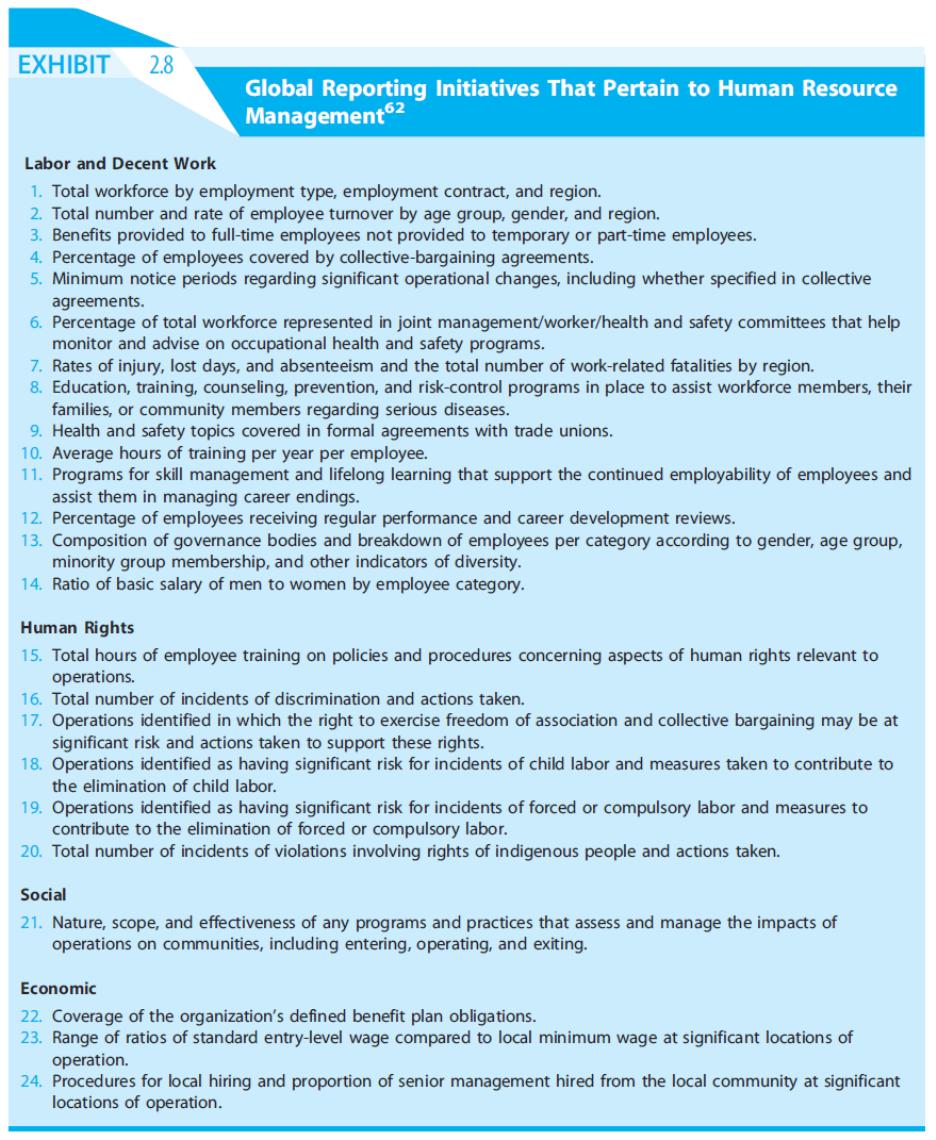
of its manufacturing operations. Exhibit 2.8 provides some HR-related standards
of the Global Reporting Initiative.
5. CONCLUSION
1. Organizations operate in dynamic environments are must evolve and
adapt to changes in society, including changing demographics and
lifestyles and expectations to contribute to, rather than take from, the
larger society.
2. Human resource management strategies can facilitate organizational
responses to society.
READINGS

Reading 2.1 – Stereotype Threat at Work
Stereotype threat is defined as the fear of being judged according to a negative stereotype.
Even if an employer were successful in hiring only non-prejudiced managers, stereotypes still
exist in the broader society and hence, the workplace. Stereotype threat has been documented
across a wide range of diversity dimensions and performance domains. It extends beyond those
in traditionally disadvantaged groups to those who are members of high-status groups.
Stereotype threat affects everyone as every individual is a member of at least one group about
which stereotypes exist.
Stereotype threat is based on the conditions of task difficulty and personal task investment.
Stereotype threat is more likely to influence performance on difficult, challenging tasks which
are at the limits of a person’s abilities. It is also more likely to influence performance when an
individual in more personally involved with a task and hence, cares about performance.
Stereotype threat can be reduced by teaching affected employees behavioral strategies for
improving performance and counteracting negative stereotypes. Stereotype threat can also be
eliminated by refuting or diminishing the stereotype relevance of a given task. Employees can
also re reminded about external factors which might constrain performance such as a difficult
client, limited resources or a tight deadline. Stereotype threat can also be minimized by
presenting a role model who contradicts the stereotype.
Mangers can actually use stereotype threat to create more diversity-friendly work
environments. Stereotypes should be acknowledged and addressed directly and managed by
focusing on a larger context or environment.
Reading 2.2 – The Ethics of Human Resources and Industrial Relations
Human resource managers typically face three kind of ethical problems. The first is the need
for discernment or determining the right thing to do in a given situation. The second is conflict
between what the HR managers feels is right and what the employer asks be done. The third is
conflicts of interest where the HR manager’s personal beliefs differ from the responsibility of
acting as an agent for the employer.
Ethical dilemmas in recruitment can involve special requests for hiring criteria from managers,
setting or recommending entry salary, how extensively to recruit, internal versus external
recruiting, privacy protection due to applicants and follow-up with rejected
applicants/candidates.
Ethical dilemmas in training and development can involve training employees who make take
their skills to a competitor, ensuring employee safety, particularly given an employee’s
language, minimizing abuses of power in mentoring relationships and fully and truthfully
informing employees about their future prospects with the employer.
Ethical dilemmas in compensation can involve compressed compensation systems, ensuring that
employers are not exploited by managers relative to compensated hours of work, comparable

worth, differences in pay between levels of responsibility and equity in pay relative to the
marketplace.
Ethical dilemmas may also be present relative to employee monitoring, progressive discipline
and termination, balancing costs of benefits with employees’ needs and choice and measures
used to retain employees.
Reading 2.3 – How Do Corporations Embed Sustainability Across the
Organization?
Many employees may be unaware of sustainability issues beyond their immediate work
responsibilities. The reading provides four recommendations for organizations as well as eight
specific training and development tools which can facilitate such awareness among employees.
Recommendations
Learning about sustainability is a companywide necessity that should not be restricted
to the discourse of leaders and senior managers
Awareness initiatives need to be cross-functional and spread across the full range of
business functions
Embedding sustainability should include both technical and action learning
opportunities
Learning cycles should include opportunities for social learning and expansion of
company knowledge systems
Most definitions of sustainability draw on the principles of the Brundtland Commission:
“Meeting the needs of the present without compromising the ability of future generations to
meet their own needs.” The three pillars of sustainability include economic, social, and
environmental. Economic sustainability is ensuring that expenditures do not exceed income.
Social sustainability embodies the humanitarian context of business and relates to issues of
poverty and income inequality, public health and health care, education and social aspects of
economic development. Environmental sustainability considers the impact of business on the
quality and quantity of natural resources.
The question remains as to whether their resolution of social and environmental problems is the
responsibility of corporations. Investing in sustainability has potential benefits for the
corporation, as it signals to stakeholders that it is committed to social and environmental goals,
which has been linked to positive corporate performance, competitive advantage, customer
loyalty, enhanced company image and goodwill, legitimacy and improvements in employee
recruitment and retention. However, investing in sustainability can incur costs that
corporations have a fiduciary obligation to evaluate to ensure this expenditure is in line with
shareholders’ interests.
Training and Development Tools
Codes of Conduct – specify minimum acceptable standards in corporate processes and
procedures
Impact Measures – social and environmental accounting tools and environmental impact
measures calculate social and environmental impact
Company Structure and Policies – clear delineation of whom, where, and how responsibility
will be managed and how sustainability will be integrated into corporate governance structures
Purchasing and Supply Chain Initiatives – dialogue with suppliers on the importance of
sustainability in the supply chain with targets and performance indicators set for affirmative
action and procurement practices that proactively support social and environmental stewardship
Communications and Dialogue – corporate publications and social media can be used to
communicate the importance of sustainability as well as the organization’s position and
practices on such to both internal and external stakeholders
Employee Training and Workshops – deliver technical information as well as company
expectations about sustainability to employees
Company Visits – learn from other organizations that have successfully implemented
sustainability initiatives
Employee Volunteering Opportunities – opportunities to enable employees to contribute their
knowledge and skills to social and environmental projects and learn first-hand about their
impact