
CHAPTER 14
GLOBAL HUMAN RESOURCE MANAGEMENT
A. OVERVIEW
This chapter outlines the intricacies and problems associated with international human
resource management activities. Multiple stages of the expatriate experience must be
successfully managed. This is especially true in the repatriation stage, when workers may
return to personal and work environments that may be very different politically and
culturally than the ones they left. Specific assignments may not be available upon return,
and expatriates may be viewed as, or feel like, outsiders in their own organization.
Strategic HR practices and processes can smooth these international issues.
B. LECTURE OUTLINE
I. OPENING CASE – REEBOK
In 1998, Nike was hit with negative publicity concerning conditions at many of its
overseas factories. Reebok, one of Nike’s main competitors, acted quickly to point out its
strong record of support for human rights and few problems for Reebok or its
sub-contractors. Reebok contracted with a respected nonprofit social research group in
Jakarta, Indonesia to audit two of its shoe factories with over 10,000 workers. These
audits marked the first time a U.S. company allowed truly independent outsiders with
expertise in labor issues to inspect their factories and make the findings public. Some
problems were identified, but some solutions were difficult as they involved introducing
industrialized-world solutions on an industrializing-world and cultural environments.
Liz Claiborne and Mattel soon followed the lead of Reebok in having outside evaluation
of their international operations.
II. INTRODUCTION
HR is critical to success of international operations See Strategic Global HR at
McDonald’s example. Organizational strategy might focus on expanding
internationally for a number of reasons, including:
1. Enhanced market opportunities.
2. Expanded scope and volume of operations to
support international initiatives, resulting in economies of scale.
3. Competitive pressures to keep pace with
industry leaders
4. Acquisition activity that results in ownership
of foreign-based operations.
III. HOW GLOBAL HRM DIFFERS FROM DOMESTIC HRM
International HR presents some unique contingencies for organizations, including:
1. More resources required to address a broader range of functional
areas.
2. More involvement in the employee’s personal life.
3. Several different HR management systems are often required for
different geographic locations.
4. More complex external constituencies, including foreign
governments, political and religious groups.
5. Heightened exposure to risk.
IV. ASSESSING CULTURE
A. Lack of appreciation for or understanding of cultures can cause huge
problems in international HR.
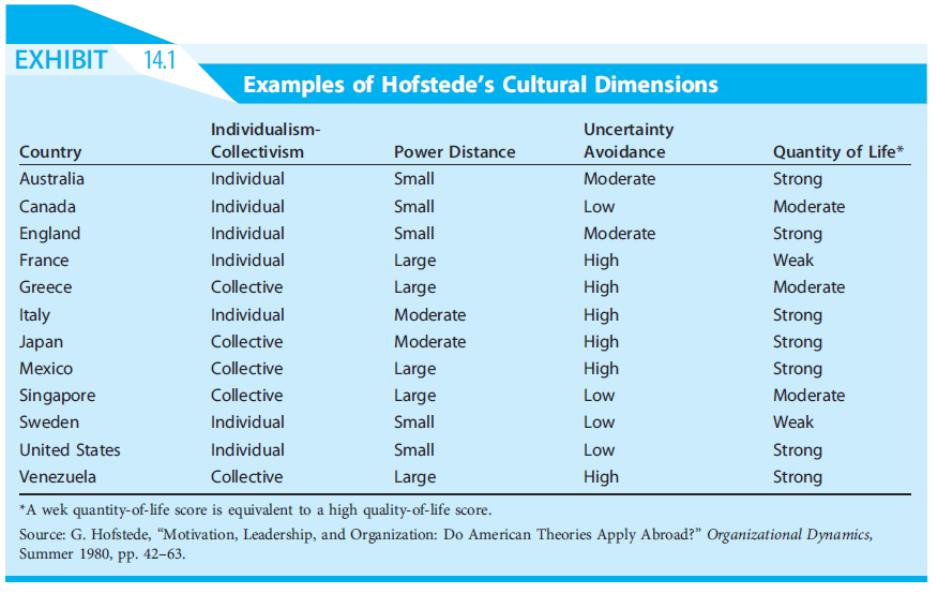
B. Hofstede explained cultural differences along four dimensions (Exhibit
14.1)
1. Individualism versus collectivism
2. Power distance
3. Uncertainty avoidance
4. Masculine versus feminine tendencies / quantity of life
C. Hall characterizes culture by communication patterns, and
identifies five silent “languages”, including: time; space; material goods;
friendships; and agreement.
D. When cultures come together in organizational settings,
special consideration must be paid to managing processes such as power
dynamics and relationships; norms of participation and decision making;
and performance management and compensation systems.
V. STRATEGIC HR ISSUES IN GLOBAL ASSIGNMENTS
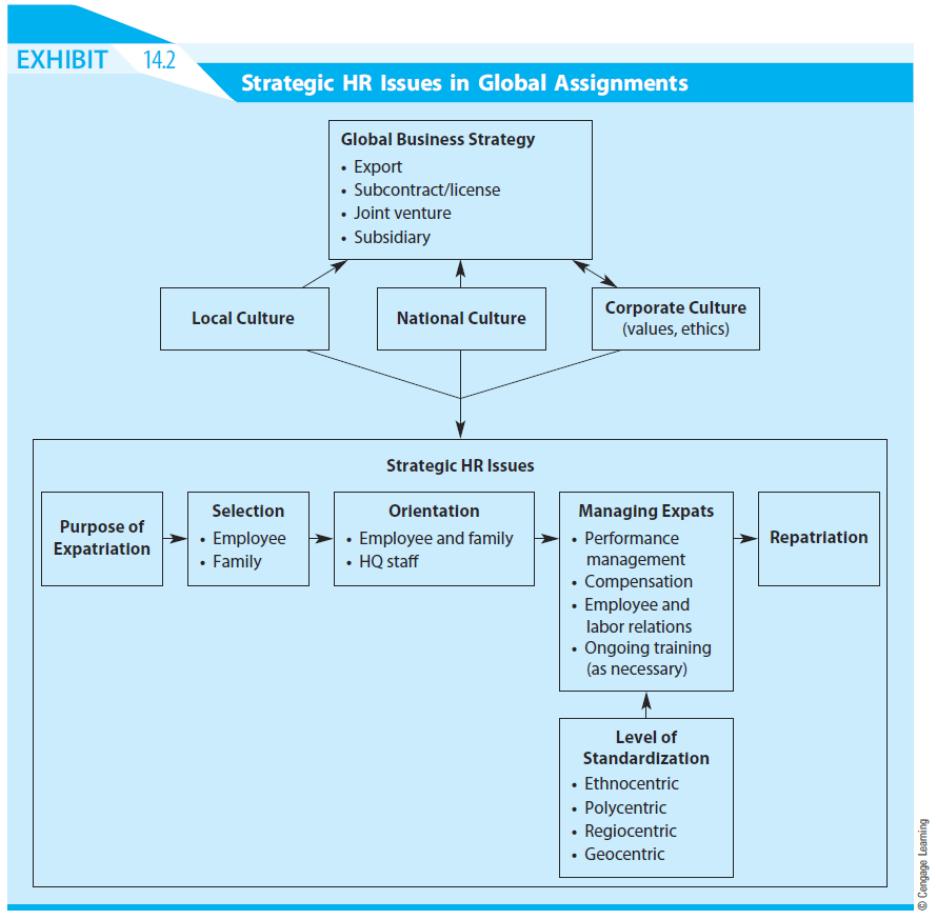
A. See EXHIBIT 14.2: STRATEGIC HR ISSUES IN GLOBAL
ASSIGNMENTS. Organizations can utilize several different approaches
to manage the process of sending workers abroad.
1. Administrative approach – involves merely assists employees with
paperwork and minor logistics.
2. Tactical approach – involves managing the “risk or failure factor”.
3. Strategic approach – involves much more support and
co-ordination; adding extensive selection systems; ongoing,
integrated training; a specific performance management system;
destination services; and a strategized repatriation program.
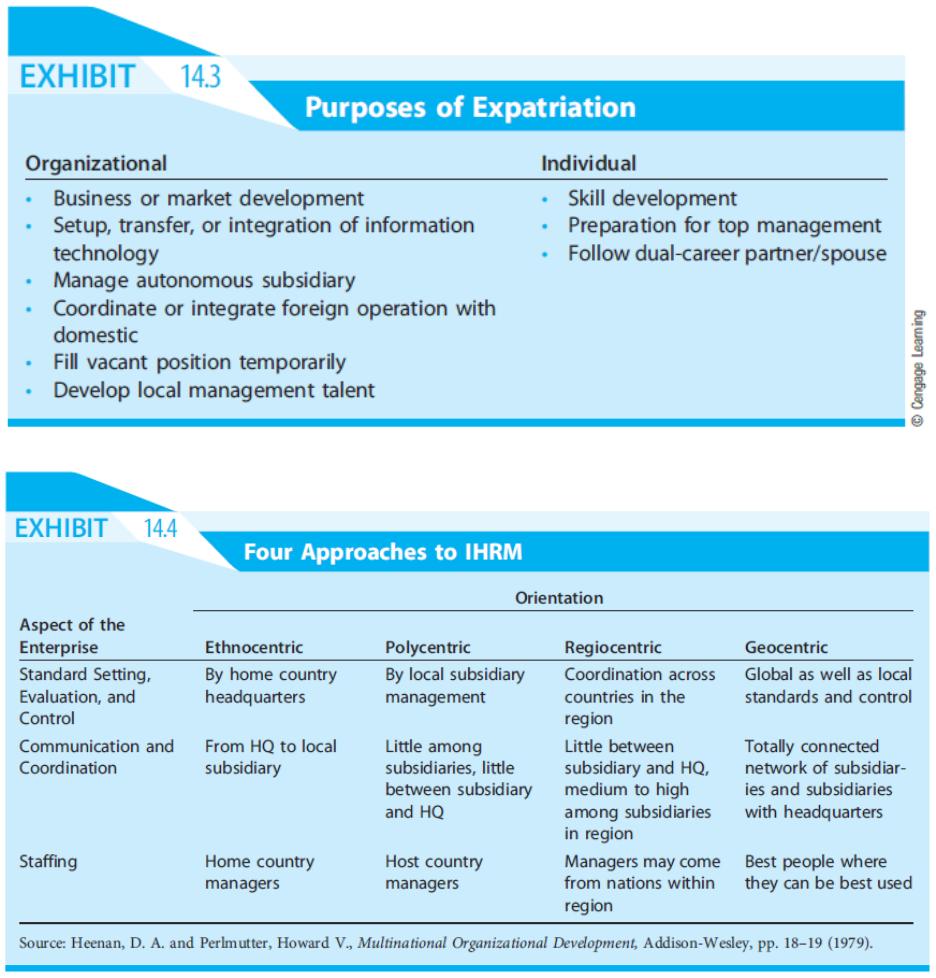
B. It is critical that organizations have a clear sense of reasons for an
expatriate assignment, as indicated in Exhibit 14.3. Screening for the
overseas assignment needs to consider cultural adaptability and should
also involve any accompanying family members. See Expatriate Selection
at Kellogg Co. example.
C. Expatriate compensation can be determined through three different
approaches; balance sheet method, higher-of-home-or-host and
localization.
D. Four different approaches can be utilized for global HR; ethnocentric,
polycentric, regiocentric and geocentric, as outlined in Exhibit 14.4.
VI. REPATRIATION
A. Repatriation of returning employees is probably the most neglected
function in international HR, yet it is the one that has the greatest impact
on the return on investment made in employees sent abroad. Retention
rates in the first year back can be as low as 50%. Organizations that fail to
develop career management programs that allow those returning from
abroad to share their knowledge and insight (rather than leave the
organization and potentially share that knowledge with competitors) have
a negative return on investment.
B. Many returning expatriates find that: there is no job assignment waiting
for them; they receive a job that they consider to be a demotion; or their
new position strips them of autonomy enjoyed abroad.
C. Critical career and personal issues must be addressed. See EXHIBIT 14.5:
ISSUES TO BE ADDRESSED IN A REPATRIATION PROCESS. See
Repatriation at Colgate-Palmolive example.
VII. THE EUROPEAN UNION
A. The European Union (EU) has a large number of umbrella
employment laws that provide far more worker protection than afforded in
the U.S.
B. Employment at will is generally followed in the U.S., but it
is generally not allowed in the EU, where it is difficult and expensive to
terminate workers. EU workers have more generous vacation, maternity,
retirement and other benefits than U.S. workers.
C. Work councils must approve many management actions in
several EU countries.
VIII. MEXICO AND CANADA
A. Even though Mexico and Canada are border countries, HR is carried out
very differently in each country. Much employment discrimination which
would be illegal in the United States is standard practice in Mexico.
Enforcement of existing laws is also very lax.
B. Canada, on the other hand, is known to vigorously enforce laws which
prohibit discrimination in employment. Workers in Canada also receive
far more protection that their counterparts in the United States.
IX. CHINA
A. Tremendous growth opportunities in the free market economy in China are
being capitalized on by western organizations with significant HR
challenges. Many university graduates are not suitable for employment in
global organizations due to deficiencies in language, interpersonal skills,
ability to work in teams and basic literacy.
B. Those who are capable of working effectively in a multinational can
command very high salaries. Retention of such workers can be a
challenge, given the high demand for them. Supervisory relations,
employer prestige, development opportunities, compensation and job title
are key factors which impact retention.
X. INDIA
A. India bears some resemblance to China given the size of its population and
growing economy. However there are stark differences between China
and India
B. India has a significant population of citizens who are well-equipped to
work in multinationals. India’s technically trained workforce is highly
sought after yet demand exceeds supply, making retention a challenge.
See Retention at Prudential Process Management Services example.
C. India has an extremely complicated legal system which involves more
than 100 different noncodified and ambiguous laws related to
employment. Termination of employees is difficult and many employee
benefits are legally required.
XI. CONCLUSION
While the principles and processes of strategic HR are universally applied to all
organizational settings and cultures, an organization whose strategy involves
international operations faces additional challenges. In order to assure greater
success in international markets, human assets must be viewed as investments,
and need to be managed more systematically and strategically than what has
traditionally been done.

READINGS
Reading 14.1: In the Eye of the Beholder: Cross Cultural Lessons in Leadership
from Project GLOBE
The article is based on a project which attempted to conceptualize worldwide differences in
leadership by examining a hypothetical situation of an American executive in charge of teams in
Brazil, France, Egypt and China.
Combining the work of Hofstede, Trompenaars and Kluckholm and Strodtback nine cultural
differences were identified
Performance orientation
Assertiveness
Future Orientation
Humane Orientation
Institutional Collectivism
In-group Collectivism
Gender Egalitarianism
Power Distance
Uncertainty Avoidance
Successful global leaders were found to be
Charismatic/value-based (able to inspire and motivate others based on firmly held core beliefs)
Team-oriented (able to build teams and implement common purpose among team members)
Participative (involve others in making and implementing decisions)
Humane-oriented (supportive, considerate, compassionate and generous)
Autonomous (independent and individualistic)
Self-protective (ensure safety and security)
When in Brazil

spend time meeting key executives
spend time with the team both at work and in informal settings
remember Brazils is low on performance orientation and future orientation and high on power
distance
rewards should be based on both individual and team performance with team emphasized
When in France
keep the personal outside of business
maintain high power distance
low human orientation may result in being non-supportive
low levels of future and performance orientation imply little interest in grand visions
strategy and action plans need to be simple and well-planned
When In Egypt
managers should act distinct from the team and present an image of omnipotence
managers need to be seen as deserving of leadership role and status
very strong in-group/out-group collectivism with in-group maintenance paramount in decision
making
group harmony important and team leader should be paternal, autocratic yet benign
high humane orientation invites family issues into workplace for boss’ assistance
team expects to provide input but decision to be made by leader
employees expect leaders to develop and communicate grand and ambitious strategies
When in China
high performance orientation, high institutional orientation and high in-group collectivism
personal relationships and networking are foundation on which business is conducted and
ultimate test of effectiveness and success
Confucian ideas stress relationships and community; word “self” has negative connotation
workers respond to exciting visions
Reading 14.2 – Cross-Cultural Management and Organizational Behavior in
Africa
Africa is the most heterogeneous of the seven continents; linguistically, culturally, and ethnically.
Hence, doing business in Africa can be a complex and sensitive issue and Western managers
need to be sensitive and adapt to the principles which guide African management.
Modern African Management Principles
Collective Solidarity: Employee teams work most effectively, achieving cohesiveness and
solidarity, by working toward a common purpose
Group Significance (Ubuntu): Ubuntu means that humanity is a shared value in which
personhood exists within a group context, only insofar as a person values others.
Harmony and Social Cohesion: Emphasis is placed on maintaining peace and keeping
conflict to a minimum by promoting internal, communal, and familial harmony
Consensus: Emphasis is placed on collective decision making.

Consultation: Group participation is strongly emphasized, as are mutual understanding,
joint problem solving, and honoring the collective wisdom of all team members.
Local Time (or “African” Time): In Africa, time standards are ambiguous, and thus
require flexibility on the part of non-African managers.
Paternal/Maternal Leadership: African firms are often structured like African families
and, therefore, organizational leaders (managers, supervisors, and owners) tend to behave
with paternal (or maternal) responsibility toward their staff members
Age and Authority: Advanced age is inherently equated with authority, business wisdom,
rank, title, and experience. Thus, an older person automatically holds a certain level of
superiority, regardless of rank, title, or education.
Dimensions of African Culture related to Workplace Behavior
Collectivism (vs. American Individualism)
Performance Feedback – discussing an employee’s performance, weaknesses, shortcomings, or
abilities openly with the employee is likely to cause embarrassment and clash head-on with the
society’s harmony norm. Team members may go so far as to protect the nonperformer, when
necessary, by sharing or dividing his or her responsibilities among themselves
High Power Distance – people of lower status show much higher deference toward those of
authority or senior status than is typical in the West. Since age and experience are esteemed, it is
often considered inappropriate to question or challenge a teacher, supervisor, or any member of
the professional elite.
Consensus-Driven Decision Making – consensus is crucial in decision making which can result
in a long process to reach decisions that satisfy everyone.
Harmony – in African culture, saving face is highly valued with direct and frank communication
not the norm and a discomfort with blunt statements. It is critical to maintain harmony at almost
any cost in interpersonal relationships
Dissent May Imply Disrespect – a show of dissent can be interpreted as a show of disrespect
and the hierarchical nature of business culture tends to discourage subordinates from openly
disagreeing, challenging the status quo, speaking one’s mind, criticizing ideas, giving feedback,
and reporting problems. To avoid disturbing harmony, Africans will often give a positive answer
and be reluctant to refuse a request.
Quality Orientation – Africans are more focused on a subjective, quality-oriented approach to
problems, which cannot be measured and is usually based on personal experience. Quantities
and objective interpretation of figures is eschewed in favor of perceptions
Importance of Family Ties – hiring relatives, rather than hiring based on merit and experience,
is the common practice. Beyond family, nepotism transcends blood ties to encompass loyal
friends and important allies, such as members of other large family firms.
Negotiations and Concessions – ultimate decision makers are usually not directly involved with
negotiations and only brought into the process to make last-minute concessions or demands.
Relationships Precede Profits – In contrast to the United States, business in Africa is about
friends and colleagues first, not deals or profits. Personal relations take precedence in business.