
CHAPTER 13
EMPLOYEE SEPARATION AND RETENTION MANAGEMENT
A. OVERVIEW
This chapter summarizes issues related to employee separation. Reductions in force are
common during organizational restructuring, and must be managed properly within the
scope of the Workers Readjustment and Training Act of 1989, which regulates force
reduction for many organizations. Both voluntary and involuntary turnover can be quite
expensive, and often results in lost organizational assets associated with employee
knowledge, skills and abilities. Mandatory retirement is generally forbidden in the U.S.,
except in certain circumstances associated with safety, etc. In sum, employee separation
is a process that must be managed effectively from the strategic point of view, as
employees are investments and assets of the organization and must be treated as such.
B. LECTURE OUTLINE
I. OPENING CASE – KRAFT
Kraft Foods has developed a retention program to reduce turnover (previously at 20%
annually) and keep highly sought after information technology (IT) employees.
Internships with rigorous performance outcomes are often used as recruitment tools, with
a 70% acceptance rate for interns offered employment. Retention of IT employees has
been successful at Kraft for a number of reasons, including: technical or managerial
tracks are present for career development; IT workers spend 10 days per year purely on
career development; IT Leadership Program matches junior and senior IT workers; a
sense of family found at work; Kraft responds to the needs of younger workers by
providing flexible hours, telecommuting, part-time options; casual dress code, on-site
health club, etc.
II. INTRODUCTION
Organizations today must be flexible and responsive to their environments in
order to appropriately respond to employee separation and retention issues. An
effective HR strategy involves managing the process by which employees leave
the organization.
III. REDUCTIONS IN FORCE
A. Workers Readjustment and Training Act (WARN) of 1989 requires
employers with 100+ employees to provide employees involved in a
reduction of force effort a minimum 60 days notice of facility closing or
large scale layoffs of 50+ workers.
1. Does not apply to federal, state or local government agencies;
faltering companies; unforeseeable circumstances; natural
disasters; and temporary facilities when workers have been
properly informed.
B. Organizations reduce their workforce for three main reasons, including:
inefficiency; lack of adaptability to the marketplace; weakened
competitive position. Layoffs can sometimes be avoided through proper

planning to ensure supply and demand are equated, thus reducing
severance costs. Related issues include:
1. Regularly staffing at less than 100%, then utilizing temporary
workers or paying overtime eliminates short term swings. See
Layoffs at Kodak example.
2. Retained workers must be managed effectively, as morale and
loyalty may drop, even among retained workers who may feel less
secure.
3. Hiring freezes, attrition and early retirements are useful here.
4. Tying a greater portion of compensation to performance is popular.
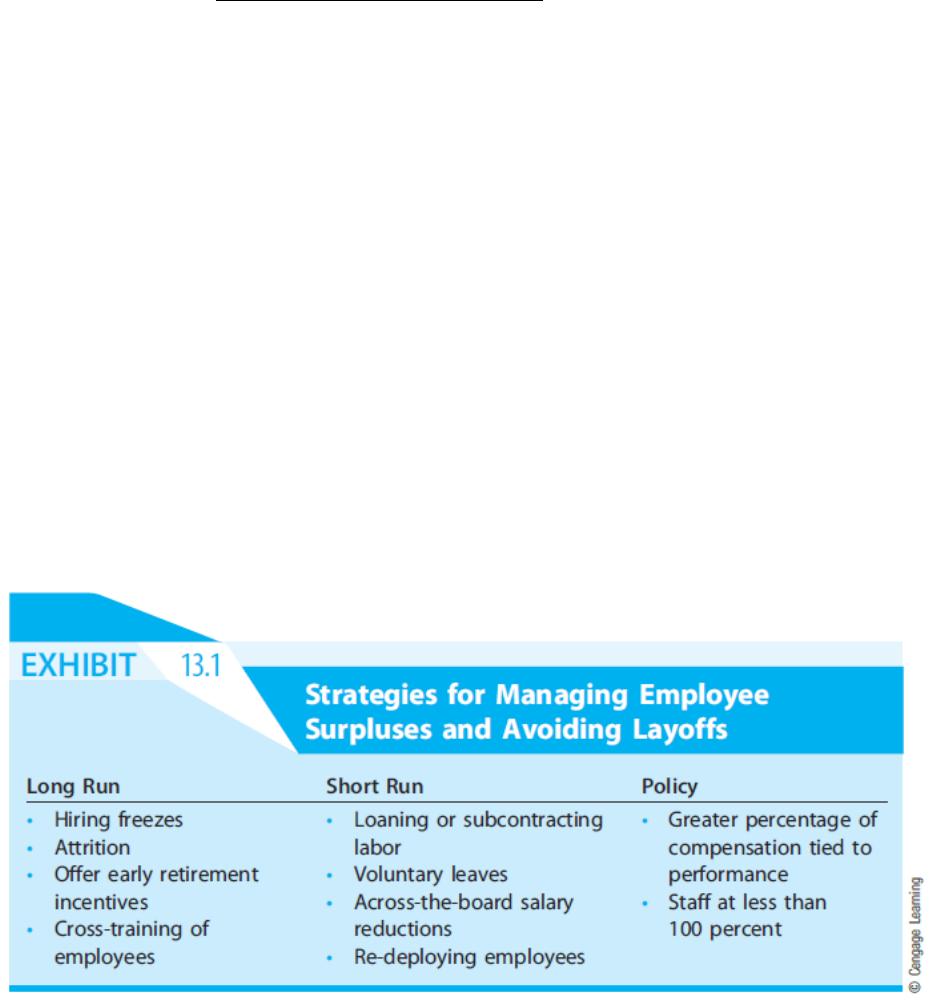
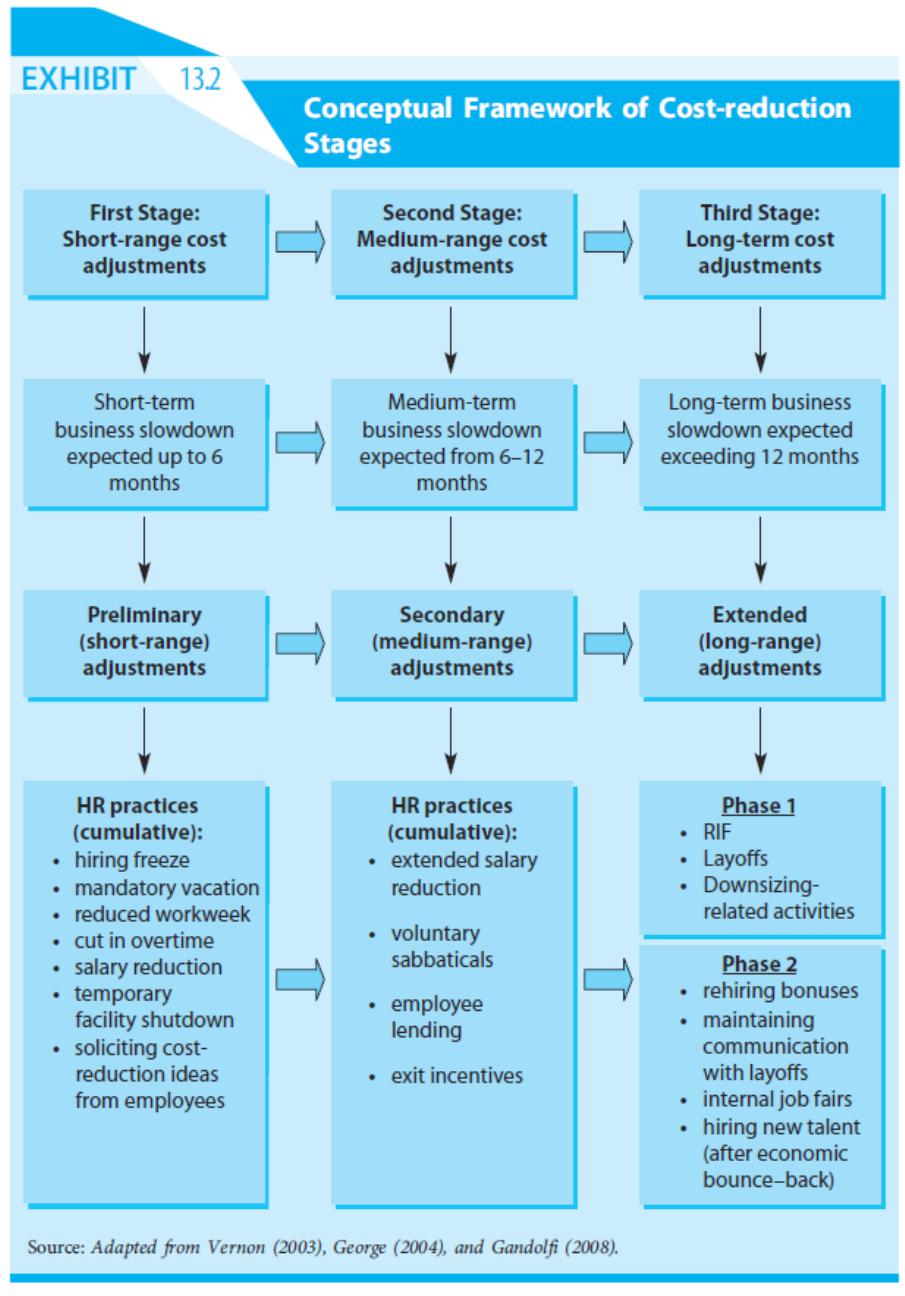
C. Exhibit 13.1 presents a variety of strategies for management
employee surpluses and avoiding layoffs. See Strategic Downsizing at
Charles Schwab example. Exhibit 13.2 presents a framework of strategic
cost-reduction strategies designed to minimize, defer or avoid layoffs or
reductions-in-force.
IV. TURNOVER
A. Voluntary turnover rates have been found to average 21% annually for
employers with 1,000 employees and over 26% for employers with 5,000
employees.
B. Turnover costs can be astronomical: Merck and Co. reports turnover costs
of 150-200% of annual salary; Sears reports turnover costs of 17% of
operating income.
C. Turnover can be beneficial as it allows organizations to: hire employees
with more current training; lower the average worker tenure and payroll
costs; permit promotion of high performers; and improve morale with the
separation of poor performers.
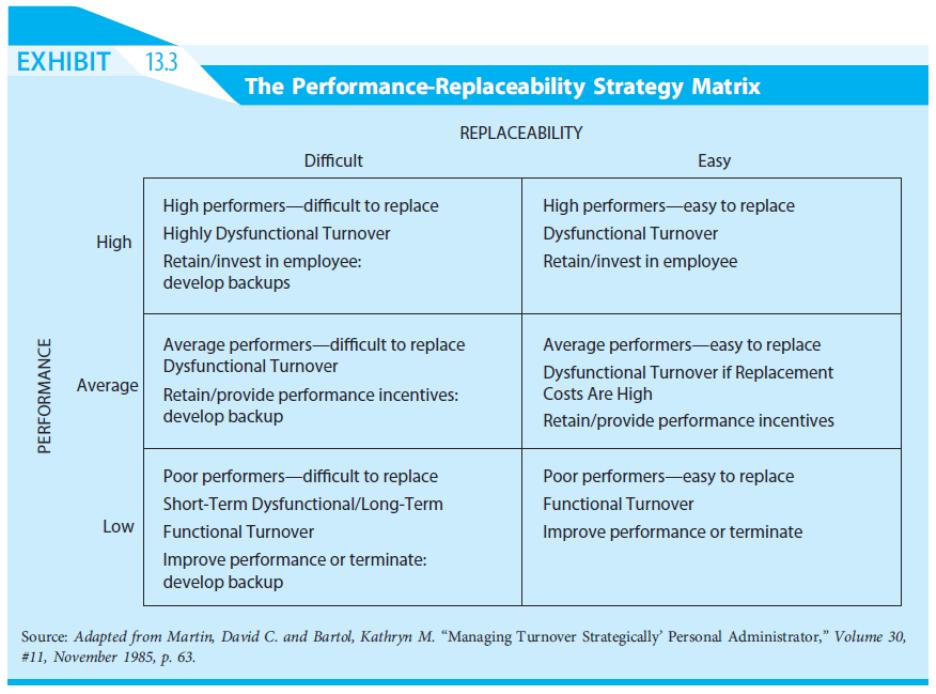
D. EXHIBIT 13.3: THE PERFORMANCE-REPLACEABILITY
STRATEGY MATRIX presents a framework for classifying individual
employee turnover based on individual performance level and difficulty
associated with replacing the individual.
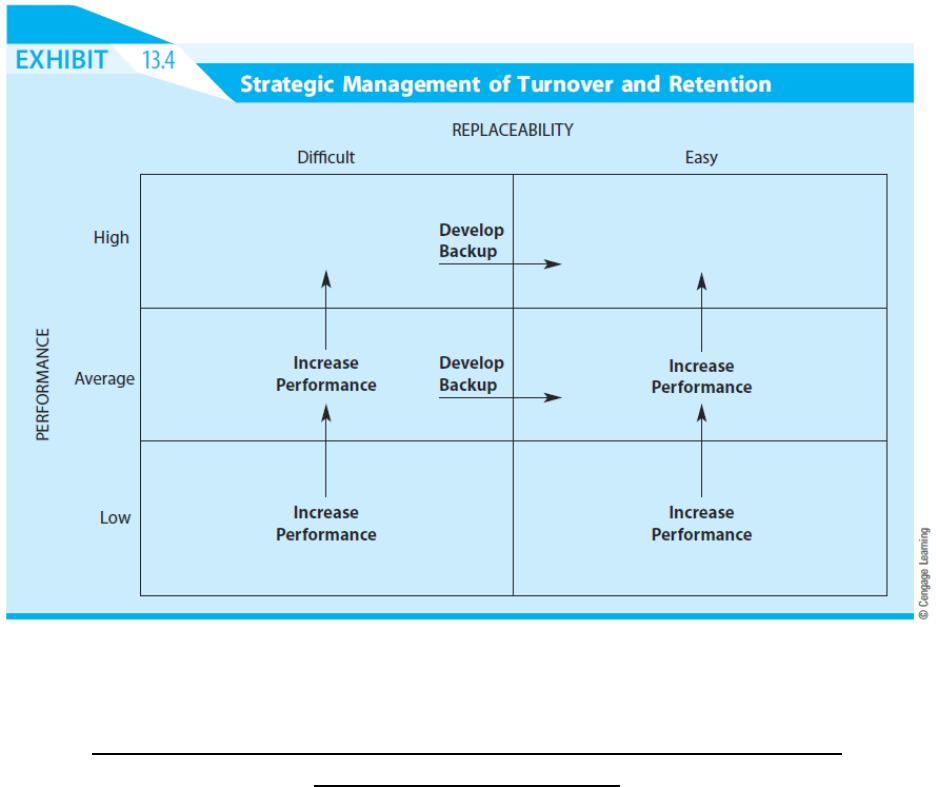
E. EXHIBIT 13.4: STRATEGIC MANAGEMENT OF TURNOVER AND
RETENTION presents strategies for strategically managing the different
types of turnover.
F. See Managing Retention at Sprint PCS example; Strategic Retention at
United Airlines and Retaining Talent at Intel examples.
V. RETIREMENT
A. Age Discrimination in Employment Act of 1967 prohibits mandatory
retirement, except for certain circumstances that involve safety, etc.
B. Older workers today are healthier for longer periods, and may wish to stay
employed. However, older workers can resist change; be difficult to
motivate; have lower productivity. Older workers often hold senior
positions, so their retirement can open positions for promotion.
C. Working through retirement years is expected by 80% of baby boomers,
with 7% of workers now over 65 years old.
D. Phased retirements and incentives to retire are strategic options that can be
beneficial to both employees and employers.
VI. ALUMNI RELATIONS
Increasing numbers of employers are maintaining good relationships and
communicating with former employees. Such alumni are potential customers and
referral sources for both new business and new employees. The proliferation of
online professional alumni networks has aided this process. See Alumni Relations
at Ernst & Young example.
VII. CONCLUSION
Employee separations must be strategically managed, and not handled in a
piecemeal way. Effective retirement and separation management can help an
organization maintain a competitive advantage, as well as the means of retaining
knowledge, expertise, experience, loyalty and positive role models while
permitting infusion of new ideas and energy. Employee separation involves
relinquishing potentially valuable organizational assets, thus separation entails
valuing human assets from the investment perspective, including disposal costs.
Management of the separation process is critical to strategic management of
organizational assets.
READINGS
Reading 13.1 – Retaining Talent: Replacing Misconceptions with
Evidence-Based Strategies
This reading addresses a number of misconceptions about employee turnover by refuting these
points with evidence-based data and recommendations for his best to manage employee turnover.
Table 1 presents five common misconceptions about turnover with the evidence that challenges
these claims
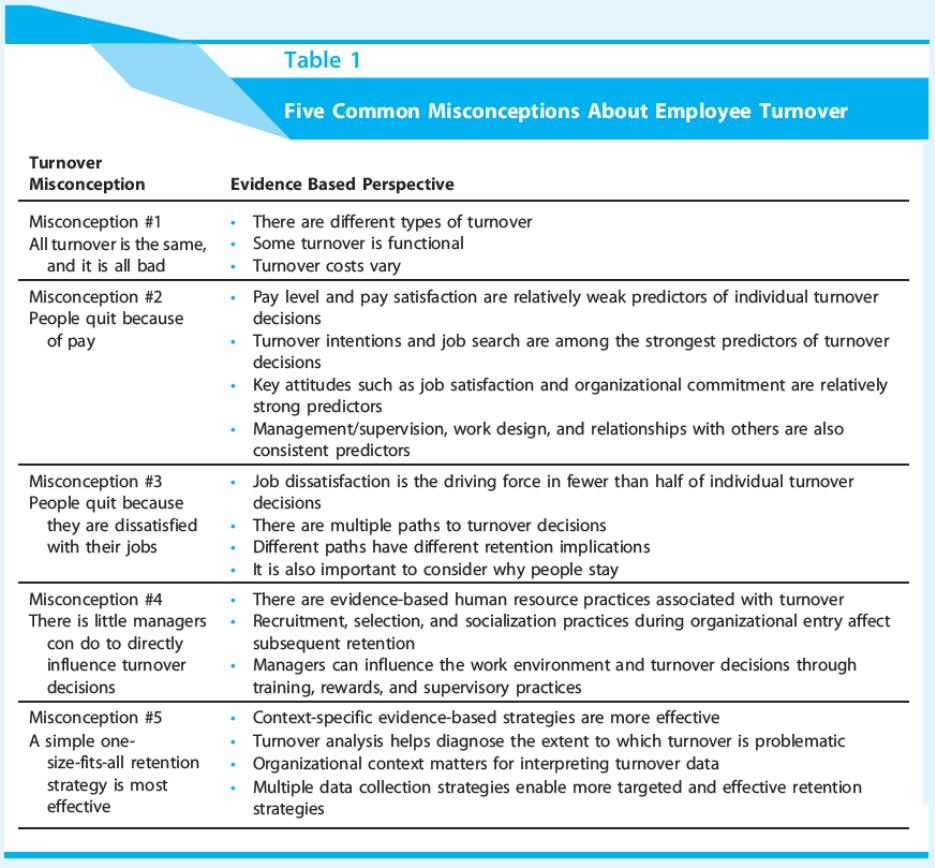
Figure 1 presents a conceptual model to apply evidence-based guidelines to turnover and
retention management.
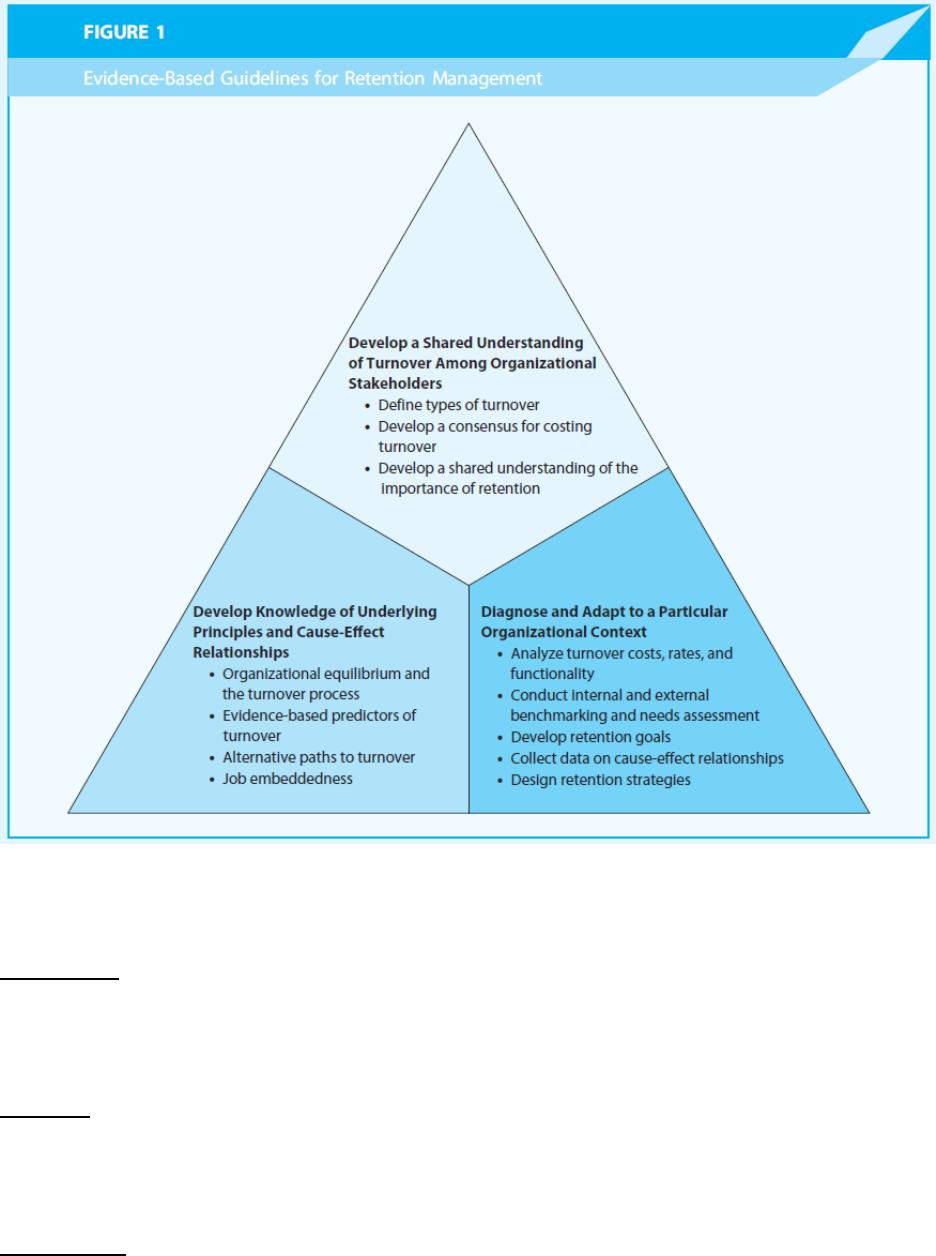
Table 3 presents a variety of HR strategies that can used to better management turnover,
specifically reducing detrimental voluntary turnover. These strategies are presented below.
Recruitment
• Providing a realistic job preview (RJP) during recruitment improves retention.
• Employees hired through employee referrals tend to have better retention than those hired
through other recruitment sources.
Selection
• Biodata (biographical data) and weighted application blanks (WAB) can be used during the
selection process to predict who is most likely to quit.
• Assessing fit with the organization and job during selection improves subsequent retention.
Socialization
• Involve experienced organization insiders as role models, mentors, or trainers.

• Provide new hires with positive feedback as they adapt.
• Structure orientation activities so that groups of new hires experience them together.
• Provide clear information about the stages of the socialization process.
Training and Development
• Offering training and development opportunities generally decreases the desire to leave; this
may be particularly critical in certain jobs that require constant skills updating.
• Organizations concerned about losing employees by making them more marketable should
consider job-specific training and linking developmental opportunities to tenure.
Compensations and Rewards
• Lead the market for some types of rewards and some positions in ways that fit with business
and HR strategy.
• Tailor rewards to individual needs and preferences.
• Promote justice and fairness in pay and reward decisions.
• Explicitly link rewards to retention.
Supervision
• Train supervisors and managers how to lead, how to develop effective relationships with
subordinates, and other retention management skills.
• Evaluate supervisors and managers on retention.
• Identify and remove abusive supervisors.
Engagement
• Design jobs to increase meaningfulness, autonomy, variety, and coworker support.
• Hire internally where strategically and practically feasible.
• Provide orientation that communicates how jobs contribute to the organizational mission and
helps new hires establish relationships.
• Offer ongoing skills development.
• Consider competency-based and pay-for-performance systems.
• Provide challenging goals.
• Provide positive feedback and recognition of all types of contributions
Reading 13.2 – Knowledge Management Among the Older Workforce
This article argues that organizations need to have a well-planned strategic means of transferring
knowledge from retiring baby boomers to members of younger generations. It dismisses the
assumptions that senior workers were problematic for organizations, citing research which show
that senior workers
• have low turnover rates
• are flexible and open to change
• possess up-to-date skills
• are interested in learning new tasks
• have low absentee rates
• have few on-the-job accidents
Senior workers also contribute responsibility and maturity, commitment to their work,
experience and loyalty. Senior workers should 1) be encouraged to remain in the workforce as
their positive contributions continue and 2) work more closely with younger workers to facilitate
knowledge transfer.
Five critical success factors relate to knowledge transfer
1. Coaching leadership style
2. Structure, roles, and responsibilities
3. Emphasis on learning and education
4. Attention to motivation, trust, reward and recognition
5. Establishing the right culture