
CHAPTER 12
LABOR RELATIONS
A. OVERVIEW
This chapter outlines the current state of labor relations, especially from the
union-management perspective. Union certification and decertification processes are
discussed in detail. Globalization, new technology, and changes in the nature of work
have all led to substantial declines in union activity and representation in the U.S. over
the last several decades. This pattern is expected to continue. The importance of
developing a modern model to advance the union-management relationship is presented,
along with desirable characteristics unions must possess in order to thrive – or even
survive.
B. LECTURE OUTLINE
I. OPENING CASE – NEW YORK METROPOLITAN TRANSIT AUTHORITY
In December 2005 the 34,000 worker MTA of New York City went on strike, crippling
the city, particularly its lower income residents. Broken-down negotiations over a new
contract due to retirement/pension contributions and wage increases resulted in a 60 hour
strike which affected public and private schools, public safety and retail shopping during
the week before Christmas. The strike was illegal under New York state law and resulted
in fine and a jail sentence for the president of the local union.
II. INTRODUCTION
The nature of the employee-employer relationship can have substantial impact on
morale, motivation and productivity. The relationship with unionized workers is
more formal due to a contract, as well as special provisions of the National Labor
Relations Act. Managers may not form or join unions.
Union membership in the U.S. has steadily declined over the last few decades.
30% of the private workforce was unionized in 1970, but only 13.9% were in
1999. This percentage decreased to 11.3% by 2013. Government employees are
five times more likely to be union members than were private sector employees
(36% versus 6.6%). Declines in union membership can be attributed to:
1. Workers becoming disenfranchised with their unions.
2. Movement of manufacturing and assembly jobs to outside the U.S.
3. Changes in the nature of work and technology that have eliminated
many traditional manual labor jobs.
4. Unions have often refused to be flexible enough to allow
organizational growth and adaptation to changing industries
and environments.
Understanding organized labor relations can be helpful because 1) union activity
is the norm is some industries; 2) settlements of unionized competitors may

impact your practices and policies; and 3) workers still have the right to unionize
if they want to. Organized labor presents several key challenges for management,
including: 1) shifts in power bases in unionized organizations; 2) union
representatives become outside players who must buy in to management
initiatives; and 3) higher organizational cost structure.
III. WHY EMPLOYEES UNIONIZE
Employees join unions is search of perceived benefits, including:
1. Economic – higher wages negotiated; expanded benefits; greater
job security; improved working hours or conditions.
2. Social – affiliation and a sense of community.
3. Political – ability to speak as one voice; equalizes balance of
power.
IV. THE NATIONAL LABOR RELATIONS ACT (NLRA)
NLRA, or Wagner Act, was passed in 1935 to provide employees the right to
unionize and to regulate union management relationships. The National Labor
Relations Board administers the Act. Steps toward unionization include:
1. Petition NLRB for an election by presenting authorization cards
signed by at least 30% of employees expressing interest in
having specific union representation.
2. Establishment of the bargaining unit
3. Election conducted, with majority of votes wins.
V. BEHAVIOR DURING ORGANIZING CAMPAIGNS
Behavior of management and the union are regulated by NLRA to ensure fairness
in communicating their positions to employees. Specific unfair labor practices are
outlined, and acceptable communication patterns from union to employee of
management to employee have been established. Unions can be decertified by
membership (at least one year after certification) in the same fashion as
certification.
VI. COLLECTIVE BARGAINING
When employees are covered by a union contract, the collective bargaining
agreement covering various terms and conditions of employment is negotiated by
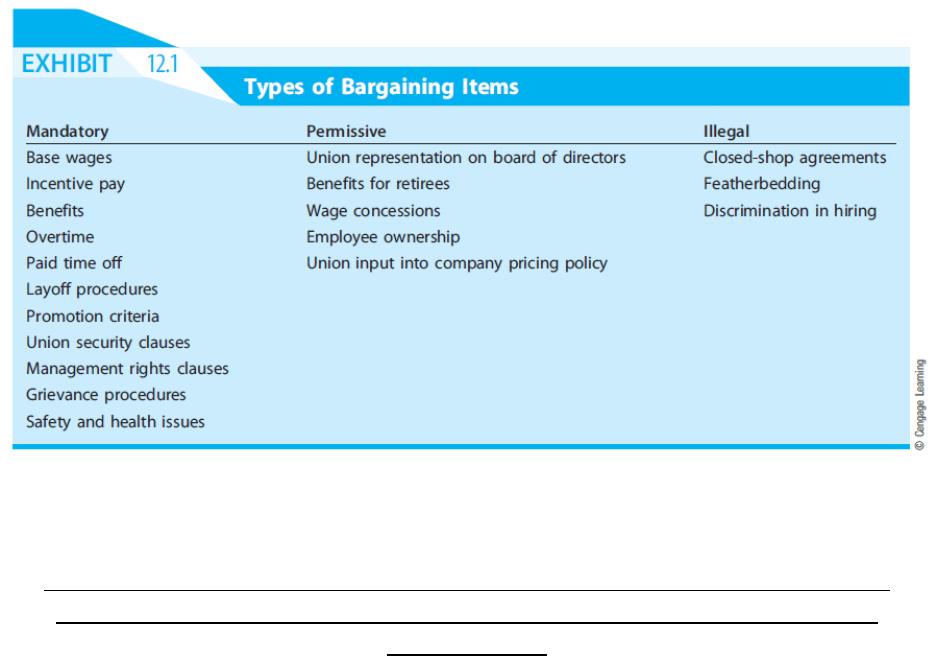
the union and the employer. Bargaining items are labeled mandatory, permissive
or prohibited, see EXHIBIT 12.1: TYPES OF BARGAINING ITEMS.
VII. FAILURE TO REACH AGREEMENT
If the union and employer can not reach an agreement, workers have the right to
strike, and the employer has the right to continue operations. Whether striking
employees must be rehired depends on the nature of the strike: economic; unfair
labor practices; wildcat strikes. Federal workers are prohibited from striking for
any reason, thus workers have no right to return to their jobs. Strike activity may
be prevented through the use of formal grievance procedures, or through the
alternate dispute resolution (ADR) processes of mediation or arbitration.
VIII. UNIONS TODAY
Union activity and representation are on a steep decline in the U.S., and perhaps
unions will not survive long-term if their traditionally adversarial relationship
with employers continues. Unions must partner with employers to seek win-win
collective bargaining outcomes. Political, negotiating and management skills are
needed by union leaders, as well as the vision to understand strategic issues facing
the employer and the organizational environment. Social media is having an
increasing role in how union organizing campaigns develop which has garnered
the interest and action of the NLRB.
IX. CONCLUSION
Unions have a long history in the U.S., although the changing nature of work,
globalization and technology have greatly reduced their membership and
effectiveness. Union leaders are challenged to create new models that address not
only the impact of a changing environment on the organization, but also how
union employees can help meet new challenges. Unions should not see
themselves as adversaries to management, but as facilitators and consultants.
READINGS
Reading 12.1 -– Putting a Big Chill on a “Big Hurt:” Genuine Interest in
Employment of Salts in Assessing Protection Under the National Labor
Relations Act
This article focuses on employer responses to the union organizing strategy known as “salting.”
Salting involves union members applying for employment with an employer the union is trying

to organize and then attempting to organize from within. The Supreme Court first ruled that this
practice was not illegal under the NLRA, saying the applicants could not be discrimination
against SOLELY on the basis of their status as a “salt.” Later a federal court found that union
organizers could lie about their status as salts on job application as long as they did not
misrepresent their credentials, skills or qualifications for employment. Employers then fought
back through the use of preferential hiring criteria as a means of excluding salts from
consideration for employment with success. In the latest case, the NLRB ruled that applicants,
including salts, had to have a genuine interest in employment to be protected under the NLRA.
The case however was decided by a very slim majority with a scathing dissent so it is likely that
this issue will continue to present itself in organizing campaigns as unions fight for their
livelihoods.
Reading 12.2 – Social Media, Employee Privacy and Concerted Activity: Brave
New World or Big Brother?
The use of online social media by both employees and organizations has contributed to the
further blurring of the separation between employees’ work and personal lives. Continuing a
trend found with early e-mail monitoring by employers, a significant number of employers now
monitor an increasing amount of the electronic communications and online activities of their
employees both in and outside of the workplace.
There are many reasons why employers engage such in monitoring; 1) to protect the employer
from a variety of legal liabilities which could come about as the result of the content of such
communications; 2) to determine the extent to which employees are actually doing their jobs
during work hours and not engaging in distracting personal business; and 3) electronic media can
be a means for disgruntled employees to transmit confidential files or provide access to secure
parts of the employer’s website or intranet
Despite the justifications for employer monitoring, there can be a significant downside to this
activity. Employees can often view electronic monitoring by employers as an invasion of their
privacy which serves to erode any trust relationship which exists between employees and
employers. However, generally speaking, employer monitoring of employee communications is
not only legal but also practical, given the nature and reach of electronic communications.
To date, courts have consistently held that employees do not have any reasonable expectation of
privacy regarding online communication, including internet usage and work e-mail systems. For
employers, monitoring of employees’ social network activities by employers is easy and
inexpensive.
However, employers face an ethical question relative to whether, as part of due diligence in the
hiring process, they should scour online networks and sources to discover information about
prospective hires. Many employers are utilizing search engines and social media to discover
information about job applicants and, in some cases, use this information to screen out
applicants.
Social network monitoring of existing employees can allow employers to monitor activities and
discover personal information which may or may not be work-related. The ethical issue for
employers is that much of which may be discovered online is not related to job performance and
how is such information to be used once it is discovered.
The American legal system has not kept up with the technological advances which have greatly
altered how we communicate. Employees currently enjoy no specific privacy rights in their
communications and very limited protection against employer monitoring and the possible
consequences employers take in response to what they discover as part of any monitoring.
Recently, however, the National Labor Relations Board has intervened on behalf of employees
and their social media activities related to their employment. Section 7 of the National Labor
Relations Act provides all covered employees the right to engage in “concerted activities for the
purpose of collective bargaining or other mutual aid or protection.” It is critical however, that in
order to receive protection that the employee’s actions or communications not simply be on her
or his own behalf nor should the employee disparage the employer, display blatant
insubordination or distribute or publicize confidential information to which the employee is
privy. However, while the NLRB has been quick to intervene in such cases, no court has yet to
rule on this interpretation