
CHAPTER 11
COMPENSATION
A. OVERVIEW
This chapter provides insight into key compensation topics. Equity issues are examined
from the individual, internal and external points of view. Basic coverage is provided of
legal requirements of compensation, including Title VII of the Civil Rights Act of 1964;
the Equal Pay Act of 1963; and the Fair Labor Standards Act of 1938. Executive
compensation closes the chapter with topics related to over compensation; controlling
compensation; tying individual compensation to organizational performance, etc.
B. LECTURE OUTLINE
I. OPENING CASE – JAMBA JUICE
Jamba Juice is a leading retail purveyor of blended-to-order fruit
smoothies, fresh-squeezed juices, and healthy soups and breads. They are a high
growth company in an intensively competitive industry, and have developed a
compensation plan that keeps them competitive with others in their industry, and
also with tech-based employers as well. Jamba’s J.U.I.C.E. Plan allows general
managers to receive a percentage of store cash flow; share profits where money
accrues in a retention account payable in three year cycles; and stock options.
II. INTRODUCTION
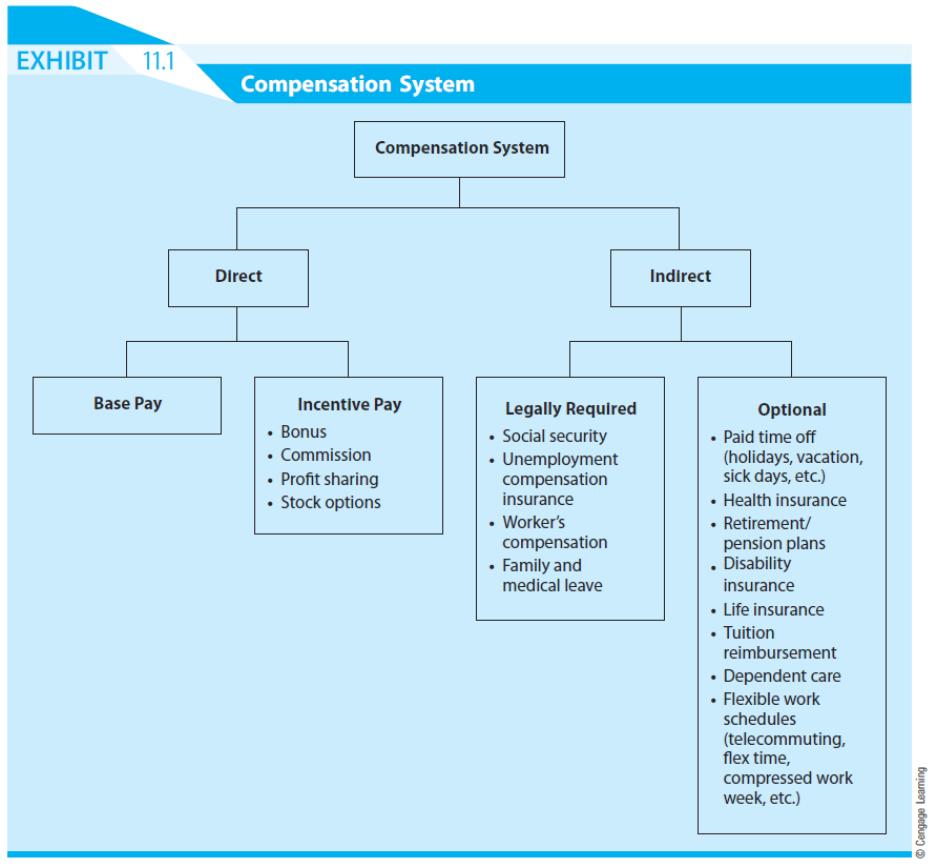
Compensation is a key strategic area for organizations, impacting ability
to attract applicants, as well as insure optimal performance levels from
employees. Compensation programs continue to assume an increasingly larger
share of organizational operating expenses, especially in service industries. Three
separate components to an organizational compensation system are illustrated in
EXHIBIT 11.1: COMPENSATION SYSTEM,, including direct cost of base and
incentive pays, as well as indirect costs.
III. EQUITY
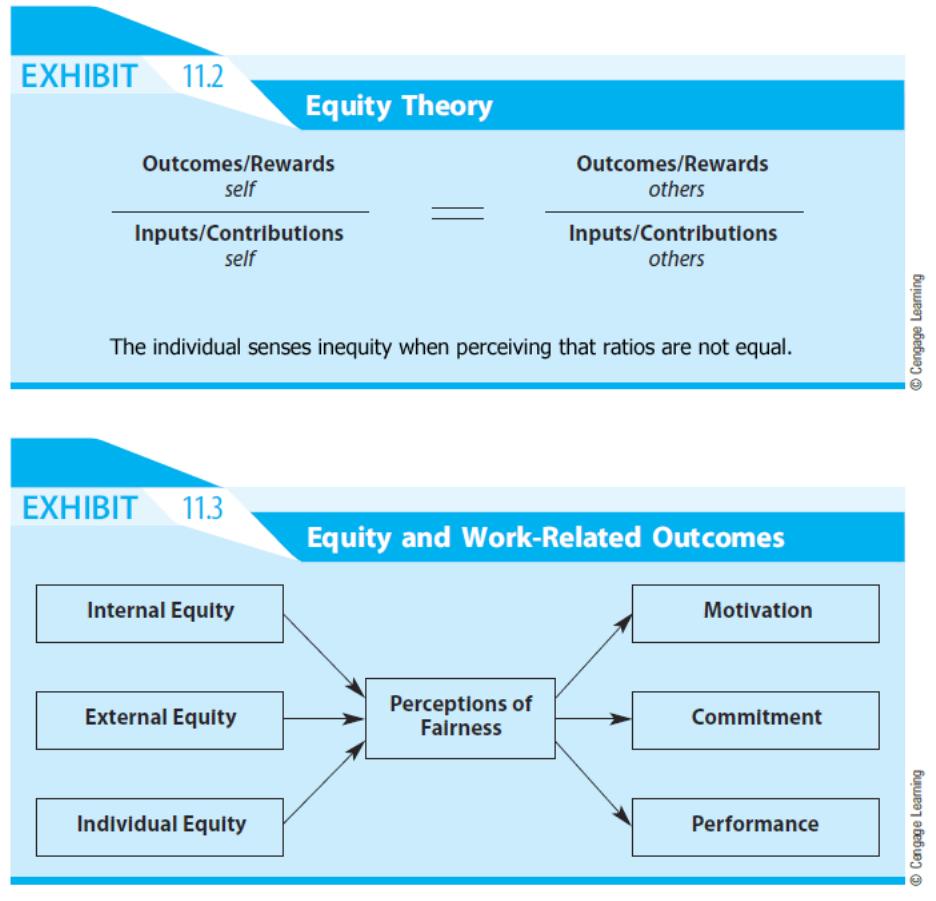
Perceived equity or fairness of the compensation system is critical. Equity
theory of motivation holds that workers assess their perceived inputs and
outcomes relative to those of others. When individuals perceive inequities, they
generally act to establish equity by increasing their outcomes or decreasing inputs.
Internal, external and individual equity impact motivation, commitment and on
the job performance.
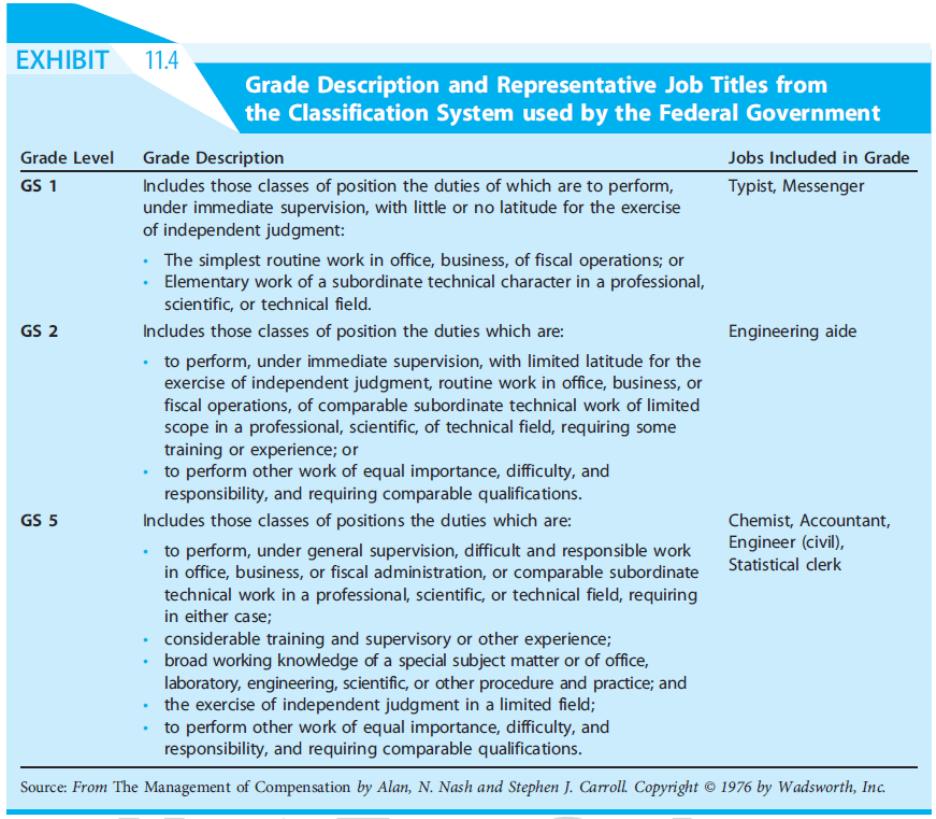
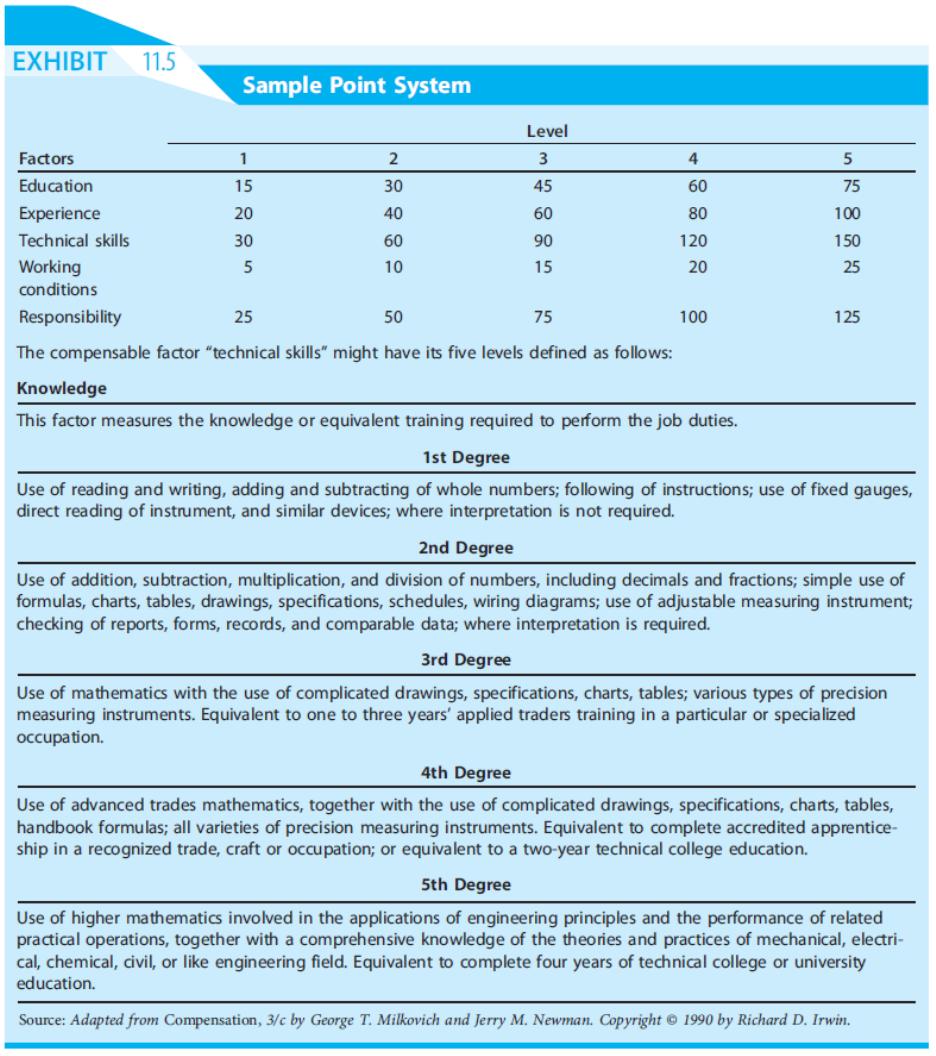
A. Internal equity – involves perceived fairness of pay differentials within an
organization. Four techniques can be utilized to establish internal equity:
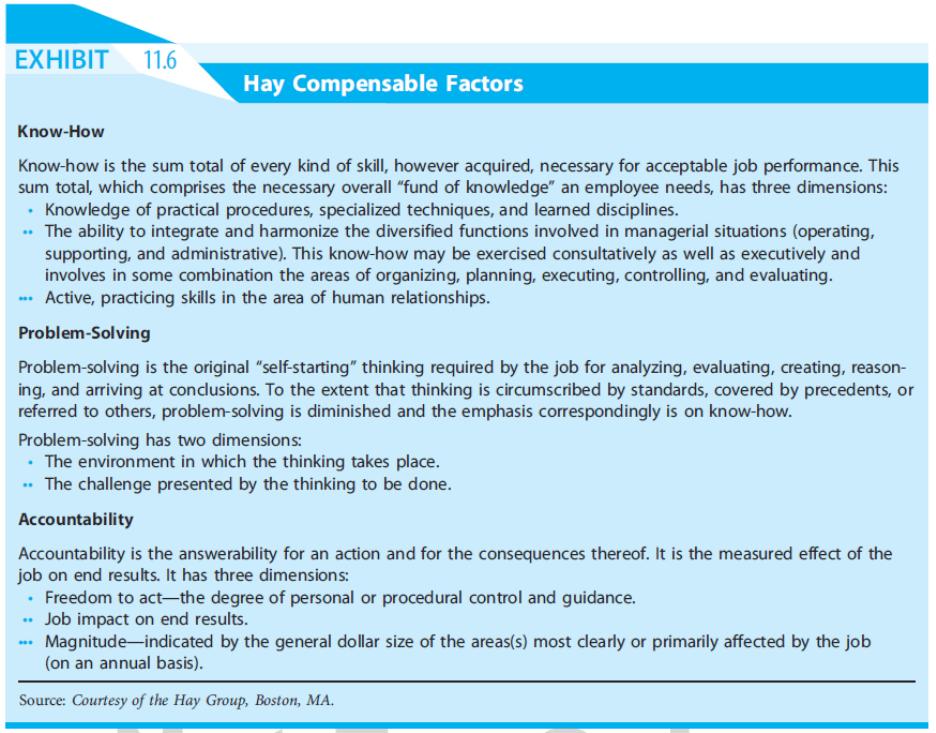
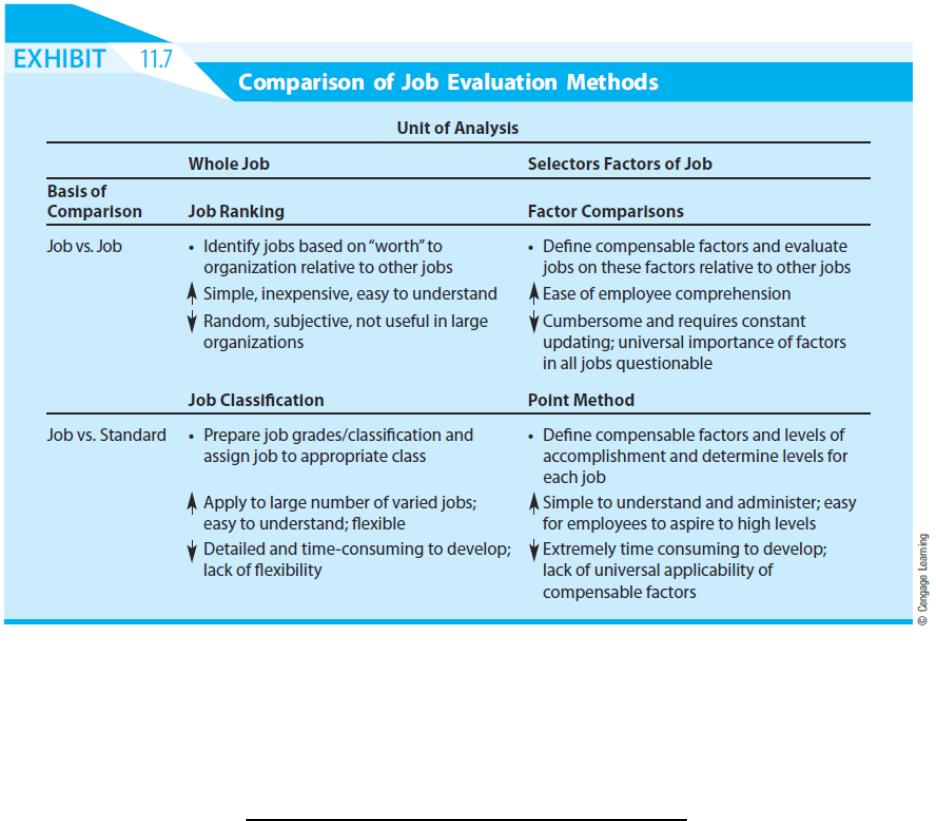
job ranking; job classification; point systems; and factor comparison.
Salary compression issues are becoming more prevalent in certain
industries based on supply and demand for entry-level skilled employees.
B. External equity – involves employee perceptions of compensation fairness
relative to those outside the organization. Organizations must be sure they

have a means of remaining competitive relative to cost structure and
market prices. Choices of lead, lag or market policy are available.
C. Individual equity – considers employee perceptions of pay differentials
among individuals who hold identical jobs in the same organization.
The effectiveness and appropriateness of merit pay, incentive pay,
skill-based pay, and team-based pay systems are also discussed as a means
of ensuring individual equity. See Joe Torre and the New York Yankees
example,; Team-based Incentive Pay at Children’s Hospital Boston
example,; Team-based Pay at Phelps Dodge example.
IV. LEGAL ISSUES IN COMPENSATION
A. Compensation is a condition of employment covered under both Title VII
of the Civil Rights Act of 1964 and the Equal Pay Act of 1963. Some note
that the Equal Pay Act is not very effective, as men and women often are
not employed in the same jobs, and the Act only requires equal pay for
equal work. To combat these limitations, the concept of comparable worth
has been advanced, although it is generally seen as falling outside of
existing federal law.
B. Fair Labor Standards Act (FLSA) of 1938 regulates federal minimum
wage, as well as policies on overtime and child labor. Certain workers are
exempt from minimum wage laws (generally managers, administrators,
outside sales people and professionals who exercise “independent
judgement” in carrying out job duties). Note: Federal minimum wage
laws and groups covered changed substantially in 2004.
V. EXECUTIVE COMPENSATION
Executive compensation is a controversial area. There is no real standard
or average due to the wide variety of factors faced by organizations and their
executives. Criticisms include the excessiveness of executive pay, and a lack of
relationship between pay and performance. Accounting practices relative to stock
options for executives is also an area of concern.
VI. CONCLUSION
Key compensation issues include: compensation relative to the market;
balance between fixed and variable compensation; utilization of individual versus
team-based pay; the appropriate mix of financial and nonfinancial compensation;
and developing an overall cost-effective program that results in high performance.
Compensation systems must be tied to behavior necessary for achievement of
strategic organizational goals.
READINGS
Reading 11.1 – Exposing Pay Secrecy
This article focuses on the issue of pay secrecy, describing its cost and benefits. Pay secrecy
essentially is a policy which restricts the amount of information employees are provided about
regarding what their co-workers are paid. Whether pay secrecy benefits or is detrimental to an
organization depends on a variety of factors. It is best understood as a continuum rather than an
all-or-nothing construct. Employers could have varying levels of pay secrecy. It also is related
to employee privacy issues, which have become much more prevalent in recent years.
Costs of pay secrecy include; 1) employee judgments about fairness and their perceptions of trust
may be sacrificed; 2) employee performance motivation can be expected to decrease; and 3)
from an economics perspective, the labor market may be less efficient because employees will
not move to their highest valued use.
Benefits of pay secrecy include organizational control, protection of privacy, and decreased labor
mobility.

Factors which influence the cost-benefit tradeoff of pay secrecy for an individual employer: 1)
nature of human capital (firm-specific versus general); 2) criteria for pay allocation (objective
versus subjective); 3) gauging of relative pay status (individual employee “guesses” where they
stand or rank in the organization’s relative pay distribution).
Reading 11.2 –The Development of a Pay-for-Performance Appraisal System for
Municipal Agencies : A Case Study
This reading presents a case study of a pay-for-performance system and outlines the process by
which it was developed. Despite its importance, both employees and management often view
the performance appraisal process as frustrating and unfair. These frustrations are largely
attributed to a reliance on performance appraisal instruments that 1) are not job related; 2) have
confusing or unclear rating levels, and; 3) are viewed as subjective and biased by staff
To address these issues, this case study: (1) identified a systematic procedure for creating
performance appraisal instruments; (2) described the appropriate training for those conducting an
appraisal interview; (3) implemented performance reviews using the developed instruments and
appraisal interview/review training, and; (4) evaluated employee attitudes toward the newly
developed system.
Steps Taken in Defining Job Performance and the Creation of an Appraisal Instrument
Step #1: Job analysis
Step #2: Rating of tasks
Step #3: Creation of appraisal instrument
Step #4: Identifying raters
Step #5: Rater training
Step #6: Performance appraisal interview
The process employed was collaborative throughout (between employee and supervisor). Once
the employee and supervisor had independently completed the appraisal instrument they met and
discussed the ratings. During this time the employee and supervisor reached an agreed upon
rating for each task statement. At this point, the appraisal was completed and signed by both the
employee and supervisor.
Once the employees completed the workshops and the trial run of the newly developed system,
they completed the performance appraisal reaction instrument again to assess their attitudes
toward the new system. Employee perceptions of procedural justice were also assessed.