READINGS
Reading 10.1 – Effective Leadership Behaviors: What We Know and What
Questions Needs More Attention
This reading focuses on attempting to make sense of the thousands of studies on leadership
which have been conducted over the past half century. The author develops a hierarchical
taxonomy of 15 leadership behaviors which are organized into four separate meta-categories
(task-oriented, relations-oriented, change-oriented and external).
Hierarchical Taxonomy of Leadership Behaviors
Task-oriented (ensure that people, equipment, and other resources are used in
an efficient way to accomplish the mission of a group or organization)
Clarifying – ensure that people understand what to do, how to do it, and
the expected results
Planning – making decisions about objectives and priorities, organizing
work, assigning responsibilities, scheduling activities, and allocating
resources among different activities.
Monitoring operations – assess whether people are carrying out their
assigned tasks, the work is progressing as planned, and tasks are
being performed adequately
Problem solving – deal with disruptions of normal operations and member
behavior that is illegal, destructive, or unsafe

Relations-oriented (enhance member skills, the leader–member relationship,
identi”cation with the work unit or organization, and commitment to the
mission)
Supporting – show positive regard, build cooperative relationships, and
help people cope with stressful situations
Developing – increase the skills and con”dence of work-unit members
and to facilitate their career advancement
Recognizing – show appreciation to others for effective performance,
signi”cant achievements, and important contributions to the team or
organization
Empowering – by giving subordinates more autonomy and influence over
decisions about the work
Change-oriented (increase innovation, collective learning, and adaptation to
external changes)
Advocating change – explaining why change is urgently needed
Envisioning change – articulate a clear, appealing vision of what can be
attained by the work unit or organization
Encouraging innovation – encourage people to look at problems from
different perspectives, to think outside the box when solving problems,
to experiment with new ideas, and to “nd ideas in other “elds that can
be applied to their current problem or task
Facilitating collective learning – promote improvement of current strategies and
work methods (exploitation) or discovery of new ones (exploration)
External (facilitate performance with behaviors that provide relevant
information about outside events, get necessary resources and assistance,
and promote the reputation and interests of the work unit)
Networking – build and maintain favorable relationships with peers,
superiors, and outsiders who can provide information, resources, and
political support
External monitoring – analyzing information about relevant events and
changes in the external environment and identifying threats and
opportunities for the leader’s group or organization
Representing – transactions with superiors, peers, and outsiders (e.g.,
clients, suppliers, investors, and joint venture partners)
Reading 10.2 – Managing the Life Cycle of Virtual Teams
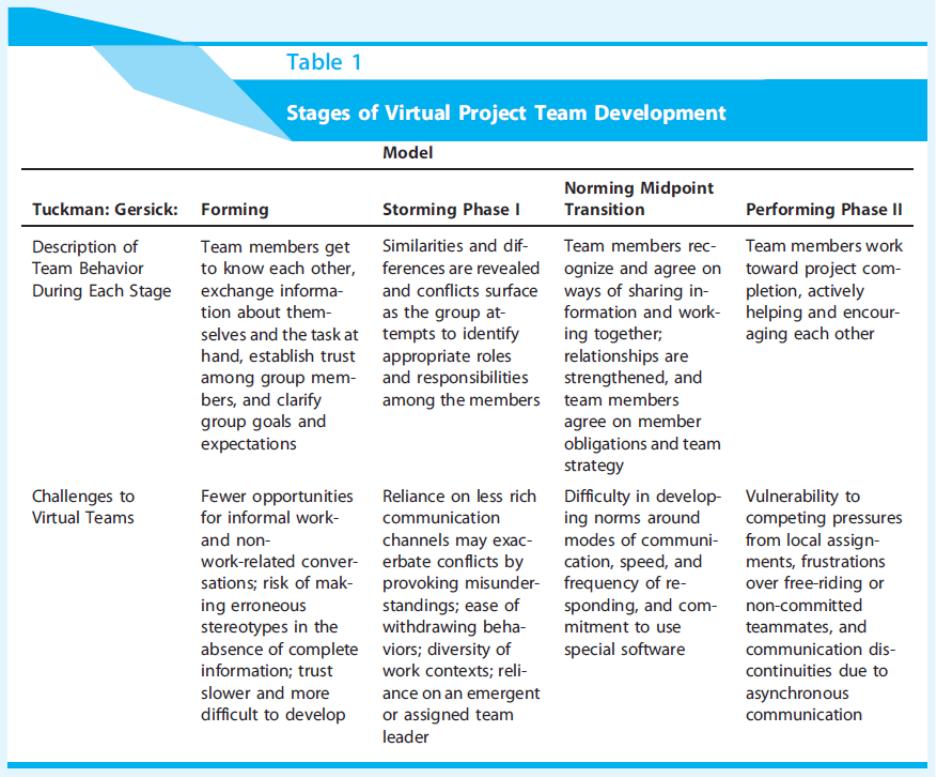
This article presents two traditional models of team development and applies them to virtual
teams, explaining the typical behaviors seen during each stage as well as the particular
challenges faced by virtual teams during each stage (Table 1).
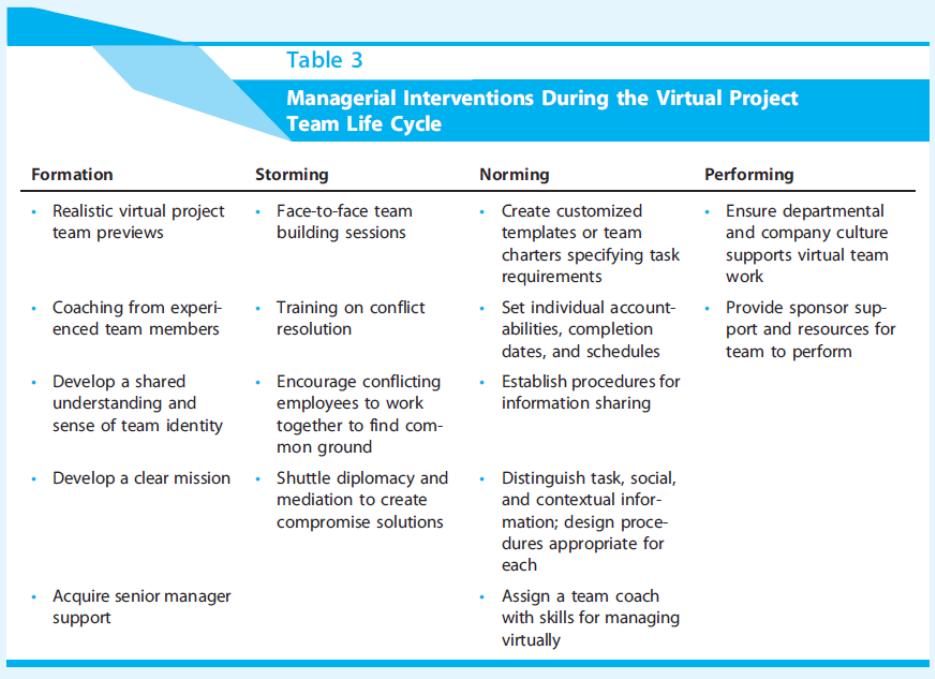
It then presents suggested managerial interventions during the virtual project team life cycle
(Table 3).