CHAPTER 1
AN INVESTMENT PERSPECTIVE OF HUMAN RESOURCE MANAGEMENT
A. OVERVIEW
This chapter introduces the concept of treating human resource management processes,
practices and procedures from a strategic point of view. The skills and knowledge pos –
sessed by individuals can be valuable assets to any organization, and should be treated as
such. Organizations should understand how to value/measure and manage from an invest-
ment point of view all assets, including those related to their employees. However, many
factors can influence the investment orientation of an organization. Understanding the
risks and benefits to the organization of investing in human capital is of great importance.
B. LECTURE OUTLINE
1. OPENING CASE – NORDSTROM
A strategic competitive advantage for Nordstrom includes a successful human resource
(HR) approach, involving heavy investment in their sales force of associates. Nordstrom
consistently produces above-industry-average profits and has continued to be profitable
when its competitors have declined or fallen flat.
2. INTRODUCTION
1. The human element is often the most important element of performance.
Thus, appropriate resources and investments must be committed by any or-
ganization to facilitate systems for attracting, motivating and managing hu-
man resources. Adopting a strategic view of HR involves considering em-
ployees as “human assets,” and developing appropriate policies and proce-
dures to manage them as valuable investments.
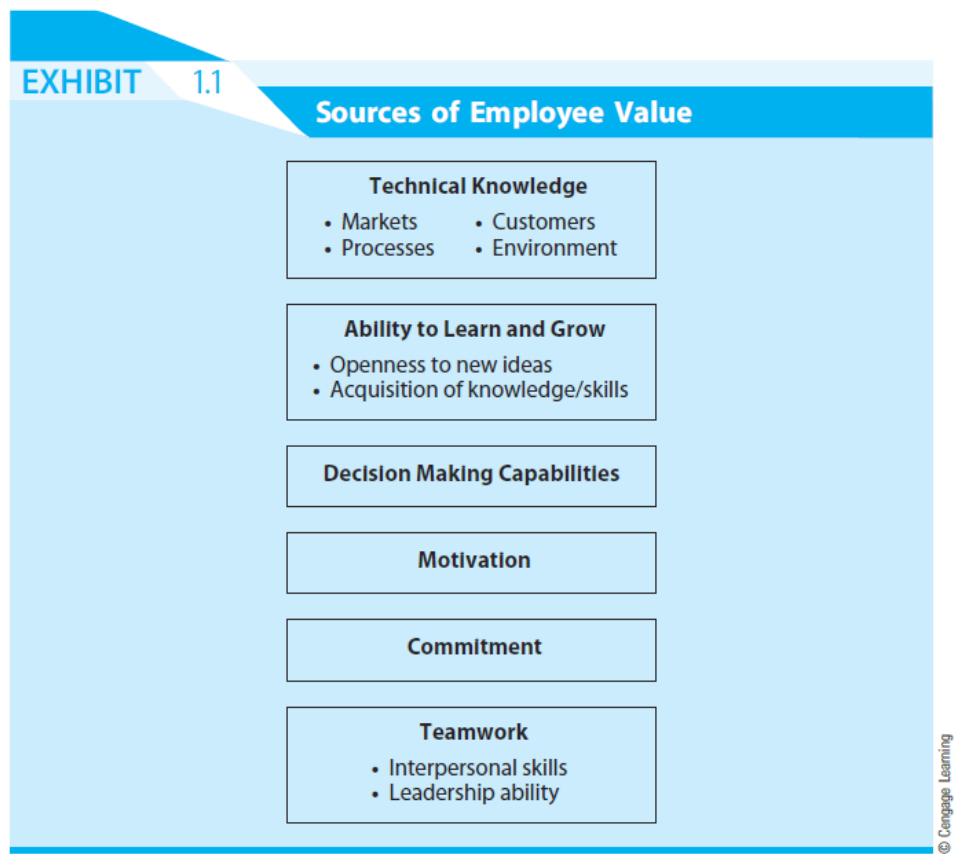
2. See Exhibit 1-1: SOURCES OF EMPLOYEE VALUE
1. Technical Knowledge
2. Ability to Learn and Grow
3. Decision Making Capabilities
4. Motivation
5. Commitment
6. Teamwork
3. ADOPTING AN INVESTMENT PERSPECTIVE
1. Characterizing employees as human assets implies the strategic management
of human resources should include considering HR from an investment per-
spective.
2. Cost/Benefit basis analysis may be used to evaluate HR programs, such as
training and development.
3. Investment perspective toward human assets facilitates their becoming a
competitive advantage as most other resources/assets can be cloned, copied
or imitated by competitors.
4. A strategic approach to HR, however, does not always involve a human rela-
tions approach to employee relations, as noted in the Managing Employees
at United Parcel Service example
5. Investments in employees must be undertaken in tandem with strategies to
retain employees long enough to realize an acceptable return on investments
in employees. This requires valuation of the employee as an asset, which
can be difficult to do.
4. VALUATION OF ASSETS
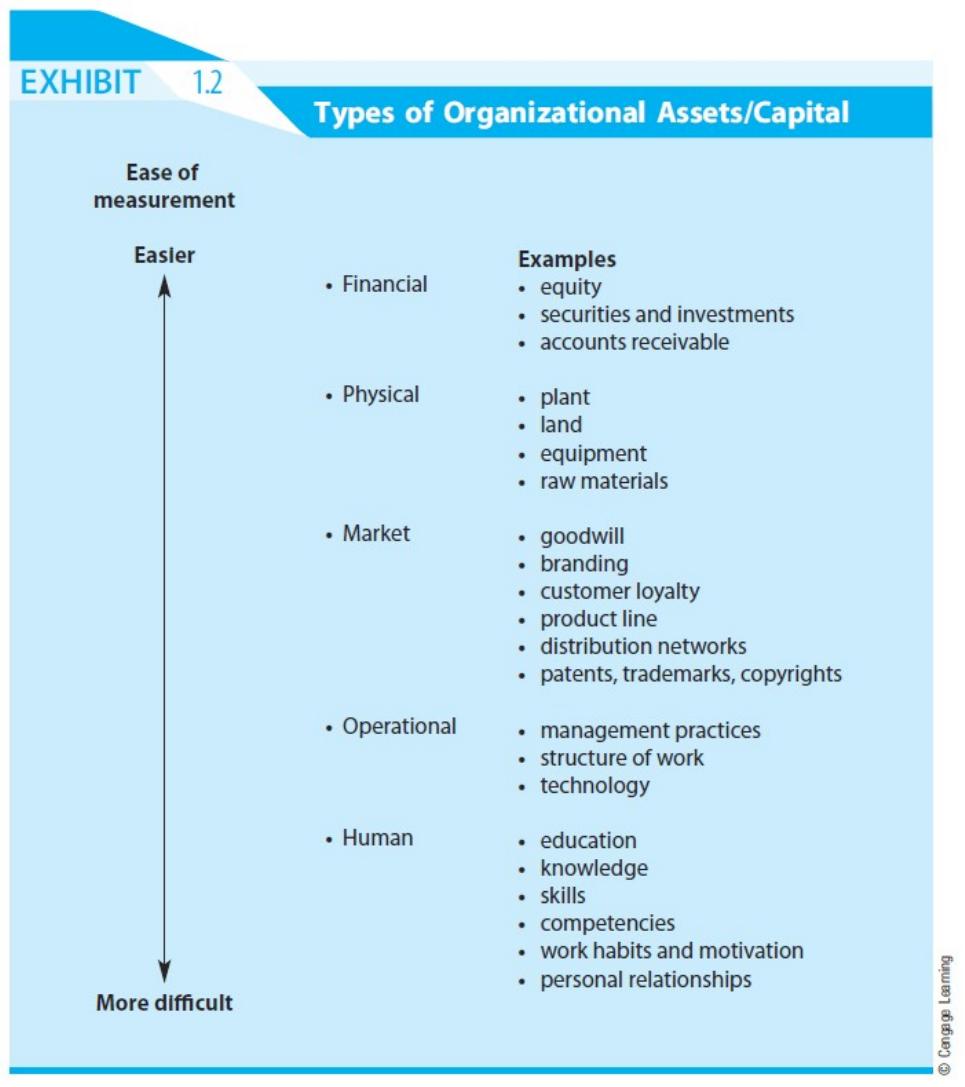
See Exhibit 1-2: TYPES OF ORGANIZATIONAL ASSETS/CAPITAL – from easi-
est to most difficult to measure
1. Financial
2. Physical
3. Market
4. Operational
5. Human
5. UNDERSTANDING AND MEASURING HUMAN CAPITAL
1. Employees are both a significant resource and significant cost for an organi-
zation, thus employee contributions to the bottom line must be measured.
2. Watson Wyatt Worldwide found the primary reason for organizational prof-
itability is the effective management of human capital.
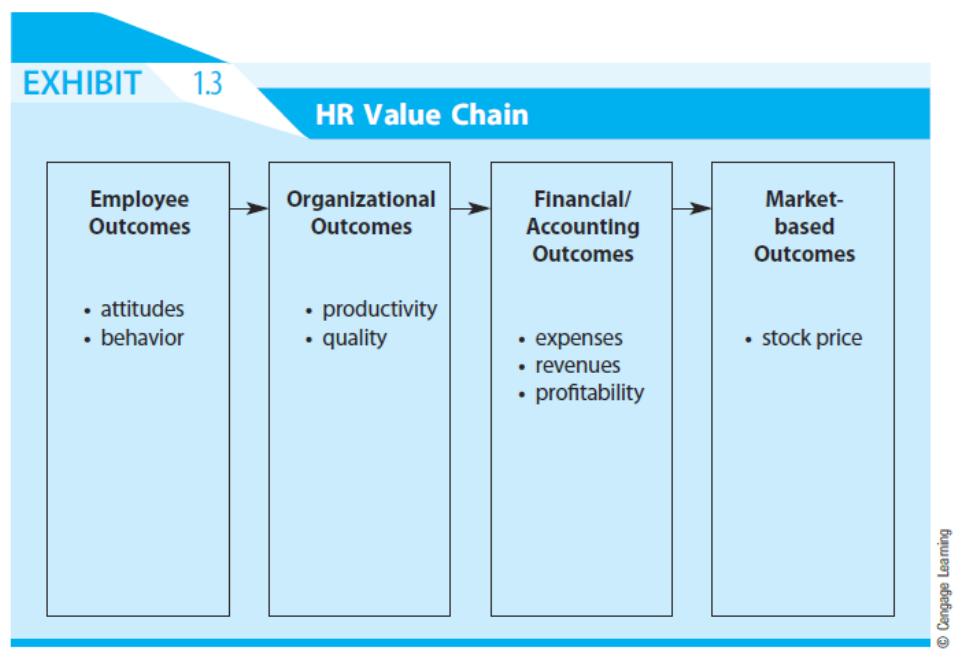
3. Dyer and Reeves defined the HR “value chain,” arguing performance could
be measured via four different sets of outcomes: employees, organizational,
financial and accounting, which have a sequential cause-effect relationship
on each other. (Exhibit 1-3: HR VALUE CHAIN)
4. Employees are increasingly attempting to develop and measure meaningful
HR metrics to aid them in developing effective strategies for managing hu-
man capital.
5. Fortune 500 firms often evaluate HR in limited, non-monetary ways, includ-
ing dimensions of retention, turnover, corporate morale, and employee satis-
faction
6. Accounting practices tend to favor valuation methods stressing past and cur-
rent asset value, while much of the value of human assets lies in the future.
Thus, organizations must be future-oriented in valuing HR.
7. Measuring Human Assets/Capital at Dow Chemical example illustrates how
Dow as developed two meaningful metrics; expected human capital return
and actual human capital return.
8. Six step model of valuation of HR initiatives
1. Identify specific business problem that HR can impact
2. Calculate actual cost of the problem
3. Choose an HR solution that addresses all or part of the problem
4. Calculate the cost of the solution
5. After implementation, calculate the value of the improvement
6. Calculate the specific return on investment (ROI)
9. HR must provide senior level management with value-added human capital
investments.
10. Moneyball and the Oakland Athletics example illustrates how nonconven-
tional staffing metrics analytical techniques resulted in championship teams
despite these teams having one of the lowest payrolls in the “industry.”
6. HUMAN RESOURCE METRICS
1. Wall Street analysts still generally fail to acknowledge human capital in as-
sessing the value of an organization and the effect that human resources can
have on stock price
2. This is rooted in the fact that there are no “standard” metrics or measures of
human capital, much as there are for other organizational assets.
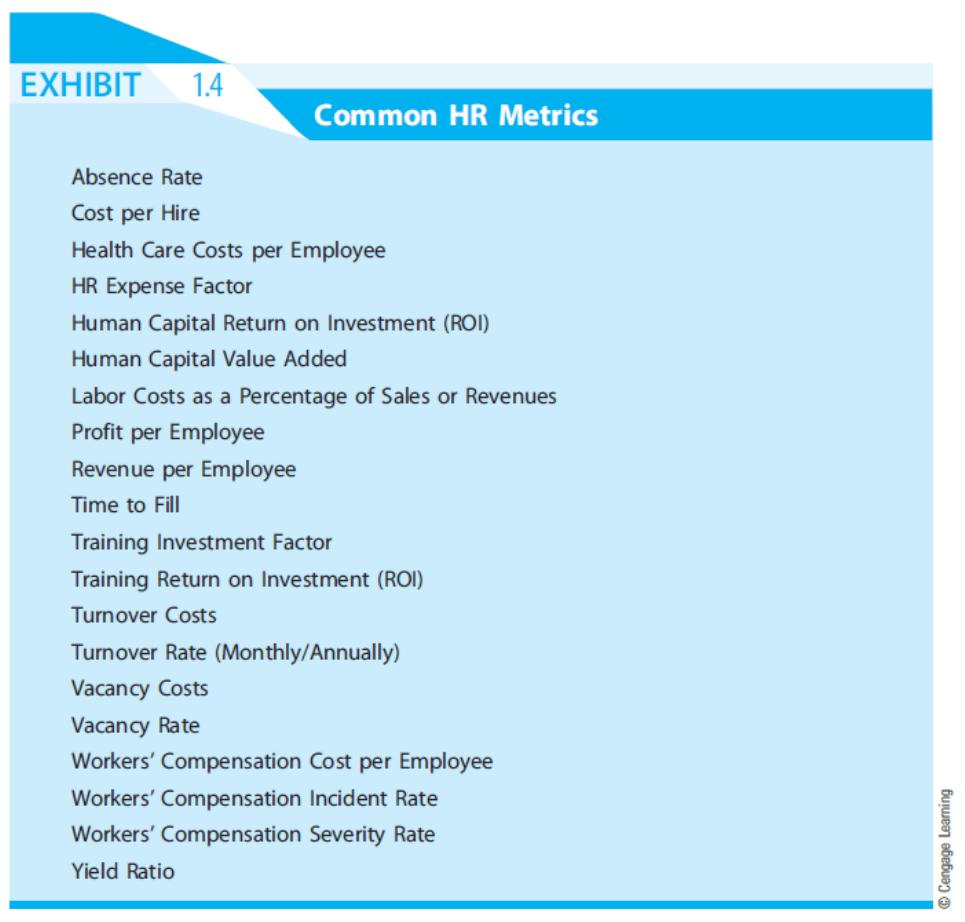
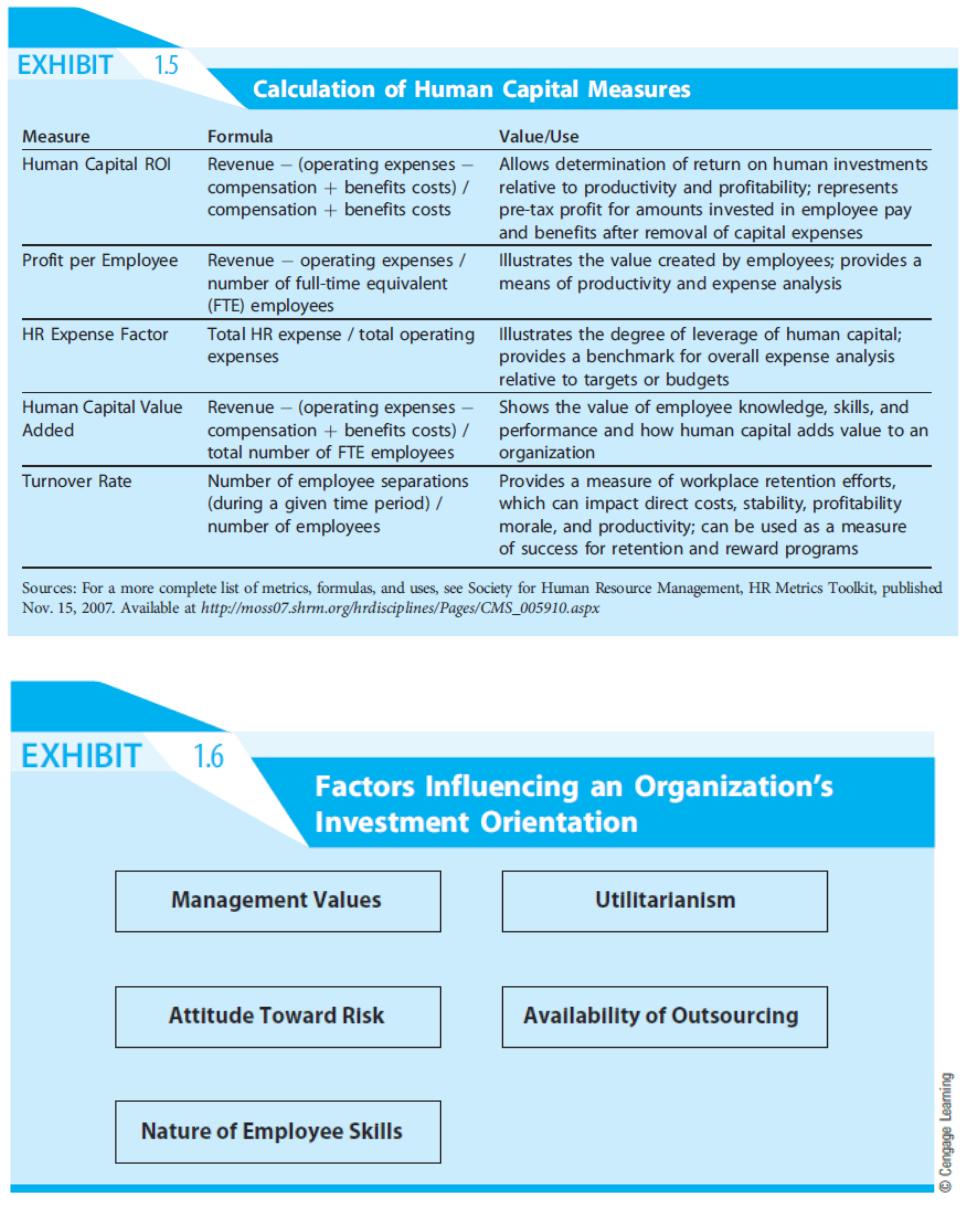
3. Exhibit 1.4 lists some Common HR Metrics while Exhibit 1.5 displays the
means of calculating five common metrics. However, the appropriate met-
rics for any given organization will be dependant on that organization’s
strategy.
4. Labor Supply Chain Management at Valero Energy describes how Valero
has applied principles of supply chain management to its staffing and em-
ployee development functions.
7. FACTORS INFLUENCING “INVESTMENT ORIENTATION” OF AN ORGANI-
ZATION
Exhibit 1-6 describes the major factors which influence how investment oriented an
organization is:
1. Management values
2. Utilitarianism
3. Attitude toward risk
4. Availability of outsourcing
5. Nature of employment skills
8. CONCLUSION
1. Effective strategies to manage human assets utilize HR practices and poli –
cies are in sync with the organization’s overall strategy and encourage the
organization to invest in its best opportunities.
2. Organizations should retain employees at least to the point of achieving an
adequate return on investment.
3. Organizations often do not follow an investment perspective of HR because
it involves making a longer-term commitment to employees, and all human
assets and their contribution to the bottom line must be assessed, which can
be difficult.
4. Once an organization develops a competitive advantage through its employ-
ees, the positive outcome is likely to be enduring, and difficult to duplicate
by competitors.
5. Although investment in human assets can be risky and the return long to de-
velop, investment in people continues to be the main source of competitive
advantage for organizations.

READINGS
Reading 1.1 – The India Way; Lessons for the U.S.
The “India Way” is characterized by and distinct from the U.S. business model in four fundamental
ways. First, Indian companies see their most important goal as serving a social mission, not maxi-
mizing shareholder value, as is the case in the United States. An advantage of this approach for
corporate performance is that it greatly enhances the ability to motivate and engage employees.
Second, Indian companies take the management of human capital seriously. They invest in the ca –
pabilities of their employees, promote internally rather than relying on outside hiring, and engage
employees with empowerment and similar arrangements. Indian companies measure and manage
almost every aspect of human resource practices and effectiveness with extreme care.
Third, the persistence of engaged employees contributes to a uniquely Indian approach to problem
solving that the authors describe with the Hindi term jugaad, banging away at hard problems with
a persistent trial-and-error approach that is deeply rooted in a culture of scarcity and constraints.
Fourth, these practices come together to create a unique approach to business strategy, one that is
internal and rests on innovations in the companies’ value chains. They are much less interested in
acquiring competencies through mergers and acquisitions, joint ventures or other externally orient –
ed approaches as compared to U.S. firms. And they are much more likely to stick with traditional
customers and search for better ways to meet their long-term needs, as opposed to relying on mar-
ket research to find new opportunities.
The India Way is unique, but the set of practices that comprise it are not necessarily dependent on
the Indian context. The India Way can serve as a model for other countries in part because it ad –
dresses the intense pressures for greater social responsibility but most importantly because it is
succeeding in the competitive environment with a competitive advantage that appears to be sus –
tainable in the long run.
Reading 1.2 – Strategic Human Resource Management as Ethical Stewardship
Ethical stewardship has been defined as ‘‘the honoring of duties owed to employees, stakeholders,
and society in the pursuit of long-term wealth creation” and is a theory of organizational gover –
nance in which leaders seek the best interests of stakeholders by creating high trust cultures that
honor a broad range of duties owed by organizations to followers. This stewardship role has been
described as values-based, principle-centered and committed to the welfare of all stakeholders. In
pursuit of the best interests of each stakeholder, leaders have a duty to optimize outcomes, rather
than settling for a compromise position that overlooks opportunities.
In order for the human resources professional to function as an ethical steward in the modern orga-
nization, she/he must display 1) a profound knowledge of the operations of the firm; 2) an under-
standing about how to implement systems by which organizations can maximize human perfor-
mance; 3) an understanding of the empirical value and cost/benefit contribution of high perfor-
mance systems; and 4) the ability to communicate effectively to top management and Boards of
Directors in a convincing manner so that those policy makers will adopt policies and systems es –
sential for creating integrated and effective HRM systems that support organizational goals.
Human resource professionals honor the obligations of ethical stewards when they develop knowl-
edge of guiding principles that characterize great organizations, and when they help organizations
to create aligned organizational cultures that match actual behaviors with espoused values. This
ability is a key element in establishing and implementing human resource systems that earn em-
ployee commitment and trust.
As ethical stewards, human resource professionals need to demonstrate their fierce commitment to
the success of the organization while creating systems that recognize employee contributions and
give credit to employees for achieving an organization’s success. This requires leadership insight
that willingly shares both power and the credit for accomplishments while accepting personal re –
sponsibility for organizational failures.
Human resource professionals act as ethical stewards when they create human resource systems
and processes that are fully aligned with the normative and instrumental goals of the organization
while giving employees credit for their role in the accomplishment of those goals. These aligned
and congruent systems and processes balance the needs of the organization with a commitment to
the best interests of its stakeholders and create reward systems that also reward employees for
contributing to organizational success.
The willingness of organizations to pursue systematically the twin goals of achieving organiza-
tional mission and assisting employees to achieve their personal goals is an implicit obligation of
ethical stewardship and organizational leadership.