
1
Chapter 10
Hearing Lab 1
The Decibel (Noncadaver Lab)
To the Instructor: This lab is ideally an in-class lab, as you will want to be free to roam around
the room giving assistance. I’ve found that students respond very well to this activity, because it
gives them a chance to “touch the beast” without pain. You’ll want to warn them to bring a
calculator that has logarithm functions, if they have one. Small groups work well.
2
Name ____________________________ Course ______________________________
Hearing Lab 1
The Decibel (Noncadaver Lab)
Today’s lab involves practice working with exponents, logarithms, and finally figuring the
decibel.
You will work in groups of four or five to go through the problems. Do not copy the work of
someone else; instead, seek out explanation when you don’t understand how to complete an item.
I want you to talk and discuss among yourselves, but I want each of you to have the experience
of working through the problems (which, by the way, represent questions on the next test).
I. Exponents and Logarithms
If you are comfortable with exponents and logarithms, go directly to the section marked
“FIGURING EXPONENTS AND LOGARITHMS” and do the problems there. Otherwise,
continue reading.
An exponent is the power to which a number is raised. For instance, 2 is the exponent in 42 (4
squared, which is 4 × 4, which = 16).
The exponent tells the number of times you will multiply an item by itself:
32 = 3 × 3 = 9
42 = 4 × 4 = 16
33 = 3 × 3 × 3 = 27
53 = 5 × 5 × 5 = 125
1. What are the exponents in the following expressions? What does the expression equal?
Exponent Answer
42 =
23 =
33 =
46 =
103 =
102 =
105 =
101 =
Logarithms (logs) are exponents. (In our work we’ll only talk about logarithms in base 10, so
3
2. Figure the Log10 values for the following:
Log10 (1,000) = _______________ Log10 (10,000) = ______________
Log10 (100) = _________________ Log10 (1,000,000) = ____________
Log10 (100,000) = ______________ Log10 (10,000,000) = ____________
By now you should see that if the exponent is a whole number, the Log10 will be the number
3. Figure a few more: Log10 (10,000,000) = __________________
Log10 (100,000,000) = _________________
Log10 (10) = _________________________
Figuring Exponents and Logarithms
1. What are the exponents in the following?
22
94
34
63
610
101
75
412
81
156
2. Determine the logarithms (Log10) in the following statements:
Log10 (1,000) = ________________ Log10 (10) = __________________
Log10 (100) = _________________ Log10 (1,000,000) = _____________
Log10 (100,000) = ______________ Log10 (10,000) = ________________
STOP AT THIS POINT AND WAIT FOR THE REST OF YOUR TEAM TO
COMPLETE THE ABOVE SECTION.
II. dB SPL Problems
Figure dB sound pressure level (SPL) in the following examples. If you have a calculator that
will figure logarithms, this could be fun. If your group doesn’t have a calculator, do those that
are marked “no calculator” until you can flag me down and I’ll loan you mine.
Note: If your calculator only calculates natural logarithms (Ln), then simply multiply the
Example for figuring dB SPL
STOP AT THIS POINT AND WAIT FOR THE REST OF YOUR TEAM TO
COMPLETE THE ABOVE SECTION.
SPL: More Complex Examples
Example: Given 12,000,000 uPa as output; figure dB SPL.
STOP AT THIS POINT AND WAIT FOR THE REST OF YOUR TEAM
TO COMPLETE THE ABOVE SECTION.
III. dB Increase and Decrease
dB increase and decrease is a really useful thing to learn (e.g., for reading from an oscilloscope
trace).
Example: You measure a sine wave, = 3 volts, zero-to-peak.
After raising the volume control (or lowering attenuation), you measure the output voltage to be
96 V.
What is the change in dB?
X dB = 20 Log10 (volts output/volts reference)
1. Given an initial reading of 11.3 V (your reference), you raise the sound output and get a
reading of 431 V. What is the dB change?
2. Given an initial reading of 640 V, you turn the loudness control down and get an output of 21
V. How many dB did you drop? (Hint: The answer is 29.68 dB change.)
3. You measure a sine wave from an audiometer. The dial says 20 dB (which you know is
Hearing Level [HL]), and you read a voltage on your oscilloscope of 46 V at 20 dB. What is
the voltage if you turn the audiometer up 6 dB? (Hint: Remember that voltage is the correlate
of pressure. What happens to dB when you double the pressure?)
6
4. Your initial voltage is 3 volts. You increase the volume control and now read 300 V. What is
the dB difference?
5. You turn on the radio and measure .006 volts. After cranking the volume up until it parts
your hair, you measure output as 600 volts. How many dB have you increased the signal?
6. Your upstairs neighbor has his stereo set to a mind-boggling level. After verbally assaulting
him, you slap an oscilloscope on the speaker leads and get a reading of 43 volts. After he
turns it down (under protest), it reads .00043 volts. How many dB did you drop the intensity?
(Hint: 43 volts is your reference.)
FINISHED!!
THAT WASN’T SO BAD, WAS IT?
Answer Key
To the Instructor:
The answer key provides the correct responses to Hearing Lab 1 The Decibel. The correct
answers are in bold.
I. Exponents and Logarithms
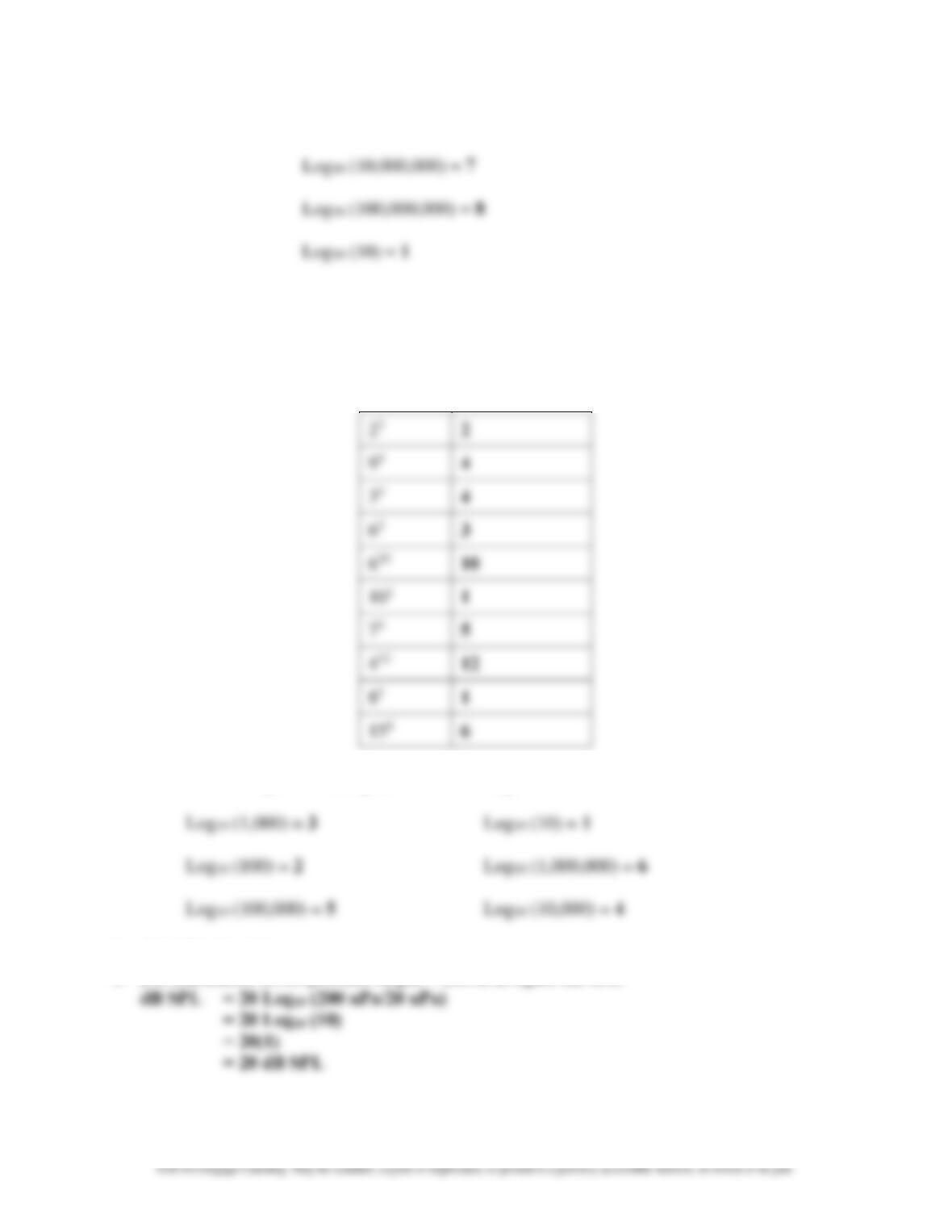
1. What are the exponents in the following expressions? What does the expression equal?
Exponent Answer
2. Figure the Log10 values for the following:
7
3. Figure a few more:
Figuring Exponents and Logarithms
1. What are the exponents in the following?
2. Determine the logarithms (Log10) in the following statements:
II. dB SPL Problems
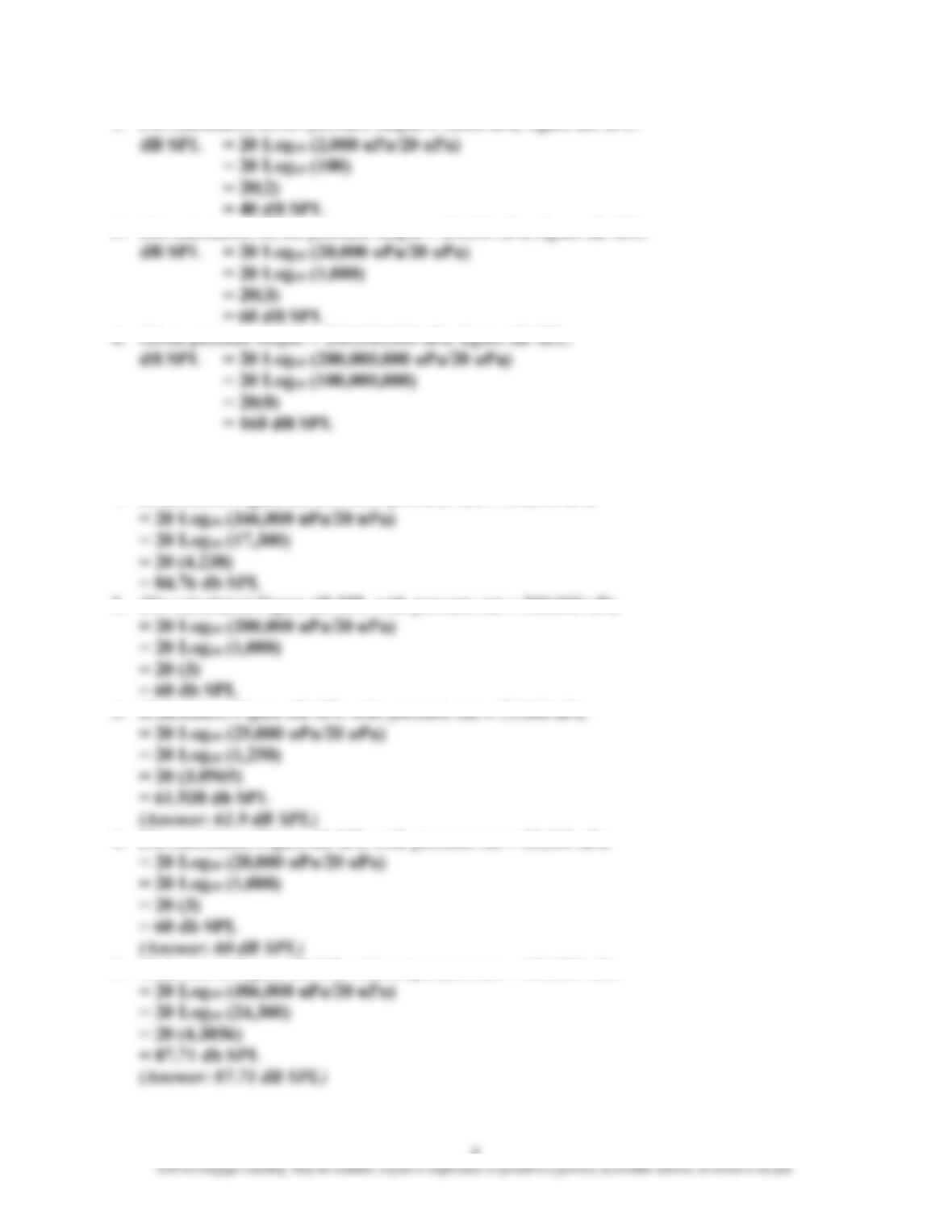
1. (No calculator) Given pressure output = 200 uPa; figure dB SPL.
8
2. (No calculator) Given pressure output = 2,000 uPa; figure dB SPL.
3. (No calculator) Given pressure output = 20,000 uPa; figure dB SPL.
SPL: More Complex Examples
1. (Calculator) Figure dB SPL with pressure out = 346,000 uPa.
2. (No calculator) Figure dB SPL with pressure out = 200,000 uPa.
4. (No calculator) Figure dB SPL with pressure out = 20,000 uPa.
5. (Calculator) Figure dB SPL with output pressure = 486,000 uPa.
9
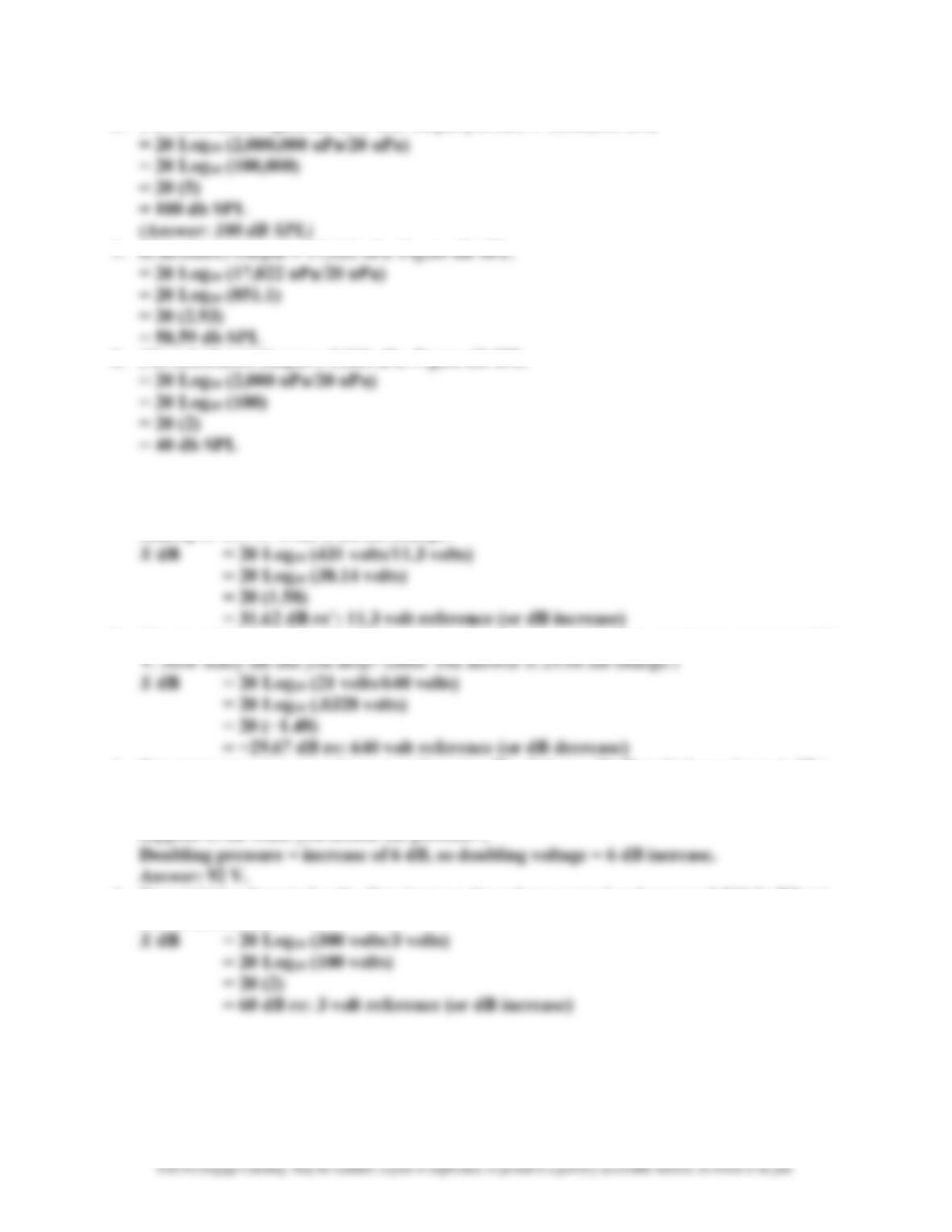
6. (No calculator) Figure dB SPL with output pressure = 2,000,000 uPa.
8. (No calculator) Output = 2,000 uPa. Figure dB SPL.
III. dB Increase and Decrease
1. Given an initial reading of 11.3 V (your reference), you raise the sound output and get a
reading of 431 V. What is the dB change?
2. Given an initial reading of 640 V, you turn the loudness control down and get an output of 21
3. You measure a sine wave from an audiometer. The dial says 20 dB (which you know is HL),
and you read a voltage on your oscilloscope of 46 V at 20 dB. What is the voltage if you turn
the audiometer up 6 dB? (Hint: Remember that voltage is the correlate of pressure. What
happens to dB when you double the pressure?)
4. Your initial voltage is 3 volts. You increase the volume control and now read 300 V. What is
the dB difference?
10
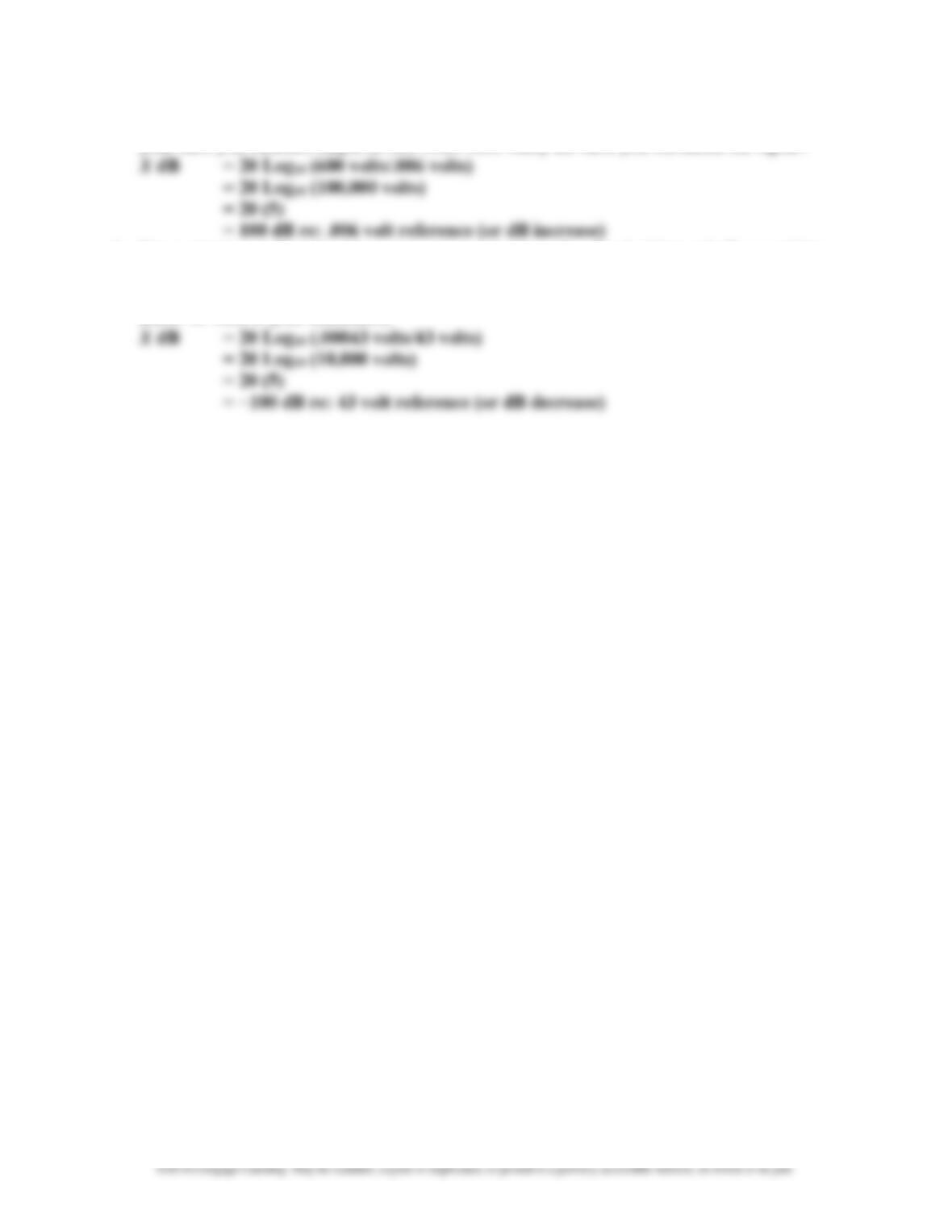
5. You turn on the radio and measure .006 volts. After cranking the volume up until it parts
your hair, you measure output as 600 volts. How many dB have you increased the signal?
6. Your upstairs neighbor has his stereo set to a mind-boggling level. After verbally assaulting
him, you slap an oscilloscope on the speaker leads and get a reading of 43 volts. After he
turns it down (under protest), it reads .00043 volts. How many dB did you drop the intensity?
(Hint: 43 volts is your reference.)