ADDITIONAL ISSUES FOR CLASSROOM DISCUSSION
1. U.S. banking regulations prevent banks from owning major corporations.
In other countries, the banking industry is much more integrated with the
corporate sector, with banks owning corporations or being owned by
them, allowing easier finance for corporations. Is the United States at a
competitive disadvantage because of its regulations? What would be the
benefits and costs if the United States were to liberalize its regulations
and allow greater integration of banking and commerce?
2. Some economists believe that the degree of government regulation and
supervision in the banking industry is excessive. Some have even
proposed that the government get out of the business of insuring bank
deposits because the private sector could provide such insurance more
efficiently. What are the pros and cons of the government turning over
the FDIC to the private sector? How did the financial crisis of 2008
in,uence your views of the government’s role in regulation?
3. Banks are merging and creating larger and larger entities. Will bank
mergers necessarily reduce competition? Should the government act to
prevent more bank mergers from occurring? Think about mergers that
give a bank a greater market share within an area versus mergers that
expand a bank’s geographic reach.
SOLUTIONS TO TEXTBOOK NUMERICAL
EXERCISES AND ANALYTICAL PROBLEMS
Numerical Exercises

Chapter 9: Government’s Role in Banking 97
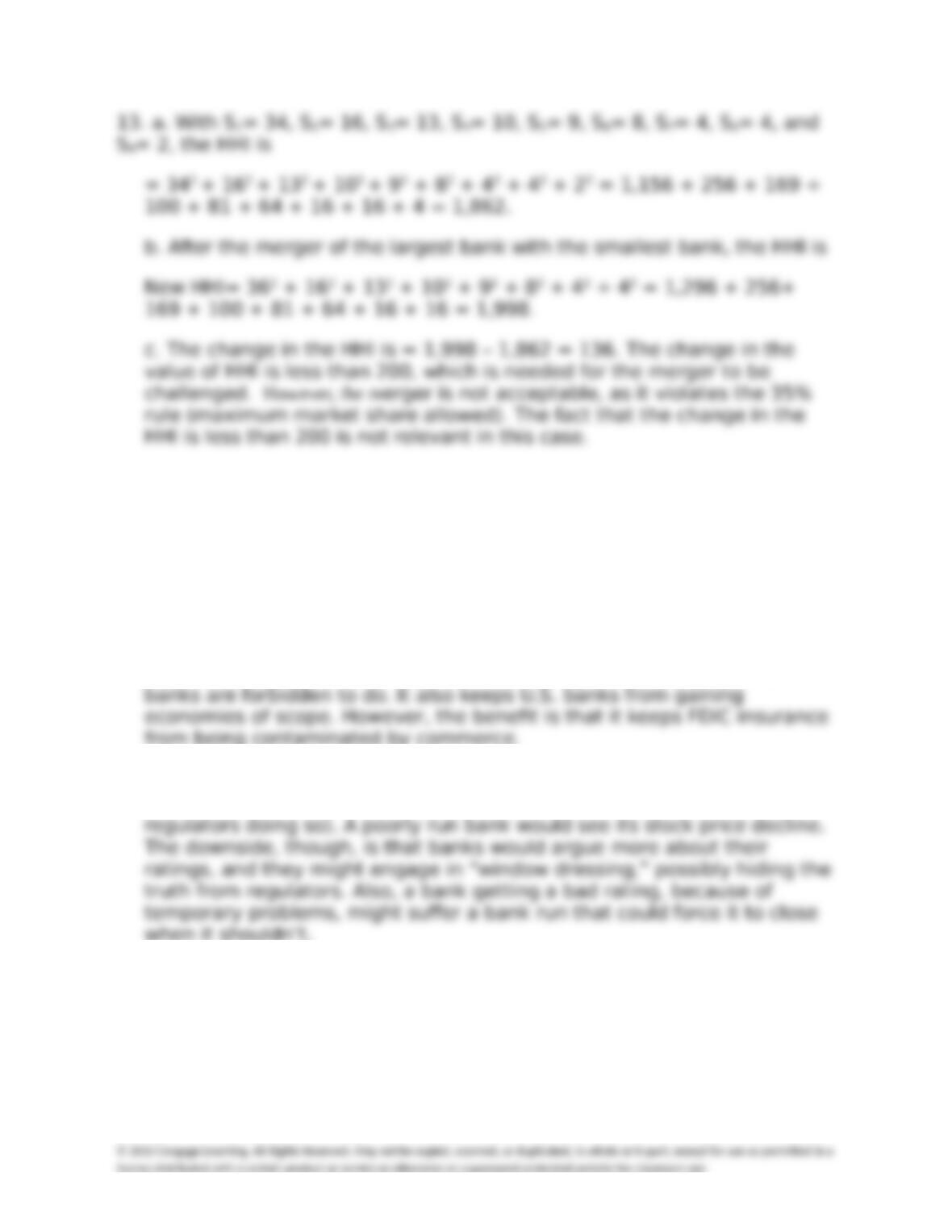
The new HHI does not exceed 1,800, and the new share of deposits does
not exceed 35 percent, so this merger cannot be challenged, even
though the change in the HHI exceeds 200.
If A and D merge, as well as B and C, the HHI is:
Chapter 9: Government’s Role in Banking 98
Analytical Problems
14. This solution is sensible because it avoids systemic risk from shutting
down a big bank. Big banks have greater eDects on other banks because
of externalities. Thus, on efficiency grounds, the solution is reasonable.
But, it may be unfair to the creditors and shareholders of the small bank
from an equity point of view.
15. Yes, the U.S. banks are at a competitive disadvantage because foreign
banks can engage in activities (such as owning companies) that U.S.
16. Bank supervision would be easier if the ratings were available to the
public because the market would pressure banks to do well (instead of
17. Mergers of banks from diDerent geographic regions don’t change the
local HHI, so they won’t violate the merger guidelines.
ADDITIONAL TEACHING NOTES
Why Banks Want More Freedom from Regulation
Chapter 9: Government’s Role in Banking 99
How Can the Government Keep Banks from Failing?
Consequences of the New Financial Holding Company Structure
A likely outcome of the new FHC structure is that banks, insurance
companies, and securities firms are likely to merge over time to oDer
one-stop shopping for their customers. The first example of this came in
1998 before the Gramm-Leach-Bliley Act was passed when Citibank, one of
the largest banks in the world, merged with Travelers Insurance, a large
insurance company. The merger appeared to violate the existing banking
law, but regulators allowed the merger to proceed as long as the company
came into compliance within two years. Citibank and Travelers were hoping
that the law would change before two years—fortunately for them, it did. As
a result, Citibank and Travelers, which combined under the new name
Citigroup, got a head start on the competition and became the first large
bank to sell insurance nationwide. Ask students to research Citigroup’s fate
during the financial crisis of 2008.
Consolidation in the Banking Industry
Competition is leading to consolidation in the banking industry. In 1980,
there were over 14,000 commercial banks in the U.S. By 1990, that number
had declined only slightly, to less than 13,000.
But in 2009, there were just under 7,000 commercial banks left. Similarly,
there were 4,300 thrift institutions in 1980, 2,800 in 1990, and just 1,200 in
Chapter 9: Government’s Role in Banking 100
2009. Credit unions with federal charters numbered 13,000 in 1980, 9,000
in 1990, and less than 5,000 in 2008.
Banking Supervision
The banking authorities try not to impose significant costs on banks, but
sometimes circumstances force them to. For example, in the early 1990s,
the authorities were very tough on commercial banks because they worried
that commercial banks were heading down the path of the S&Ls. As a result,
they toughened their stance toward any questionable activities that banks
were engaging in. Bank managers were greatly annoyed and complained
bitterly at the time, but in retrospect the subsequent health of the banking
industry proved that the authorities provided a valuable service to the