Chapter 8: How Banks Work 89
CHAPTER 8
How Banks Work
TEACHING OBJECTIVES
Goals of Part 2: Fundamentals of Banking
A. Describe how banks work (Chapter 8) and discuss the government
regulations of banks (Chapter 9).
B.
Goals of Chapter 8
A. Describe how banks operate and their role in the nancial system.
B. Discuss the key role of information problems that banks face and how
they solve such problems.
E.
F.
TEACHING NOTES
A. The Role of Banks
1. Introduction
a) A bank is a nancial intermediary that accepts deposits from
savers and makes loans to borrowers; we call commercial banks,
thrift institutions, and credit unions by the generic term bank in
this chapter
b) Banks are efficient at matching savers and borrowers because they
pool funds and gather information about borrowers
2. Asymmetric-Information Problems
a) Borrowers know more about their businesses than banks do, so the
loan process is a situation of asymmetric information, which
means that one party to a transaction knows more than another
b) Asymmetric information includes both adverse selection and
moral hazard
c) Adverse selection occurs when worse-than-average risks are more
likely to enter a contract; that is, bad borrowers are more likely to
seek a loan than good borrowers
(1)A general example is the used car market, in which the average
car in the market is of below-average quality
(2)Banks offering loans at high interest rates face the problem that
borrowers willing to pay such high rates are probably bad risks
Chapter 8: How Banks Work 90
d) Moral hazard means the existence of a contract changes the
behavior of a party to the contract, doing harm to one party
(1)Moral hazard occurs when people do not take precautions with
their property if they are insured fully against loss
(2)In banking, moral hazard occurs when the recipient of a bank
loan behaves di2erently than if it didn’t have the loan, to the
detriment of the bank; for example, by not using the funds as
the bank intends
e) Solution to asymmetric-information problems include gathering
information and restricting borrowers’ activities by requiring
collateral, imposing net worth requirements, and writing
covenants into the loan contract
3. Failures of the Banking System
a) The Savings-and-Loan Crisis
(1)Savings and loan associations (S&Ls) once made half of the
mortgage loans in the country, but now make less than one- fth
of them
(2)S&Ls lent funds for home mortgages and had undiversi ed
portfolios both in terms of the type of loans and the location of
the loans (their local communities)
b) The Credit Crunch of the Early 1990s
(1)A credit crunch occurs when banks do not lend as much as
they normally would, but impose stricter standards on
borrowers
(2)A credit crunch occurred in the early 1990s because banks
faced losses on real-estate loans and higher capital
requirements
(3)Small rms were damaged by the credit crunch as they could
not obtain funds needed to operate
c) The Financial Crisis of 2008
(1)Declining housing prices led to mortgage defaults that led to
losses at banks, which led to drops in stock prices, which led to
a deep recession
Chapter 8: How Banks Work 91
(2)Firms could not obtain nancing and international trade declined
sharply; the Fed and the Treasury Department bailed out large
nancial rms
B. How Do Banks Earn Pro ts?
1. A Bank’s Balance Sheet
a) Assets = Liabilities + Equity Capital
(1)
b) Assets include reserves, securities, and loans
c) Liabilities include transaction deposits, nontransaction deposits,
and borrowings
2. Reserve Accounting
a) A bank’s reserves include its vault cash plus its deposits at the
Federal Reserve
b) A bank must hold a certain amount of reserve, based on the
schedule of reserve requirements and the amount of transactions
deposits at the bank; see Table 8.1
c) A bank with excess reserves can hold them, lend them in the
federal funds market, buy securities with them, or make loans
with them; point out the Policy Perspectives about Interest on
Reserves
d) The interest rate in the federal funds market is the federal funds
rate
e) A bank with a shortfall of reserves must borrow in the federal funds
market, borrow from the Fed at the discount window and pay the
discount rate, sell some securities, reduce its outstanding loans,
or issue some CDs
3. Bank Pro ts
a) A bank earns pro ts from interest it charges borrowers and fees for
its services, less its costs, which include interest it pays on
deposits and costs of operation, mainly wages for employees; see
the box on Those Pesky ATM Fees
b) The spread is the difference between the average interest rate the
bank earns on its assets and the average interest rate it pays on its
deposits; a higher spread means higher pro ts, but the spread is
Chapter 8: How Banks Work 92
4. The Risks Banks Take
a) Default risk (also called credit risk) is the risk that a borrower
will not repay a loan or the issuer of a security will not make its
interest payment or principal repayment
b) Interest-rate risk arises because market interest rates may
change, a2ecting the value of a bank’s assets
c) Banks try to diversify their portfolios to reduce default risk and loan
committees approve only those loans that are consistent with the
C. Those Pesky ATM Fees
1. ATMs were free to use when banks were rst establishing a network of
machines and wanted to encourage their use
2. But once the ATM network was large enough, banks began charging
for the use of ATMs, by people without accounts at their bank, thus
giving banks the incentive to install their own machines instead of
free riding on machines provided by other banks
D. Why Are Interest Rates on Credit Cards So High?
1. As interest rates on most securities declined in the 1990s and 2000s,
credit card interest rates did not fall very much
2. One reason for high credit card rates is adverse selection—broadly
advertised credit cards attract borrowers who are likely to default
3. Another reason for high credit card rates is that people do not shop
around very much; many people fail to switch to cards with lower
rates, so credit card companies have little incentive to reduce their
rates
4. A nal reason for high credit card rates is that the customers using
credit cards have changed over time and now include less
creditworthy people, so a higher interest rate o2sets the higher
default risk that banks face
E. Policy Perspectives: Interest on Reserves
1. During the nancial crisis of 2008, Congress authorized the Fed to pay
interest on banks’ reserve balances; because of this change and other
lending by the Fed, reserves increased greatly (see Figure 8.1)
2. Interest on reserves could become another monetary policy tool
3. Update students on changes in reserves as economic conditions
change
Chapter 8: How Banks Work 93
electronic banking and the use of ATMs, many students will never have
talked with an actual banker. Students may be surprised to learn that
much of a banker’s activities involve salesmanship, especially nding
borrowers in competition with other banks.
2. Before they read the chapter, ask your students what they think about
bank’s charging ATM fees. Then, once they have read the chapter and in
particular the box on ATM fees, ask them to consider whether their
earlier views are still correct.
3. In recent years, some banks have been accused of exploitative practices
by getting poor people to take out credit cards or other forms of credit at
high interest rates or with high fees. But, as recently as 30 years ago,
people with low incomes and low wealth had no access to credit at all. Is
it better that they have access to credit at a high cost or that they have
no access to credit at all?
SOLUTIONS TO TEXTBOOK NUMERICAL
EXERCISES AND ANALYTICAL PROBLEMS
Numerical Exercises
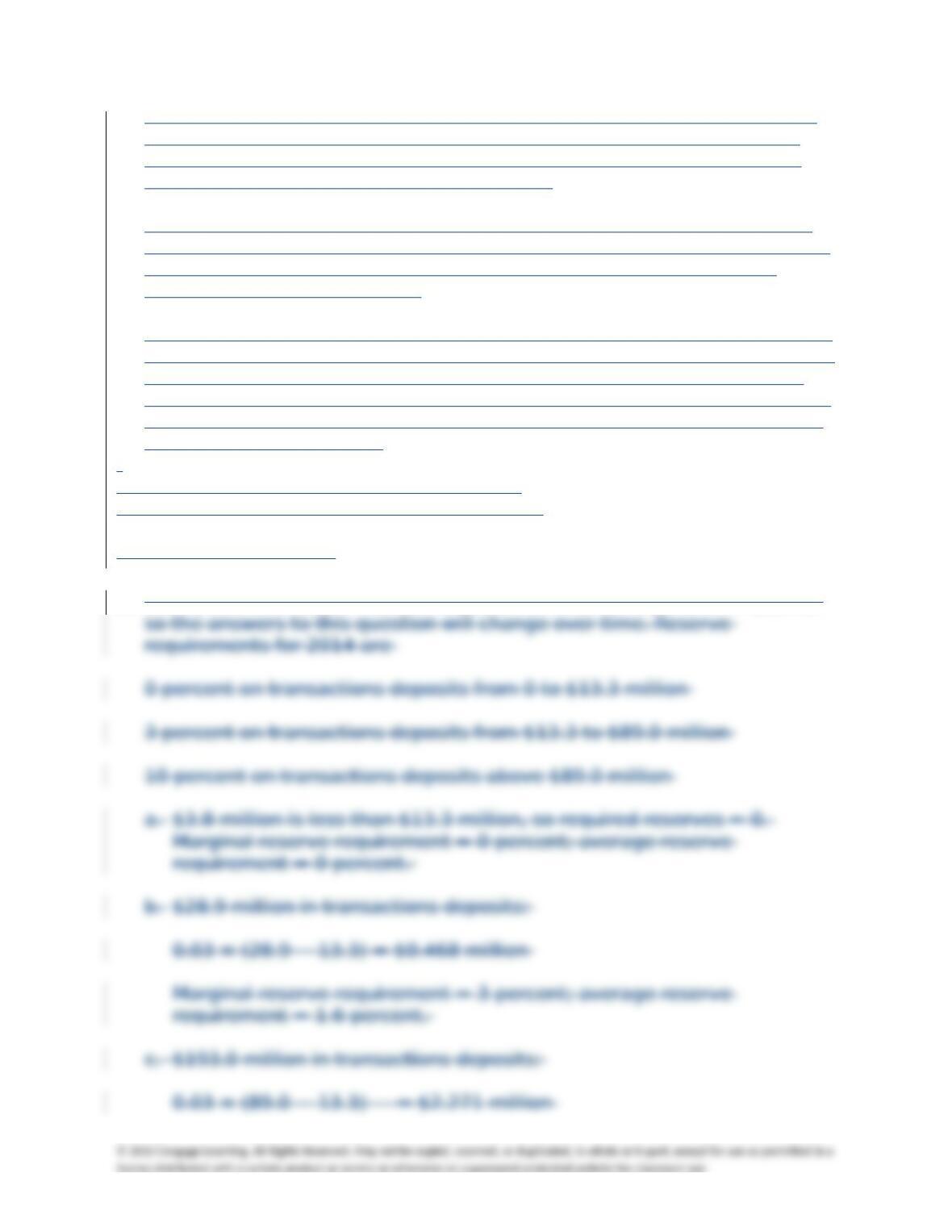
11. Each year, the Federal Reserve adjusts the reserve requirement cuto2s,
Chapter 8: How Banks Work 94
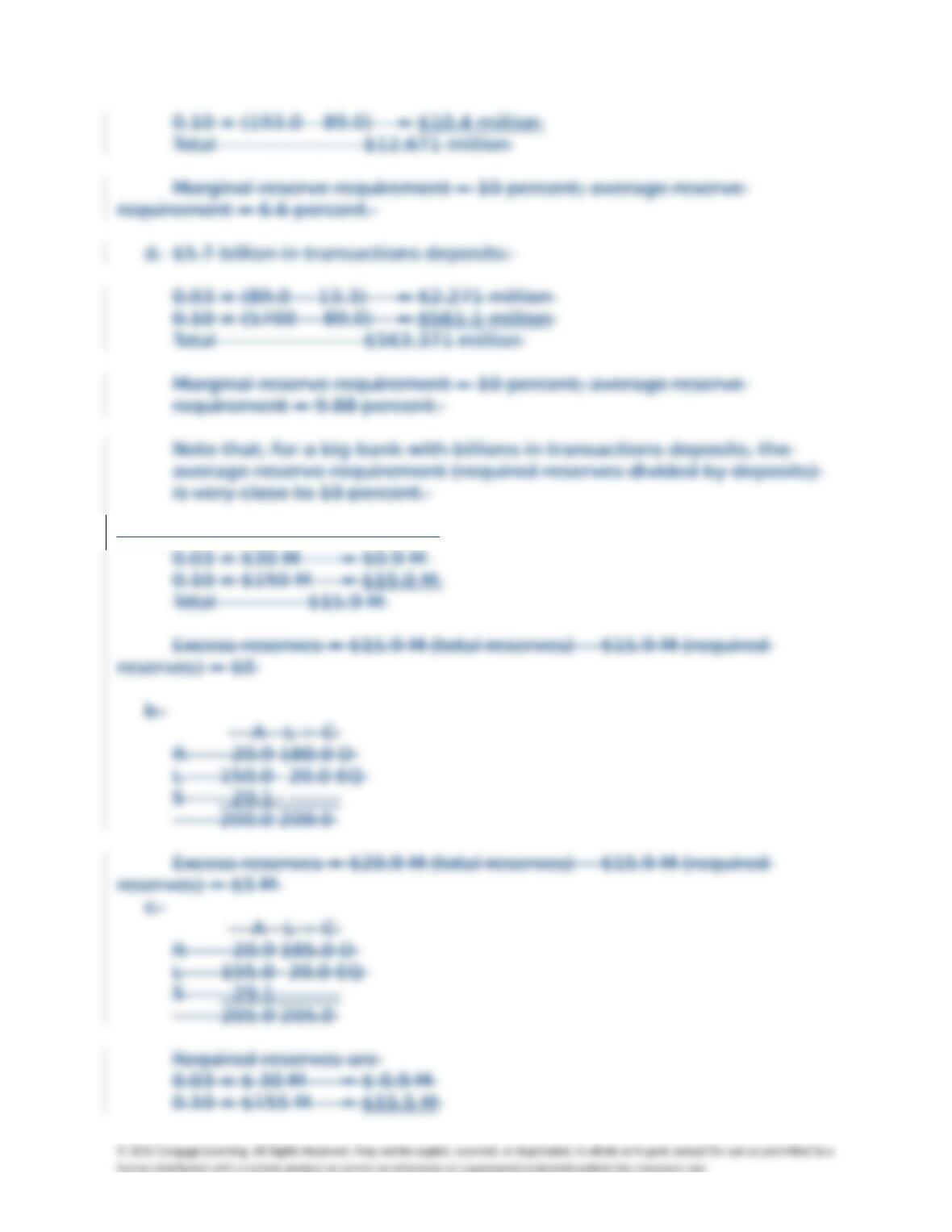
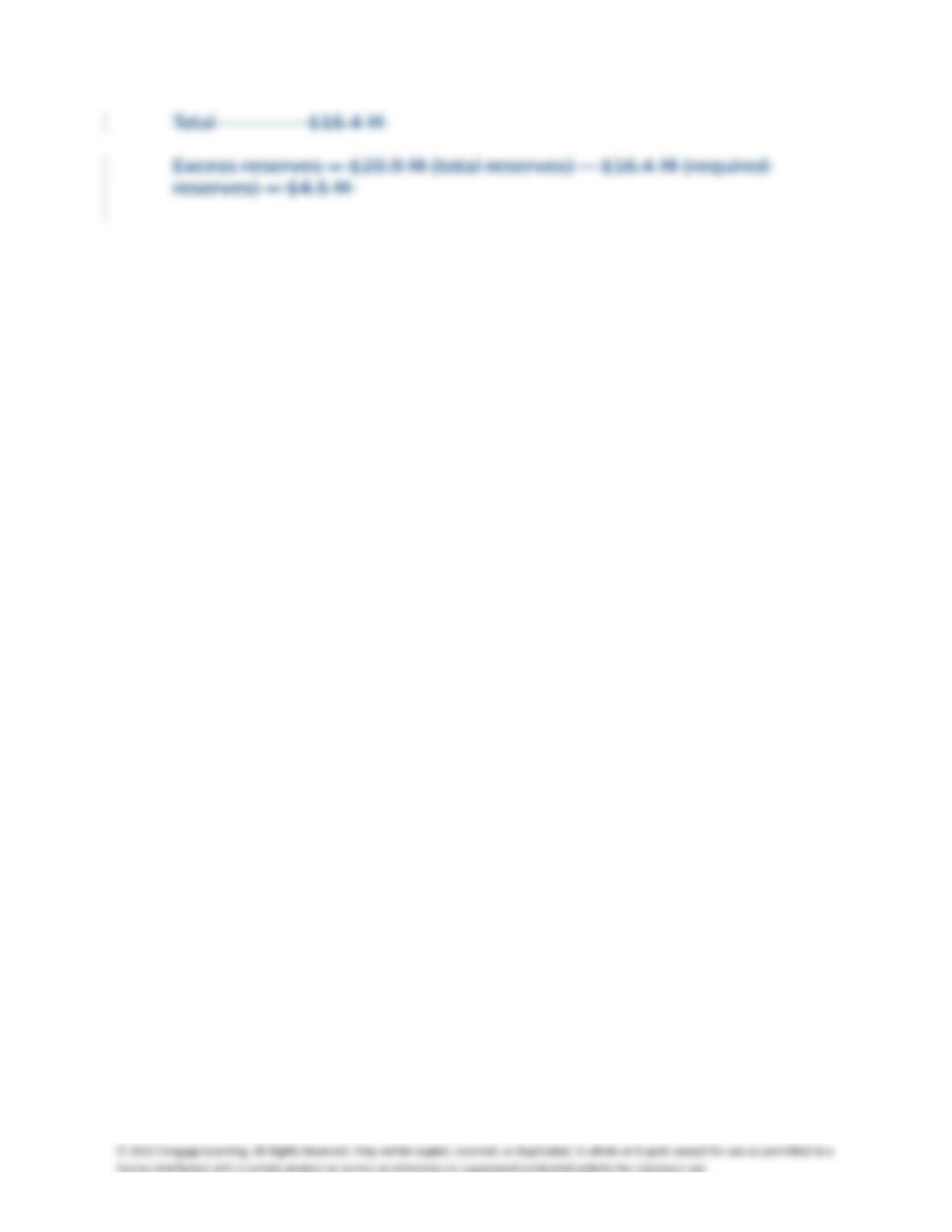
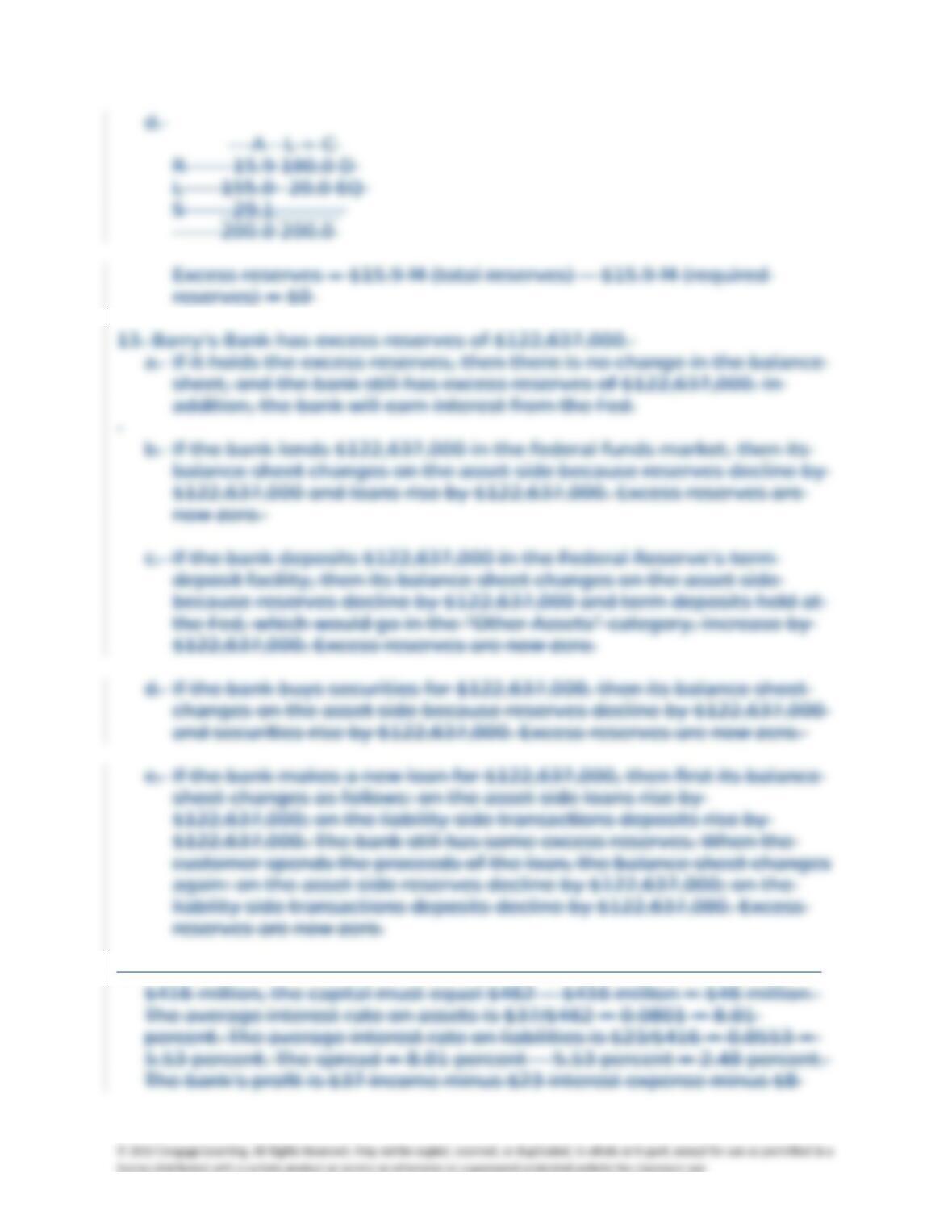
12. a. Required reserves are
Chapter 8: How Banks Work 95
Chapter 8: How Banks Work 96
14. (Amounts in millions) Because assets = $462 million and liabilities =
Chapter 8: How Banks Work 97
Analytical Questions
15. Small rms depend more on bank loans than large rms, so they are
hurt more by a credit crunch. In a credit crunch, banks lend less than
they otherwise would. Lending to small rms is more subject to
asymmetric-information problems than lending to large rms. Moral
hazard is greater because a small rm can hide money more easily and
has fewer assets that a bank could seize. Adverse selection is greater
because less information is known about small rms. Thus, small rms
have trouble raising funds in capital markets (that is, selling bonds and
stocks), so they must use bank loans.
16. In support of the policy, it could be argued that a higher insured amount
keeps wealthy people from withdrawing their funds, if a bank gets into
trouble; withdrawals would make the bank more likely to fail. Also, the
new policy protects a greater percentage of depositors. On the opposite
side is the argument that if wealthy people stand to lose, they will spend
more effort monitoring the bank’s health. This will ensure that the bank
is sound.
17. If the Fed paid interest on reserves equal to the federal funds rate,
18. If a bank chose to keep its risk very low, it would not earn very much on
its assets, so it could not pay much to depositors and would lose
business. The idea of protecting banks from competition was the
prevailing view of government regulation of banking from the 1940s to
the 1960s. Government regulations prevented banks from competing
vigorously, so they earned very large pro ts and had substantial
monopoly power, especially in small towns. But, lack of competition
meant the spread was very large, so depositors earned very little, and
borrowers paid high interest rates on loans. Thus, the cost of the
increased degree of bank safely was borne by the banks’ customers.
ADDITIONAL TEACHING NOTES
Chapter 8: How Banks Work 98
Example of Adverse Selection
Suppose a health insurance company o2ered major medical insurance to
anyone for $5,000 a year. It would nd itself besieged with requests for
insurance from people with major illnesses; yet it would get no interest from
healthy people. Thus, people select whether to apply for the insurance or
not, based on the knowledge of their own health status. The role of
asymmetric information is clear in this example—the health insurance
company does not know anyone’s health history, but the people themselves
do.
How Monetary Policy Can Lead to a Credit Crunch
5. The main reasons for the credit crunch from 1990 to 1992 were the
easy credit of the late 1980s and the regulatory requirement for
additional capital. But, sometimes tighter monetary policy (a
reduction in the money supply) can cause a credit crunch. When the
Federal Reserve tightens monetary policy, nominal interest rates rise.
When that happens, banks may fear that the economy will slow.
Bankers may raise their credit standards, cutting o2 loans to
businesses that would normally qualify. Also, the rise in interest rates
raises the costs for borrowers, so balance sheets worsen. The rise in