ADDITIONAL ISSUES FOR CLASSROOM DISCUSSION
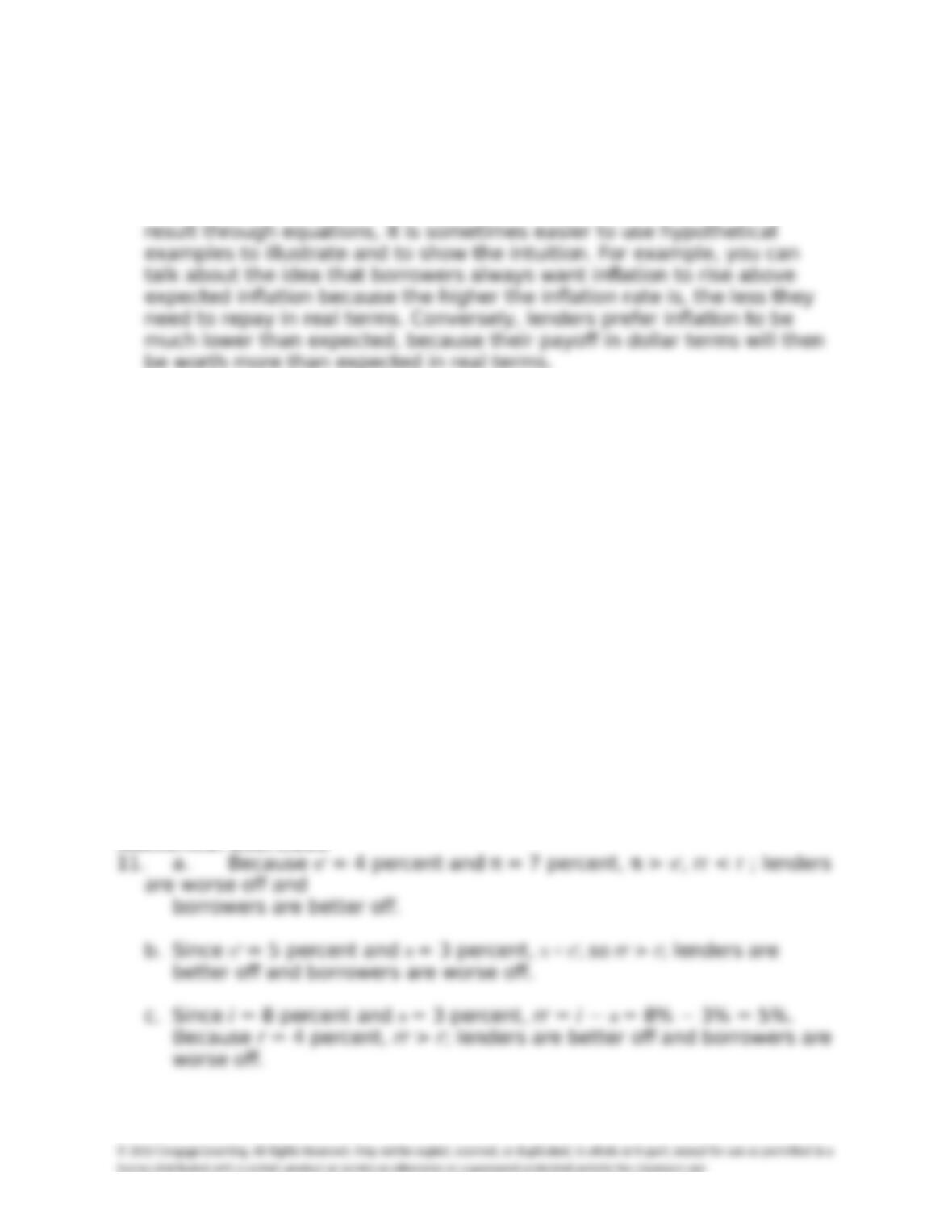
1. Students often find it difficult to work quickly through the logic of the
following question: Would you rather be a borrower or lender if inflation
turned out to be higher than expected? Rather than focusing on the
2. The discussion about inflation and the tax system is crucial to our
discussion of monetary policy in Chapter 17. It may be helpful to go
through a number of examples of how the numbers work, so they can
see that the tax on nominal income translates into a large tax rate on
real income, with the real tax rate rising with inflation.
3. You can get an interesting discussion going regarding the best way to
avoid the distortion from the interaction of inflation and the tax system.
Students are intrigued about the di’erent possibilities, including
improving the tax system to make it neutral with respect to inflation. But
if you talk about the complications, especially when it comes to figuring
out the portion of capital gains that is attributable to inflation, they will
see why it has not yet been done. The idea that, if inflation were zero,
the distortion would go away is important to our discussion of monetary
policy in Chapter 17.
SOLUTION TO TEXTBOOK NUMERICAL
EXERCISES AND ANALYTICAL PROBLEMS
Numerical Exercises
Chapter 6: Real Interest Rates 53
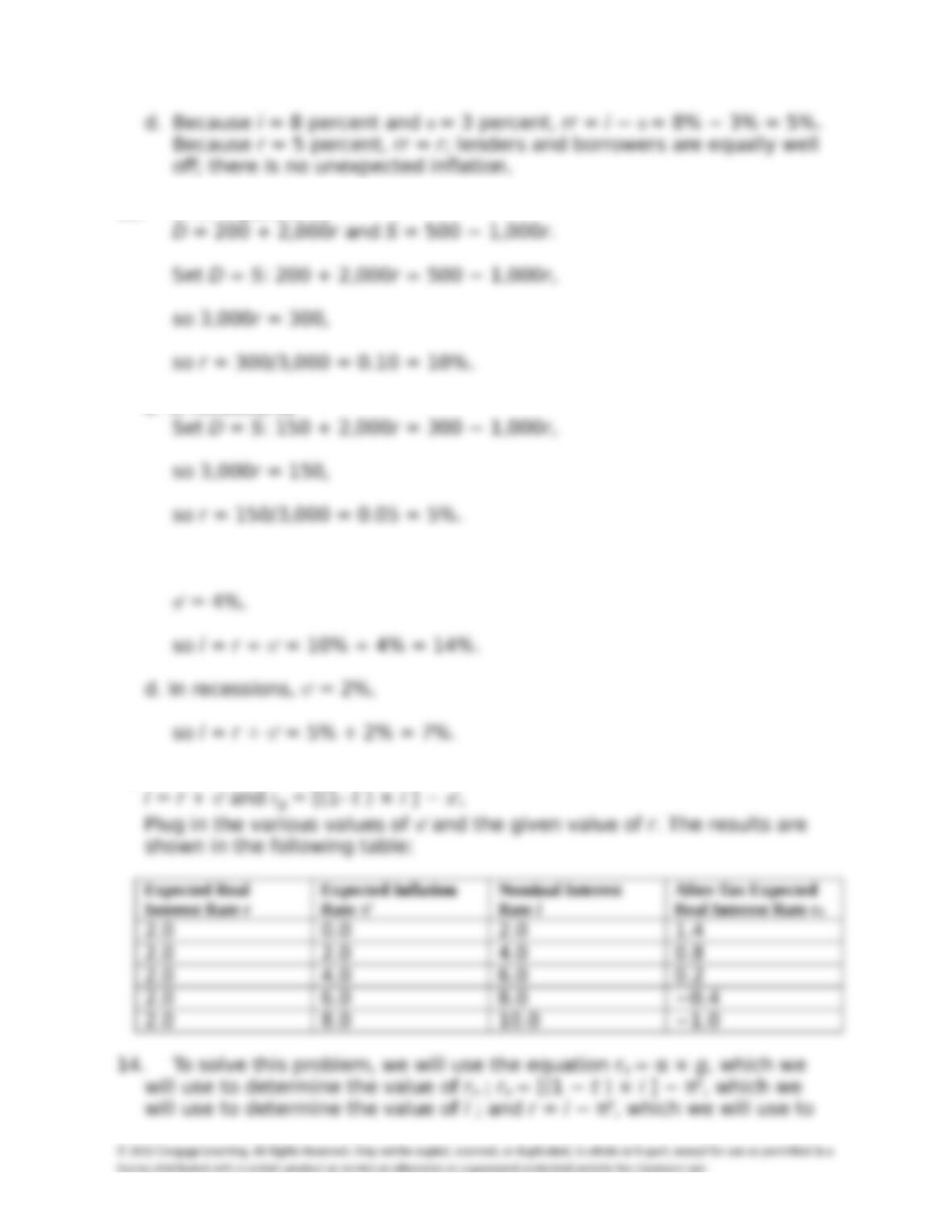
12. a. In expansions,
b. In recessions,
c. In expansions,
13. Use the equations
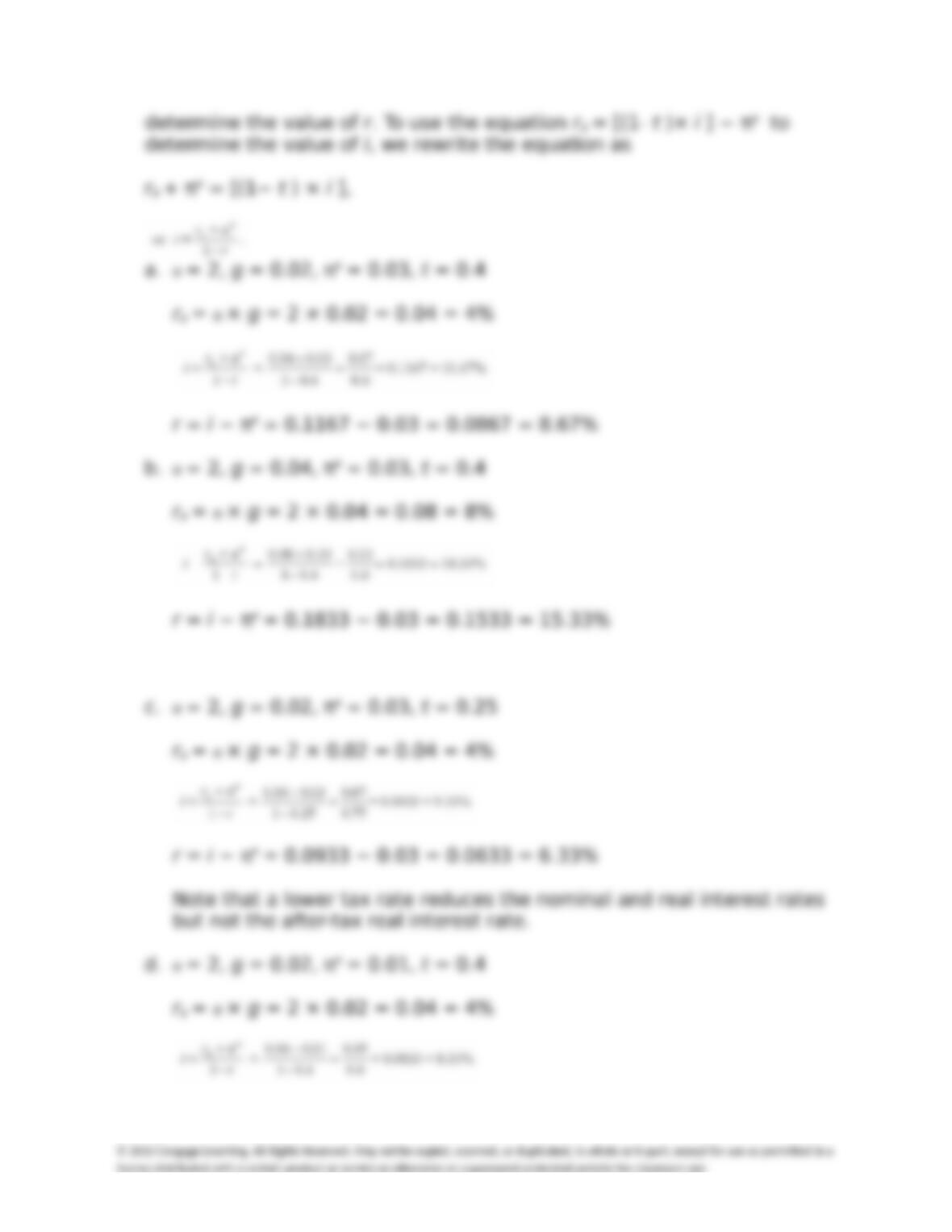
Chapter 6: Real Interest Rates 54
Note that faster economic growth raises all three interest rates.
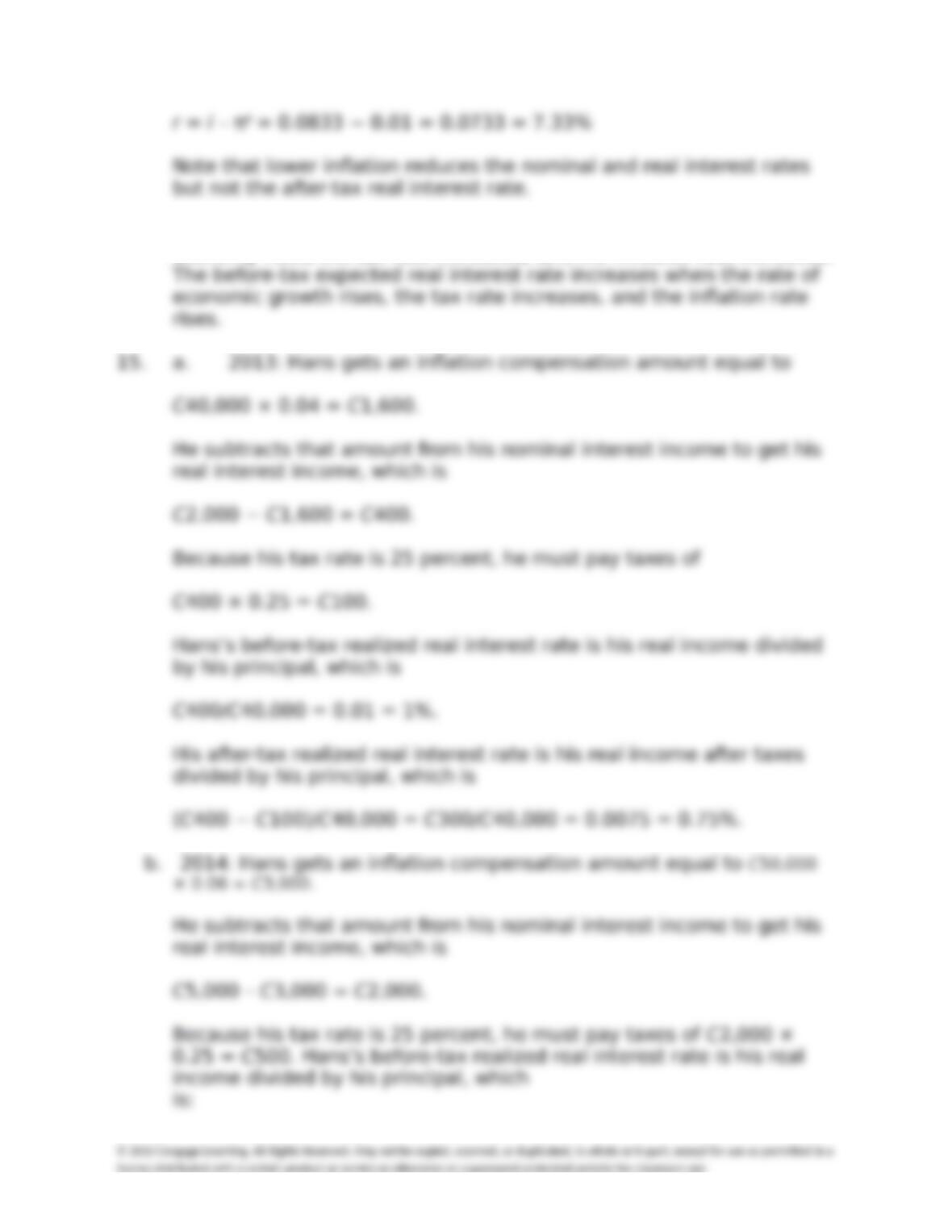
Chapter 6: Real Interest Rates 55
e. The nominal interest rate increases when the growth rate of the
economy rises, the tax rate increases, and the inflation rate increases.
Chapter 6: Real Interest Rates 56
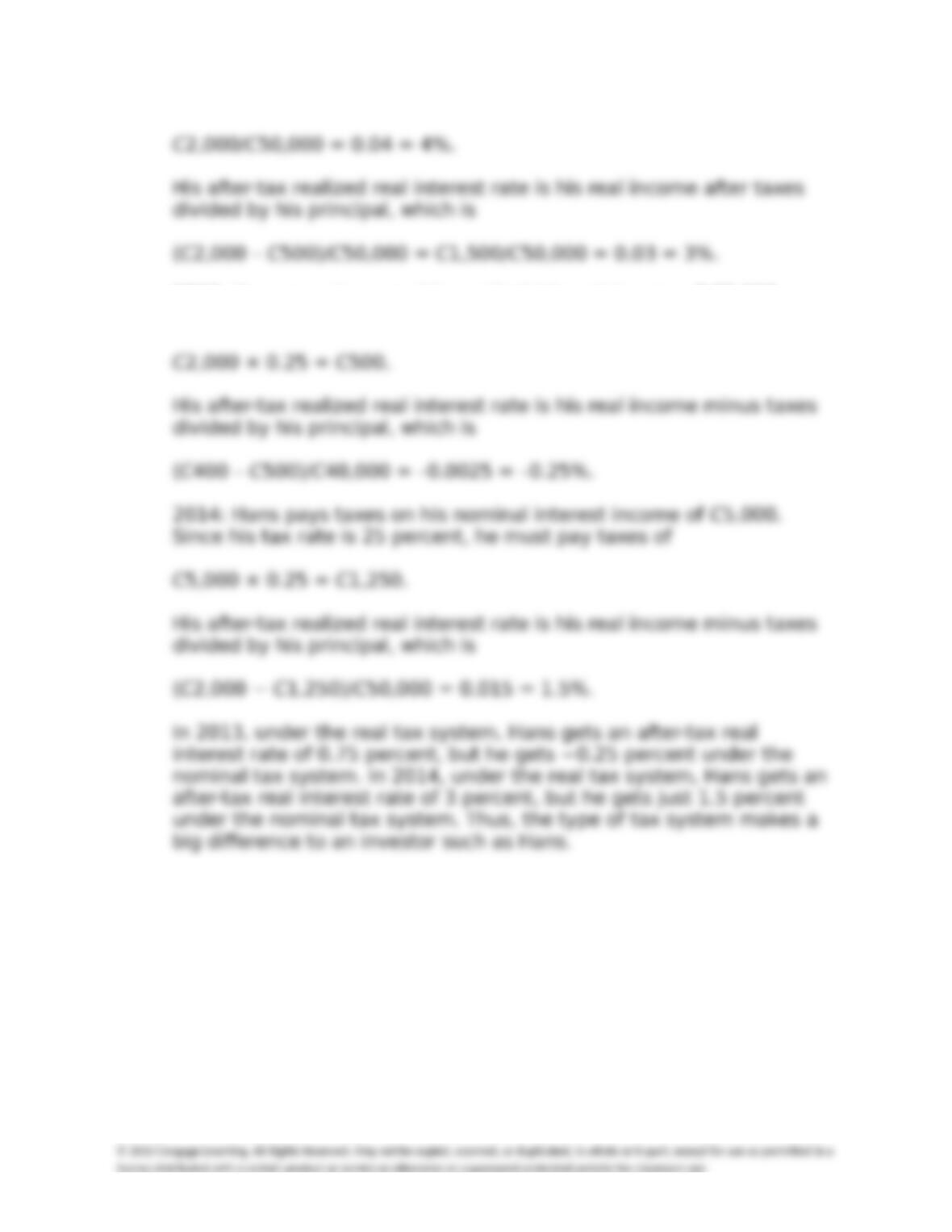
c. 2013: Hans pays taxes on his nominal interest income of C2,000.
Since his tax rate is 25 percent, he must pay taxes of
Analytical Problems
16. Both the homeowner and the bank share the risk of changes in the
price level in nominal terms, but they both reduce their risk in real terms.
Thus, in real terms, they both gain. The contract eliminates the risk from
inflation by indexing to the inflation rate. Such a mortgage would be
beneficial to both borrowers and lenders.
17. Since both the supply and demand for bonds depend only on the
after-tax expected real interest rate, which is independent of the
Chapter 6: Real Interest Rates 57
expected inflation rate, higher expected inflation will not a’ect supply or
demand. For the after-tax expected real interest rate to remain constant,
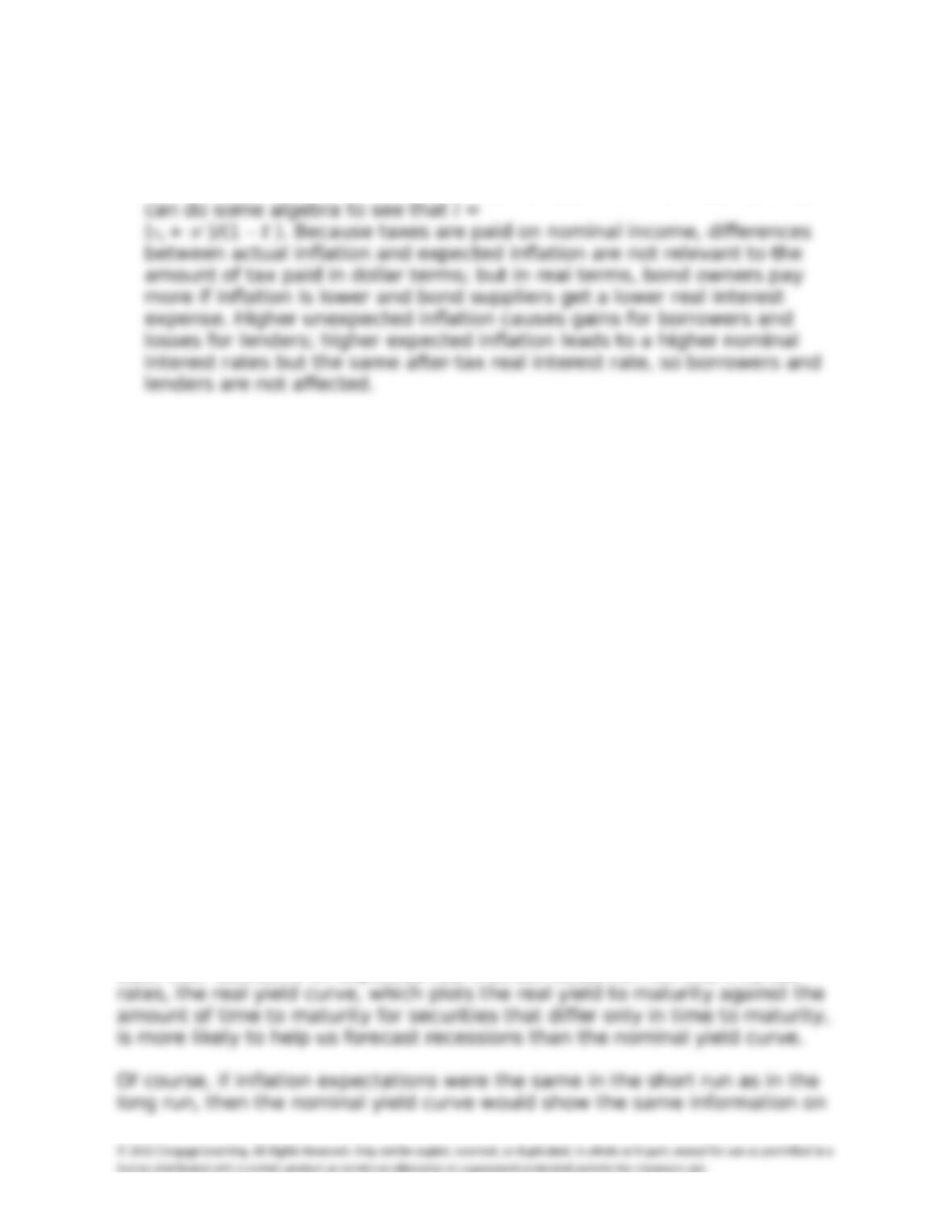
and since ra = [(1− t ) × i ] − πe , the higher expected inflation rate must
lead to an increase in the nominal interest rate. From that equation, we
18. When inflation is unexpectedly high, banks’ profits decline. The rise in
inflation will lead nominal interest rates to rise, so the bank will have to
increase the interest rates on its deposit accounts. But, the bank is
locked in to making many long-term loans at interest rates that cannot
rise (although it will raise the interest rate it charges on new loans). As a
result, the banks’ profits are squeezed by having to pay out more
interest to depositors but not getting more interest on its loans. As profits
fall, the banks’ stock prices fall.
19. You might make a loan even if there were a negative after-tax
expected real interest rate because alternatives might be worse. For
example, if you expected to lose 1 percent in real after-tax terms from
such a loan, that deal might be better than holding cash if the inflation
rate were high or investing in other assets whose value was declining.
Historically, there have been times when many investment returns were
negative at the same time, such as the 1970s.
ADDITIONAL TEACHING NOTES
The Concept of the Real Yield Curve
Because of changes in expected inflation over time, the yield curve drawn
with real interest rates may be more useful in forecasting the economy than
the yield curve drawn with nominal interest rates. Because business firms
base their decisions on expected real interest rates, not nominal interest
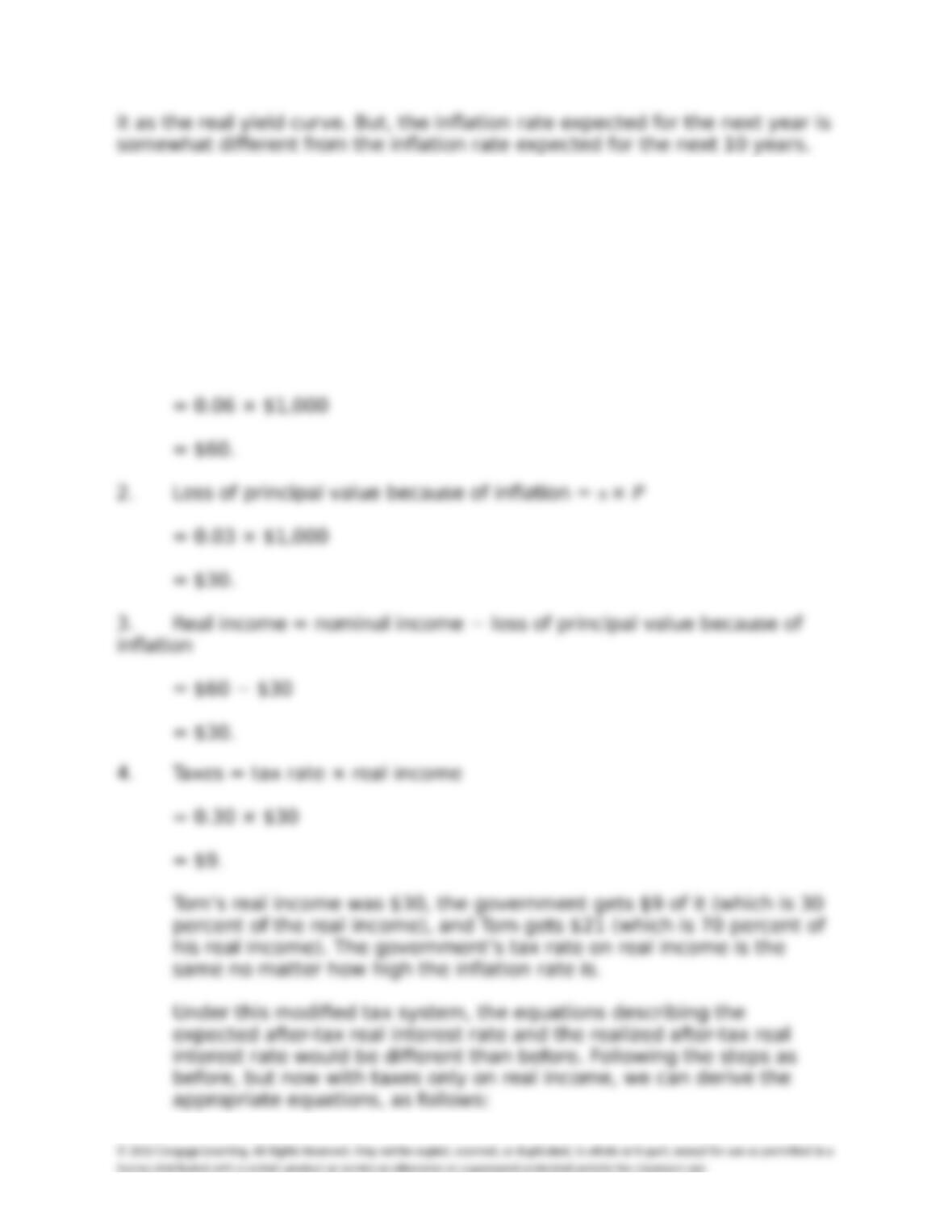
Chapter 6: Real Interest Rates 58
Discussion of Alternative Tax System Based on Real Income Rather
than Nominal Income
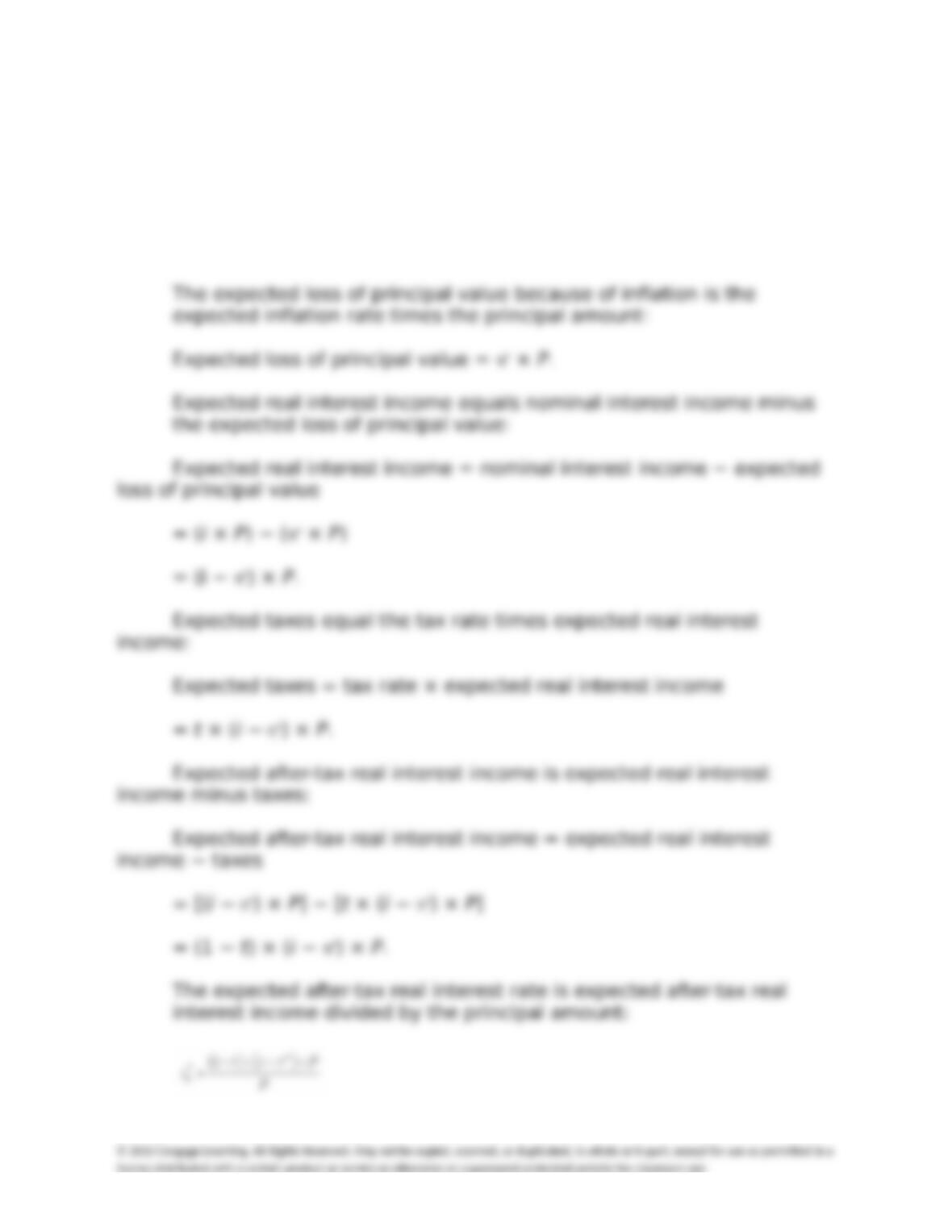
Recall the example in which Tom invested $1,000 at 6 percent interest. He
had a 30 percent tax rate and the inflation rate was 3 percent. Under the
modified tax system that is based on real income, the steps to calculate
Tom’s taxes are:
1. Nominal interest income = i × P
Chapter 6: Real Interest Rates 59
Suppose P is the principal amount invested, i is the nominal interest
rate, t is the (real) tax rate, and πe is the expected inflation rate.
Nominal interest income equals the interest rate times the principal
value:
Nominal interest income = i × P.
Chapter 6: Real Interest Rates 60
The asterisks (*) in equations (14) and (15) mean that these are the
real interest rates under an alternative tax system that taxes only real
income, not nominal income. In both equations (14) and (15) you can
see that there is now no interaction between inflation and taxes; the
tax rate applies to the real interest rate in both cases. Note the
di’erence between these equations and equations (12) and (13),
where the tax rate was applied to the nominal interest rate, then
expected inflation was subtracted.
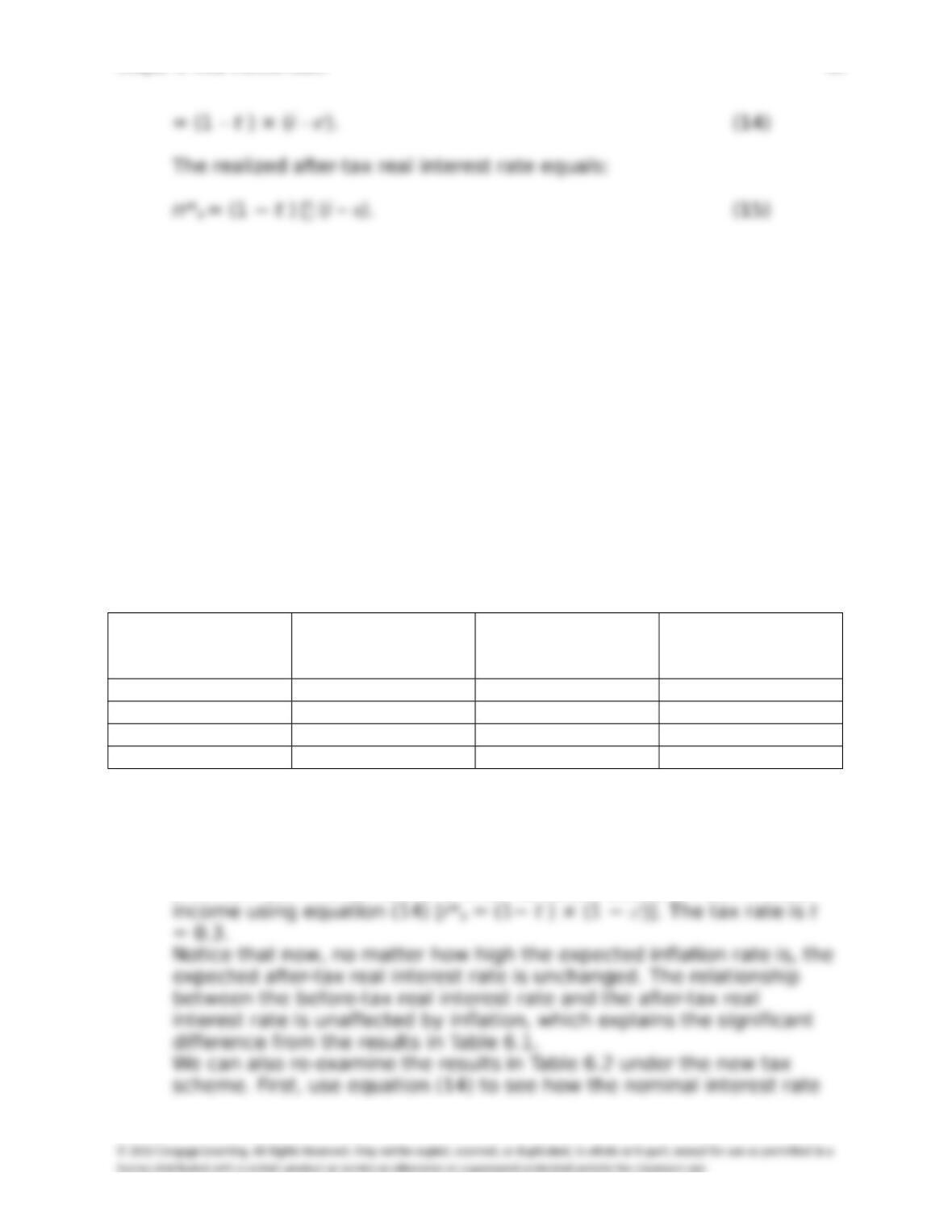
If we repeat the exercise from Table 6.1 with this new tax scheme, we
get the results shown in Table 6.3.
Table 6.3: How the After-Tax Real Interest Rate Varies with the
Expected inflation Rate,
When the Real Interest Rate Is Constant and Taxes Are Based on
Real Income
..
Real interest
rate,
r
Expected inflation
rate, πe
Nominal interest rate,
i
After-tax real interest
rate, r*a
3.0 0.0 3.0 2.1
3.0 3.0 6.0 2.1
3.0 6.0 9.0 2.1
3.0 9.0 12.0 2.1
…
.Note: All interest rates and inflation rates are in percent. The table
takes as given the data in the first two columns on the real interest
rate (r) and expected inflation rate (πe), then generates values for the
nominal interest rate (i) using equation (2) [i = r + πe], and the
after-tax real interest rate (r*) when taxes are based on real interest
Chapter 6: Real Interest Rates 61
would change with the expected inflation rate for a fixed after-tax real
interest rate. Equation (14) is:
r*a = (1− t ) × (1 − πe)
Divide both sides of the equation by 1 − t to get: ..
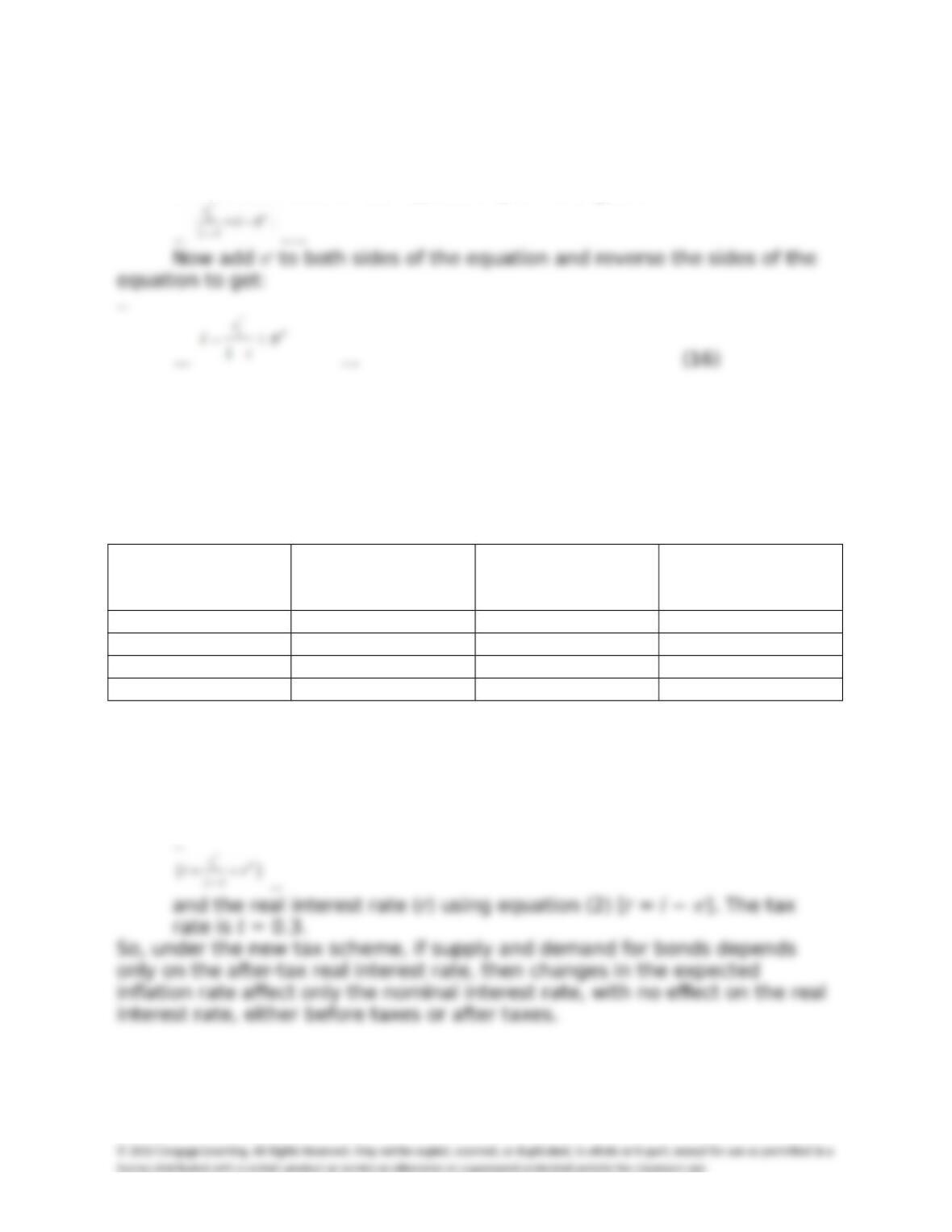
Using equation (16) to derive a comparable table to Table 6.2 under
the new tax scheme, we find the results shown in Table 6.4.
Table 6.4: How the Real Interest Rate Varies with the Expected
inflation Rate,
When the After-Tax Real Interest Rate Is Constant and Taxes Are
Based on Real Income
..
After-tax real
interest rate,
r*a
Expected
in2ation rate, πe
Nominal
interest rate, i
Real interest
rate, r
2.0 0.0 3.0 3.0
2.0 3.0 6.0 3.0
2.0 6.0 9.0 3.0
2.0 9.0 12.0 3.0
..
Note: All interest rates and inflation rates are in percent. The table
takes as given the data in the first two columns on the after-tax
expected real interest rate (r*a) and the expected inflation rate (πe).
Values for the nominal interest rate (i) are generated using equation
(16)