Chapter 6: Real Interest Rates 52
CHAPTER 6
Real Interest Rates
TEACHING OBJECTIVES
Goals of Chapter 6
A. Define real interest rates, show how inflation affects them, and describe
why inflation is a problem for investors.
B. Develop a version of the present-value formula in real terms.
C. Examine the historical data on real interest rates and see how they
respond to changes in the inflation rate and how they change during
recessions.
D. Investigate how the combination of taxes and inflation reduces returns
on financial investments.
TEACHING NOTES
A. Introduction
1. Investors care about what they can buy with their investment income,
not their earnings in dollars
2. The real interest rate adjusts for expected or actual inflation
B. What Are Real Interest Rates?
1. Introduction
a) An investor’s well-being depends not just on the interest rate but
on the rate of inflation
b) We need to adjust all returns for inflation
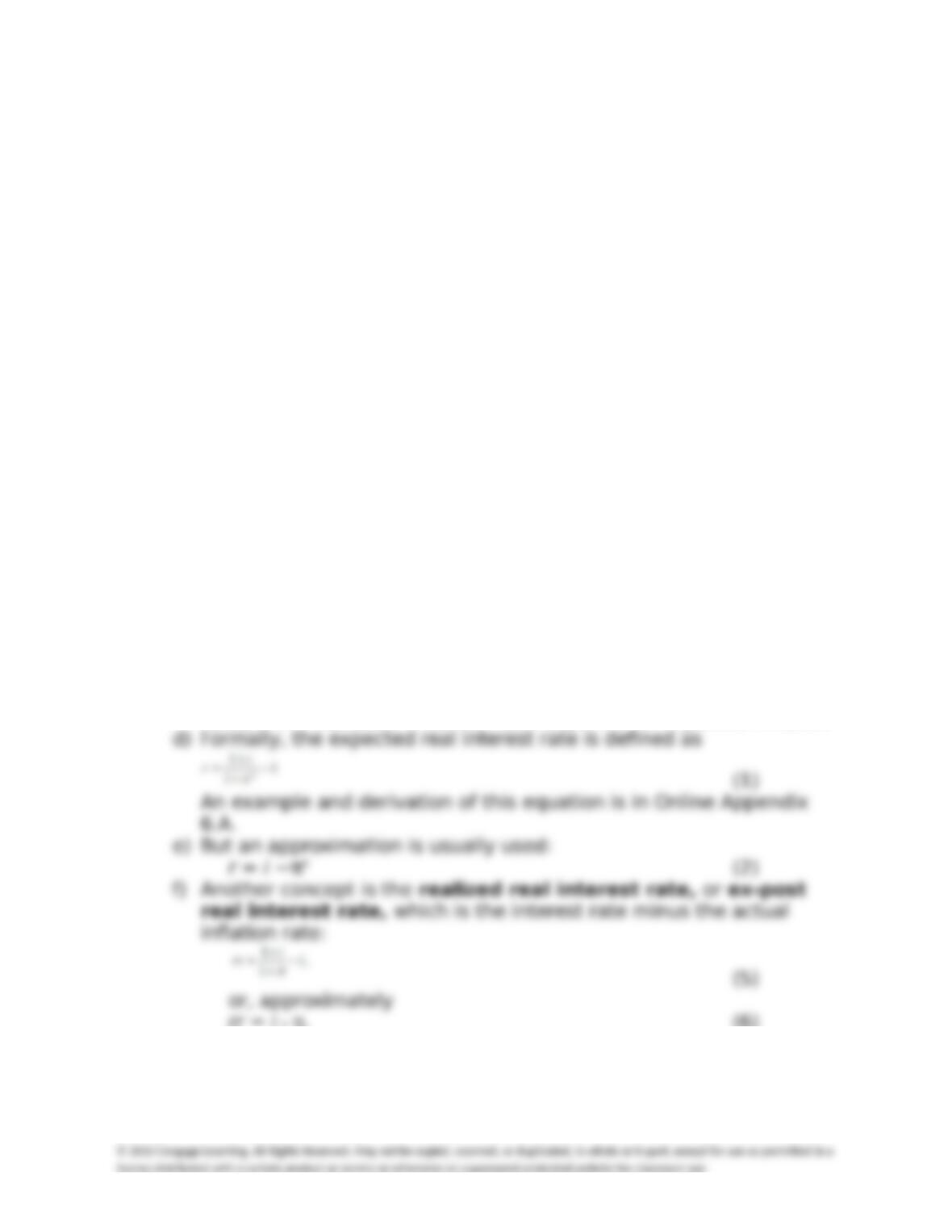
c) The expected real interest rate, or ex-ante real interest
rate, is the nominal interest rate adjusted for expected inflation
rr = i – π. (6)
2. The Impact of Unexpected Inflation on Real Interest Rates
Chapter 6: Real Interest Rates 53
a) Comparing the realized real interest rate to the expected real
interest rate, we see that the difference depends on the actual
inflation rate relative to the expected inflation rate:
r − rr = π −πe . (9)
b) So, when actual inflation exceeds expected inflation, the expected
real interest rate will exceed the realized real interest rate
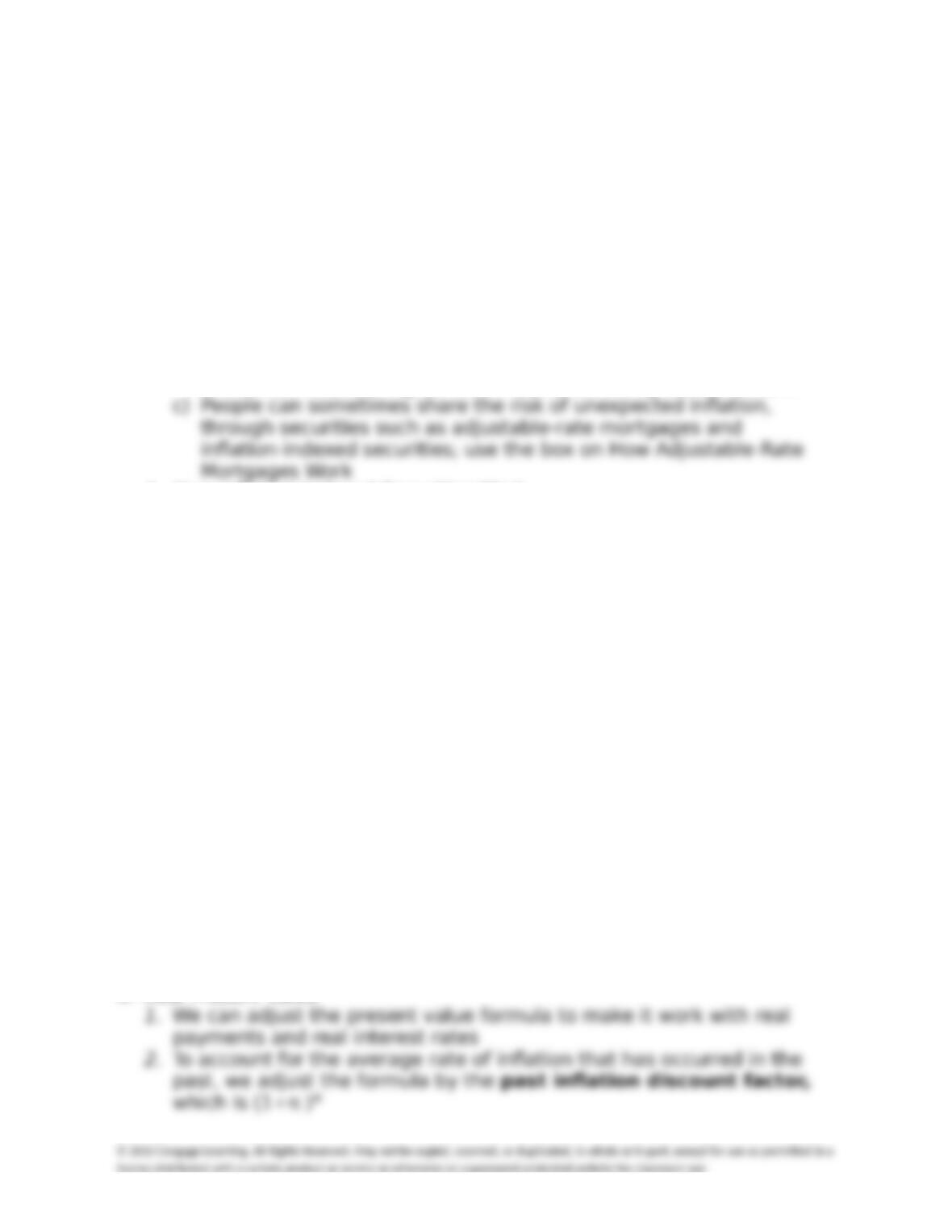
c) Unexpectedly low inflation helps lenders and hurts borrowers;
unexpectedly high inflation helps borrowers and hurts lenders
3. Why Inflation Risk Is a Problem for Investors
a) Investors do not like inflation unpredictability because it increases
the risk to the real return on their investments
b) An example shows how the real return is affected and that the risk
to the real return is higher with more uncertainty about inflation
4. How Inflation-Indexed Securities Work
a) The U.S. government introduced inflation-indexed securities in
1997, with adjustment for inflation so that bond owners could
essentially lock in a real return; Treasury Inflation-Protected
Securities (TIPS)
b) The value of the principal is adjusted to offset inflation and
maintain the real value at a constant level; the interest payment is
based on the inflation-adjusted principal
c) But inflation-indexed securities are not perfect for two reasons:
(1) There is a lag in the data on inflation, so the indexation is not
exact
(2) The government taxes the returns to the securities based on
nominal returns, not real returns, so an investor is taxed on the
inflation adjustment to the principal
C. How Adjustable-Rate Mortgages Work
1. Adjustable-rate mortgages are mortgage loans in which the interest
rate changes over time, as other market interest rates change
2. Because banks and homeowners share the risk of a change in interest
rates, the average adjustable-rate mortgage interest rate is, on
average, lower than a fixed interest rate, which is the standard for
mortgage loans, but for which banks bear all the risk
3. Adjustable-rate mortgages are not popular among homeowners who
do not want to share the risk, because they cannot afford to do so
D. Real Present Value
Chapter 6: Real Interest Rates 54
3. To account for the average rate of inflation expected to occur in the
future, we adjust the formula by the future in#ation discount
factor, which is (1+πe )N
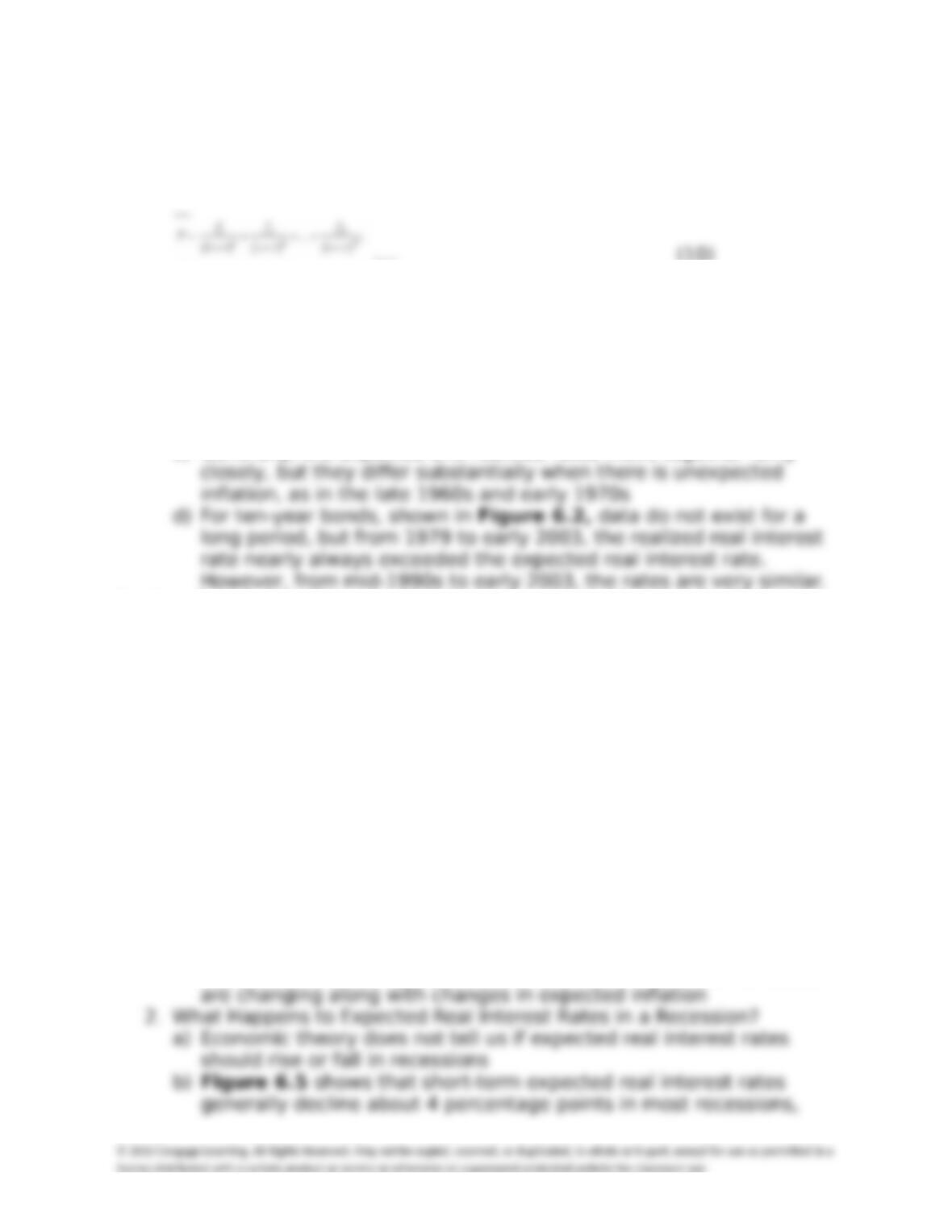
4. The real present-value formula is
…. (10)
where the f terms are future real payments and r is the real rate of
discount
E. What Affects Real Interest Rates?
1. Measuring Real Interest Rates
a) We use data from surveys of economists as measures of expected
inflation, allowing us to calculate real interest rates
b) Figure 6.1 shows the expected real interest rate and realized real
interest rate on one-year bonds
c) Generally, the expected and realized rates move together fairly
F. How Do Expected Real Interest Rates React to Changes in the Expected
Inflation Rate?
a) The Fisher hypothesis suggests that an increase in the expected
inflation rate will cause an increase in the nominal interest rate
with the expected real interest rate unchanged
b) Normally, we plot the demand and supply of a bond against the
price of the bond (Figure 6.3a), but because the bond price is
inversely related to the nominal interest rate, we can plot the
demand and supply of the bond against the nominal interest rate
by making the demand curve slope upward and the supply curve
slope downward (Figure 6.3b)
c) A rise in the expected inflation rate shifts both the demand curve
and the supply curve up by the amount of the change in the
expected inflation rate, so the nominal interest rate rises by
exactly the change in the expected inflation rate, keeping the
expected real interest rate unchanged (Figure 6.4)
d) Movements over time in the expected real interest rate do not
disprove the Fisher hypothesis, because over time other variables
Chapter 6: Real Interest Rates 55
while long-term expected real interest rates also generally decline,
but not as much
G. Application to Everyday Life: How Inflation and Taxes Reduce Investors’
Returns
1. An example shows that even with relatively low rates of inflation,
government taxes on nominal returns can reduce investors’ after-tax
real returns substantially
2. The effective tax rate on returns increases with the rate of inflation
and imposes a significant cost on society
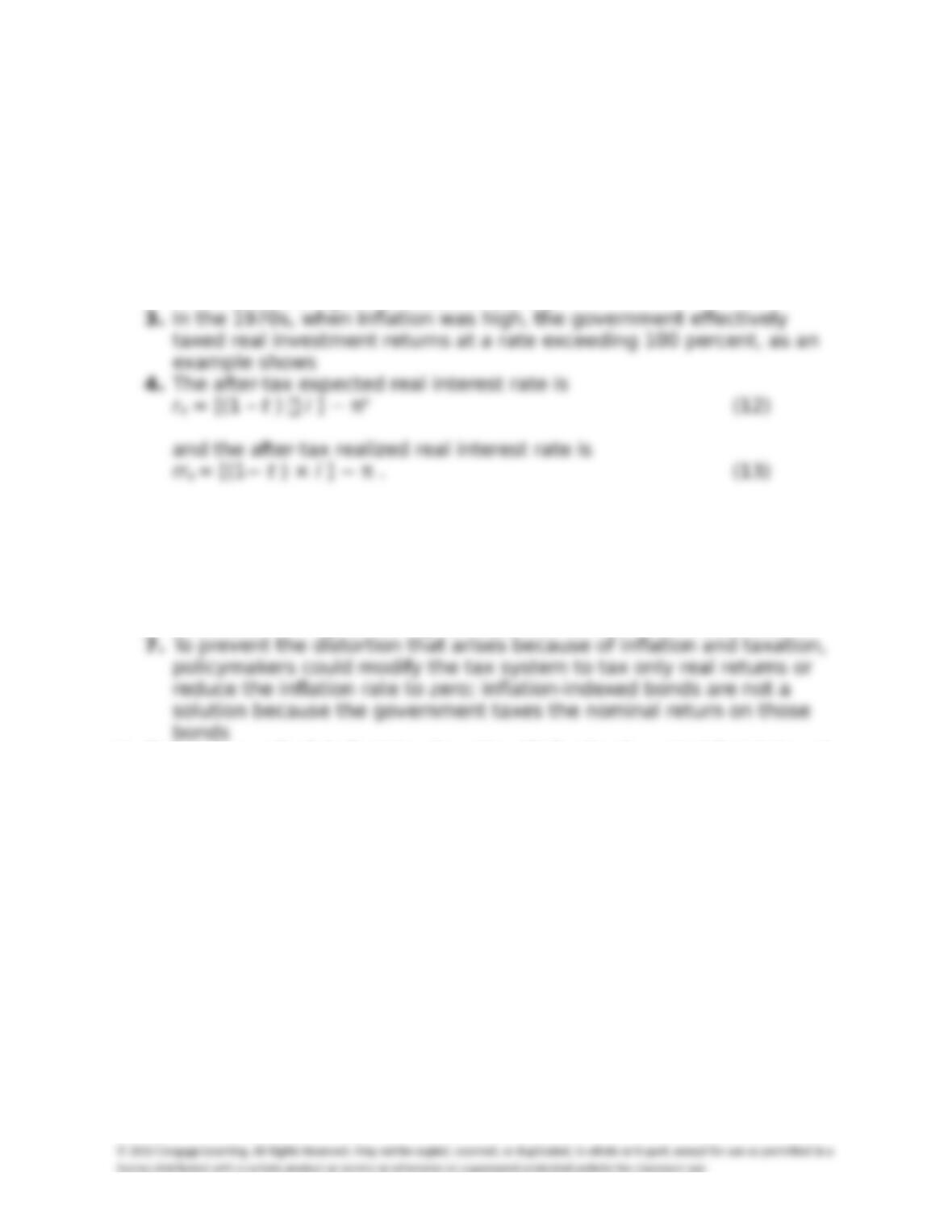
5. If the expected real interest rate is constant, then, as the expected
inflation rate increases, the after–tax expected real interest rate
declines; see Table 6.1
6. If the after-tax expected real interest rate were to remain constant as
the expected inflation rate rose, the before-tax expected real interest
rate would be higher for higher expected inflation; see Table 6.2
H. Online Appendix 6.A: Deriving Equation (1) for the Expected Real Interest
Rate
1. An example shows the logic of equation (1)
2. Numbers showing the derivation in dollar terms are compared with
equations that show how equation (1) is derived