SOLUTIONS TO TEXTBOOK NUMERICAL
EXERCISES AND ANALYTICAL PROBLEMS
Numerical Exercises
11. The bonds are comparable in all ways except taxability, so they must
pay the same after-tax return in equilibrium. After taxes, the corporate
bond pays a return of
Chapter 5: The Structure of Interest Rates 45
15. ….
Chapter 5: The Structure of Interest Rates 46
Analytical Problems
17. You would rather be holding long-term bonds than short-term bonds, if
interest rates declined, because the present value (which equals the
price) of your long-term bonds will rise more than the present value of
short-term bonds.
18. The increased demand for long-term bonds would increase their price
and reduce their yield to maturity. As a result, the term premium might
decline temporarily as the “safe haven” aspect of the bonds became more
important than the risk inherent in long-term bonds.
Chapter 5: The Structure of Interest Rates 47
than today’s market interest rate because that would mean that the bond
had more capital gains. We could adjust the present-value formula for
As an example, consider three bonds, A, B, and C, all issued within a short
period. Bond A pays interest of $20 each year for two years and repays
the principal of $1,000 at the end of the two years; it is issued when the
market interest rate is 2 percent. Bond B is issued just a bit later when the
market interest rate suddenly and unexpectedly rises to 8 percent, so
bond B pays interest of $80 each year for two years and repays the
principal of $1,000 at the end of the two years. Bond C is issued just a bit
later when the market interest rate suddenly and unexpectedly falls to 5
percent, so Bond C pays interest of $50 each year for two years and
repays the principal of $1,000 at the end of the two years. The market
interest rate is now expected to remain at 5 percent for the next two
years.
First, we can use the present-value formula, without adjusting for taxes:
Now, consider an investor who has a capital-gains tax rate of 20 percent
but a tax rate on interest income of 35 percent. Suppose that the prices of
the three bonds were based on the before-tax present-value formula, as
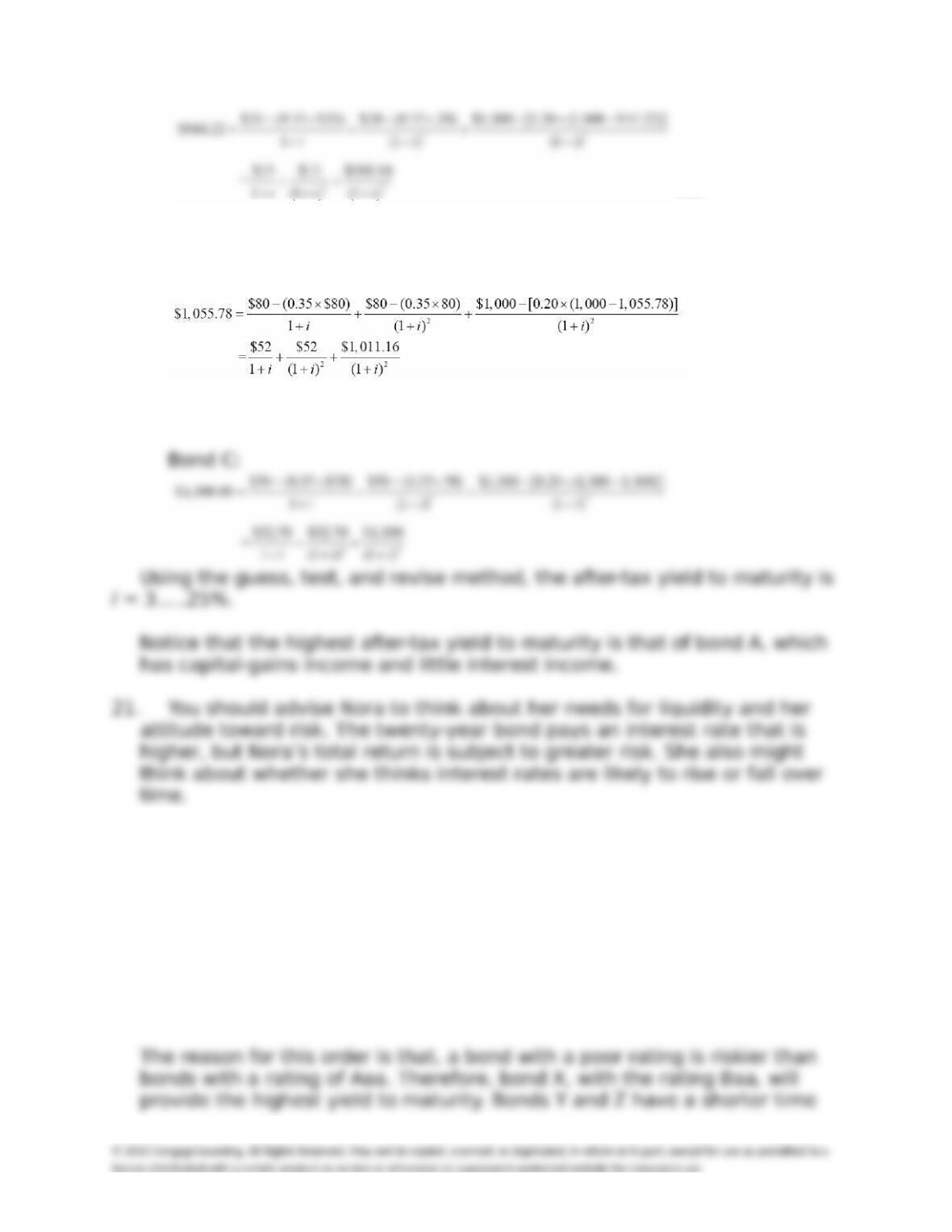
shown above: $944.22 for bond A, $1,055.78 for bond B, and $1,000.00
for bond C. Then, we could calculate the investor’s after-tax yield to
maturity for each bond by using those prices and using the after-tax
income in the numerator of the present-value formula:
Bond A: …
Chapter 5: The Structure of Interest Rates 48
….
Using the guess, test, and revise method, the after-tax yield to maturity is
i = 3.7%.
Bond B: ….
…
Using the guess, test, and revise method, the after-tax yield to maturity is
i = 2.8%.
22. Based on the yield to maturity of the bonds, from highest to lowest, the
corporate bonds can be listed in the following order:
Bond X – with Baa rating
Bond W – with Aaa rating
Bond Y – with Aaa rating, but a shorter time to maturity than bond X
and W
Bond Z – with Aaa rating which trades in a more liquid market than
the other bonds

Chapter 5: The Structure of Interest Rates 49
ADDITIONAL TEACHING NOTES
Discussion of Segmented-Markets Theory and Preferred Habitat
Some textbooks discuss the segmented-markets theory and the
preferred-habitat theory. In this textbook, we don’t do that because it is more
a “history of thought” topic, rather than of independent interest to students
of money and banking. A general supply-and-demand approach would
explain why people’s preferences would lead them to have a preferred
habitat, so discussing the history of thought does not seem necessary.