ADDITIONAL ISSUES FOR CLASSROOM DISCUSSION
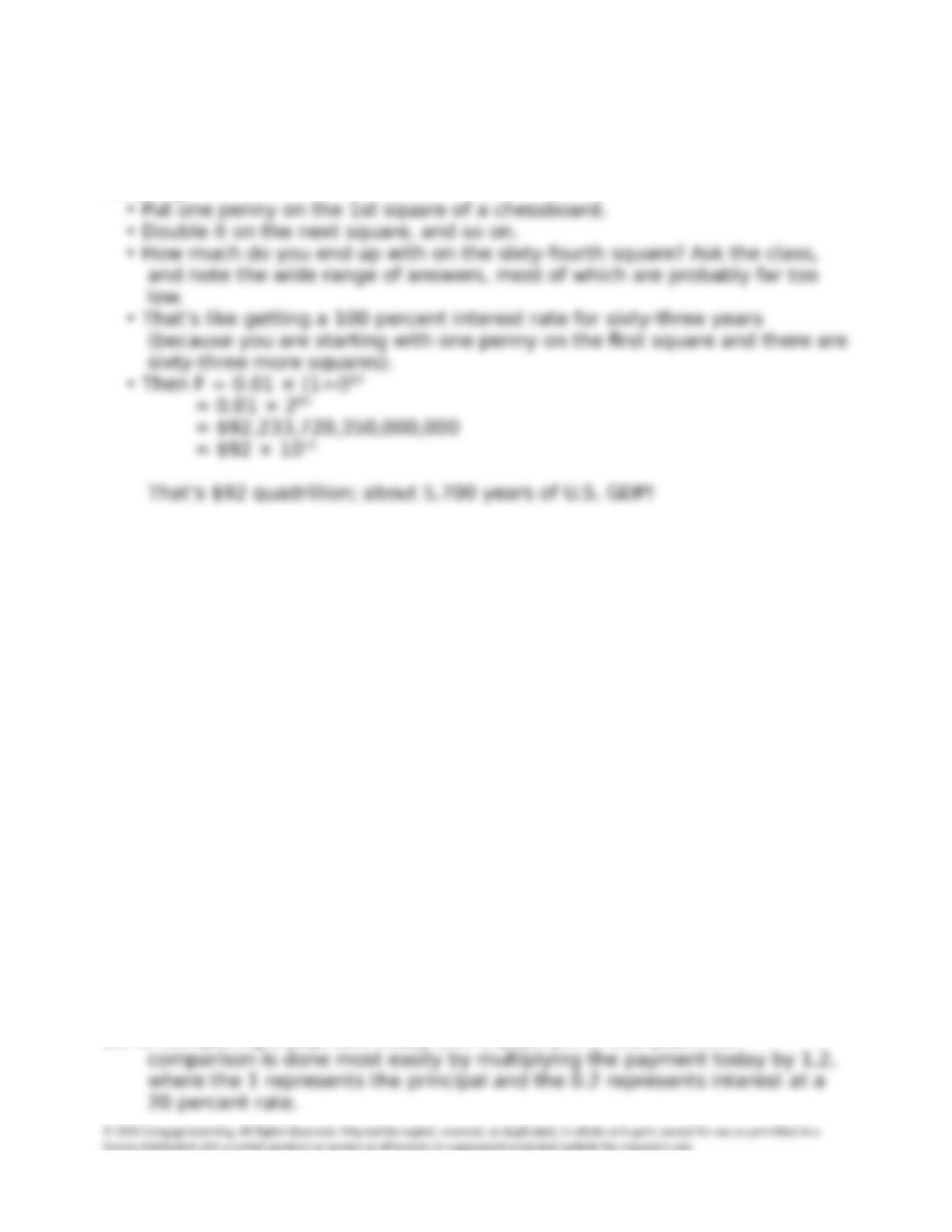
1. Here’s a nice example that illustrates the power of compounding: penny
doubling
2. Students really like the car-leasing example because many of them may
have had the opportunity to buy or lease a car and others will need to make
such a decision in the future. You could start a discussion by asking them
how many would buy a car and how many would lease if they had a choice
right now. There are many legitimate reasons to buy or to lease; but
financial di<erences are not a major reason because in either case the
present-value calculations are the same, contrary to the thought of the
newspaper columnist discussed in the textbook.
3. The textbook describes the guess, test, and revise method for finding a
solution to some of the present-value problems. Project Excel on the screen
in your classroom to show your students a function called “Goal Seek,”
which does the guess, test, and revise method instantly. It is located under
the “Tools” tab in old version of Excel, and under “Data” and then “What-If
analysis” in the new version of Excel. Numerical Exercise 14 is particularly
nicely illustrated with this method.
SOLUTIONS TO TEXTBOOK NUMERICAL
EXERCISES AND ANALYTICAL PROBLEMS
Numerical Exercises
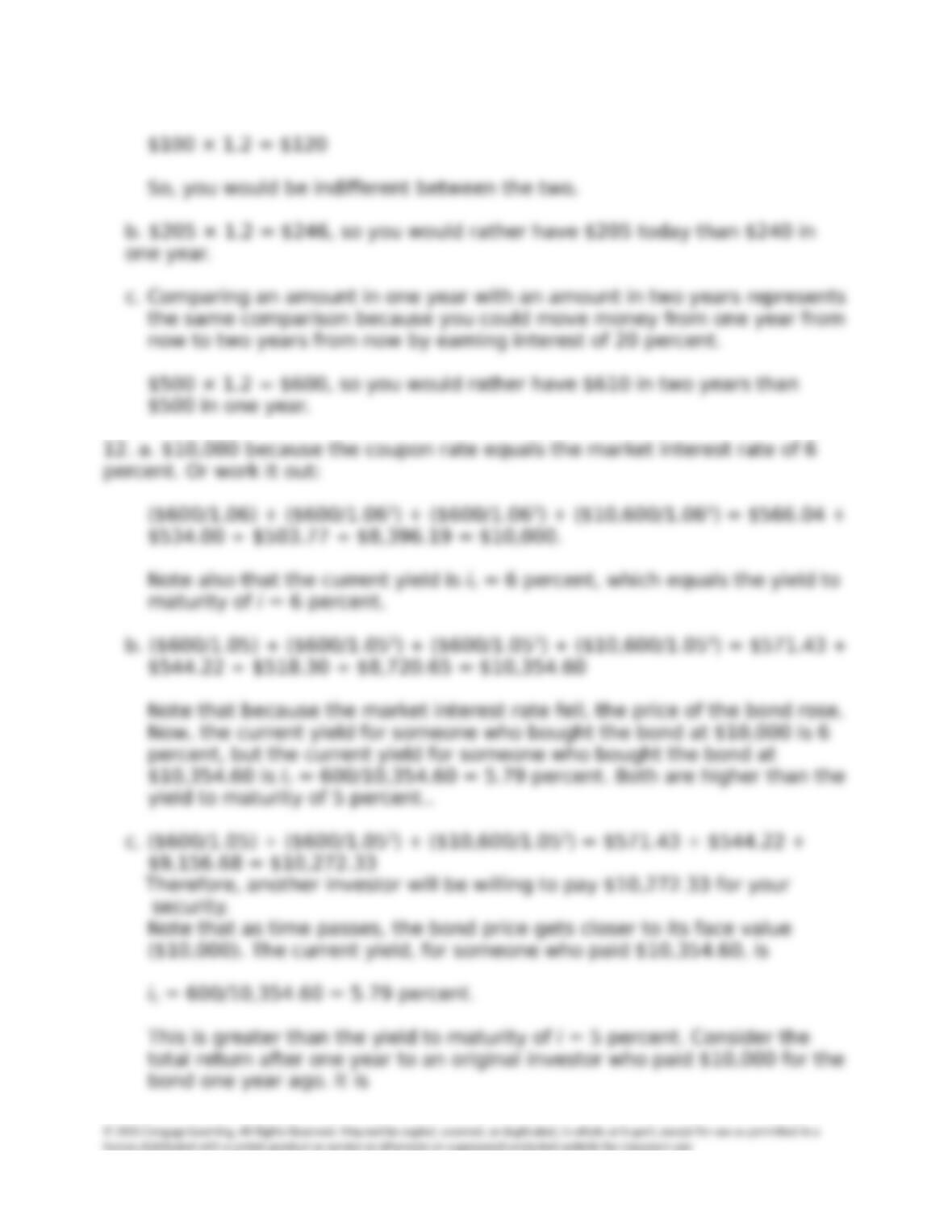
11. a. Comparing a payment today with a payment in one year, the
Chapter 4: Present Value 32
Chapter 4: Present Value 33
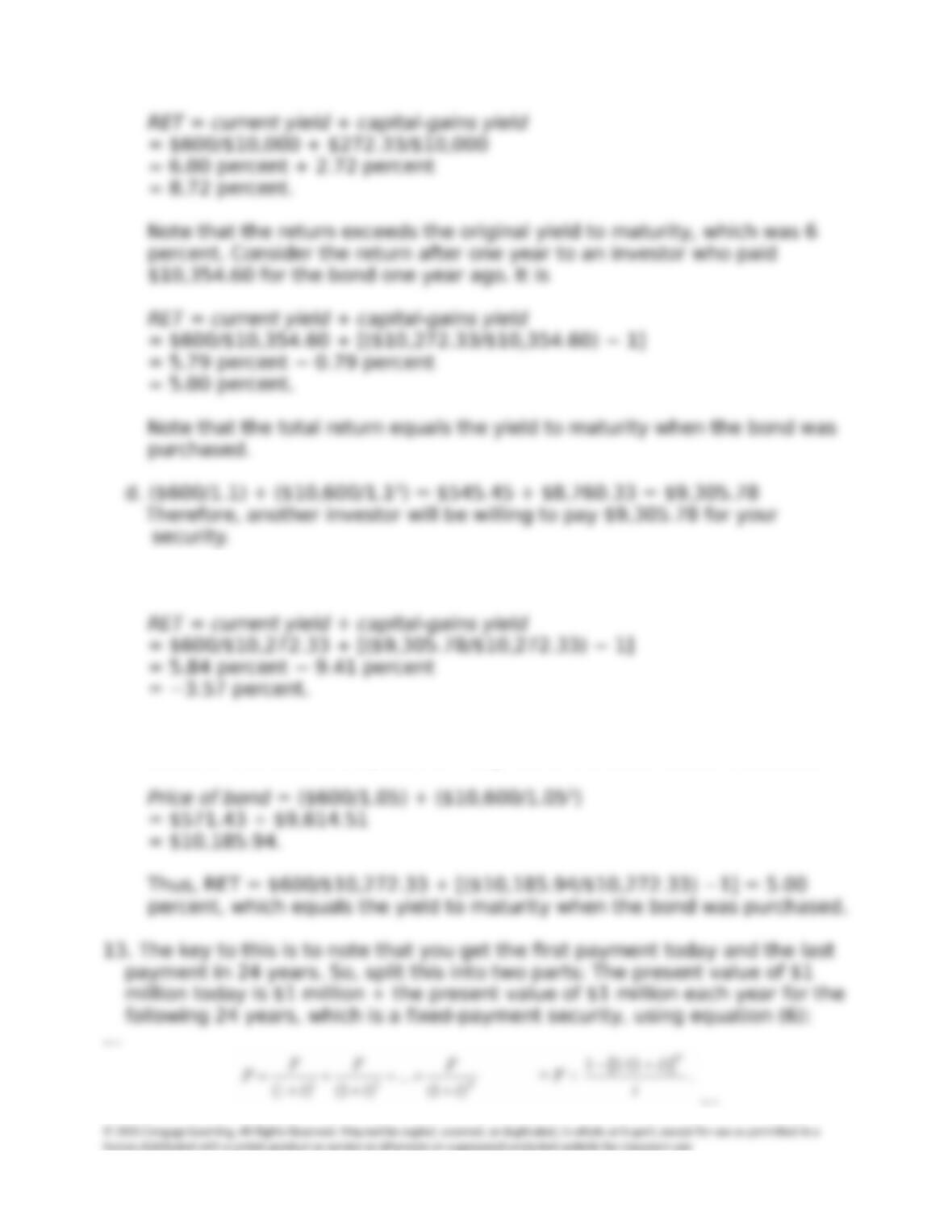
The return over the last year on the bond is:
Suppose that an investor had sold the bond just before the market
interest rate rose to 10 percent. The price of the bond would have been:
Chapter 4: Present Value 34
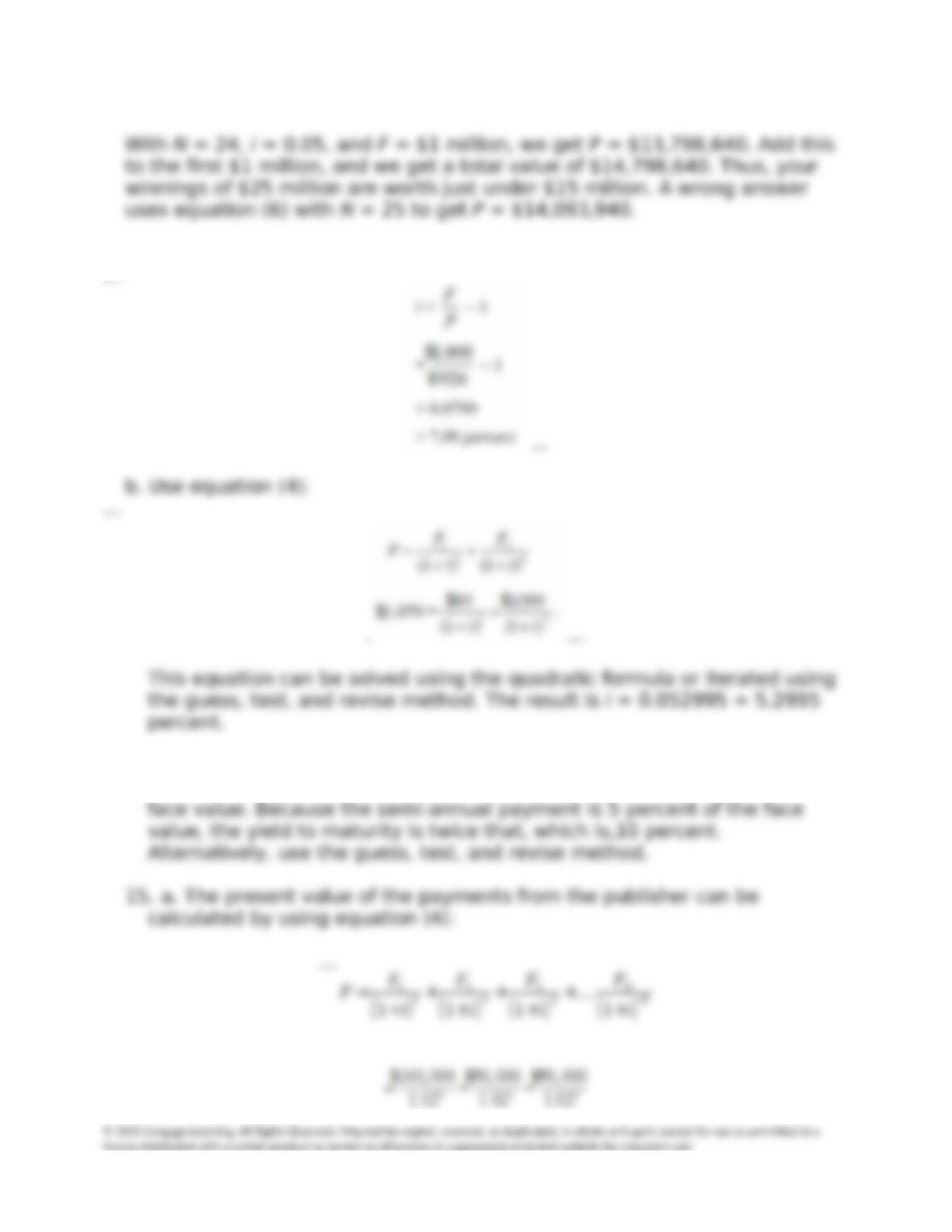
14. a. Because equation (2) says P = F/(1 + i), we can use equation (9):
c. A bond sold at its face value that pays a constant coupon and has an
interest rate equal to the coupon rate, assuming that its price equals its
Chapter 4: Present Value 35
b. You will earn $105,000 at the end of each of the next two years, if you sell
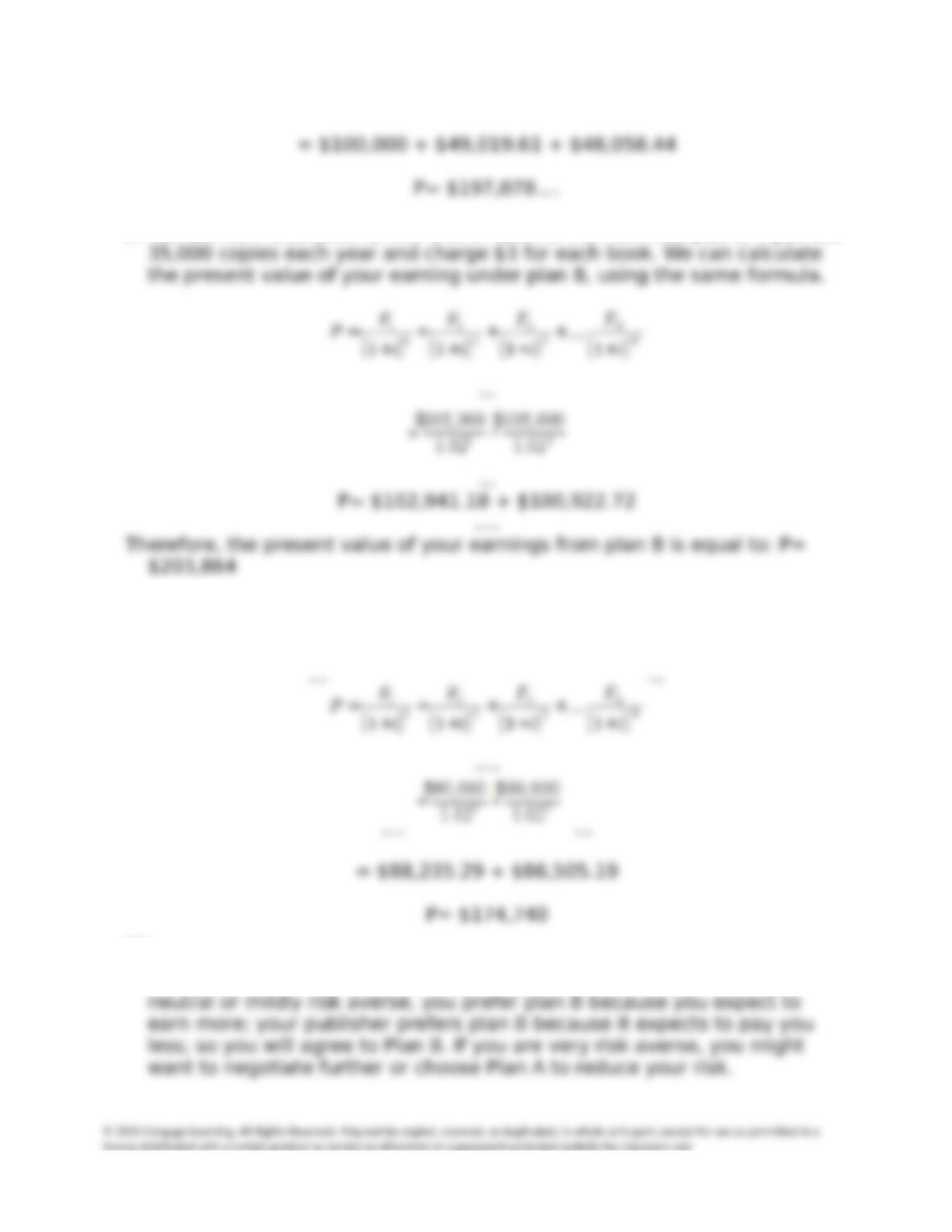
c. If the publisher thinks that you will sell 30,000 copies each year, then the
present value of your future earnings is:
….
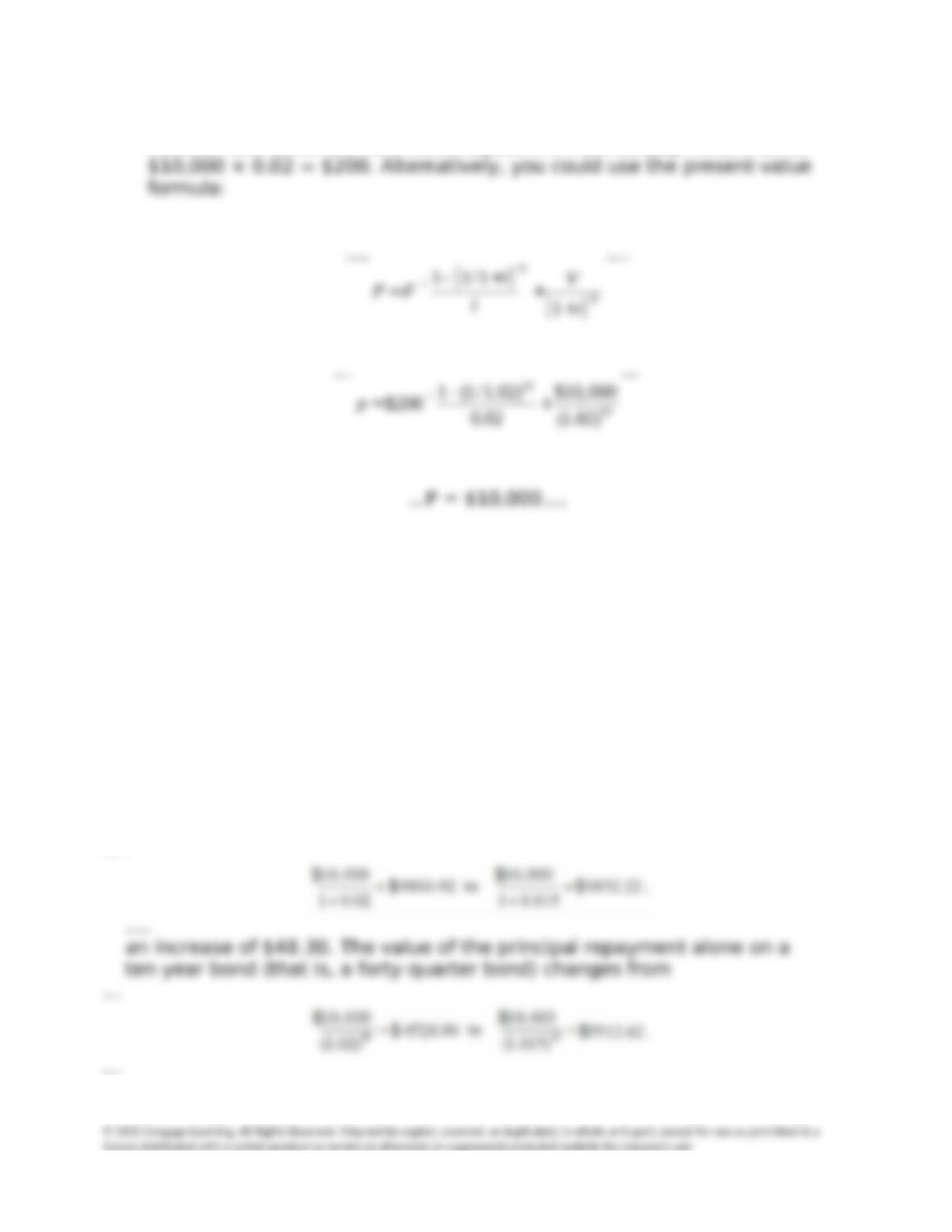
d. Note that Plan A is less risky than Plan B. From your point of view, the
returns to Plan B are higher, but there is more risk. So, if you are risk
Chapter 4: Present Value 36
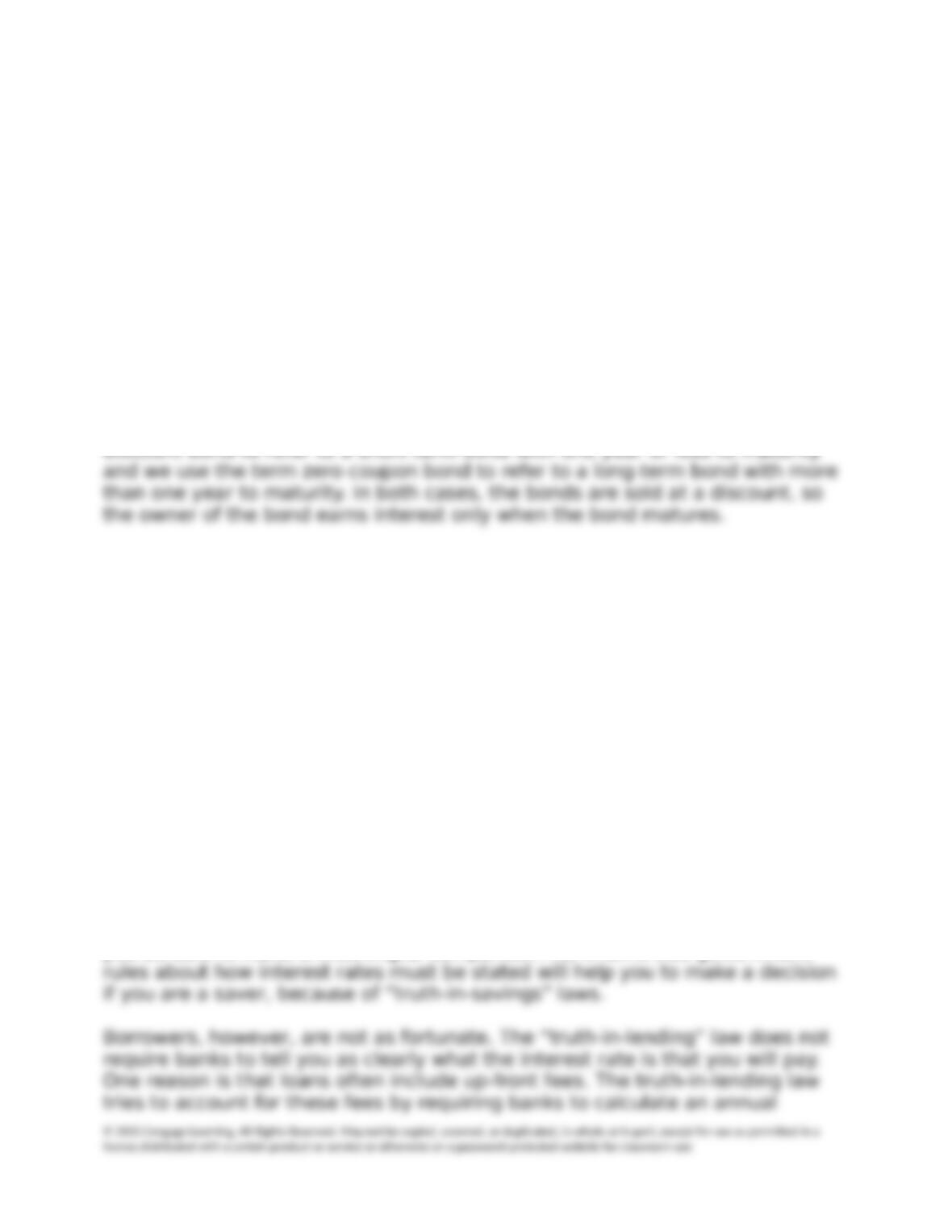
16. The present value of the coupon bond is equal to $10,000 because the
interest rate times the face value equals the interest payment; that is,
Analytical Problems
17. The decline in interest rates would increase the price of a security with ten
years to maturity by much more than a security with three months to
maturity, so you would rather have the long-term security because you will
earn a large capital gain. To see this, look at equation (4) and note that the
principal and many other terms have a discount factor that raises 1 + i to
much higher powers (by a factor of 40 for the last terms), so they have a
large impact on the present value of those terms. For example, suppose that
the principal is $10,000 and the interest rate (quarterly) changes from 2.0
percent (that is, 8.0 percent annually) to 1.5 percent (that is, 6.0 percent
annually). Then the value of the principal for the three-month bond changes
from
….
Chapter 4: Present Value 37
an increase of $983.72. In addition, the value of the coupon payments also
would increase more for the ten-year bond.
18. The monthly payment on a car lease is lower than the monthly payment on
a car loan because with a car loan you are paying o< the entire value of the
car over the life of the loan, whereas with a lease you are paying o< only the
di<erence between the car’s price and the residual value.
ADDITIONAL TEACHING NOTES
Discussion of Discount Bonds
In economics, we usually use the term discount bond to refer to a bond that
has only one payment, which occurs at maturity. Generally, we use the term
Discussion of the Term “Simple Loan”
A loan agreement between a financial intermediary and a household or
business that requires just one payment is sometimes referred to as a simple
loan; however, bankers and lawyers sometimes use that term in a di<erent
way, so we will not use the term in this textbook.
Annual Percentage Rate
The Policy Insider box in the chapter discussed the Annual Percentage Yield
(APY), which is relevant when a saver deposits funds in a bank. That box
discusses how the Annual Percentage Rate (APR), which is relevant for a
borrower, may be misleading. If you want to go into more detail, here are some
things that you can talk about.
As a saver, you may wish to compare di<erent financial securities that promise
you di<erent payments at di<erent times. As a borrower, you may wish to
compare di<erent loans with alternative amounts paid at di<erent dates. Will
you be able to make a meaningful comparison? As it turns out, government
Chapter 4: Present Value 38
percentage rate by amortizing certain fees over the length of the loan. The
annual percentage rate (APR) is the interest rate that you are e<ectively being
charged on a loan, including the amortization of certain up-front fees.
For example, if you take out a thirty-year mortgage loan for $97,000 with fees
of $3,000, you are really borrowing $100,000. If the annual interest rate is 7.75
percent, the bank would calculate your payments based on the present-value
formula, using equation (8), with a present value of $100,000. Because
payments are made monthly, the interest rate is i = 0.0775/12. Monthly
payments for thirty years mean, the number of payments is 30 × 12 = 360.
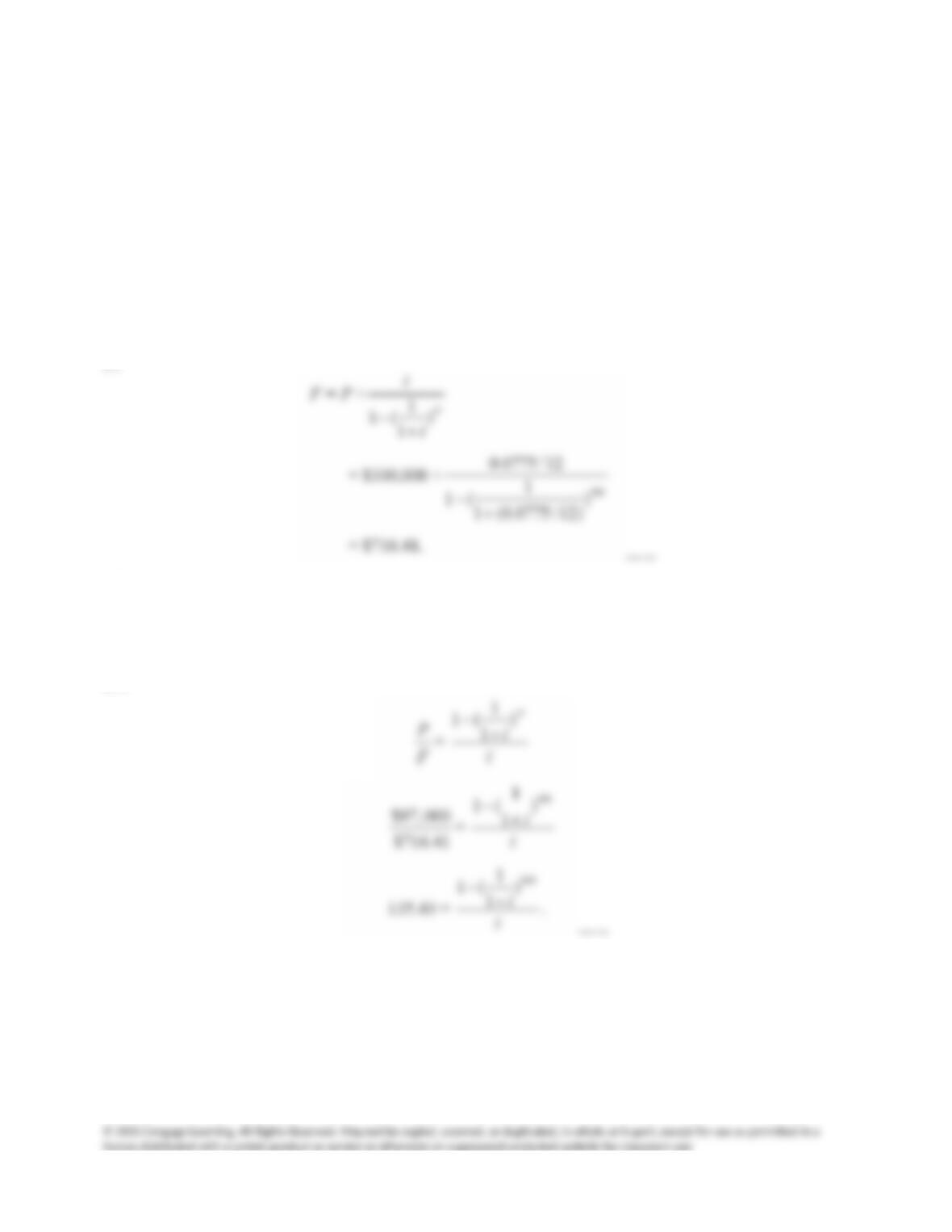
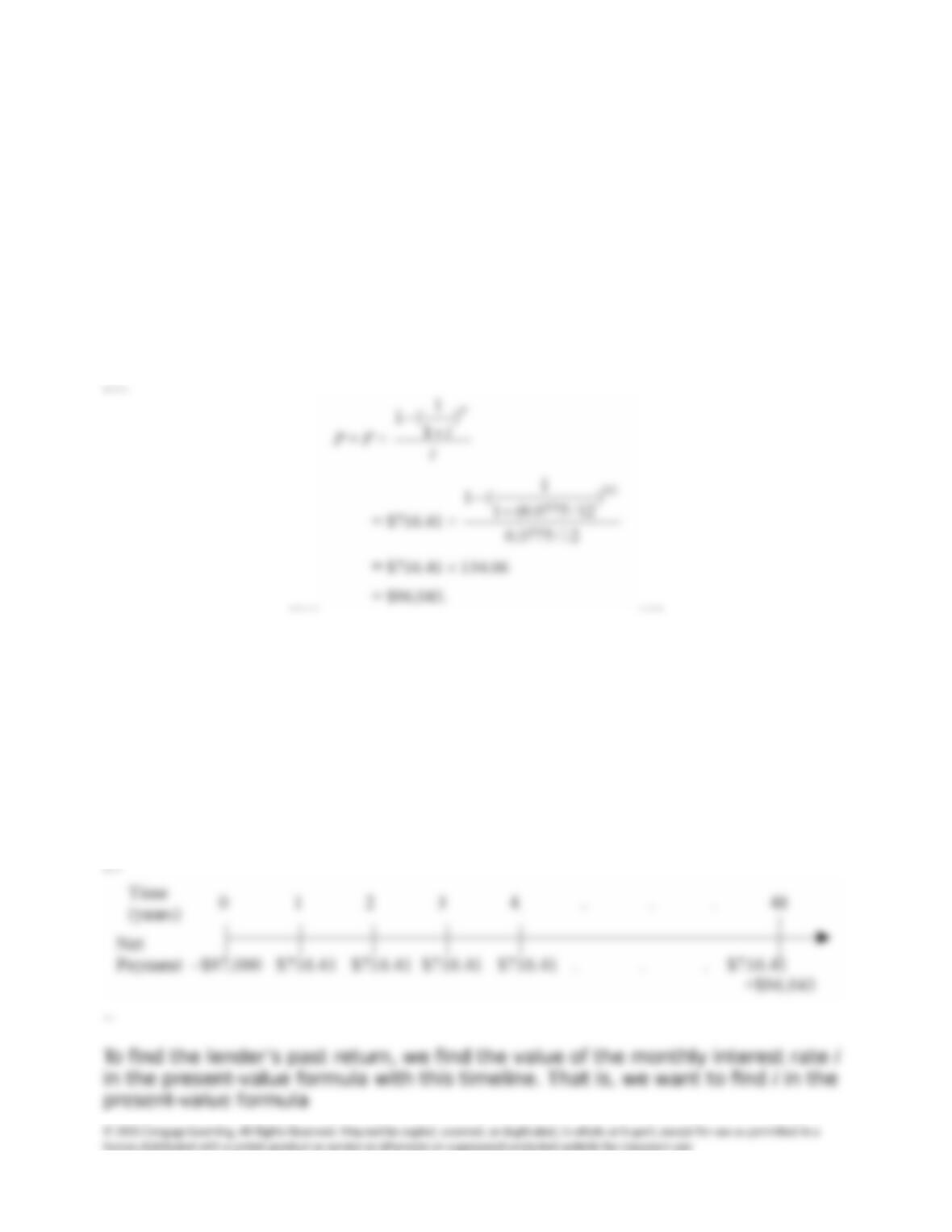
Your payments each month are:
…
…
To determine the APR, the bank would again use the present-value formula, but
this time using as the principal amount P = $97,000, because that is the
amount the consumer receives, using the monthly payment amount F =
$716.41, and solving for i in equation (12):
….
This equation can be solved by the guess, test, and revise method, choosing
di<erent values of i until the right-hand side of the equation equals the
left-hand side. After a few iterations, you will (nd that i = 0.081/12, so the APR
is 8.1 percent. Note that the $3,000 in fees e<ectively makes the APR higher
than the stated annual interest rate of 7.75 percent.
Chapter 4: Present Value 39
Suppose, you took out this mortgage but then decided to refinance it after
several years. We can calculate your average interest rate (which is the past
return earned by the bank) by again using the present-value formula. For
example, suppose you paid $716.41 each month for four years, then decided
that you wanted to re(nance your mortgage because a new lender is o<ering
you a much lower interest rate. You ask your current lender how much you still
owe on your loan, which amounts to asking what the present value on the loan
is, after you have made forty-eight payments. To (nd this, the lender uses the
present-value formula, equation (6), with an interest rate equal to the stated
annual interest rate (7.75 percent) divided by twelve, because payments are
made monthly. Because you have made forty-eight of the 360 payments, only
312 payments remain, so the present value is
So, you have made forty-eight payments of $716.41 each, a total of
$34,387.68, but the principal amount you owe the lender is just under $4,000
less than you borrowed initially because most of your payments have gone
towards paying o< interest on the loan and have not reduced the principal by
very much. In addition, the first $3,000 of the loan that you paid o< went to
cover the bank’s fees. What is the past return earned by the original lender
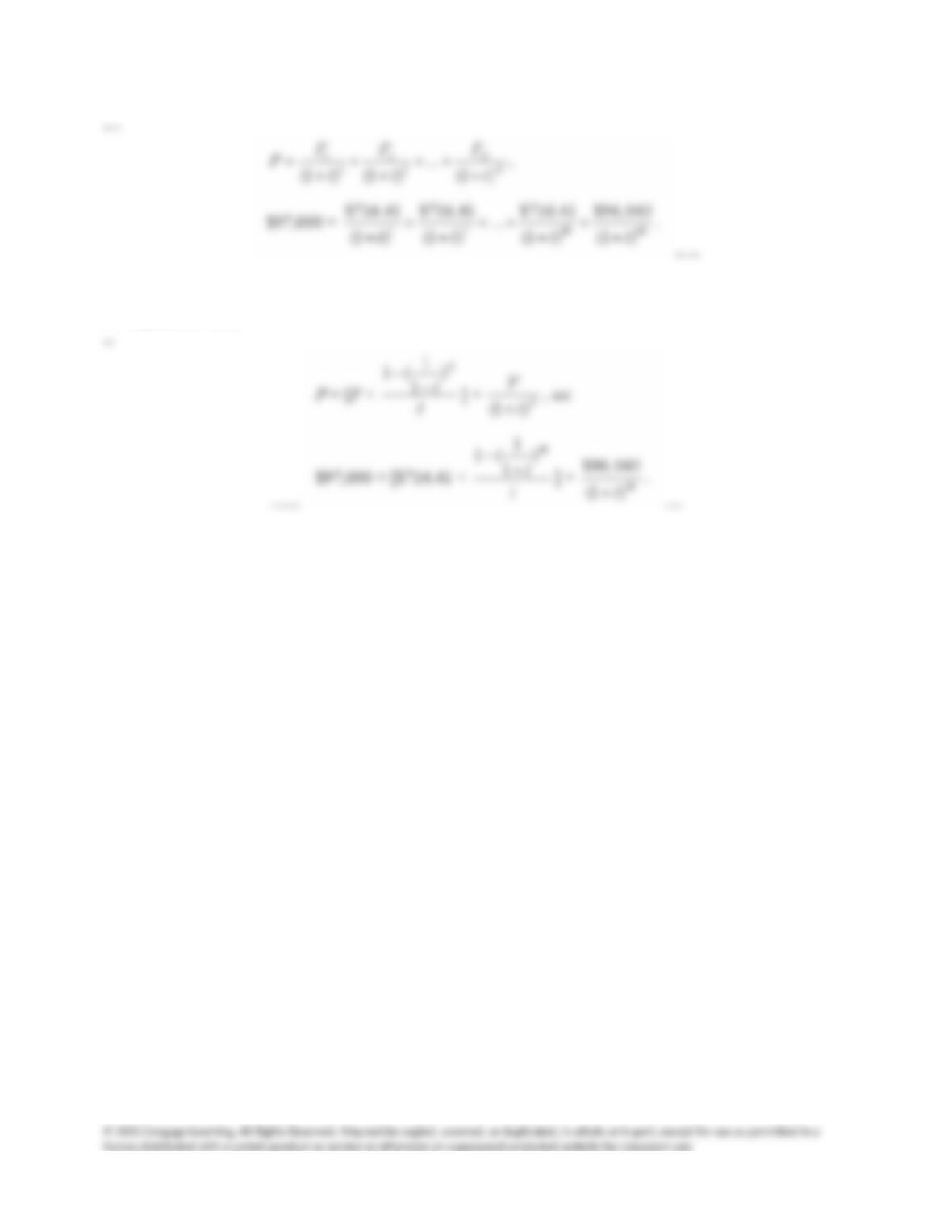
when you pay o< the loan after four years? The lender gave you $97,000
initially, then received forty-eight monthly payments of $716.41 each, then
received $96,043 from your new lender, when you refinanced your loan. So,
the lender’s timeline is:
Chapter 4: Present Value 40
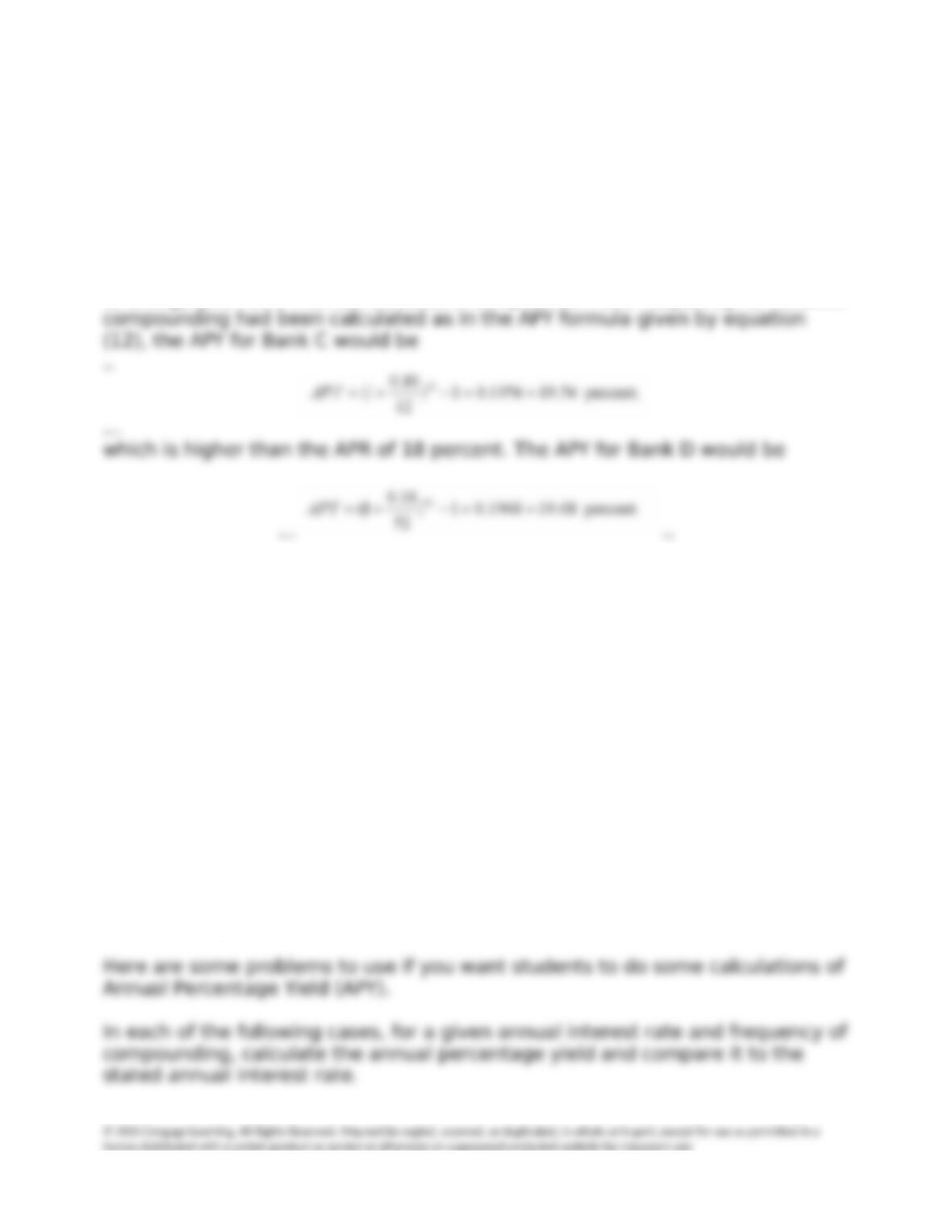
Note that this form looks identical to that of a coupon bond, which we analyzed
in equation (7):
Once again, the guess, test, and revise method can be used. Making a few
guesses about i quickly leads to the result that i = 0.725 percent. But,
remember that this is a monthly interest rate; multiplying it by 12 gives the
annual interest rate, which is 0.725 × 12 = 8.7 percent. This is the lender’s
past return (and the e<ective interest rate that you have paid) over the past
four years from your loan. Note that the return of 8.7 percent exceeds the APR
of 8.1 percent, because you paid o< the loan early.
So, as a result of the inclusion of fees in the APR calculation, the APR is less
than the past return earned by the lender, if you pay your loan o< early or
refinance the loan. Because the average home loan runs about seven or eight
years, most lenders earn more than the stated APR, which also means that the
borrower is paying more than the stated APR.
Loans di<er in many ways, such as in terms of fees for various items such as
points (an up-front fee for getting a loan, where one point means one percent
of the value of the loan), as well as various processing fees, fees for preparing
documents, fees for appraisals of homes in the case of a mortgage loan, and
so on. By law, banks have some discretion about including certain fees in the
calculation of the annual percentage rate (APR) of the loan. So, if you are
trying to compare two di<erent loans, but the banks have included di<erent
costs in calculating the APR, you cannot make a fair comparison. And because
the time to maturity a<ects the comparison, you will not be able to compare
loans with di<erent times to maturity. For example, you cannot compare the
APR on a (fteen-year loan with that on a thirty-year loan.
Chapter 4: Present Value 41
In addition, for some types of loans called open-end loans, the APR calculation
required by the government does not include compounding. The most common
types of loans, for which this is true, are credit cards and home-equity lines of
credit. The APR formula for open-end loans ignores compounding completely.
For example, if Bank C o<ers you a credit card with a stated annual interest
rate of 18 percent compounded monthly, and Bank D o<ers you a loan with a
stated annual interest rate of 18 percent compounded weekly, the APRs of
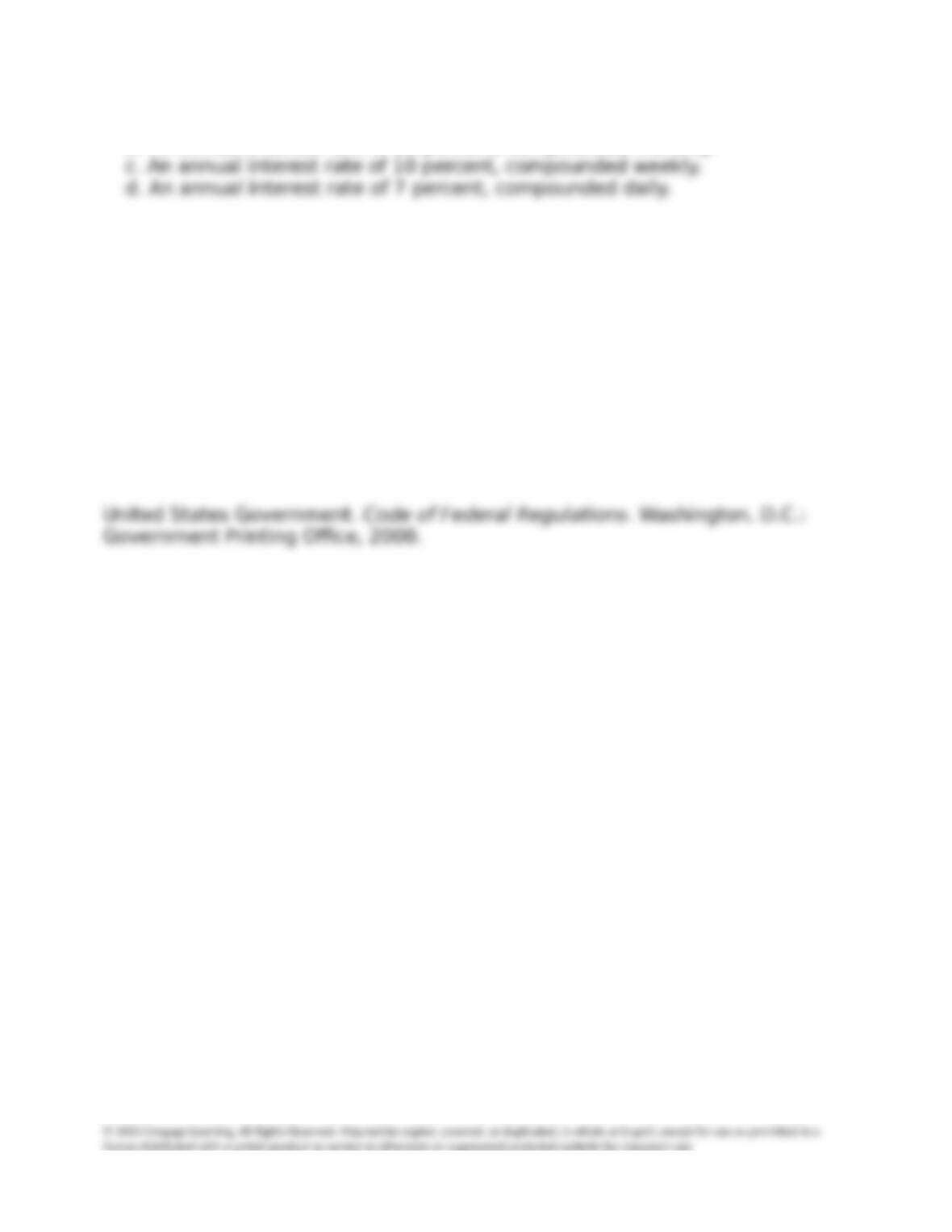
both loans are the same—18 percent. But we know that Bank D is really going
to charge you more interest because it compounds more frequently. If, instead,
There is not a dramatic di<erence between the APYs of the two banks, which is
why the government allows the simple APR formula to be used for comparing
credit card interest rates. But, wouldn’t it be more truthful if the APY formula
were used? And shouldn’t people know that they will be paying almost 20
percent interests on their credit cards, not just 18 percent, because of
compounding? That is why Federal Reserve Governor Edward Gramlich once
said, “in practice the finance charge and the corresponding APR have never
disclosed the full cost of credit.”
As it turns out, the government does not require the use of the APY formula,
because with credit cards and home-equity lines of credit the balance on the
loan is constantly changing. As a result, it is not clear what the balance is on
whichever interest is being charged. Still, it would seem that a consumer
should be able to compare loans such as this by getting the answer to the
question: If I were to borrow $1,000 and let the interest accumulate over the
course of a year, what will be the interest rate I pay, which would reTect
compounding?
Chapter 4: Present Value 42
a. An annual interest rate of 6 percent, compounded quarterly.
b. An annual interest rate of 16 percent, compounded monthly.
REFERENCES
Board of Governors of the Federal Reserve System. What You Ought to Know
About Federal Reserve Regulation Z: Truth in Lending and Consumer Credit
Cost Disclosure. Washington, D.C., 1969.
Gramlich, Edward M. “Statement Before the Subcommittee on Financial
Institutions and Regulatory Relief and the Subcommittee on Housing
Opportunity and Community Development of the Committee on Banking,
Housing, and Urban A<airs, U.S. Senate, July 17, 1998,” Federal Reserve
Bulletin, September 1998, pp. 730–735.