CHAPTER 4
Present Value
TEACHING OBJECTIVES
Goals of Chapter 4
A. Develop the idea of present value and show how the concept can be used in
a variety of applications.
B. Look at how people use the present-value formula to make decisions.
C. Use the concept of present value to look backward at past returns or
forward at future returns.
D. Apply our knowledge of present value with practical advice on how to
negotiate a car lease.
TEACHING NOTES
A. Introduction
1. A dollar today is worth a di”erent amount than a dollar at a date in the
future.
2. The concept of present value relates the values of dollars received at
di”erent dates.
B. The Present Value of One Future Payment
1. Investing, Borrowing, and Compounding
a) First, compare money today to money in one year
(1) You earn interest on a deposit of money in a bank account
(2) You pay interest when you borrow
(3) Interest equals principal times the interest rate
b) Second, consider compounding over several years
(1) Compounding occurs when you earn interest this year on interest
earned previously
2. Discounting
a) One payment in one year
(1) The same principle used in compounding can be used in reverse to
5nd the value today (called the present value) of a future amount.
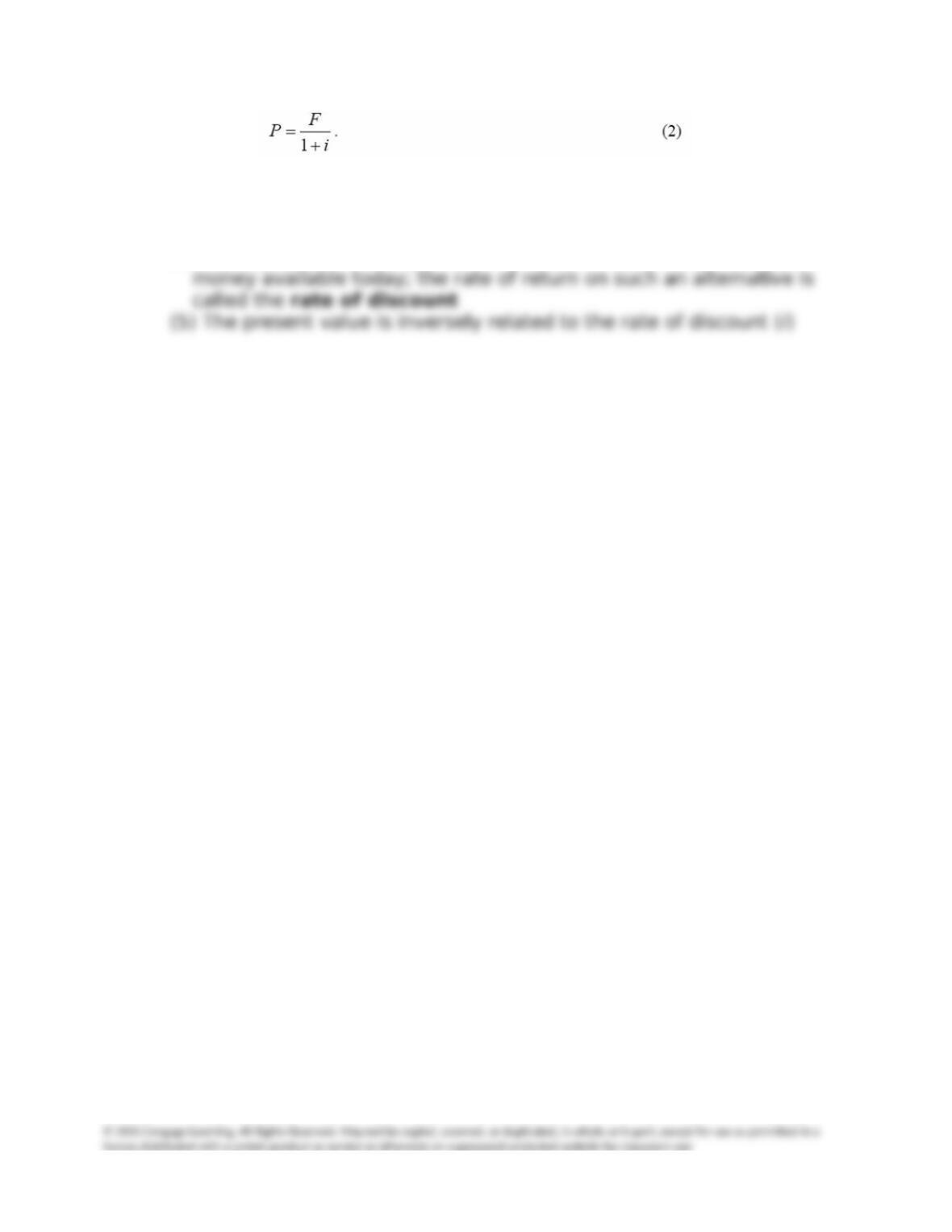
(2) For a payment F received in one year, the present value is
Chapter 4: Present Value 32
(3) In equation (2), the term 1 + i is called the discount factor and the
process of dividing a future value by the discount factor is called
discounting
(4) The discount factor depends on what an investor would do with
Chapter 4: Present Value 33
b) One payment more than one year in the future
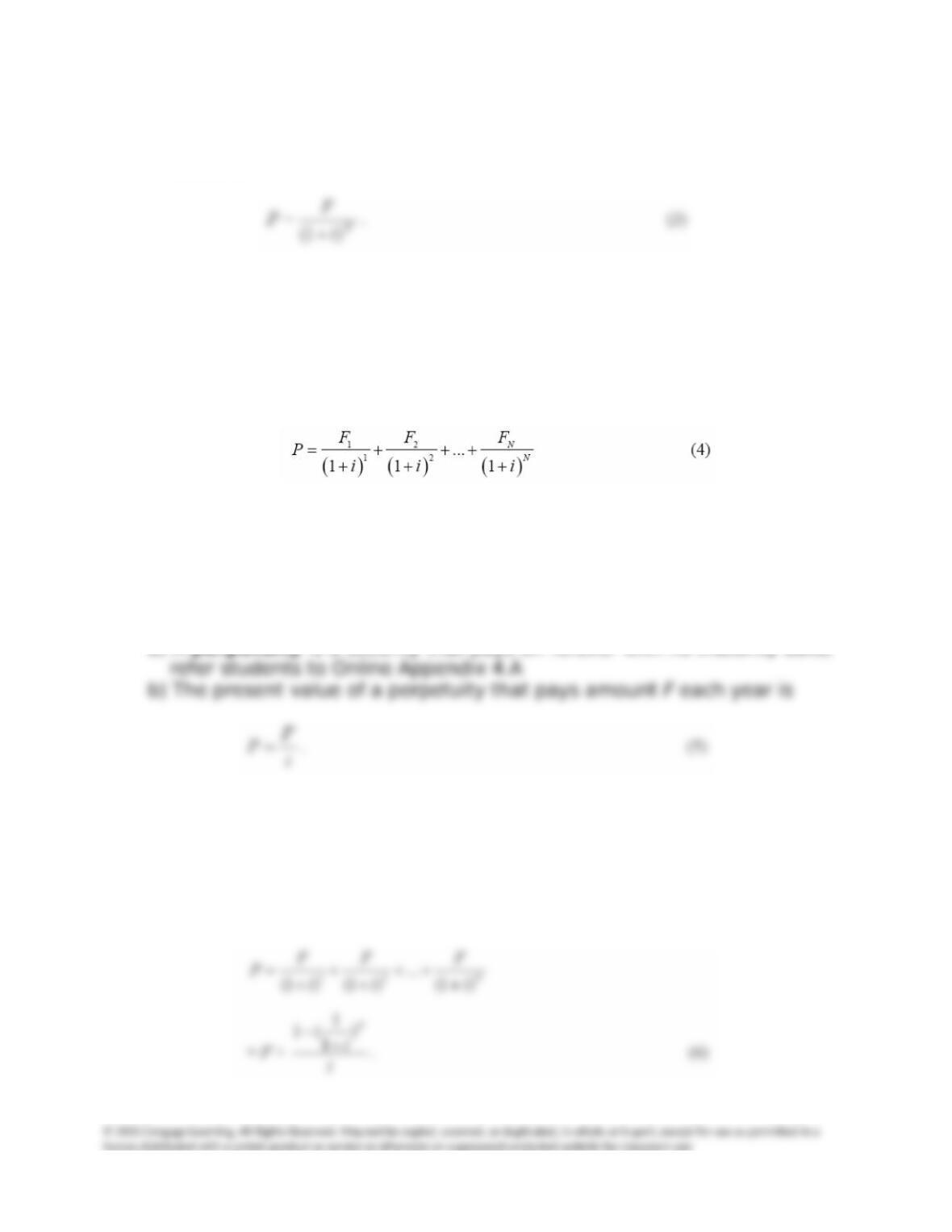
(1) The present value of an amount F being received N years in the
future is
(2) An example is a discount bond
C. The General Form of the Present-Value Formula
1. Introduction
a) The present-value formula describes the present value of a set of
payments of F1 in one year, F2 in two years, and so on, out to FN in N
years, where the rate of discount is i. The present value is
b) A higher rate of discount leads to a lower present value
2. Timelines to Describe Payment Amounts
a) Timelines are a convenient way to show payments over time, allowing
amounts to be easily inserted into the present-value formula correctly
b) Examples illustrate the timelines and the present-value formula
3. The Present Value of a Perpetuity
a) A perpetuity is a security that pays o” forever with no maturity date;
4. The Present Value of a Fixed-Payment Security
a) De5ne amortization. A (xed-payment security is one that
amortizes (pays o”) the principal over time, so there is no principal
remaining at maturity; refer students to Online Appendix 4.B
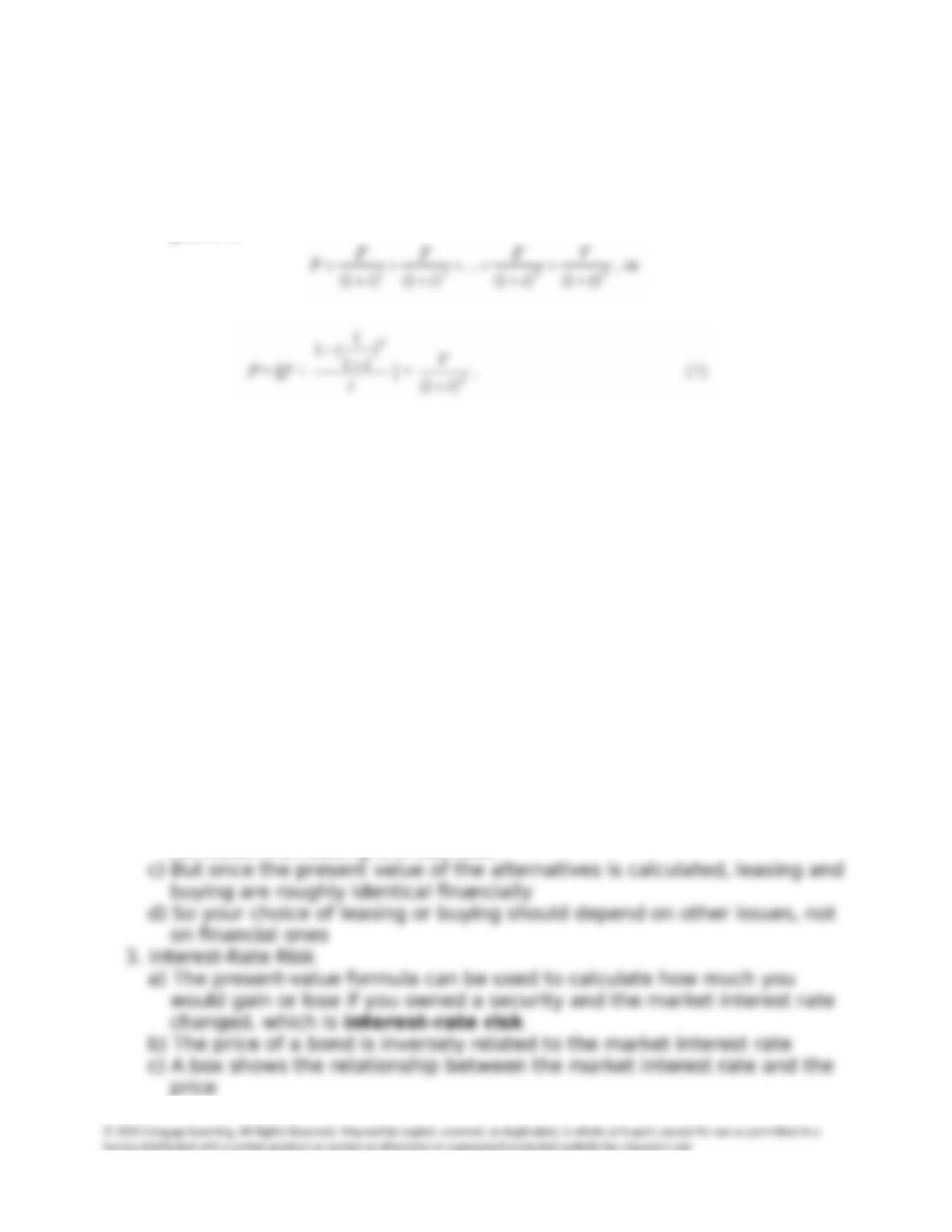
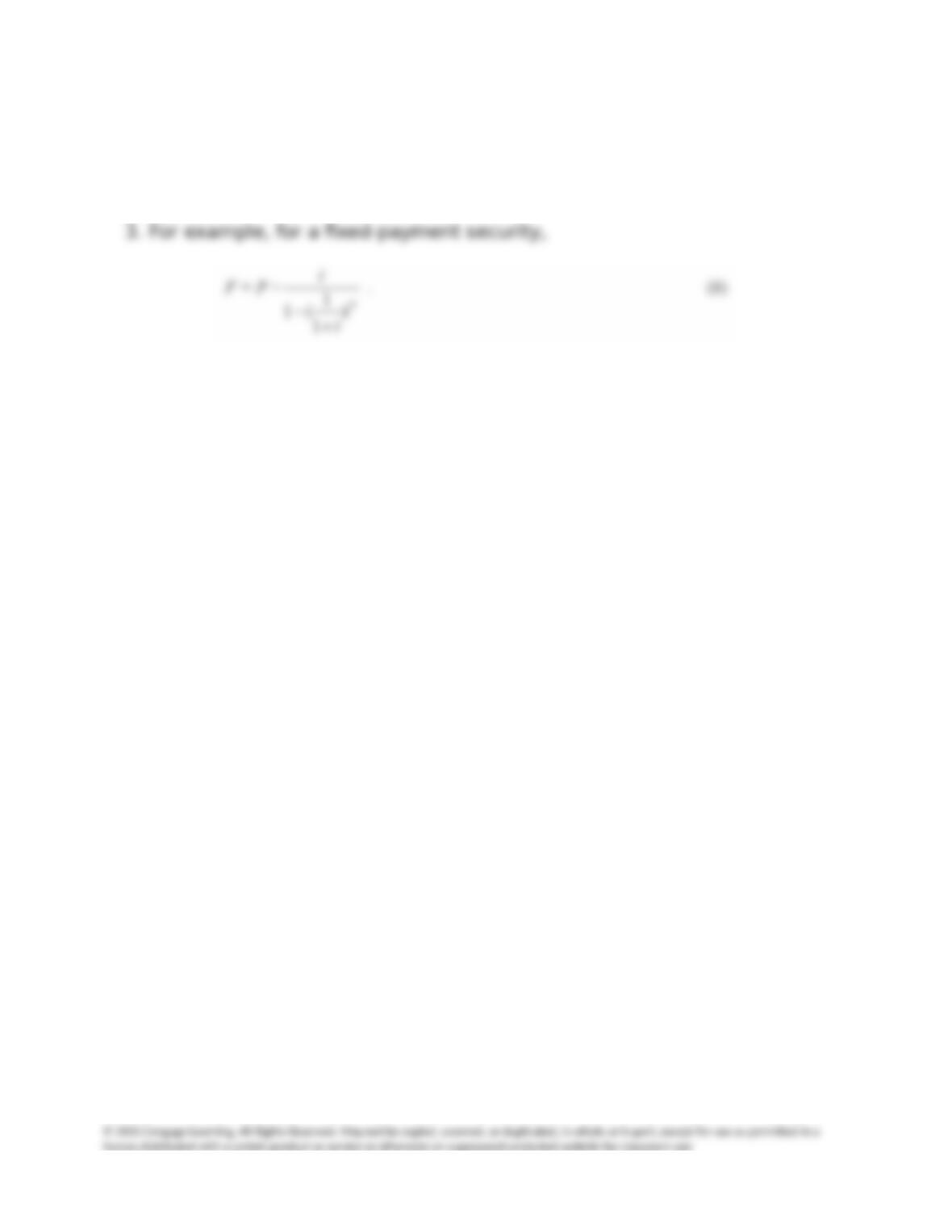
b) The present value of a 5xed-payment security with a payment of F each
year is
Chapter 4: Present Value 34
5. The Present Value of a Coupon Bond
a) A coupon bond does not amortize the principal, but pays a regular
interest payment until maturity, when it repays its face value
b) The present value of a coupon bond making an interest payment of F
each year for N years, then repaying the face value of V at the end of N
years is
6. The Present Value When Payments Occur More Often Than Once Each Year
a) When payments occur more often than once each year, we can use the
same basic formulas, but adjust i and N, multiplying the number of
years times the number of periods per year to get N, and dividing the
rate of discount by the number of periods per year to get i
b) For example, a thirty-year mortgage loan with monthly payments and
an interest rate of 6 percent has N = 30 × 12 = 360 and i = 0.06/12 =
0.005
D. Using Present Value to Make Decisions
1. Comparing Alternative O”ers
a) You can compare alternative monetary payments with di”erent
amounts to be received over di”erent time periods, calculating the
present value of each alternative and choosing the one with the highest
present value (if you are receiving the payments) or the lowest present
value (if you are making the payments)
b) Examples include buying a car and buying bonds
2. Buying or Leasing a Car
a) Should you buy or lease a car?
b) Simple calculations that ignore the present-value formula erroneously
conclude that leasing is a bad deal
Chapter 4: Present Value 35
E. Using the Present-Value Formula to Calculate Payments
1. The present-value formula can be used to calculate payment amounts,
given a principal amount and an interest rate
2. Simply use equation (2), (3), (4), (5), (6), or (7), but solve for F, given P, i ,
and N
Chapter 4: Present Value 36
F. Looking Forward or Looking Backward at Returns
1. Introduction
a) The present-value formula can be used to calculate the past return to
a security, which is its average annual return over time
b) The present-value formula can also be used to calculate the yield to
maturity of a debt security, which is the average annual return an
d) The present-value formula is used in these situations by solving for i ,
given the other terms in the present-value formula
2. One Payment in One Year
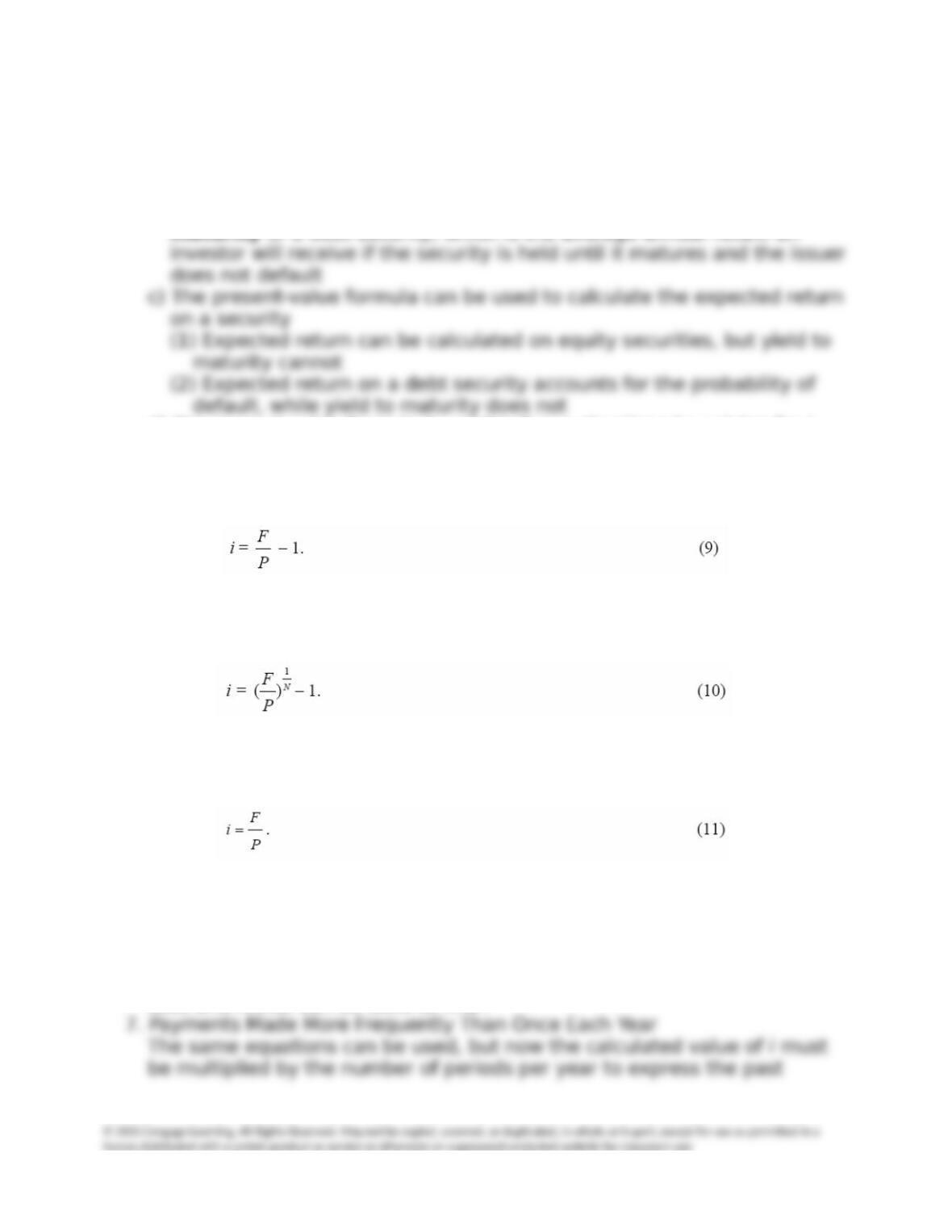
Using equation (2) and solving for i gives
3. One Payment More Than One Year in the Future
Using equation (3) and solving for i gives
4. Perpetuity
Using equation (5) and solving for i gives
5. Fixed-Payment Security
Equation (6) cannot be solved for i directly, but methods such as guess,
test, and revise can be used to 5nd i
6. Coupon Bond
Equation (7) cannot be solved for i directly, but methods such as guess,
test, and revise can be used to 5nd i
Chapter 4: Present Value 37
return, expected return, or yield to maturity in annual terms; use Policy
Insider box on Annual Percentage Yield
G. Policy Insider: Annual Percentage Yield
1. The Truth-in-Savings Act requires banks to inform the annual percentage
yield (APY) on one’s deposit, which allows her to compare interest rates
that are compounded in di”erent ways
2. For example, monthly compounding at an 8 percent stated annual interest
rate has an APY of 8.3 percent. This APY is the interest rate that yields the
same amount with annual compounding
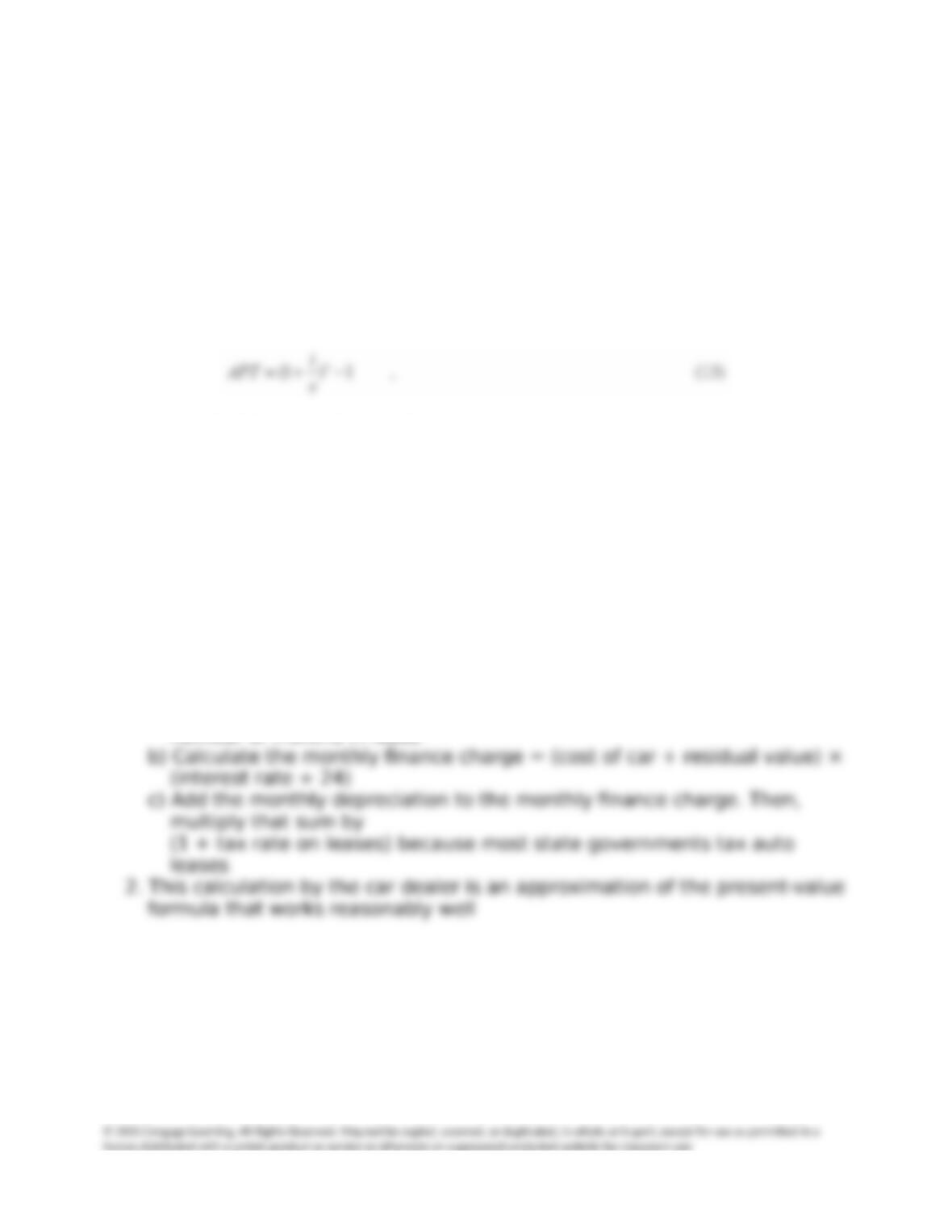
3. The APY is calculated using the following formula:
where i is the stated annual interest rate, and compounding occurs x
times per year
4. For example, if Bank A o”ers a 5.7 percent interest rate but compounds
interest just once each year, while Bank B o”ers a 5.6 percent interest
rate compounded monthly, which is a better deal? The APY is 5.7 percent
for Bank A but 5.75 percent for Bank B, so Bank B o”ers a higher
expected return
5. Unfortunately for borrowers, reporting of APRs by banks may be
misleading. because banks may choose to include certain fees and may
calculate the APR di”erently
H. Application to Everyday Life: How to Negotiate a Car Lease
1. The present-value formula is all you need to calculate a car lease
a) Calculate the monthly depreciation = (cost of car − residual value) ÷
number of months in lease
I. Online Appendix 4.A: Deriving the Present-Value Formula for a Perpetuity
J. Online Appendix 4.B: Deriving the Present-Value Formula for a Fixed-Payment
Security