SOLUTIONS TO TEXTBOOK NUMERICAL
EXERCISES AND ANALYTICAL PROBLEMS
Numerical Exercises
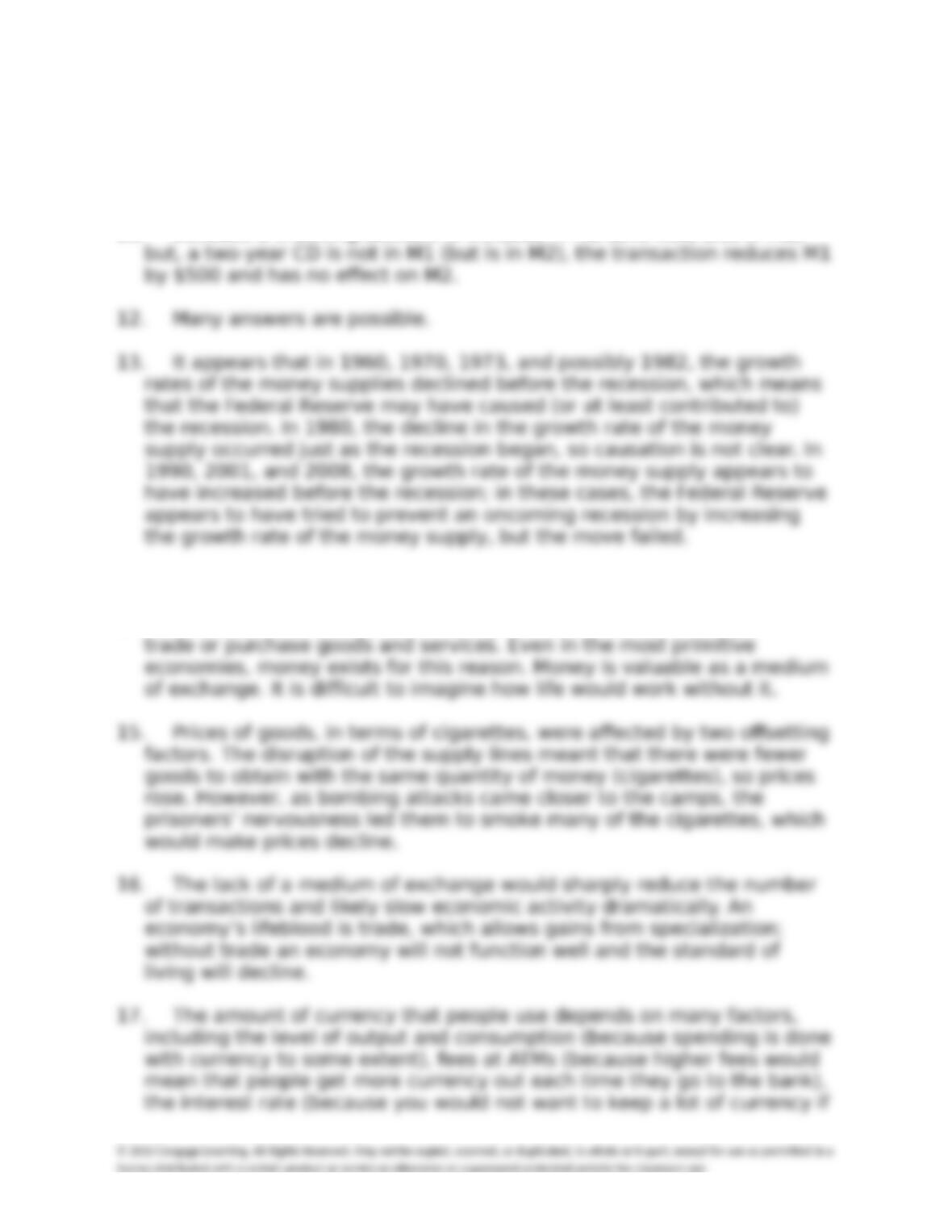
11. Because a checking account is included in M1 (and thus also in M2)
Analytical Problems
14. Societies have always used money to make it easier for people to
Chapter 3: Money and Payments 26
ADDITIONAL TEACHING NOTES
Note that the four functions of money (versus three that are often
discussed) originate with Jevons.
The definition of hyperinBation as when the monthly inBation rate exceeds
50 percent comes from
Cagan.
The Empirical View of Money
One approach to defining di”erent monetary aggregates is to consider all
the di”erent items that might be money and investigate the degree to
which they are most closely related to the economy’s output. In that sense,
money is what money does. One way to implement this idea is to give each
asset a weight in constructing a measure of the total amount of money. For
example, currency might get a weight of 1, since it’s clearly money, while
money in a checking account might get a weight of 2/3, if, on average, only
More on the Fed’s Role in the Payments System
The Fed still clears a large volume of checks in the economy, though this
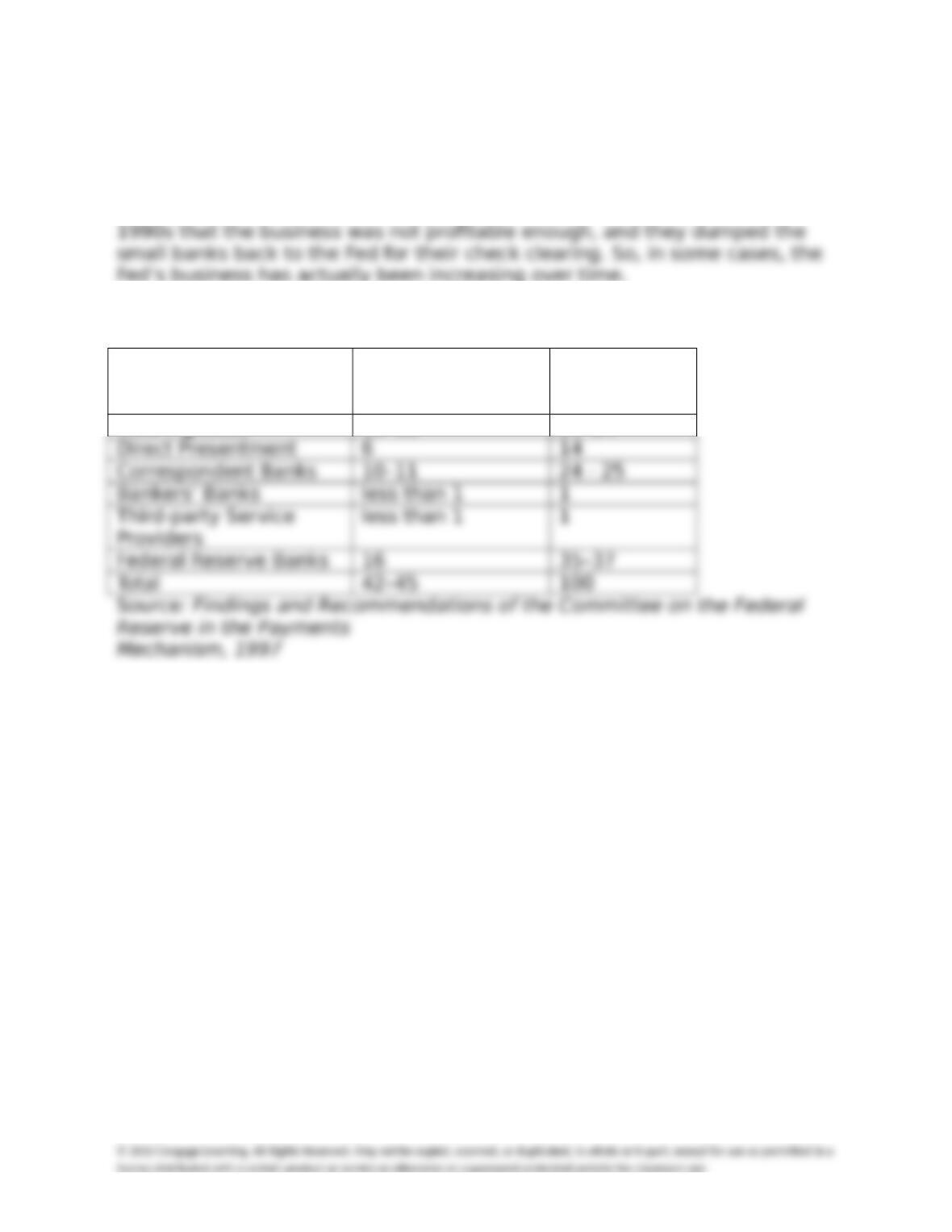
may soon be changing. Table 3.2 below shows that the Fed still maintains
just over one-third of the volume of checks. The biggest alternatives are
clearinghouses (organizations usually established by groups of banks to
clear local checks) and correspondent banks (large banks that provide
services to smaller banks). Some checks are cleared by direct presentment,
Chapter 3: Money and Payments 27
which means that a bank receiving a check from one of its customers takes
the check directly to the bank on which it is drawn (rather than through the
Federal Reserve System). Bankers’ banks and third-party providers have a
very small share. In some cases, banks that had been serving as
correspondent banks and clearing checks for smaller banks decided in the
Table 3.2
1996 Interbank Check Collection Market
Check collection
channel
Volume
(billions of
checks)
Market
share
(percent)
Clearinghouse 10–11 23–24
DIDMCA required the Fed to compete with the private sector in clearing
checks. Perhaps surprisingly, the Fed has been quite successful in doing so.
It does this by keeping its payments operations separate from its other
activities (such as setting monetary policy and regulating banks), seeking a
pro=t on its payment operations that is roughly equivalent to private-sector
enterprises, and reporting its financial results to Congress and the public.
Banks sometimes complain that the Fed’s accounting is not legit (they think
the Fed hides some of its true costs), and thus that the Fed has a
competitive advantage. But, given that the Fed has less than 40 percent of
the check-clearing business, the banks seem to have done fairly well. And
the Fed must service the most expensive customers, while the private
sector attracts the more pro=table ones.
If the Fed’s participation in the payments system helps to solve the problem
of an externality, a situation in which the benefit to society of providing
payments services to some people exceed the private benefit, then the
Fed’s role is justi=ed. The Fed’s participation may help reduce the overall
costs of running the payments system and ensure that there is equal access
for everyone, which may thus improve society’s welfare.

Chapter 3: Money and Payments 28
REFRENCE
For an interesting reference on dollar coins see Lotz, Sebastien, and
Guillaume Rocheteau, “The Fate of One-Dollar Coins in the U.S.,” Federal
Reserve Bank of Cleveland Economic Commentary (October 15, 2004).